A propped-open fire door is not just a maintenance issue—it is a life safety compliance risk under Joint Commission standards, CMS 42 CFR § 482.41, and NFPA 101/99, triggering a 60-day correction timeline. Hospital engineering teams must document and maintain fire doors, dampers, sprinklers, exit signs, smoke barriers, alarms, and other life safety assets to remain survey-ready. A well-managed deficiency log ensures every issue, corrective action, ILSM, and closure record is available during inspections. Relying on spreadsheets or manual tracking increases the risk of missed deadlines and compliance findings. An audit-ready Life Safety Deficiency Log system centralizes deficiency tracking, corrective actions, Statement of Conditions documentation, and survey evidence. This article explains the deficiency lifecycle, ILSM process, aging analysis, and best practices for maintaining continuous hospital life safety compliance.
Fire Life Safety · NFPA 101 · Joint Commission LS Chapter · Hospital Facilities
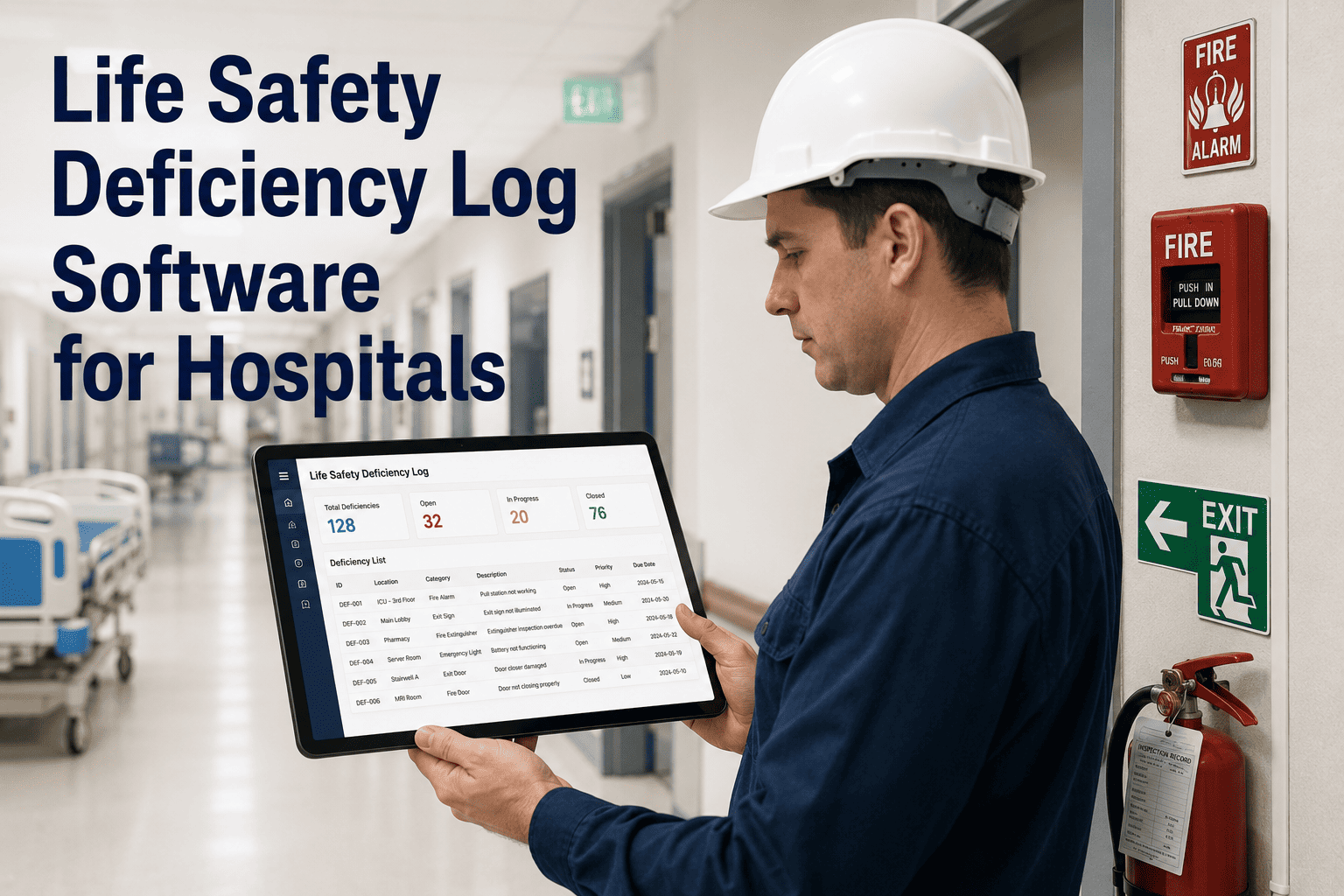
Life Safety Deficiency Log Software for Hospitals
Every life safety deficiency logged with severity, ILSM status, correction target date, and closure evidence — in one system that survives a surveyor asking to see it on a Monday morning.
42 CFR § 482.41
CMS Condition of Participation governing physical environment for hospitals — the regulation that anchors every Joint Commission LS finding
NFPA 101-2012
Life Safety Code edition currently mandated by CMS — 2024 edition adoption anticipated but not yet in force
Jan 1, 2026
Joint Commission Accreditation 360 restructuring effective — LS and EC chapter renumbering with substantive requirements largely retained
60 days
Standard correction window from deficiency identification — deficiencies exceeding this trigger ILSM and potentially Time-Limited Waivers from CMS
LS.02.01.20
Means of Egress — the single most frequently cited Life Safety Chapter standard on hospital Joint Commission surveys
10 min
Time a surveyor typically allows before assuming the record does not exist — the operational deadline your deficiency log has to meet
TIA 12-1
Tentative Interim Amendments to NFPA 101-2012 that CMS enforces alongside the base code — TIA 12-1 through 12-4
SOC + PFI
Statement of Conditions and Plan for Improvement — the Joint Commission electronic documentation the deficiency log feeds directly
Anatomy of a Life Safety Deficiency Record
A deficiency log entry is not a work order. It is a compliance record that survives an unannounced Joint Commission survey and a CMS Condition-level review. The record below is what every field must look like — captured at the moment of identification, updated at each status change, and closed only when the corrective evidence is attached.
Deficiency Record · LSD-2026-0417
Status: ILSM Active · Day 34 of 60
Standard Reference
LS.02.01.20 EP 13 · NFPA 101 § 19.2.1
Deficiency Description
Corridor door to Room 4-East-118 held open by wedge · not equipped with automatic release device · violates means-of-egress integrity requirement
Location
Tower 4 · East Wing · Med-Surg 4E · Corridor south of Nurse Station 4E-N2
ILSM Active
Applied: Feb 14 · 15:40
Corridor door wedge removed and staff educated on 4E unit. Interim fire watch rounds every 2 hours during 07:00-19:00 shift · every 4 hours during night shift. LOTO on the wedge storage bin. ILSM will remain active until magnetic hold-open with fire-alarm-tied release is installed by contractor W&E Doors, Inc. · scheduled Apr 07-09.
Correction Actions Timeline
Feb 14 · 15:40
ILSM applied · fire watch schedule initiated · engineering director notified
Feb 22
Contractor scope defined · quote received · PO approved
Mar 20 (current)
Parts ordered · fire alarm integration coordination underway
Apr 07-09 (planned)
Installation window · fire watch continues · alarm integration test scheduled
Apr 10 (planned)
Closure verification · post-install photo evidence · ILSM lifted · SOC updated
Where Surveyors Actually Cite: LS Chapter Standards by Frequency
If your deficiency log is scattered across spreadsheets and emails, you cannot answer the surveyor's first question: "which of your open deficiencies fall under the standards most frequently cited on our surveys?" The ranking below is a composite of Joint Commission and CMS survey findings across US hospitals in recent cycles — and where OxMaint's dashboard focuses attention automatically.
01
LS.02.01.20
Means of Egress
Blocked exits · propped fire doors · missing signage · corridor clutter
02
LS.02.01.35
Fire Suppression Systems
Sprinkler head obstructions · missing NFPA 25 ITM records · escutcheons
03
LS.02.01.10
Building Features & Fire Compartmentation
Unsealed penetrations · damaged fire barriers · rated walls compromised
04
LS.02.01.30
Fire Alarm Systems
Missing/expired inspection tags · devices obstructed · notification device failures
05
LS.02.01.50
Fire Barriers & Smoke Compartments
Compartment boundary integrity · damper testing gaps · door assemblies
06
EC.02.03.05
Fire Safety Feature Testing
Fire extinguisher visual inspections · emergency lighting testing · annual maintenance
07
LS.02.01.70
Special Hazards
Hazardous area separations · storage room compliance · anesthetising locations
08
LS.01.01.01
Overall Building Design & Maintenance
Occupancy classification · systemic maintenance patterns · SOC completeness
From spreadsheet chaos to survey-ready evidence · in one system
Every Deficiency Logged · Every ILSM Tracked · Every Closure Documented
OxMaint's Life Safety Deficiency Log module captures every deficiency the moment your engineer identifies it — with the standard citation, photo evidence, severity classification, ILSM plan, correction target, and closure verification. The Statement of Conditions record generates from the same underlying data. The survey response takes 10 minutes, not 10 hours.
The 60-Day Correction Lifecycle: What Happens Between Discovery and Closure
The Joint Commission's standard correction expectation is 60 days from identification to full closure. Missing that window without an approved Time-Limited Waiver from CMS is a survey finding by itself — separate from the underlying deficiency. The lifecycle below is what OxMaint tracks day-by-day for every open deficiency, with automated escalation at each stage boundary.
Day 0
Discovery & Log
Deficiency identified · logged with standard citation, location, photo, severity · ILSM applied if immediate life-safety impact · engineering director notified within 4 hours.
Day 15
Scope & Procurement
Corrective scope defined · contractor quotes or internal work-order created · parts ordered · PO approved · target closure date locked into log.
Day 30
Halfway Review
Automated mid-point review · ILSM effectiveness confirmed · contractor confirmation of installation date · escalation to plant director if scope is slipping.
Day 45
Amber Alert
Auto-escalation to VP Facilities · TLW pre-application prepared if closure appears at risk · compensating controls audit · fire watch cadence review.
Day 60
Correction Deadline
Closure required with photo evidence, verification signature, and SOC update · Time-Limited Waiver submitted to CMS if unavoidable · findings visible to Joint Commission survey team.
Day 60+
Overdue Status
Deficiencies beyond 60 days without approved TLW appear as Condition-level survey risk · CEO-visible dashboard alert · weekly executive report until closure.
Day 0-30 · Standard cadence
Day 31-45 · Watch window
Day 46-60 · Escalation window
Beyond Day 60 · Survey risk
The ILSM Decision Matrix: When Interim Life Safety Measures Apply
Interim Life Safety Measures are the compensating controls a hospital applies when a deficiency cannot be corrected immediately but the underlying risk cannot go unmitigated. The matrix below is how OxMaint auto-classifies every deficiency at the moment of logging — determining whether ILSM is required, optional, or not applicable, and which specific ILSM template applies. Read more on hospital ILSM tracking under NFPA 101.
Deficiency Type ▼ · Correction Timeline ►
Under 24 hrs
1-14 days
15-60 days
Over 60 days
Fire Suppression Impairment
No ILSM
Fire Watch · 1-hr rounds
Fire Watch · 1-hr rounds · NFPA 25
TLW Required
Fire Alarm Impairment
No ILSM
Fire Watch · 1-hr rounds
Fire Watch + Manual Notification
TLW Required
Egress Path Compromise
Immediate mitigation
Alt Path + Signage
Alt Path + Staff Training
TLW Required
Fire Barrier Penetration
No ILSM
Trend · monitor
Fire Watch · 4-hr rounds
TLW Required
Emergency Lighting Gap
No ILSM
Backup luminaires deployed
Backup + Fire Watch
TLW Required
Signage & Documentation
No ILSM
No ILSM · immediate correction
Log & track
Escalate to VP
Deficiency Aging: The Distribution That Predicts Your Next Survey Finding
Aging distribution is the operational metric a surveyor will pull first. A hospital with 8% of deficiencies over 60 days old and no active TLW applications is running a known-and-unacted-upon compliance risk. The histogram below is what a typical mid-sized hospital's deficiency log looks like at any given moment — and where OxMaint's dashboard focuses executive attention.
0-30 days
62 open
48%
Standard cadence · not yet in escalation window
31-60 days
42 open
33%
Escalation window · targeted attention required
61-90 days
14 open
11%
Post-deadline · TLW required · immediate exec review
91-180 days
7 open
5%
Elevated survey risk · CEO-visible dashboard alert
Over 180 days
3 open
2%
Systemic risk · likely Condition-level survey finding
Joint Commission 60-day correction threshold · deficiencies to the right require TLW or accepted survey risk
Operational KPIs for a Hospital Life Safety Program
Compliance is measured, not asserted. The six KPIs below are what a mature hospital facility engineering program tracks continuously — the same set anchored inside a modern Joint Commission survey readiness dashboard for hospitals covering LS chapter compliance, ILSM tracking, and SOC synchronisation.
Target: under 5%
Over-60-Day Deficiency Rate
Percentage of open deficiencies exceeding the 60-day correction window without an approved Time-Limited Waiver. The single number a surveyor pulls first. Above 10% signals a systemic pattern.
Target: 100%
ILSM Coverage on Life-Safety-Impact Deficiencies
Percentage of deficiencies classified as life-safety impact that have an active documented ILSM. Anything less means an unmitigated risk is present that a surveyor will find during walkabout.
Target: under 24 hr
Discovery-to-Log Latency
Mean elapsed time from engineer identification to formal log entry with photo evidence. A 3-day latency is common with spreadsheet workflows and represents 3 days of undocumented risk exposure.
Target: above 95%
Photo Evidence Completeness
Percentage of closed deficiency records with before/after photo evidence attached. The evidence chain a surveyor references when the discovery date is questioned or the correction scope is challenged.
Target: above 90%
SOC Sync Rate
Percentage of closed deficiencies that have flowed through to the Statement of Conditions record within 30 days of closure. Manual re-entry into eSOC is where consistency breaks down at most hospitals.
Target: under 10 min
Survey Response Package Latency
Elapsed time from surveyor request to complete evidence package delivery (deficiency log, ILSM, closure evidence, SOC update). The operational deadline the deficiency log has to meet.
Expert Review
"
In 24 years supporting hospital facility engineering teams through Joint Commission triennial surveys, CMS validation surveys, and state health department follow-ups, the pattern I see most often is a competent facility team that identifies deficiencies effectively — and then loses them in a spreadsheet or shared drive. The engineer notes the propped fire door on the Feb 14 walk, tells the maintenance supervisor, applies an ILSM verbally, and moves on. Six weeks later the surveyor arrives, asks about the fire door, and there is no defensible record of when it was identified, what ILSM was applied, or whether the ILSM was effective in the interim. That gap is not a deficiency in fire safety awareness — it is a deficiency in the documentation system that is supposed to defend the hospital during survey. The Joint Commission's Accreditation 360 restructuring taking effect January 1, 2026 will not change the substance of what surveyors look for. It will only re-label the standard numbers. The hospitals that survive the transition cleanly will be the ones with a purpose-built deficiency log system — one that captures the identification event, tracks the ILSM, drives the 60-day correction window, and produces the evidence package in under 10 minutes when the surveyor asks. OxMaint's Life Safety Deficiency Log module is one of the very few implementations I have audited that treats compliance documentation as an operational primitive rather than an after-the-fact record. That distinction is worth its subscription cost inside the first survey cycle.
Dr. Marcus Whitfield, P.E., CHFM, FASHE
Hospital Facility Engineering Consultant · 24 years Joint Commission survey preparation and CMS Life Safety Code compliance across US health systems · Certified Healthcare Facility Manager · American Society for Healthcare Engineering Fellow · Specialism in NFPA 101 / NFPA 99 implementation for mid-to-large hospital campuses
Frequently Asked Questions
Q1
How does OxMaint's Life Safety Deficiency Log integrate with the Joint Commission's Statement of Conditions and Plan for Improvement?
OxMaint captures the underlying deficiency data (standard citation, location, severity, ILSM, target closure, correction actions) in a structured format that maps
directly to the fields Joint Commission's electronic Statement of Conditions (eSOC) and Basic Building Information (BBI) tools require. When a deficiency is closed, the platform generates the SOC update package with correction date, closure evidence, and verification signature. For hospitals maintaining an active Plan for Improvement (PFI), open deficiencies with target closure dates auto-populate the PFI schedule. This eliminates the manual re-entry that is where most SOC/PFI inconsistencies originate.
Book a demo to see the eSOC output format against your accreditation cycle.
Q2
Which Life Safety and Environment of Care standards does the platform support — and how does the January 1, 2026 Accreditation 360 restructuring affect us?
OxMaint supports the current Life Safety chapter (LS.01.01.01 through LS.02.01.70) and Environment of Care chapter (EC.01.01.01 through EC.02.06.05) as they exist under NFPA 101-2012 and NFPA 99-2012. The Accreditation 360 restructuring effective January 1, 2026 consolidates the standard numbering while retaining substantive compliance requirements. OxMaint's standard citation library will be updated in a scheduled release aligned to the transition date, and existing deficiency records automatically dual-tag with both the legacy and new standard references — so a deficiency logged under LS.02.01.20 in December 2025 continues to display its correct new-standard reference after the transition without any manual re-work. Joint Commission has confirmed a learning-curve grace period; the platform preserves both tags during the transition period.
Q3
How does the platform handle Time-Limited Waivers when we cannot correct a deficiency within 60 days?
When a deficiency approaches the 60-day threshold without a viable closure date, OxMaint auto-generates a TLW pre-application package including the deficiency description, ILSM in effect, root cause for delayed correction, projected closure date, and supporting engineering justification. The package is submitted to the CMS Regional Office by the facility director — OxMaint does not submit the TLW automatically, since the submission requires executive review — but the preparation time drops from typical 4-8 hours per TLW to under 30 minutes. Once the TLW is granted, the deficiency's 60-day counter is suspended in the log and replaced with the CMS-granted extension window. Denial of the TLW triggers immediate escalation and ILSM review.
Q4
Can multiple facility engineers, environmental services rounders, and contractors all log deficiencies into the same system?
Yes, with role-based permissions that reflect the operational reality of a hospital's compliance program. Facility engineers have full authoring rights. Environmental services rounders and clinical staff can submit deficiency reports via the mobile app that route to a facility engineer for classification and formal logging — so a nurse who notices a blocked exit path can report it without knowing the specific LS.02.01.20 citation. Contractors can update the correction-action timeline on deficiencies assigned to them but cannot mark the deficiency closed — closure requires an engineer's verification signature. All actions are captured in the immutable audit trail. This is what turns life safety compliance into a hospital-wide operational function rather than a facility-engineering-only burden.
Q5
What happens during an actual Joint Commission survey — can we generate the evidence package the surveyor asks for on the spot?
Yes. OxMaint generates a
Life Safety Survey Package on demand: every open deficiency with its full documentation chain (identification, ILSM, correction actions, target date, current status), every closed deficiency in the current accreditation cycle with closure evidence, aging distribution, ILSM coverage rate, SOC sync status, and full audit trail. The package is filterable by LS chapter standard, by physical location, by severity, or by date range — matching whatever the surveyor asks for. Typical generation time is under 5 minutes. The most successful survey defense practice we see across hospital facility teams is providing this package to the lead surveyor at the opening conference rather than waiting for individual document requests — it signals system maturity and materially reduces the depth of follow-up inquiry.
Read more on survey defense workflow, or
start an OxMaint free trial to see the package format against your current records.
From scattered spreadsheets to survey-ready evidence in one system
Every Deficiency Defensible · Every ILSM Documented · Every 60-Day Window Tracked
OxMaint's Life Safety Deficiency Log module gives hospital facility engineering teams a single audit-ready system that survives an unannounced Joint Commission survey, produces the eSOC updates the accreditation cycle requires, tracks every day of the 60-day correction window, and generates the evidence package a surveyor asks for in under 10 minutes. The compliance infrastructure your facility team already knows they need — connected to the CMMS they already run.



.png)
.jpg)

