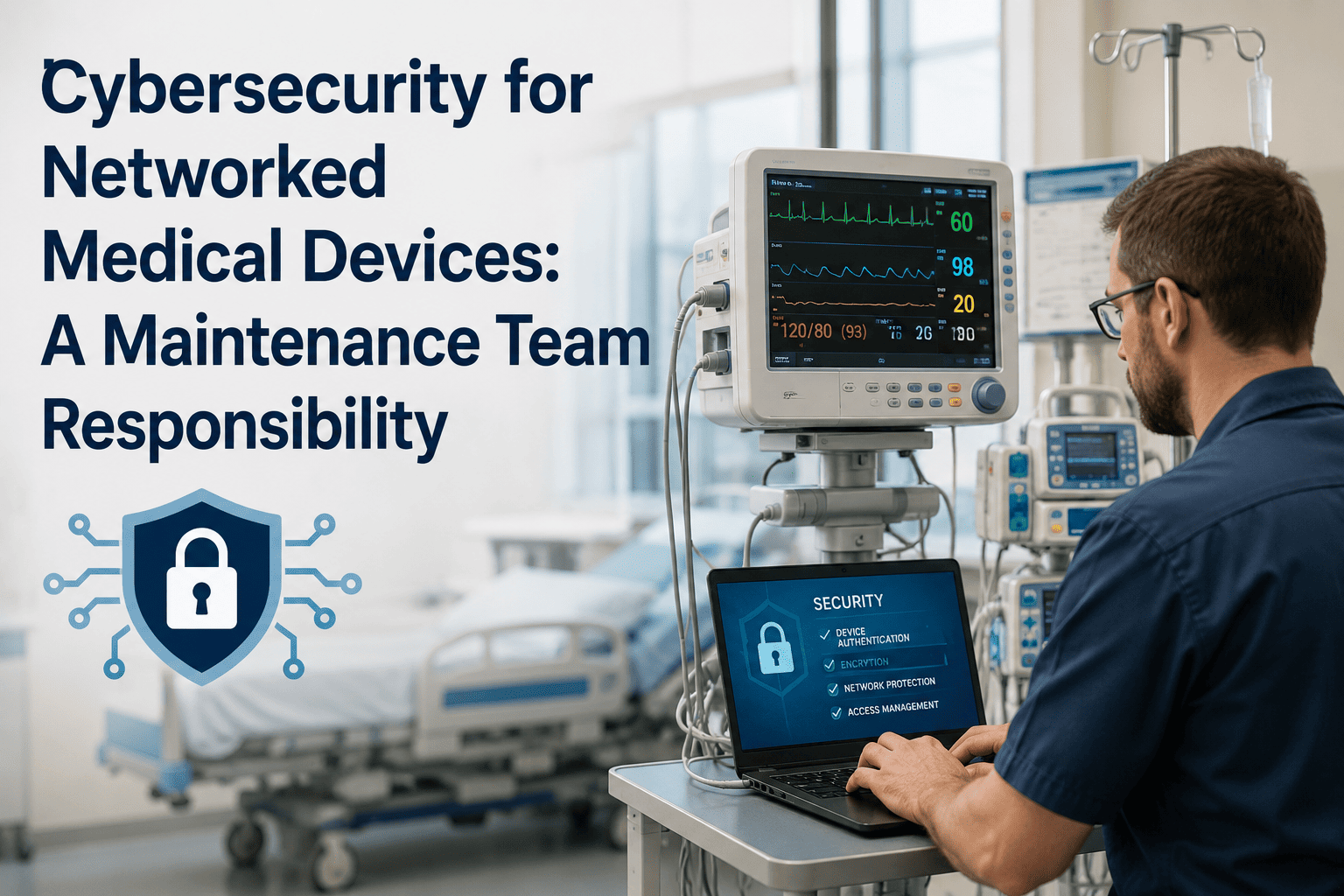
When a hospital's MRI scanner gets hit by ransomware or a networked infusion pump broadcasts unencrypted patient data, the biomedical engineering team is now on the front line — not just IT. OxMaint's CMMS tracks patch status, network segmentation compliance, and vulnerability remediation for every connected medical device in your fleet, giving biomedical teams a single audit trail that satisfies both FDA postmarket cybersecurity guidance and hospital IT security requirements. The threat is real: healthcare suffered more cyberattacks than any other sector in 2024, and 83% of connected medical devices run on unsupported operating systems.
Healthcare Security · Biomedical · 2026
Cybersecurity for Networked Medical Devices: A Maintenance Team Responsibility
Patch management, network segmentation verification, and vulnerability tracking are now biomedical maintenance responsibilities — here is how CMMS brings them under one roof with full compliance documentation.
83%
of networked medical devices run on OS no longer supported by manufacturer
1 in 3
hospitals experienced a medical device-related cyberattack in 2024
$10.9M
average cost of a healthcare data breach (IBM Security 2024)
2025
FDA now requires cyber risk management in 510(k) premarket submissions
Why Biomedical Teams Own Device Cybersecurity Now
The FDA's 2023 Consolidated Appropriations Act and subsequent postmarket cybersecurity guidance formally shifted responsibility for connected medical device security onto the device lifecycle — which means biomedical engineering, not just IT. Patch deployment, SBOM verification, segmentation checks, and vulnerability tracking must now be documented as part of the equipment maintenance record. OxMaint connects these tasks to existing PM workflows so they are tracked, timestamped, and reportable alongside every other maintenance activity.
Biomedical Team Owns
Device patch verification and documentation
Manufacturer cybersecurity advisory tracking (MDS²)
Pre-deployment network readiness validation
SBOM (Software Bill of Materials) recordkeeping
FDA postmarket cyber compliance documentation
+
IT / InfoSec Team Owns
Network segmentation design and enforcement
Firewall rules for medical device VLANs
SIEM alerting for anomalous device behavior
Active directory and authentication policies
Incident response and forensic investigation
→
OxMaint CMMS Bridges Both
Single record combining PM and cyber tasks
Patch status visible to biomed and IT simultaneously
Vulnerability open/close tracked on work orders
Audit export for FDA and TJC in one click
Automated alerts when devices fall out of compliance
The 4-Layer Medical Device Cyber Defense Stack
Effective medical device cybersecurity is not a single tool — it is a layered approach where each layer depends on the one below it. Biomedical teams are responsible for Layers 1 and 2; IT owns Layers 3 and 4. OxMaint's CMMS is the documentation spine that makes all four layers auditable.
4
Incident Response & Recovery
IT + Biomed · Rapid isolation, forensics, and service restoration
CMMS provides device history and last-known-good configuration to speed recovery. Work orders capture isolation actions and restoration steps as audit evidence.
IT
3
Network Segmentation & Monitoring
IT Primary · Biomed Verification
Devices placed on isolated VLANs. Biomedical teams verify segmentation during annual PM using OxMaint segmentation checklist — creating documented proof of compliance.
Shared
2
Patch & Vulnerability Management
Biomedical Primary · OxMaint Tracked
Manufacturer patches applied on approved schedule. MDS² advisories tracked as open items in CMMS. Every patch logged with version, date, technician, and verification test result.
Biomed
1
Device Inventory & SBOM Registry
Biomedical Owns · Foundation of All Security
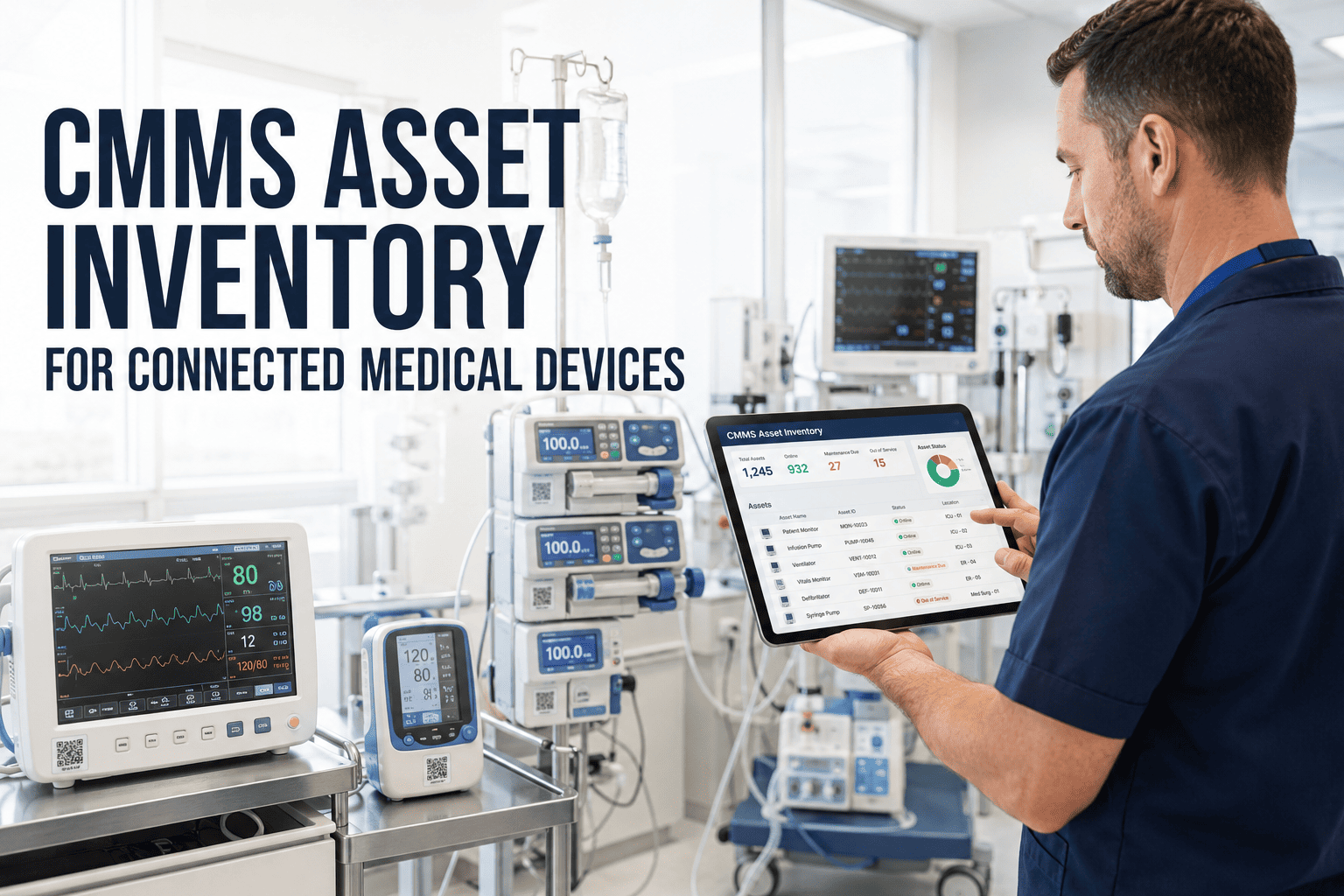
You cannot secure what you cannot see. OxMaint's complete device registry includes OS version, firmware, network address, SBOM status, and manufacturer cybersecurity disclosure — for every connected device in the fleet.
Biomed
Patch Management Compliance: Before vs. After CMMS
| Task |
Without CMMS |
With OxMaint |
| Identify unpatched devices |
Manual spreadsheet, updated quarterly at best |
Live dashboard — real-time patch status per device |
| Track manufacturer advisories |
Email monitoring, informal notes |
Advisory linked to device record, open work order created |
| Document patch deployment |
Paper log or shared drive file |
Timestamped work order with tech signature and version |
| Verify segmentation at PM |
Not tracked — no standard checklist |
Checklist embedded in PM work order, completion required |
| Produce FDA audit evidence |
3–5 days to assemble records |
One-click export — complete history per device |
| Alert on overdue patches |
No automated alerting |
Escalating alerts to biomed manager and IT security |
Your Device Inventory Is Your Security Foundation
See how OxMaint builds a complete connected device registry with OS, firmware, and patch status — in one afternoon.
High-Risk Device Categories Requiring Priority Attention
Not all connected medical devices carry equal cyber risk. The risk scoring below reflects FDA MedWatch advisory frequency, attack surface size, and patient harm potential — helping biomedical teams triage their security patch workload.
Critical
Infusion Pumps
Network-accessible dosing controls
Legacy OS with no vendor patch support
Direct patient safety impact if compromised
High FDA advisory frequency (12+ per year)
Critical
Imaging Systems (MRI, CT, PET)
Windows XP / 7 still active in many fleets
Large attack surface — DICOM server exposure
High-value ransomware target (revenue impact)
OEM patch cycles slow (12–18 months)
High
Patient Monitors
Wireless connectivity across all units
Alarm data interception risk
Mixed fleet with varying firmware versions
High unit count creates broad surface
Medium
Ventilators & Respiratory Devices
COVID-era additions often not fully registered
Remote monitoring features add attack vectors
Manufacturer cybersecurity programs vary widely
PM-integrated patch checks essential
Expert Review
4.8
Expert Score
Device Cyber Compliance
The FDA's postmarket cybersecurity guidance has fundamentally changed the biomedical engineering role. Patch management and vulnerability tracking are now maintenance activities — they need to live in the same system as PMs and work orders, with the same documentation standards. A CMMS that does not track cybersecurity tasks alongside physical maintenance is no longer fit for purpose in a modern hospital biomedical program. OxMaint's approach of embedding cyber checklists directly into PM work orders is exactly the right architecture for this regulatory environment.
Principal Biomedical Engineer, FDA Device Compliance Consulting
15 years advising health systems on medical device regulatory compliance and postmarket surveillance
Frequently Asked Questions
Does FDA require biomedical teams to document medical device cybersecurity activities?
Yes — the 2023 Consolidated Appropriations Act and FDA's postmarket cybersecurity guidance require manufacturers and healthcare organizations to maintain records of patch deployment, vulnerability remediation, and network segmentation compliance. For health systems, this means biomedical departments must document cybersecurity tasks in a way that is retrievable for FDA inspections and TJC surveys.
OxMaint's CMMS creates this documentation automatically as part of normal work order completion — no separate cyber-tracking system required.
What is MDS² and how does OxMaint help track manufacturer cybersecurity disclosures?
MDS² (Manufacturer Disclosure Statement for Medical Device Security) is the standardized document that medical device manufacturers provide to disclose the cybersecurity capabilities and risks of their devices. OxMaint stores MDS² documents against each device record and creates automatic work orders when advisories are issued by the manufacturer — ensuring your team receives, reviews, and responds to every disclosure with a documented audit trail.
Book a demo to see how MDS² tracking integrates with your existing PM schedule and biomedical team workflow.
Can OxMaint track network segmentation compliance for medical devices during scheduled PMs?
Yes — OxMaint supports custom checklist items embedded directly into PM work orders. Your biomedical team adds a network segmentation verification step to the annual PM checklist for connected devices — confirming the device is on the correct VLAN, firewall rules are active, and no unauthorized connections are detected. Completion of this step is timestamped and recorded, creating the documented evidence that both IT security and TJC EC.02.04.01 audits require. Devices that fail segmentation checks automatically generate a corrective work order assigned to IT.
How does OxMaint handle devices with manufacturer-only patch rights — where biomed cannot directly apply updates?
OxMaint tracks the patch status of every device regardless of who applies the patch. For devices where the OEM performs all firmware and software updates, OxMaint manages the service request to the manufacturer, tracks the expected completion date, and documents the patch version and date when the OEM confirms completion. This means your CMMS record always reflects actual patch status — including OEM-serviced devices — giving you a single complete view of your fleet's cybersecurity posture even when update authority is split between your team and the manufacturer.
Medical Device Cybersecurity Is a Maintenance Responsibility. Manage It Like One.
OxMaint tracks patch status, network segmentation, MDS² advisories, and vulnerability remediation alongside every PM — giving your biomedical team complete cyber compliance documentation in one system.


.png)
