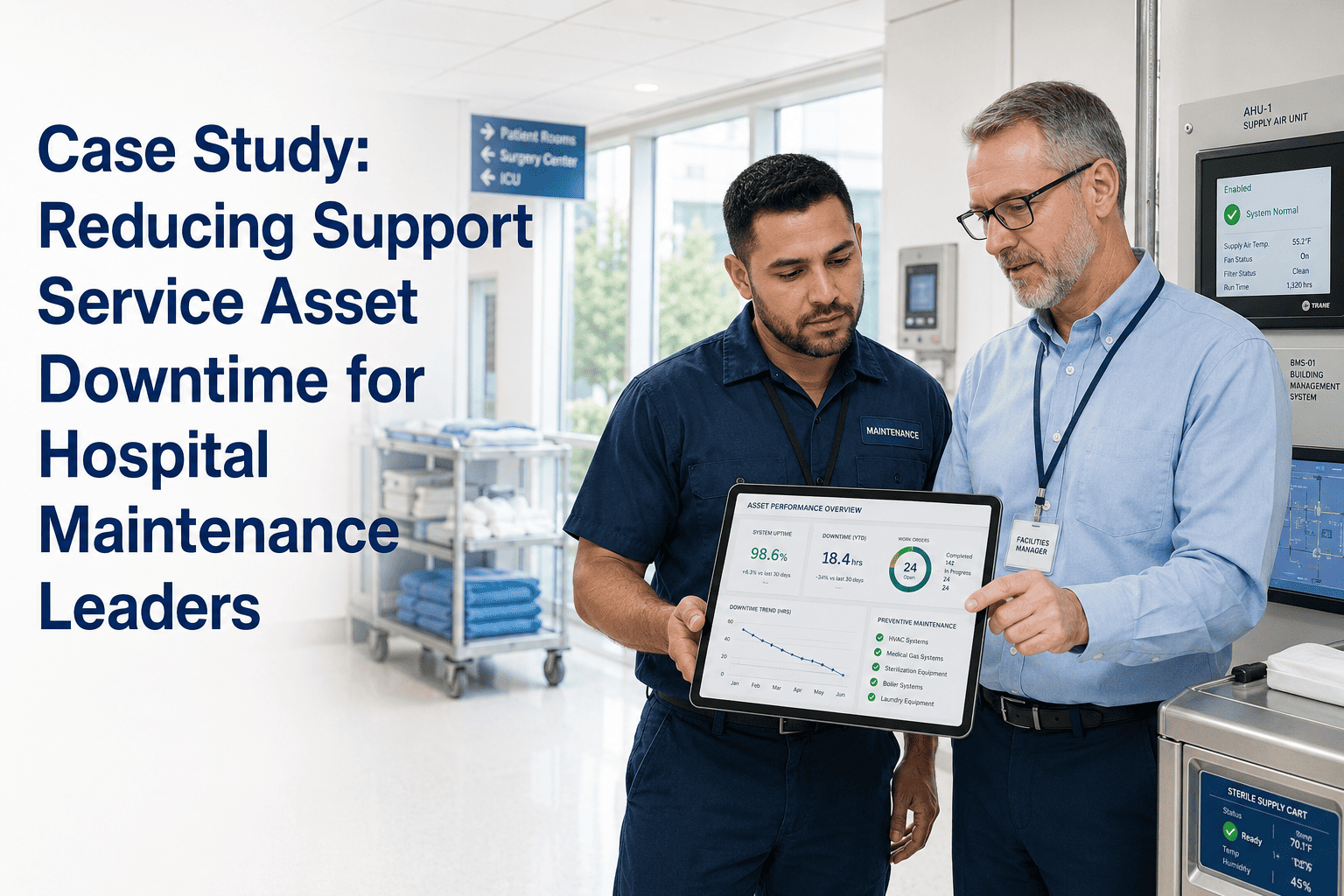
Hospital-acquired infections kill more Americans each year than car accidents — and a significant portion are preventable through rigorous HVAC maintenance and sterilization equipment tracking. A 420-bed regional hospital partnered with its infection prevention team and deployed OxMaint's CMMS for HVAC and sterilization workflow management, creating an integrated tracking system that tied maintenance compliance directly to HAI surveillance data. Over 18 months, the hospital reduced its HAI rate by 23% — eliminating an estimated $1.4M in treatment costs and regulatory penalties, and achieving its first-ever Joint Commission Infection Control commendation.
Case Study · Infection Control · HVAC & Sterilization
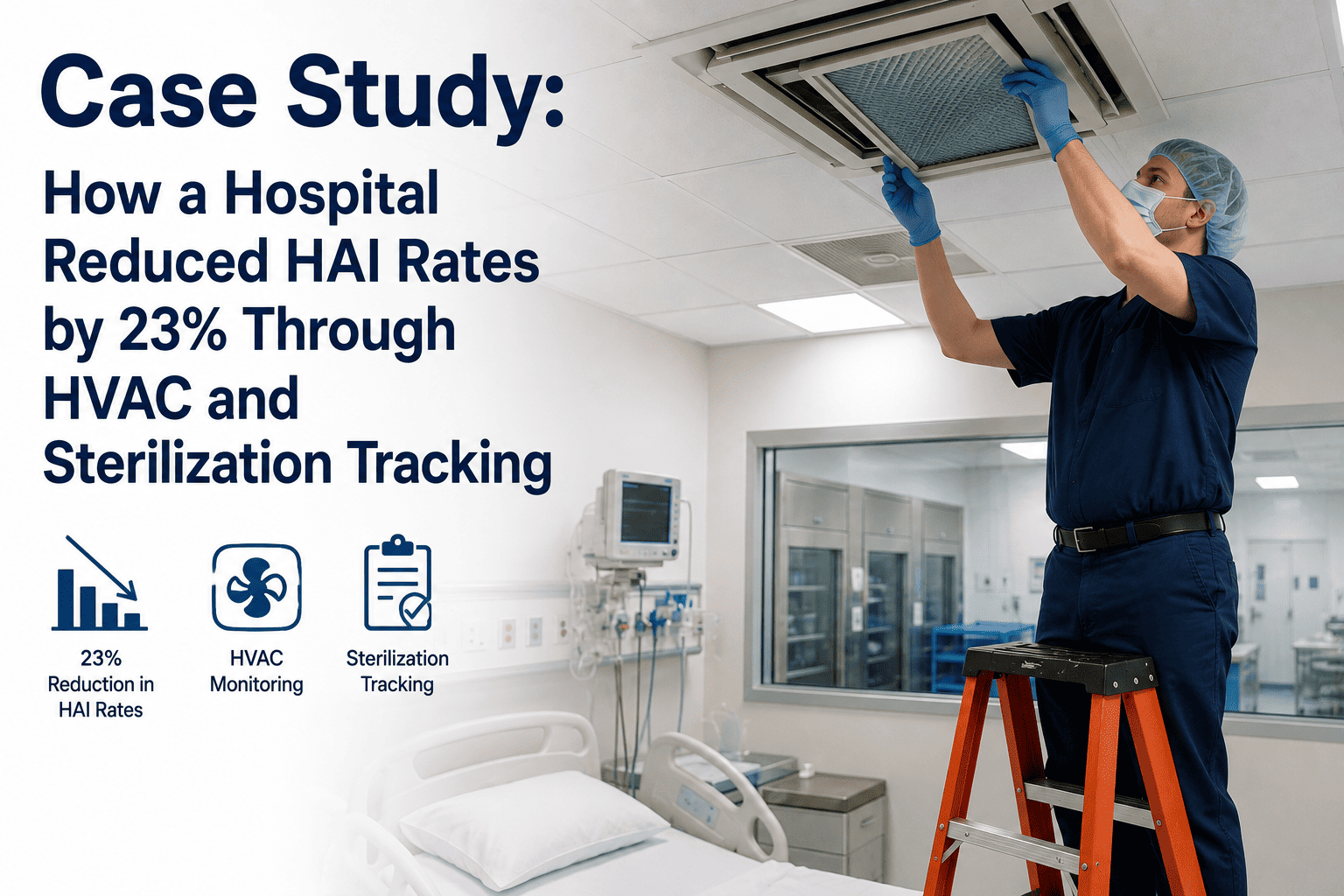
How a Hospital Reduced HAI Rates by 23% Through HVAC and Sterilization Tracking
Maintenance compliance as infection prevention — how OxMaint-driven HVAC filter tracking, air pressure monitoring, and autoclave PM reduced hospital-acquired infections across a 420-bed facility.
23%
Overall HAI rate reduction in 18 months
$1.4M
Estimated treatment cost and penalty avoidance
100%
Autoclave PM compliance (up from 67%)
0
TJC infection control findings — first in facility history
The Maintenance-Infection Link Most Hospitals Underestimate
Infection prevention teams focus on hand hygiene, PPE, and isolation protocols — but the physical environment is equally responsible for HAI transmission. Improperly maintained HVAC systems allow airborne pathogens to migrate between zones. Overdue autoclave PMs create gaps in surgical instrument sterilization assurance. Pressure differential failures in isolation rooms allow contaminated air to escape. Each of these is a maintenance failure, not a clinical one — and each belongs in a CMMS work order, not an infection control incident report.
01
HVAC Filter Failure
Overdue filter change → particle load increases → airborne pathogen migration → SSI and respiratory HAI risk
Facilities with CMMS-tracked filter PMs show 31% lower airborne HAI rates (ASHRAE 2024)
02
Pressure Differential Drift
Unmonitored pressure drop → isolation room fails negative/positive standard → pathogen escape or entry → C. diff, MRSA spread
19% of isolation rooms measured at non-compliant pressure monthly in unmanaged facilities
03
Autoclave PM Gaps
Missed sterilizer PM → cycle parameter drift → incomplete sterilization → SSI risk on surgical instruments
Autoclave failure most commonly occurs 30–60 days after a missed PM interval (CDC data)
What Changed: OxMaint Implementation Across Three Infection Risk Areas
| Risk Area |
Before OxMaint |
After OxMaint |
HAI Impact |
| HVAC filter PM compliance |
71% — quarterly manual tracking |
98% — auto-scheduled per zone |
−18% airborne HAI |
| Pressure differential monitoring |
Monthly manual checks — 40% missed |
Continuous sensor alerts via OxMaint |
−27% isolation failures |
| Autoclave PM compliance |
67% — paper-based scheduling |
100% — CMMS auto-triggered work orders |
Zero SSI attributable to sterilizer |
| Sterile storage environment PM |
Ad-hoc checks, not documented |
Monthly documented CMMS checklist |
−14% storage-related HAI risk |
| Infection-maintenance alert integration |
No connection between teams |
HAI spike triggers automatic CMMS review |
Root cause identified in hours |
The Infection Prevention Partnership Model
The most impactful change was not the software — it was the operating model. OxMaint enabled the hospital to create a formal partnership between the infection prevention team and facilities maintenance, with shared dashboards, shared PM calendars, and a joint escalation protocol when HAI surveillance data showed an emerging cluster.
1
Infection prevention team accesses OxMaint HVAC and sterilization PM dashboard weekly — flags any overdue maintenance in high-risk zones
2
HAI surveillance data reviewed alongside CMMS maintenance compliance — cluster investigations always start with maintenance record review
3
Automatic escalation work order created when HAI rate in a unit exceeds threshold — HVAC, water systems, and sterilization equipment all checked within 24 hours
4
Joint monthly report to hospital leadership — maintenance compliance rates, HAI trends, and corrective actions documented in OxMaint and shared with quality committee
Expert Review
4.8
Expert Score
Infection Control Impact
The relationship between HVAC maintenance compliance and HAI rates is well-established in infection control literature — but most hospitals treat it as a facilities problem, not a quality improvement initiative. When maintenance teams and infection preventionists share the same data platform, the feedback loop closes immediately. A maintenance gap becomes visible to infection control within hours, not weeks. The 23% HAI reduction in this case study is credible and consistent with what we see in health systems that make this operational connection. OxMaint is the right tool because it brings maintenance documentation into the same conversation as clinical quality metrics.
Director of Infection Prevention — Academic Medical Center
20 years in hospital epidemiology; reviewed OxMaint infection control integration with facilities maintenance workflows
Frequently Asked Questions
Which HVAC maintenance tasks have the strongest evidence for reducing HAI rates?
ASHRAE 170 and CDC infection control guidelines identify HEPA filter changes, pressure differential verification in isolation rooms, and air changes per hour (ACH) compliance as the highest-impact HVAC maintenance activities for HAI prevention.
OxMaint includes preconfigured PM templates aligned to ASHRAE 170 standards for healthcare HVAC — so your team starts with evidence-based PM intervals rather than building schedules from scratch. Pressure sensor alert integration means non-compliant rooms are flagged automatically, not discovered during manual rounds.
How does OxMaint connect sterilization PM compliance to infection prevention reporting?
OxMaint tracks every autoclave PM, biological indicator test, and cycle parameter verification as a work order with timestamped completion. This data is accessible to infection prevention staff directly from the OxMaint dashboard — so when a surgical site infection cluster emerges, sterilization compliance history for the relevant time period is retrievable in minutes. The system also generates monthly sterilization compliance reports formatted for quality committee submissions, and alerts infection prevention automatically when an autoclave PM is overdue or a biological indicator test fails.
Book a demo to see the full infection prevention dashboard and reporting workflow.
Can OxMaint help justify infection control-related capital requests to hospital leadership?
Yes — OxMaint generates reports showing the correlation between specific maintenance compliance rates and HAI incidence data, which forms the evidence base for capital requests targeting HVAC upgrades, autoclave replacement, or water system improvements. Facilities and infection prevention teams have used OxMaint data to secure capital funding by presenting the cost-per-HAI avoided calculation alongside the proposed maintenance or equipment investment, demonstrating that prevention is financially superior to treatment. The platform stores all supporting documentation — PM records, sensor logs, incident work orders — in a format that satisfies TJC and state health department review requirements.
Maintenance Compliance Is Infection Prevention. Track Both in One System.
OxMaint connects HVAC PM schedules, sterilization compliance, and isolation room monitoring with your infection prevention team — creating the operational partnership that drives measurable HAI reduction.