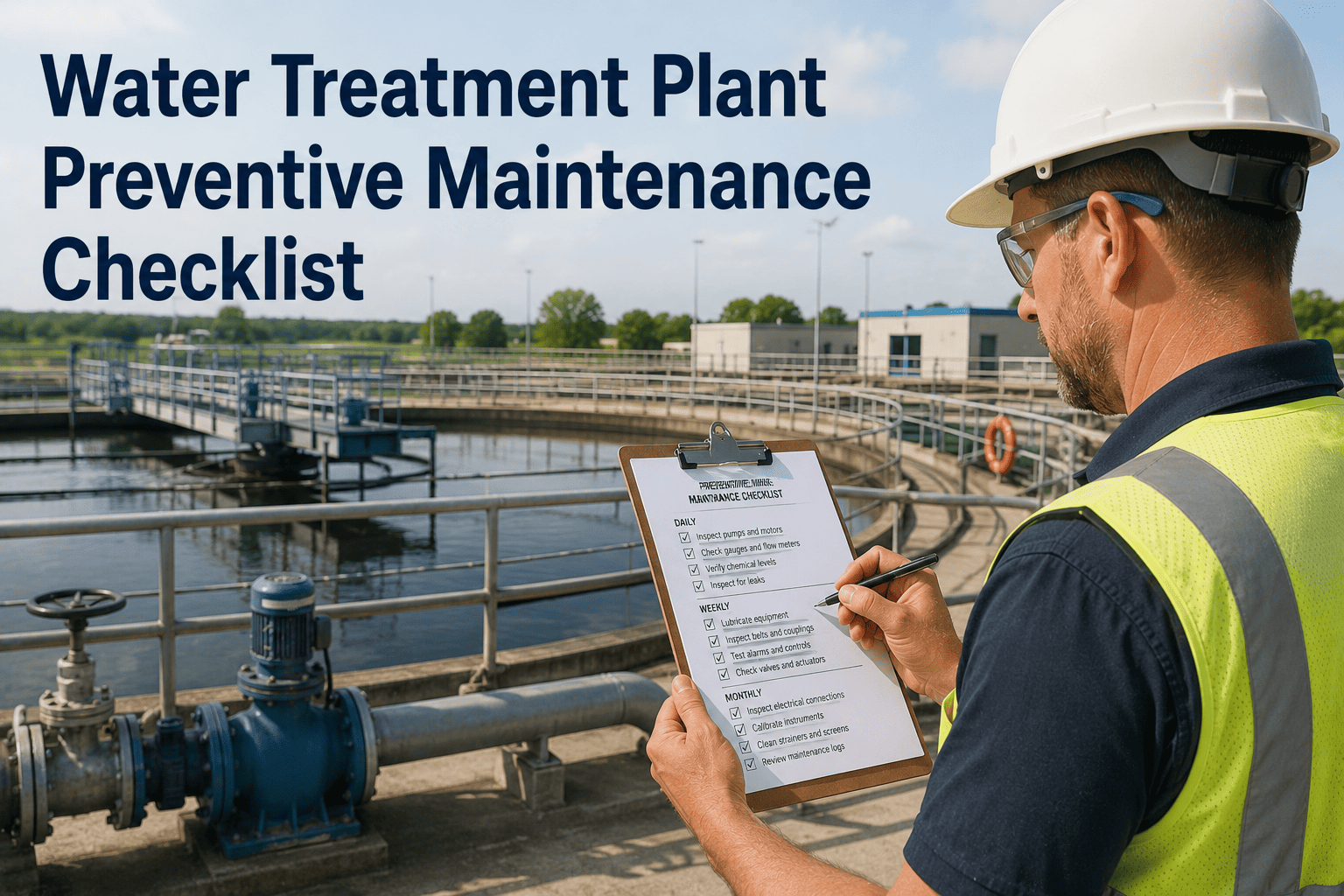
Water treatment plants operate under a maintenance discipline unlike any other public utility — not because the equipment is uniquely complex, but because the consequence of failure is a public health event measured in illness, regulatory enforcement, and loss of public trust that takes years to rebuild. The EPA's Safe Drinking Water Act requires documented operations and maintenance programs for all public water systems. Yet 43% of community water systems cited in EPA enforcement actions list inadequate maintenance documentation as a contributing violation factor. A structured, digitally tracked preventive maintenance program is not optional infrastructure for a water utility in 2026 — it is the operational foundation that keeps a facility compliant, its equipment reliable, and its community protected. OxMaint's Preventive Maintenance platform schedules, assigns, and documents every checklist item in this guide — turning compliance from a paper burden into a live, searchable operational record.
Water Treatment Plant PM Checklist — By System Area
This checklist is structured around the six primary system areas of a conventional water treatment plant. Each section includes daily, weekly, monthly, and annual inspection tasks with the regulatory basis for each interval.
Digitize This Checklist Into Scheduled Work Orders
OxMaint converts every system area and inspection frequency into auto-scheduled PM work orders — assigned to your operators, tracked to completion, and stored in an EPA-compliant audit record. Book a demo to see water utility configuration.
Expert Review
The most common finding in water system compliance reviews is not that the maintenance was not done — it is that it cannot be proven. Operators perform daily checks, filter backwashes happen on schedule, and pumps are inspected regularly. But when a state regulator or EPA auditor asks for the maintenance record supporting those activities, the answer is often a paper logbook with incomplete entries, a spreadsheet that was not updated for two months, or a shared drive folder where individual operators stored their own records in different formats. A digital CMMS that captures every maintenance event with a timestamp, an operator ID, and a structured record format does not change what your team does — it changes what you can prove. In water utilities, the ability to prove it is not a documentation nicety. It is the difference between a compliance finding and an enforcement action with five-figure daily penalties.
Compliant Water Utility Maintenance Starts With Documented Records
OxMaint builds the documented PM program your water system needs for SDWA compliance, state primacy reviews, and AWWA audit preparation — starting from the work orders your operators complete every day. Start free with no IT infrastructure required.
Frequently Asked Questions
What documentation does EPA require for water treatment plant preventive maintenance?
The Safe Drinking Water Act (40 CFR Parts 141 and 142) requires public water systems to maintain operations and maintenance records sufficient to demonstrate compliance with treatment technique requirements and monitoring protocols. State primacy agencies typically require that maintenance records be retained for a minimum of 3–10 years depending on the record type. Records must include sufficient detail to establish what was inspected, when, by whom, and what condition was found. OxMaint's compliance records meet these requirements with timestamped, operator-attributed digital records exportable for any state review or EPA audit request.
How should water utilities handle emergency repairs versus scheduled PM in CMMS?
OxMaint maintains separate work order classifications for scheduled PM, condition-based maintenance, and reactive emergency repairs — which is essential for water utilities tracking their reactive maintenance ratio for AWWA benchmarking purposes. Emergency work orders are created immediately when a failure occurs, linked to the affected asset, and carry a separate cost code that feeds the reactive-vs-planned ratio analytics. The ratio trend is visible in the OxMaint analytics dashboard, giving utility managers early warning when their reactive work is rising above the 20% threshold that predicts future compliance risk. Book a demo to see work order classification configuration for water utilities.
Can operators complete PM checklists on mobile devices in the field?
Yes. OxMaint's mobile app for iOS and Android allows operators to receive assigned PM work orders, complete structured inspection checklists with pass/fail and numeric entry fields, attach photos of conditions found, log parts used, and close work orders — all from a smartphone or tablet without returning to an office workstation. Completed checklists are immediately stored in the compliance record with the operator's credentials and a GPS-tagged timestamp. For confined space or remote locations with poor connectivity, OxMaint supports offline completion that syncs automatically when connectivity is restored. The full checklist completion process for a standard pump inspection takes under 4 minutes on mobile.
Does OxMaint support multi-facility water utility management across multiple treatment plants and pump stations?
Yes. OxMaint's portfolio management module supports water utilities managing multiple treatment plants, booster pump stations, storage tanks, and distribution monitoring points from a single dashboard. Each facility has its own asset register and PM schedule, but compliance rates, open defects, and overdue inspections are visible simultaneously across the entire system. Utility directors see the highest-risk facilities immediately — those with declining PM compliance or rising defect counts — and can drill into individual assets with one click. Custom alert thresholds notify the appropriate supervisor when any facility's compliance falls below the defined minimum, typically before a state regulator observes the same trend in quarterly reporting data.