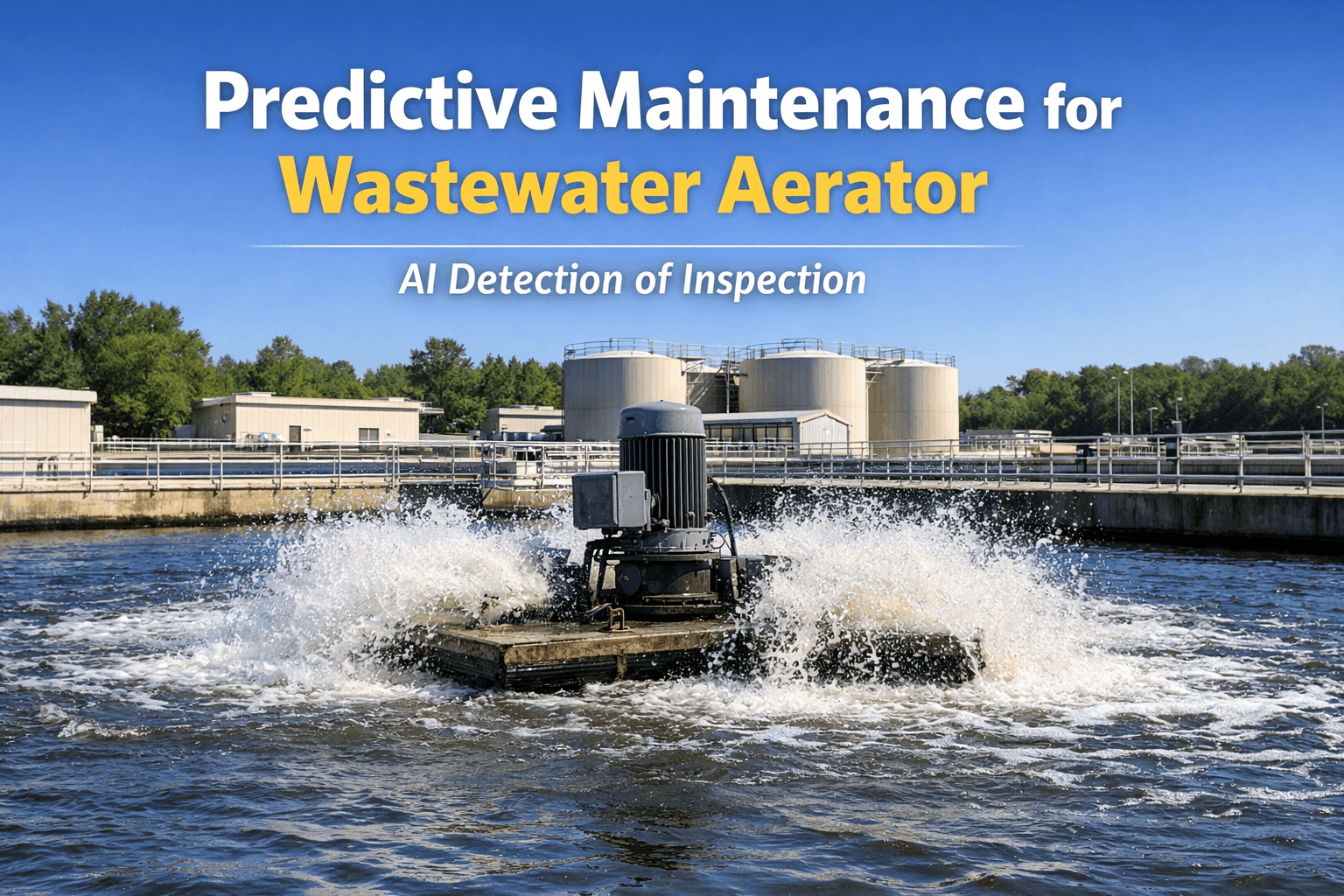
A regional wastewater treatment authority managing 12 activated sludge plants discovered their aeration costs were spiraling out of control—consuming 60% of their total energy budget. A routine audit revealed the cause: a catastrophic failure of three large surface aerators during a holiday weekend, which went undetected for 48 hours. The dissolved oxygen (DO) levels plummeted, killing biomass and resulting in a permit violation that cost $145,000 in finesand remediation. The root cause was a bearing failure that vibration sensors would have caught weeks in advance, but the manual inspection rounds were skipped due to staffing shortages. The incident wasn't isolated—across the district, reactive maintenance on aerators was costing $220,000 annually in overtime and emergency parts, while inefficient oxygen transfer wasted another $180,000 in electricity. Wastewater treatment is an energy-intensive, critical public service—when aeration fails, compliance and budgets suffer immediately.
60%
of plant energy usage
Inefficient, poorly maintained aerators waste massive amounts of electricity
$145K
permit violation cost
Fines and remediation expenses from a single major DO crash event
48hr
detection delay
Time lag between mechanical failure and operator discovery without IoT sensors
$220K
annual emergency spend
Overtime labor and expedited shipping for unplanned aerator repairs
Wastewater treatment plants face a critical challenge: maintaining continuous aeration to support biological processes while managing aging equipment and tight budgets. Aerators—whether surface mechanical, diffused air, or submersible—are the heart of the secondary treatment process. They operate in harsh, corrosive environments 24/7, making them prone to gearbox failures, motor burnouts, and diffuser fouling.
Legacy maintenance relies on manual rounds ("look, listen, and feel") and calendar-based oil changes. This fails to detect subtle degradation like bearing spalling or diffuser clogging until it becomes a crisis. IoT integration with AI-powered CMMS solves this by monitoring vibration, temperature, and amps in real-time, predicting failures before they impact effluent quality.
Harden treatment plant reliability using mobile inspections
Aerator failures don't happen instantly—they give warning signs. A slight increase in gearbox vibration, a rise in motor temperature, or a drop in DO transfer efficiency are all precursors to failure. Mobile inspections ensure operators capture these signs during daily rounds, rather than just pencil-whipping a paper log.
Digital Operator Rounds
Operators scan asset QR codes at each basin. The app prompts specific checks: oil level, noise check, visual spray pattern. Photos are required for any abnormality. Readings like amps or DO levels are validated against limits instantly.
Vibration Analysis Alerts
IoT sensors continuously monitor gearbox and motor vibration. AI algorithms distinguish between normal load variations and bearing defects. Alerts are sent to maintenance leads days or weeks before catastrophic failure occurs.
Automated Work Orders
When an inspection flags a high temperature or a vibration threshold is breached, the CMMS automatically generates a work order. It assigns the right technician, attaches the vibration spectrum, and lists required parts/tools.
Energy Efficiency Tracking
By correlating power consumption (amps) with DO levels, the system identifies aerators with fouled diffusers or mechanical drag. Maintenance can be targeted to restore efficiency, directly lowering the plant's energy bill.
Mobile capability is crucial for sprawling treatment plants where Wi-Fi might be spotty. Offline-first apps allow operators to complete rounds on clarifiers and aeration basins without connectivity, syncing data once they return to the control room. This ensures no data is lost and every asset is checked.
Treatment plants deploying mobile inspections can start with a free 30-day trial that includes pre-loaded aerator checklists, barcode generation, and predictive maintenance dashboards.
92%
Reduction in unplanned aerator downtime when combining mobile operator rounds with continuous vibration monitoring—stabilizing biological processes and compliance
Operationalizing AI insights — a wastewater architecture with IoT
IoT sensors on aerators produce a flood of data points: vibration velocity, acceleration, kurtosis, temperature, current draw. Without AI, this data is just noise. AI analytics contextualize this data, learning the unique "heartbeat" of each aerator to distinguish between a rag caught on an impeller and a failing planetary gear.
Plant Operations Dashboard
Asset health scores
Energy efficiency trends
Predictive failure alerts
Compliance risk indicators
Reliability Engine
Vibration signature analysis
Thermal anomaly detection
Remaining Useful Life (RUL) calc
Maintenance optimization
Asset Sensor Network
Vibration (Tri-axial)
Temperature (Bearing/Oil)
Motor Current (Amps)
Dissolved Oxygen (DO)
SCADA Integration
The AI model builds a profile for each unit: Surface Aerator #3 normally vibrates at 0.15 IPS, but Aerator #5 runs smoother at 0.08 IPS. When #5 jumps to 0.18 IPS, the AI flags it as a "High Risk" anomaly, even though it's below the ISO standard alarm limit. This early detection allows for a simple bearing grease or alignment check instead of a $25,000 gearbox replacement.
Asset Health Scoring: Each aerator is assigned a health score (0-100). A score of 95+ means optimal. A drop to 70 triggers a "Plan Maintenance" alert. A drop below 50 triggers an "Immediate Action" work order. This helps prioritize maintenance resources to the assets that actually need it.
Energy-Based Condition Monitoring: AI correlates motor amps with DO readings. If amps remain high but DO levels drop, the system identifies "Diffuser Fouling" or "Impeller Damage," prompting a cleaning or inspection cycle rather than a mechanical repair.
Facilities ready to upgrade to predictive aeration management can schedule an architecture review to discuss sensor placement, SCADA integration, and AI model training requirements.
The 90-Day Implementation Plan
Transitioning a treatment plant to predictive maintenance must be done without interrupting the biological process. This phased approach ensures seamless integration of technology into daily operations.
Pilot Basin & Sensor Install
Select one aeration basin for the pilot. Install wireless vibration/temp sensors on motors and gearboxes. Deploy mobile inspection tablets to operators. configure basic alerts (e.g., Temp > 180°F). Train staff on the new workflow.
Sensors online
Mobile app live
Asset tagging complete
Baseline data started
Data Integration & Expansion
Expand sensor coverage to remaining basins. Integrate SCADA data (DO, Flow, Amps) into the CMMS. Enable AI learning mode to establish baselines for each unit. Refine inspection checklists based on operator feedback.
Full plant coverage
SCADA link active
AI learning enabled
Checklists optimized
Predictive Mode Activation
Activate AI predictive alerts. Switch from calendar-based to condition-based maintenance for oil changes and greasing. Implement "Asset Health" dashboards for plant management. Begin tracking energy efficiency gains.
Predictive alerts on
CBM scheduling
Health dashboards
Energy tracking
Optimization & Reporting
Review first quarter ROI. Adjust alarm thresholds to reduce false positives. Set up automated compliance reporting for state regulators. Train team on advanced vibration analysis interpretation.
ROI report
Thresholds tuned
Compliance automated
Advanced training
Success depends on operator buy-in. When operators see that the system catches issues they used to get blamed for, adoption skyrockets. Start with the "Bad Actor" aerators—the ones that fail most often—to show immediate value. Book a deployment strategy session to customize this roadmap for your facility.
Ready to modernize your wastewater maintenance? Our experts will help you design a sensor network and digital workflow that fits your plant's specific equipment and compliance needs.
Before & After: Manual vs. Predictive Aerator Maintenance
| Metric |
Legacy Manual System |
AI-Driven Predictive System |
Impact |
| Inspection Compliance |
65% (Pencil-whipped logs) |
99% (Digital, GPS-verified) |
Audit-ready compliance |
| Failure Detection |
Post-failure (Reactive) |
3-4 weeks pre-failure |
Zero catastrophic breakdowns |
| Energy Efficiency |
Variable / Unknown |
Optimized continuously |
15-20% energy savings |
| Maintenance Strategy |
Calendar-based (PM) |
Condition-based (CBM) |
40% less routine labor |
| Emergency Repair Costs |
$220K / year |
$35K / year |
84% cost reduction |
| Asset Life Extension |
Run to failure (7-10 years) |
Life optimized (12-15 years) |
50% extended CAPEX cycle |
The shift transforms the maintenance team from "firefighters" putting out mechanical failures to reliability engineers optimizing the process. Instead of changing oil because it's "Tuesday," they change it because the sensor indicates degradation. This frees up hundreds of labor hours for higher-value tasks like system upgrades and process improvements.
ROI Validation: Real Savings for Water Utilities
Justifying the investment to the water board or city council requires hard numbers. Based on typical 10-20 MGD plants, here is the financial impact of predictive aerator maintenance:
Energy Savings: Aeration accounts for 50-60% of plant energy. Optimizing transfer efficiency by just 10% through timely diffuser cleaning and mechanical repair saves $50k-$100k annually for a mid-sized plant.
Avoided Catastrophes: Preventing one major gearbox failure ($35k replacement + crane rental + overtime) pays for the entire sensor network for the year. Avoiding a permit violation fine ($25k-$100k+) is an even bigger insurance policy.
Labor Optimization: Automating data collection eliminates 1-2 hours of manual logging per day. Shifting from reactive to planned repairs reduces overtime by 75%.
Capital Deferral: Extending the life of a $250,000 aeration system by 5 years saves over $40,000 annually in amortized capital costs.
$385K
Average 3-year net savings for a 15 MGD plant through energy reduction, avoided repairs, and labor efficiency gains
For most facilities, the payback period is less than 12 months. Plants can request a customized ROI calculator to input their specific energy rates, labor costs, and asset counts for a precise projection.
Frequently Asked Questions
Will the sensors work in the corrosive environment of an aeration basin?
Yes. Industrial IoT sensors for wastewater are rated IP67 or IP69K, designed specifically for wet, corrosive, and outdoor environments. They are typically encased in robust materials to withstand hydrogen sulfide (H2S) and UV exposure. Wireless connectivity means no running conduit or cables across the basins, eliminating a common point of failure. We recommend sensors tested specifically for wastewater applications.
Ask about our ruggedized sensor partners.
Do we need to replace our existing SCADA system?
No. The predictive maintenance platform sits on top of or alongside your existing SCADA. It pulls data from SCADA (like DO levels and flow rates) via secure API or OPC-UA protocols and combines it with the new vibration/temp sensor data. It enhances your SCADA with analytics and work management capabilities that SCADA systems typically lack. It is a non-intrusive add-on layer.
See integration options in a free trial.
How does the AI tell the difference between a mechanical fault and a process change?
The AI correlates multiple data streams. If vibration increases but motor load also increases proportionally (due to higher flow/process demand), the AI recognizes this as "normal operation." If vibration increases while load is steady or decreasing, it flags a "mechanical anomaly." By training on your specific plant's data for 30-60 days, the model learns to filter out process-related noise, significantly reducing false alarms compared to simple threshold alarms.
Is the mobile app usable by operators who aren't tech-savvy?
Yes, the mobile interface is designed for simplicity. It uses large buttons, clear prompts, and visual cues (Green/Red) for pass/fail. Voice-to-text allows operators to dictate notes instead of typing. Scanning a QR code takes them directly to the right checklist, eliminating navigation confusion. Most plants report that operators prefer the app over paper clipboards within one week of use because it simplifies their reporting duties.
Schedule a demo to see the user-friendly interface.
Can this system help with regulatory compliance reporting?
Absolutely. Every inspection, sensor reading, and maintenance action is time-stamped and logged in a tamper-proof digital record. You can generate reports showing exactly when assets were inspected, what the readings were, and what corrective actions were taken. This provides a "digital thread" of due diligence that is invaluable during state or EPA audits, proving that the plant is proactively maintained according to manufacturer and regulatory standards.
Secure Your Plant's Biological & Mechanical Health
Start your journey to predictive maintenance today with a free 30-day trial. Get full access to mobile inspections, IoT integration, and AI analytics to prevent the next aeration failure.