When a traffic signal goes dark at a busy intersection, the chaos is immediate. Commuters face gridlock, accident risks skyrocket, and the liability exposure for the municipality begins to tick upward with everypassing minute. A power failure isn't just an inconvenience; it's a critical public safety incident that demands a rapid, coordinated response.
This guide equips traffic operations managers and signal technicians with a comprehensive troubleshooting framework for signal power failures. From diagnosing utility feed issues to pinpointing cabinet shorts, we cover the essential steps to restore safe operations. Agencies ready to modernize their intersection management can start building their smart traffic monitoring system today.
Why Signal Power Reliability is Non-Negotiable
Traffic signals are the heartbeat of urban mobility. Their reliability relies on a stable power supply and robust backup systems. Modern traffic departments are adopting CMMS platforms to track power events, battery health, and utility coordination, ensuring that intersections remain operational even when the grid wobbles.
For traffic teams, power failures present unique challenges: the urgency of restoring "stop/go" control vs. flashing red, the coordination required with utility companies during storm events, and the critical need to maintain battery health for that one inevitable bad day. A failure in the transfer switch or a dead UPS battery can turn a manageable flicker into a four-way blackout.
Designing Preventive Task Systems for Signal Uptime
Reactive maintenance—rushing to a dark signal—is high-stress and inefficient. Preventive maintenance focuses on the systems that keep the lights on: batteries, connections, and surge protection. A robust PM program catches the corroded terminal or the swollen battery before it causes a blackout.
Sensor-driven data enables condition-based preventive task scheduling that aligns maintenance intensity with actual battery impedance readings and power quality logs, creating a resilient intersection network.
Smart UPS systems report input voltage, battery charge status, and power events to the central management system.
System flags "Battery Health Low" or "Frequent Power Sags" indicating developing issues at specific intersections.
Automated ticket generated for "UPS Battery Replacement" or "Service Point Inspection" based on data.
Technicians perform load tests, clean terminals, and verify transfer switch operation, documenting results in mobile app.
System confirms healthy voltage and battery status, closing the ticket and resetting the maintenance clock.
This disciplined approach ensures that maintenance resources target intersections with the highest risk of power failure. Research demonstrates that proactive battery management can reduce dark signal events by over 50%. Traffic departments ready to implement data-driven power maintenance can schedule a consultation with traffic signal CMMS specialists to design custom workflows.
Symptoms & Troubleshooting Strategies
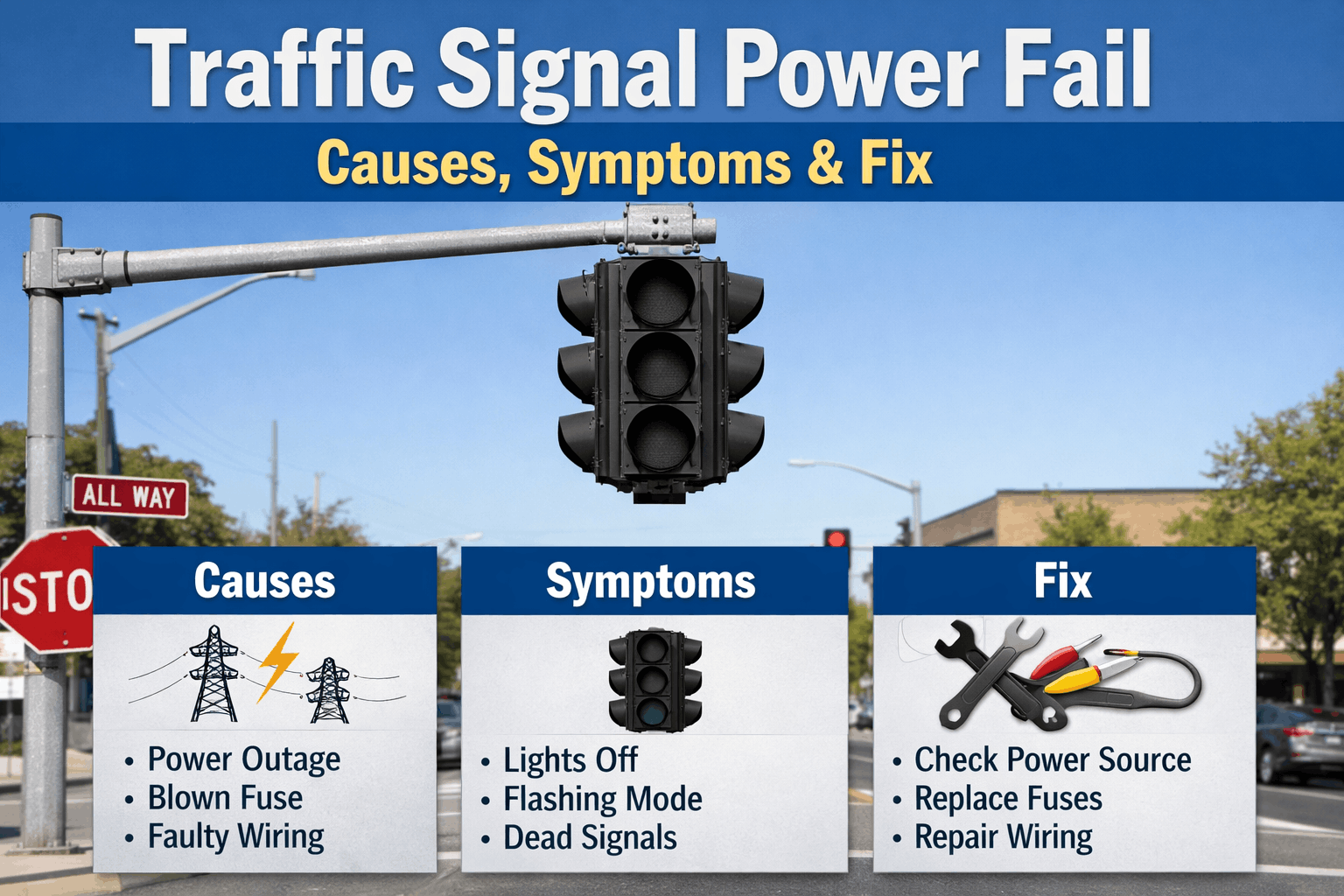
Implementing a robust response to power failures requires moving from "it's dark" to specific diagnostic categories. Successful troubleshooting requires structured analysis of the failure point.
| Symptom | Probable Cause | Field Check | Corrective Action |
|---|---|---|---|
| Dark Signal (All Heads) | Utility outage or main breaker trip | Check meter voltage & main breaker | Contact utility or reset breaker (check for short) |
| Signal in Flash Mode | Conflict monitor trip or power "bump" | Check MMU/CMU logs | Reset unit; if recurring, inspect field wiring |
| UPS Alarm Active | Bad batteries or blown fuse | Load test batteries | Replace battery string or fuse |
| Cabinet Fan Not Running | Thermostat failure or bad motor | Bypass thermostat | Replace fan unit to prevent overheating |
| Intermittent Resets | Loose neutral or ground connection | Tighten all terminal block screws | Secure loose connections, verify bond |
| GFCI Tripping | Moisture ingress or device fault | Inspect cabinet seal & auxiliary items | Reseal cabinet, replace faulty GFCI |
The transition from reactive resets to root-cause solving typically occurs when technicians are empowered with mobile diagnostic checklists that force the identification of why the power failed, not just that it failed.
Oxmaint CMMS delivers integrated asset tracking, automated maintenance tasks, and mobile diagnostics designed specifically for traffic signal operations.
Trusted by transportation departments managing critical intersection infrastructure
Implementation Roadmap: From Blackouts to Resilience
Transportation departments transitioning from "fix-it-when-it-breaks" to precision maintenance requires structured implementation that prioritizes critical intersections first.
Operationalizing AI Insights: A Signal Health Lifecycle
The true value of integrated monitoring emerges when power data flows seamlessly into AI-powered analytics. This ecosystem prevents the most common cause of intersection blackouts: dead backup batteries during a storm.
For municipal operations, these improvements translate directly to safer streets and reduced liability. An intersection that stays powered is an intersection that protects the public. Government agencies can explore AI-powered signal health dashboards designed specifically for transportation applications.
Compliance Documentation and Regulatory Reporting
Signal reliability isn't just an operational goal; it's a legal necessity. MUTCD standards and local regulations require rigorous documentation of maintenance activities to defend against liability claims in the event of accidents.
Oxmaint delivers comprehensive asset tracking, sensor integration, and mobile-first workflows designed specifically for traffic signal departments.
Join cities nationwide modernizing critical traffic infrastructure management
Best Practices for Traffic Signal Power Management
Successful management of signal power requires attention to unique operational constraints—grid fluctuations, environmental exposure, and 24/7 reliability demands. Agencies achieving high reliability consistently follow these best practices:
Conclusion: The Municipal Imperative for Intersection Safety
Traffic signal power is more than just electricity; it is the foundation of order and safety at intersections. When municipalities treat power failures as unacceptable risks rather than "business as usual," they unlock massive gains in reliability and public trust. Citizens expect green lights to work. Drivers expect safe passage. Traffic engineers require systems that perform. All three objectives align when agencies deploy connected power monitoring, automated preventive tasks, and rigorous battery management.
The agencies that implement these capabilities benefit from extended asset lifecycles, reduced liability exposure, and the confidence that comes from audit-ready documentation. Those that delay face the continuous drain of emergency repairs, shortened equipment life, and the looming risk of critical intersection failures.
The technology exists. The engineering principles are proven. The implementation roadmap is clear. What remains is the organizational commitment to transform legacy maintenance into precision reliability programs. For a personalized assessment of your traffic signal fleet's modernization readiness, request a tailored implementation strategy from traffic signal CMMS specialists.