A transit agency's reliability is only as strong as its brake inspection records, its engine PM cycles, and the speed at which its maintenance team can detect a developing failure before it strands passengers at a stop. In 2026, FTA Triennial Review auditors are scrutinizing preventive maintenance compliance rates more closely than ever — and agencies without a CMMS that documents every inspection and work order are routinely cited for insufficient records regardless of how well their mechanics actually perform the work.
Government · Public Transit · Fleet Maintenance
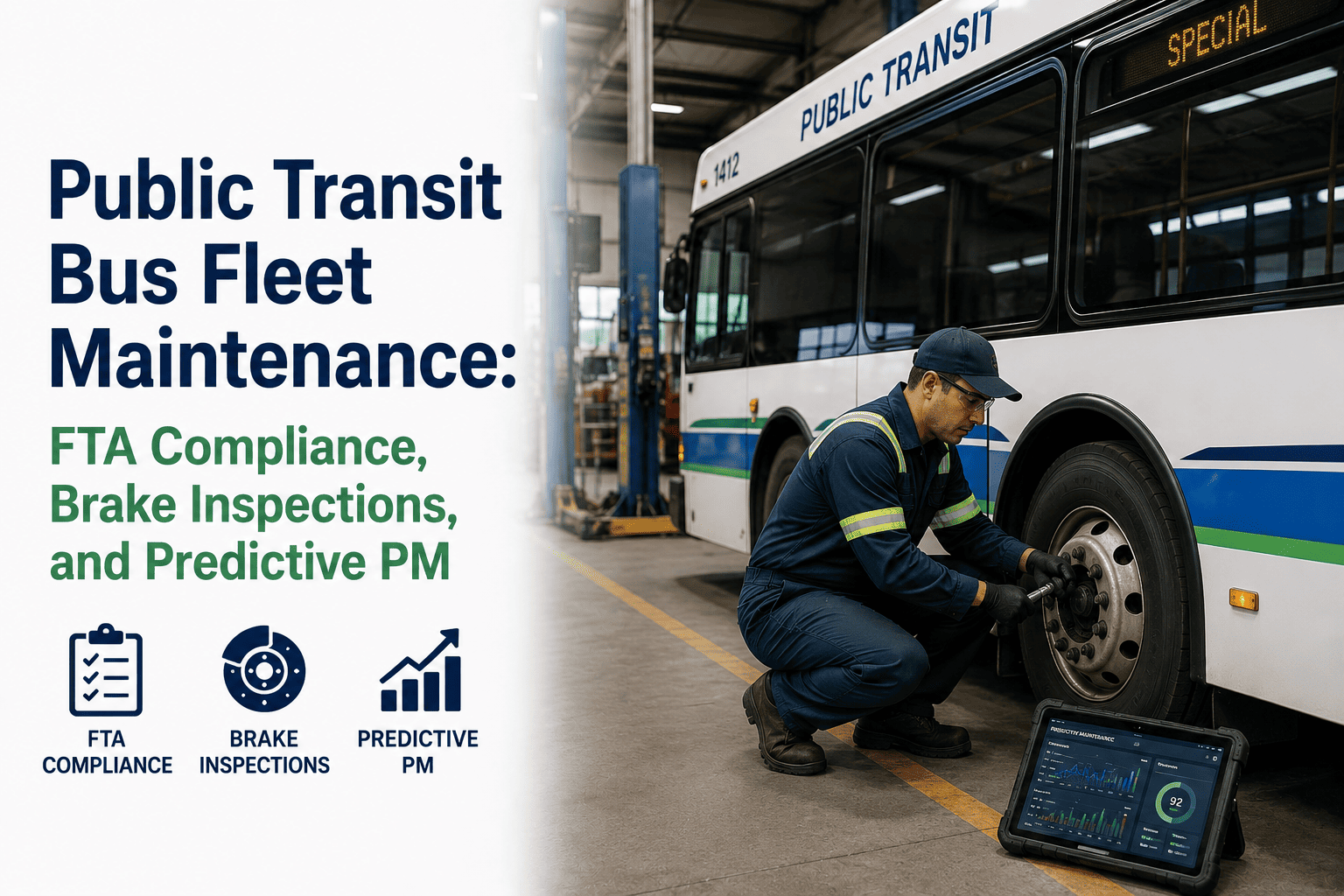
Public Transit Bus Fleet Maintenance: FTA Compliance, Brake Inspections, and Predictive PM
The complete maintenance framework for transit agencies — FTA compliance documentation, brake inspection cycles, engine PM intervals, and telematics-driven predictive failure detection.
$50K+
FTA grant clawback risk for agencies with PM compliance below 80%
62%
of transit road calls caused by brake, engine, or electrical failures — all preventable with PM
4× faster
failure detection with telematics integrated into CMMS vs manual odometer-based scheduling
FTA Compliance
What FTA Triennial Review Actually Audits in Fleet Maintenance
The FTA Triennial Review examines maintenance under the Vehicle and Equipment Management area. Auditors look for four specific elements — and each requires a paper trail your CMMS must produce instantly.
Element 1
Written Maintenance Plan
A documented PM plan covering inspection intervals, maintenance procedures, and system-level standards. FTA expects to see OEM-backed or industry-standard intervals — not internally invented schedules. Your CMMS PM templates serve as living proof of this plan.
Element 2
PM Compliance Rate — 80% Minimum
Agencies must demonstrate that at least 80% of PM tasks were completed on schedule. The FTA calculates this as completed PMs divided by scheduled PMs in the review period. A CMMS generates this metric automatically — agencies without one typically calculate it manually under audit pressure, introducing errors that compound findings.
Element 3
Fleet Age and Condition Monitoring
FTA requires agencies to track fleet age against the Federal Transit Administration's minimum useful life standards — 12 years or 500,000 miles for standard urban buses. Vehicles operated beyond useful life without a documented condition assessment and justification create audit findings and capital funding complications.
Element 4
Safety-Critical System Records
Brake inspections, ADA lift maintenance, fire suppression system checks — FTA auditors specifically pull safety-critical records and look for consistent documentation, technician certification, and corrective action closure. Incomplete records are treated as missed maintenance regardless of what was physically performed.
PM Interval Reference
Bus Fleet PM Schedule — FTA and OEM-Aligned Intervals
Based on APTA standards, OEM specifications for major bus platforms (New Flyer, Gillig, Nova Bus), and FTA-accepted PM frameworks. Use mileage or time triggers — whichever occurs first.
| System |
PM Interval |
FTA / Safety Classification |
Technician Cert Required |
CMMS Work Order Type |
| Brake Inspection (visual + functional) |
Every 6,000 miles or 90 days |
Safety-critical — mandatory documentation |
ASE Brake certification or equivalent |
Safety PM — auto-generate |
| Engine Oil and Filter |
Every 6,000–8,000 miles |
Reliability — affects road call rate |
None beyond agency qualification |
Mileage-triggered PM |
| Transmission Service |
Every 25,000 miles |
Reliability and warranty compliance |
OEM certification recommended |
Mileage-triggered PM |
| ADA Lift Inspection |
Daily pre-trip + monthly functional |
ADA Section 37.163 — safety-critical |
ADA lift certified technician |
Daily log + monthly PM |
| HVAC System |
Seasonally (before heating/cooling season) |
Reliability and passenger comfort |
EPA 609 for refrigerant systems |
Seasonal PM work order |
| Fire Suppression System |
Every 6 months |
Safety-critical — NFPA 10 standard |
Licensed fire suppression tech |
Bi-annual safety PM |
| Full Chassis Inspection |
Annually or 50,000 miles |
FTA fleet condition monitoring |
Agency-qualified mechanic |
Annual PM + condition report |
OxMaint — Transit Fleet CMMS
FTA audit in 60 days? Your PM compliance report should take 60 seconds to generate.
OxMaint tracks mileage-triggered and time-based PMs for every bus in your fleet, auto-generates safety-critical work orders, and produces FTA-formatted compliance reports with one click. See it working with your fleet size and routes.
Predictive Maintenance
How Telematics and CMMS Integration Predict Failures Before Road Calls
Integrating bus telematics data with your CMMS shifts maintenance scheduling from calendar-based to condition-based — catching deterioration weeks before it becomes a road call or safety incident.
01
Engine Fault Code Monitoring
Telematics feeds real-time engine fault codes into CMMS, auto-generating work orders when fault frequency or severity crosses defined thresholds. Eliminates the gap between fault occurrence and mechanic awareness.
02
Brake Wear Sensor Alerts
Electronic brake wear indicators on modern bus platforms transmit pad thickness data. CMMS creates a brake replacement work order when wear approaches the 3mm threshold — before safety limits are reached on the road.
03
Fuel Economy Baseline Deviation
A 15% or greater drop in miles-per-gallon relative to a vehicle's established baseline is a reliable predictor of engine, injector, or transmission issues. CMMS flags the deviation and schedules diagnostic inspection before catastrophic failure.
Expert Review
What Transit Maintenance Directors Are Saying
We failed our first FTA Triennial Review maintenance element because our PM completion rate was 71% — we knew the work was getting done, we just couldn't prove it. After implementing a CMMS with automatic work order generation and technician sign-off, we hit 94% documented compliance in the next review cycle with the same crew size.
Fleet Maintenance Director
Urban transit authority, 220-bus fleet — Northeast US
Telematics integration was the game changer for us. We were doing oil changes on a fixed 6,000-mile schedule regardless of actual engine condition. With CMMS pulling fault code data, we now have routes where oil changes happen at 7,800 miles with no adverse outcomes, and three buses where fault patterns told us to change at 4,200 miles — preventing two road calls in the first six months.
Director of Operations and Maintenance
Regional transit agency, 85-bus fleet — Midwest US
FAQs
Frequently Asked Questions — Transit Bus Fleet Maintenance
What PM compliance rate does the FTA require for transit agencies?
The FTA's Triennial Review uses 80% as the minimum acceptable PM completion rate — calculated as the number of PM tasks completed on schedule divided by the number of PM tasks due in the review period. Agencies below 80% receive a deficiency finding and must submit a corrective action plan. Agencies chronically below 80% risk losing FTA funding eligibility. A CMMS that
automatically generates PM work orders and tracks completion rates makes hitting and proving compliance far easier than manual systems.
How often are brake inspections required on transit buses?
Most FTA-aligned PM programs and OEM specifications require brake system inspection every 6,000 miles or 90 days — whichever occurs first. Safety-critical nature means these work orders require documented technician sign-off with certification credentials attached. ADA lift inspections also require daily pre-trip logs in addition to monthly functional testing.
Book a demo to see how OxMaint handles safety-critical PM documentation requirements.
What is the FTA minimum useful life for transit buses?
The FTA minimum useful life for standard 35-40 foot urban transit buses is 12 years or 500,000 miles. Operating vehicles beyond this threshold without a documented condition assessment and agency justification creates issues during capital grant applications and Triennial Review. Agencies must track each vehicle's age and mileage against these thresholds and flag approaching end-of-life in their asset management system to plan replacement capital requests in advance of budget cycles.
How does telematics integration improve transit bus predictive maintenance?
Telematics integration connects real-time vehicle data — engine fault codes, brake wear sensor readings, fuel economy metrics, and idle time — directly to the CMMS maintenance schedule. Instead of waiting for a scheduled PM date, the system generates work orders when actual vehicle condition indicates maintenance is needed. For transit agencies, this typically reduces road calls by 30–40% in the first year of implementation because it catches developing failures during the maintenance window rather than during revenue service when a breakdown strands passengers and triggers expensive emergency response.
Get Started Today
Your next FTA Triennial Review is closer than you think.
OxMaint helps transit agencies hit the 80% PM compliance threshold, document every safety-critical inspection, and integrate telematics data for condition-based scheduling — all in one platform built for public sector fleet teams. Schedule a demo tailored to your fleet size and FTA requirements.