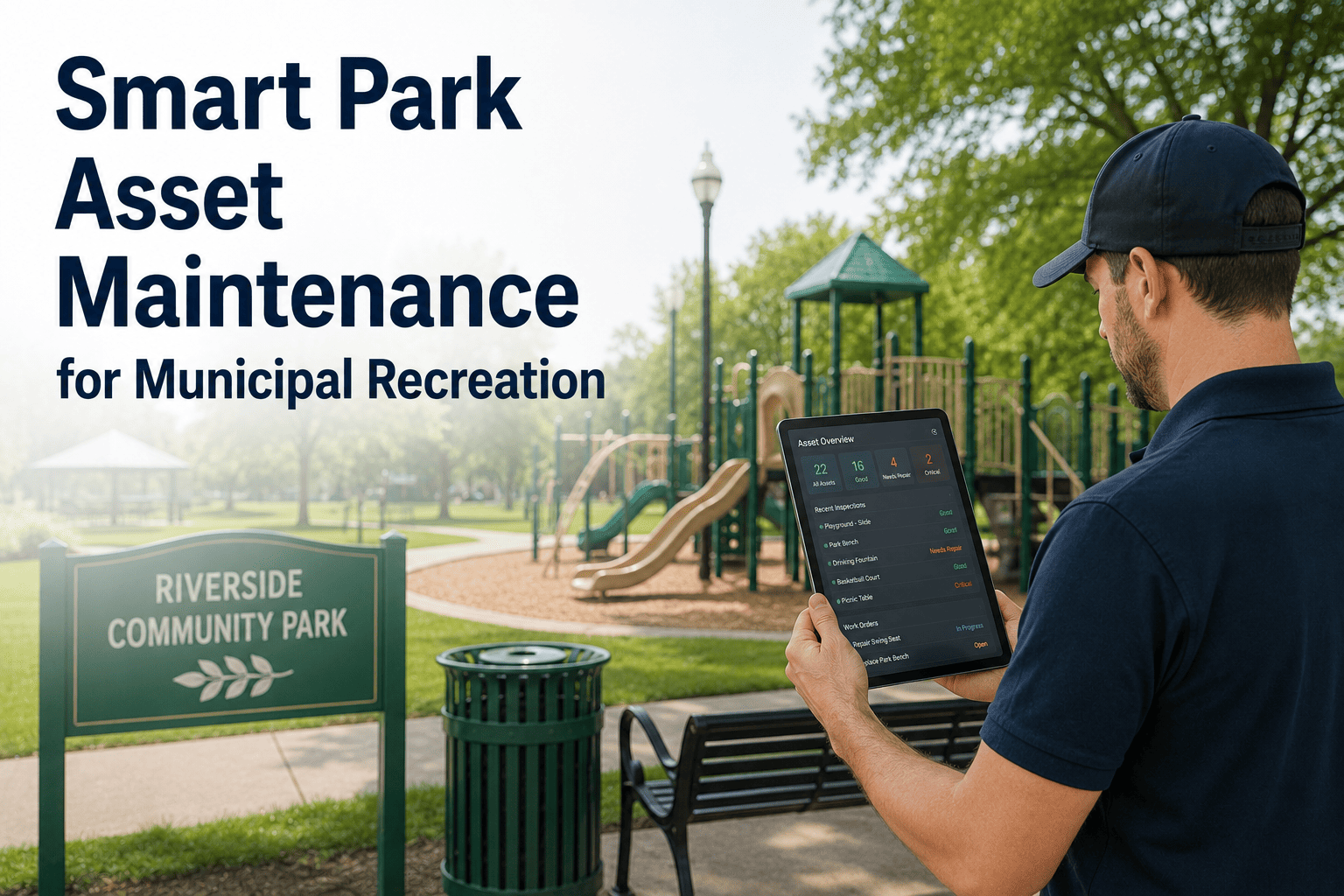
When a parks department supervisor asks "Why hasn't the broken swing chain at Liberty Park been replaced?" and the maintenance lead answers "We didn't know it was broken because the paper inspection form is still in the truck," the disconnect is critical. Managing a few acres is simple; managing a municipal portfolio of 50+ parks, 200 miles of trails, and dozens of athletic fields requires digital precision. A missed trash pickup is an annoyance; a missed playground safety inspection is a lawsuit. Yet many parks departments still rely on memory, paper forms, and spreadsheets to track assets that are spread across square miles of terrain. The equipment degrades continuously—UV light cracks slides, soil compaction ruins turf, irrigation heads clog with sediment—but without a CMMS triggering these maintenance intervals based on GPS location and usage, nobody notices until a citizen complains. Talk to our team about closing the gap between your dispersed assets and your maintenance crew.
Parks & Recreation Management Guide
Parks and Recreation Facility Maintenance: Playgrounds, Fields, & Trails
Mobile CMMS with GPS mapping enables efficient maintenance across dispersed facilities. Manage playground safety compliance, athletic field turf health, trail conditions, and restrooms from a single digital platform.
100%
Audit trail compliance for ASTM F1487 playground safety standards
40%
Reduction in travel time with GPS-optimized maintenance routes
24hr
Faster resolution time for citizen-reported safety hazards
30%
Extension in athletic field lifespan through scheduled aeration/seeding
Why Park Assets Degrade Without Mobile Maintenance
Parks and recreation assets face a unique challenge: they are outdoors, exposed to the elements, and subject to unmonitored public use. A factory machine is in a controlled environment; a park slide is baked by the sun, frozen by winter, and jumped on by hundreds of children. Athletic fields suffer from soil compaction that is invisible until the grass dies. Irrigation leaks underground can waste thousands of gallons before surfacing. Without a mobile CMMS that puts inspection checklists and asset history in the hands of field crews, maintenance becomes purely reactive—fixing things only after they break or injure someone. Start your free trial to switch from reactive repairs to proactive stewardship.
The Six Failure Modes of Unmanaged Park Assets
Playground Liability
High Risk
Missed safety inspections allow loose S-hooks, entrapment gaps, and surfacing degradation to persist, creating massive legal liability.
Turf Failure
$$$
Without tracked aeration and fertilization schedules, soil compacts, drainage fails, and fields become unplayable mud pits requiring costly sod replacement.
Irrigation Waste
40% Loss
Stuck valves and broken heads in remote park corners often go unnoticed for weeks, wasting budget and creating standing water hazards.
Facility Vandalism
Daily
Graffiti and damage to restrooms deter public use. Slow response times signal neglect, encouraging further vandalism.
Trail Erosion
Structural
Small washouts on trails expand rapidly during storms. Reactive fixing costs 10x more than preventive drainage clearing.
Amenity Decay
Silent
Benches, picnic tables, and signage rot or rust silently. Lack of inventory tracking means replacements are never budgeted.
The Parks Maintenance Lifecycle
A reliable parks and recreation department requires a structured maintenance lifecycle that bridges the gap between the field and the office. From the moment a hazard is identified to the final compliance report, every step must be digital and location-aware. This lifecycle ensures that dispersed facilities receive the same level of care as the main office, creating a safe and inviting environment for the community.
CMMS-Driven Parks Workflow
From reporting to resolution in a single mobile platform
Staff or citizens report issues via mobile app. GPS automatically tags the exact location of the asset (e.g., Slide #3, North Park).
Instant
›
CMMS assigns priority based on asset type. Playground safety hazards trigger emergency alerts; graffiti triggers standard work orders.
Automated
›
Work orders are grouped by geolocation. Crews receive optimized routes to address multiple issues in the same park zone.
Daily
›
Techs access SOPs and manuals on mobile. Parts usage is logged, and "After" photos are required to close the ticket.
On-Site
›
For critical assets like swings, a secondary safety sign-off is triggered to ensure compliance standards are met.
Post-Work
›
All data is archived. Reports on inspection completion rates and safety scores are auto-generated for stakeholders.
Weekly
›
System resets PM timer (e.g., "Check mulch depth in 30 days") based on the completion of the current task.
Continuous
Mobilize Your Parks Maintenance Team
Oxmaint puts the power of a CMMS in your pocket. Track playground inspections, field prep schedules, and facility repairs from anywhere—ensuring your parks remain safe, beautiful, and open for the community.
Asset Categories: The Parks Maintenance Stack
Municipal parks departments manage a diverse "stack" of physical assets—each with distinct maintenance profiles, safety standards, and public expectations. Playgrounds require strict legal compliance; athletic fields require agronomic precision; restrooms require high-frequency sanitation. A unified CMMS handles these distinct needs within a single dashboard. Book a demo to see asset-specific workflows.
Park Asset Maintenance Profiles
Focus: Safety Compliance & Risk Mitigation
Daily visual sweeps Monthly functional checks Surfacing depth audit Hardware torque check ASTM F1487 compliance
Maintenance: High Frequency. Zero tolerance for deferred maintenance due to injury risk.
Focus: Playability, Turf Health & Revenue
Mowing/Line marking Aeration & overseeding Irrigation tuning Infield dragging Lighting inspection
Maintenance: Seasonal Intensity. Schedule driven by league games and tournament bookings.
Focus: Hygiene, Aesthetics & Security
Restroom sanitization Graffiti removal Trash removal HVAC/Plumbing PM Lock/Door checks
Maintenance: Daily/Weekly. High public visibility; directly impacts citizen satisfaction.
Focus: Access, Drainage & Vegetation
Trail surface grading Tree trimming Invasive species control Drainage clearing Signage updates
Maintenance: Seasonal/Event-driven. Focus on long-term preservation and safe access.
Before & After: Reactive vs. CMMS-Managed Parks
The difference between a park system that feels neglected and one that feels vibrant is often not the budget, but the management method. Moving from paper-based, reactive workflows to a GPS-enabled CMMS transforms the efficiency of the crew and the quality of the public space.
Streamline Your Parks Operations
Oxmaint integrates GPS tagging, mobile checklists, and automated scheduling to give you full visibility over your parks, fields, and trails. Stop chasing paper and start managing your community's most valuable outdoor assets with precision.
CMMS Capabilities for Parks & Recreation
A parks-focused CMMS does more than just list tasks; it adapts to the outdoor nature of the work. Features like offline mode (for remote trails), geolocation tagging (for finding that specific sprinkler head), and visual asset mapping transform how field crews interact with their work. Start your free trial to experience these features.
Key CMMS Features for Outdoor Maintenance
01
GPS Asset Mapping
Pinpoint exact locations of dispersed assets
Map-based work order visualization
Geofenced work zones
02
Mobile Inspections
Digital ASTM playground checklists
Photo upload for damage evidence
Voice-to-text notes for field crews
03
Automated Scheduling
Seasonal recurring tasks (e.g., Winterize)
Usage-based intervals for fields
Weather-dependent scheduling adjustments
04
Inventory Management
Track parts across multiple depots
Auto-reorder for common items (bulbs, soap)
Link parts to specific park locations
05
Vendor Management
Manage contractors for specialty work
Track warranties on new equipment
Centralized invoicing and certificates
06
Capital Planning
Track total cost of ownership per park
Forecast replacement dates for equipment
Data for budget justification
Expert Perspective: Visibility is Key to Safety
"
We used to run our parks department on yellow notepads and voicemail. If a seasonal worker noticed a crack in a slide, they'd write it down, put it in their pocket, and maybe remember to tell someone on Friday. That crack could sit there for a week. We manage 45 parks spread over 60 square miles. When we switched to a mobile CMMS, everything changed. Now, that worker snaps a photo of the crack, and it instantly alerts the safety supervisor. We know exactly where our crew is, what they fixed, and we have a timestamped photo record for liability protection. Our field quality scores are up 40% because nothing falls through the cracks anymore. It’s not just about efficiency; it’s about keeping our kids safe.
— Director of Parks & Recreation, Mid-Sized Municipality
100%
Visibility into safety hazards across all 45 parks
2hr
Average time to dispatch for safety-critical issues
Zero
Lost work orders since implementation
Municipalities that succeed in maintaining high-quality public spaces share a common discipline: they treat park assets with the same data-driven rigor as public works infrastructure. Playgrounds, fields, and trails are not "set and forget" amenities—they are active assets that degrade with use. By integrating mobile CMMS into daily operations, these departments ensure that every park is safe, clean, and ready for the community to enjoy. Start building your parks maintenance program with Oxmaint today.
Build a Better Park Experience
Oxmaint centralizes asset tracking, mobile inspections, work order management, and safety compliance into one platform—ensuring your parks and recreation facilities are always at their best.
Frequently Asked Questions
How does a CMMS help with playground safety compliance?
A CMMS allows you to digitize standard safety checklists (like ASTM F1487 or CPSC guidelines) and assign them as recurring tasks. Technicians must complete the specific checklist on their mobile device, preventing "pencil whipping." If a hazard is found (e.g., "loose bolt"), the system can force the user to take a photo and automatically generate a corrective work order. This creates an unalterable digital audit trail proving that inspections were performed and issues were addressed, which is critical for liability protection.
Can the mobile app work in remote parks without cell service?
Yes, modern CMMS apps like Oxmaint act with "offline-first" functionality. Crews can download their route and work orders for the day while at the depot. When they are in a remote trail area or a park with poor signal, they can still view asset details, complete checklists, and log time. The data syncs automatically to the cloud as soon as the device reconnects to a network, ensuring no data is lost.
How does the system handle seasonal changes in park maintenance?
Parks maintenance is highly seasonal. A CMMS allows you to build "seasonal changeover" schedules. For example, in late autumn, the system can automatically trigger "Winterize Irrigation" and "Close Restrooms" work orders across all relevant assets. In spring, it triggers "Playground Mulch Top-up" and "Start-up Irrigation." You can also pause recurring mowing tasks during winter months and reactivate them in spring, ensuring your schedule always matches reality.
Can we track vandalism and graffiti separately?
Absolutely. You can configure specific "Failure Codes" or "Problem Types" for vandalism or graffiti. This allows you to run reports at the end of the year to see exactly how much time and money was spent specifically on vandalism remediation vs. normal wear and tear. This data is powerful when advocating for security improvements (like cameras or lighting) in specific parks that show high vandalism costs.
Is it possible to manage both vertical assets (buildings) and horizontal assets (fields/trails)?
Yes. A robust CMMS handles both. You can track HVAC filters, plumbing, and roofs for your community centers and restrooms (vertical assets) alongside turf health, irrigation lines, and trail grading for your grounds (horizontal assets). Both types use the same work order system, but can have different checklists and priority levels assigned to them.