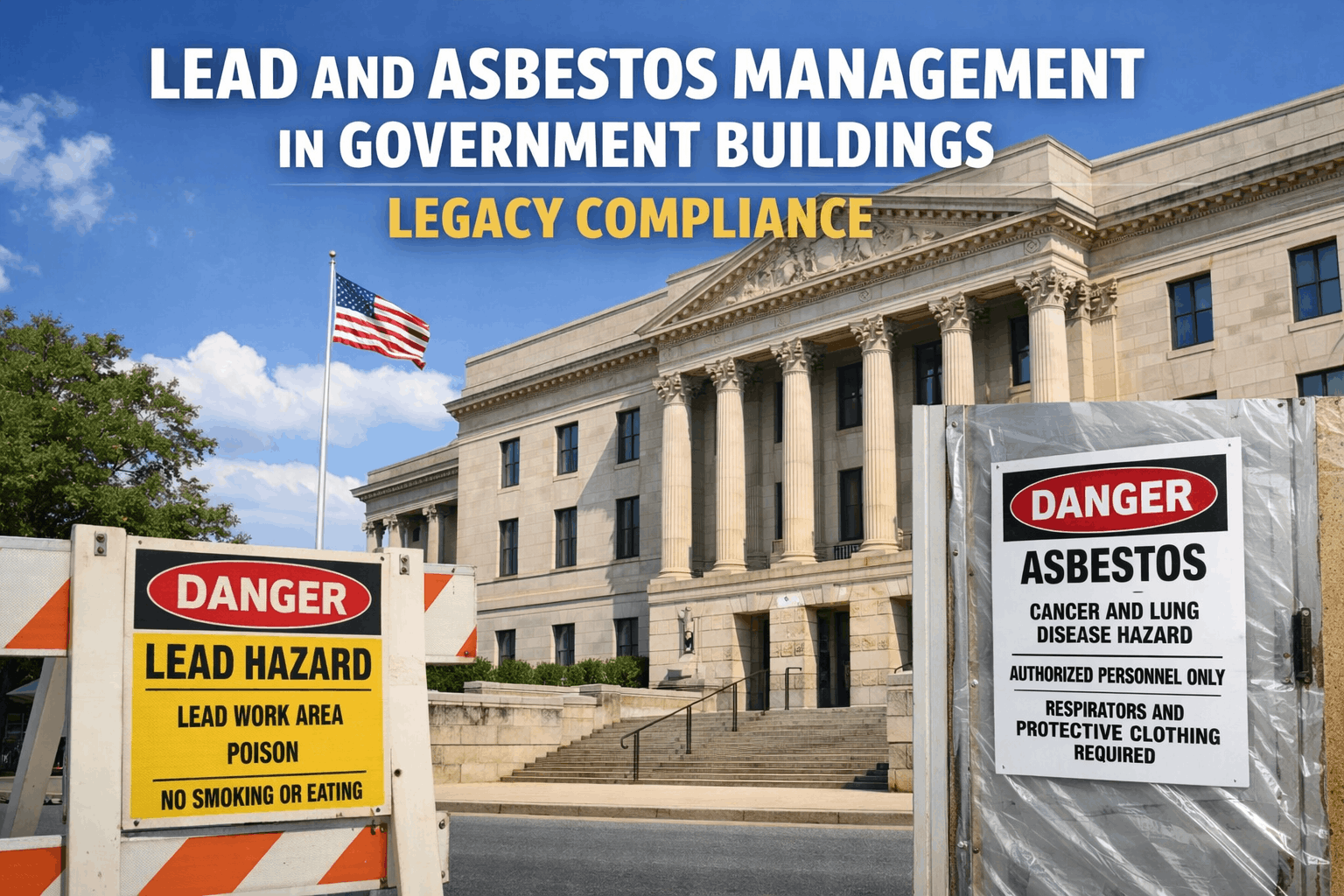
When a municipal facilities director asks "Why is our $4 million courthouse HVAC renovation delayed by six weeks?" and the project manager answers "The contractor breached a wall that wasn't on the 1998 survey and exposed friable pipe insulation, triggering an OSHA stop-work order and EPA fines," the compliance gap is unmistakable. Managing renovations in facilities that predate 1980 is not just about construction—it is about strict environmental containment. A missing floorplan is an annoyance; missing an asbestos management plan before demolition is a federal liability. Yet many public sector operations have zero centralized digital tracking for their government building survey records, abatement histories, or 10-day NESHAP notifications. Hazardous material government records degrade in physical binders—surveys get lost, contractor licenses expire, and legacy building compliance lapses—but without a CMMS tracking these regulatory intervals, nobody notices until a contractor is exposed and a regulator halts the project. Talk to our team about integrating digital hazard tracking into your facilities maintenance programme.
Public Sector Hazmat Management
Lead and Asbestos Management in Government Buildings: Legacy Compliance
Many government buildings predate 1980 and contain lead and asbestos. Digital tracking of surveys, abatement records, notifications, and monitoring ensures EPA and OSHA regulatory compliance during renovations.
100%
Digital retention of historical government building survey data
0 Days
Renovation delays due to missing legacy building compliance records
10-Day
Automated NESHAP notification tracking prior to demolition
Zero
OSHA fines for unmanaged lead paint government buildings exposure
Why Legacy Building Compliance Degrades Without Digital Tracking
Government environmental hazard management faces a fundamentally different documentation challenge than new construction. Asbestos government facility records and lead testing government reports are often scattered across decades of decentralized filing cabinets. Abatement completed in the 1990s might only be documented on paper, leaving current facility managers blind to residual hazards. When a modern plumbing or electrical project begins, the lack of a centralized asbestos management plan or lead paint compliance history means contractors risk disturbing legacy toxins. Without scheduled audits and a digital vault tying hazardous material government data directly to asset work orders, regulatory compliance erodes invisibly until an exposure incident occurs. Start your free trial to digitize your abatement tracking automatically.
The Six Compliance Failure Modes of Legacy Government Buildings
Lost Historical Surveys
40%
Paper-based asbestos inspection government records are lost during staff turnover, forcing expensive, redundant testing before minor repairs.
Missed EPA Notices
$10K+
Failing to file the mandatory NESHAP 10-day notification before demolition triggers immediate, severe EPA daily fines.
Lapsed Certifications
Silent
Contractor lead abatement government certifications expire mid-project without oversight, voiding regulatory compliance and creating liability.
Accidental Disturbance
High
Maintenance teams drill into unlabelled walls, disturbing friable asbestos because work orders weren't linked to the hazard registry.
Air Monitoring Failures
0.1 f/cc
Exceeding OSHA permissible exposure limits (PEL) due to poor containment tracking and lack of real-time air clearance logging.
Project Stoppages
6 Weeks
Renovations grind to a halt when "surprise" lead or asbestos is discovered, destroying budgets and extending facility downtime.
The Hazmat Renovation Compliance Lifecycle
A reliable government hazmat management programme requires a structured compliance lifecycle—from pre-renovation surveying through containment verification to final air clearance. Each phase feeds documentation into the CMMS, creating a closed loop where regulatory health is continuously monitored, gaps are detected before demolition begins, and mandatory notifications are auto-generated on schedule.
CMMS-Scheduled Hazmat Abatement Workflow
From legacy building surveys to fully documented EPA/OSHA compliance
Review CMMS vault for existing lead testing government records and asbestos profiles before issuing work orders.
Pre-Planning
›
Dispatch certified inspectors to collect samples. Upload lab results directly to the building's digital hazard registry.
Pre-Renovation
›
Draft and attach the formal asbestos management plan and contractor scope of work to the renovation project file.
Planning Phase
›
CMMS triggers 10-day NESHAP notification reminders. Document submission receipts in the regulatory compliance log.
10 Days Prior
›
5
Containment Verification
Inspectors complete mobile checklists verifying negative air pressure and poly-sheeting before abatement begins.
Day Zero
›
Log third-party PCM/TEM air monitoring results and final visual inspection sign-offs before removing containment.
Post-Abatement
›
Scan and link hazardous waste disposal manifests to the project, updating the building's continuous compliance history.
Closeout
Automate Your Legacy Compliance Tracking
Oxmaint centralizes your asbestos tracking government records, lead paint compliance data, and contractor certifications—auto-generating alerts before unmanaged renovations create regulatory liabilities.
Compliance Subsystems: The Environmental Maintenance Stack
Safe renovation in legacy government facilities relies on four tightly coupled subsystems—each with distinct documentation requirements and legal liabilities. Tracking surveys provides hazard awareness. Monitoring ensures worker safety. Contractor management ensures legal execution. And waste tracking ensures environmental closure. Failure in any single subsystem cascades into severe OSHA or EPA penalties, corrupting the project timeline. Book a demo to see subsystem-level compliance tracking.
Hazmat Compliance Subsystem Profiles
Focus: Asbestos Inspection Government & Abatement
AHERA Survey Vault NESHAP 10-Day Notices Friable Material Mapping O&M Plan Tracking Clearance TEM Results
Requirement: Pre-renovation survey review + formal management plans. Target: 100% hazard awareness prior to wall breach.
Focus: Lead Paint Government Buildings & RRP Rule
XRF Testing Logs EPA RRP Certifications Encapsulation Records Soil Contamination Data Wipe Clearance Docs
Requirement: Identify surfaces with >1.0 mg/cm² lead + use certified firms. Target: Zero exposure incidents during prep work.
Focus: Air Quality & Worker Exposure Limits
Daily Air Log Uploads Negative Pressure Checks OSHA PEL Tracking Personal Pump Data Visual Inspection Signs
Requirement: Daily logging during active abatement + final clearance. Target: Documented proof of safe atmospheric conditions.
Focus: Contractor Certifications & Waste Manifests
License Expiration Alerts Insurance Verification Cradle-to-Grave Waste Tracking Landfill Receipts State Notification Archiving
Requirement: Active tracking of abatement firm licenses and waste transit. Target: Fully auditable chain of custody for all hazardous waste.
Before & After: Manual Binders vs. Digital Hazmat Tracking
The difference between a government facility renovation that proceeds smoothly and one plagued by stop-work orders, EPA fines, and public relations disasters is entirely explained by how legacy hazards are tracked. The physical hazards in the building are identical—the management discipline is not.
Keep Your Renovation Projects on Schedule
Oxmaint's compliance layer connects your government environmental hazard data directly to maintenance and renovation workflows—ensuring that every drill, demolition, or repair is executed with full regulatory awareness.
CMMS Capabilities for Government Hazmat Management
A compliance-aware CMMS does not just schedule HVAC filter changes—it safeguards the institution. From tracking lead abatement government projects to securely archiving final air clearance documents, the CMMS transforms scattered compliance documents into actionable intelligence that protects workers and budgets alike. Start your free trial to explore legacy compliance features.
Digital Compliance Intelligence Outputs
01
Centralized Survey Vault
Digitized historical AHERA/Lead surveys
Floorplan mapping of known hazards
Instant access for emergency responders
02
Hazard-Linked Work Orders
Auto-warnings on WO generation
Required PPE checklists enforced
Mandatory pre-work survey reviews
03
Regulatory Notification Tracker
10-day NESHAP countdown alerts
Local/State permit expiration tracking
Document receipt archiving
04
Vendor Compliance Hub
Contractor license verification gates
Insurance/Bonding expiration alerts
Approved abatement vendor registry
05
Clearance Document Chain
Daily air monitoring log uploads
Final visual inspection sign-offs
Lab analysis PDF associations
06
Waste Manifest Archiving
Cradle-to-grave tracking numbers
Landfill acceptance receipts
EPA compliance reporting summaries
Expert Perspective: Visibility is Liability Protection
"
Everyone focuses on the cost of abatement. Nobody plans for the cost of stopping a major renovation because a legacy hazard was forgotten. We were upgrading the plumbing in a 1968 municipal administrative building. Three weeks into the project, a subcontractor hit presumed asbestos-containing material (PACM) behind a wall that wasn't on the contractor's drawings. The entire site was shut down. The investigation revealed that an asbestos survey from 2004 had identified that exact pipe chase, but the paper report was sitting in a retired facilities manager's filing cabinet. The delay cost us $85,000, not including the emergency abatement premiums and OSHA paperwork. When we implemented a CMMS-tracked government hazmat management system, we digitized every survey, linked them to the physical asset hierarchy, and made them mandatory reading before any wall-penetrating work order could be closed. Now, legacy building compliance is just part of the workflow. The hazards are still there, but the surprise is gone.
— Director of Facilities, State General Services Administration
100%
Visibility into known legacy hazards pre-renovation
Zero
Accidental hazard disturbances after CMMS integration
0 Days
Lost to missing clearance documentation
Government agencies that succeed with legacy facility management share a common discipline: they treat environmental documentation with the same rigour as structural engineering. Asbestos management plans, lead paint compliance records, and air monitoring logs are not "file and forget" documents—they are active compliance tools that protect lives and budgets. By integrating digital hazard tracking into CMMS-scheduled maintenance workflows, these programmes achieve the regulatory certainty that justifies public trust. Start building your hazmat compliance programme with CMMS-integrated digital records.
Protect Your Workers and Your Budget
Oxmaint's compliance management platform tracks government building survey data, contractor certifications, NESHAP notifications, and final clearance manifests across your entire legacy portfolio—ensuring regulatory compliance before demolition begins.
Frequently Asked Questions
Why is digital tracking essential for asbestos government facility management?
Asbestos records generated decades ago are frequently lost during administrative turnovers. Because asbestos is only a hazard when friable (disturbed and airborne), safe operations rely entirely on knowing where it is before drilling or demolition begins. A digital CMMS ties the historical asbestos inspection government data directly to the building's digital twin. If a technician attempts to generate a work order to repair pipes in "Zone 4," the system automatically flags that Zone 4 contains legacy thermal system insulation (TSI), preventing an accidental exposure event.
How does the CMMS assist with EPA NESHAP notification requirements?
The EPA's National Emission Standards for Hazardous Air Pollutants (NESHAP) requires a formal notification to the delegated state or local agency at least 10 working days before any demolition or regulated asbestos renovation begins—even if no asbestos is present. The CMMS workflow integrates this regulatory milestone into the project management timeline. It will not allow the project status to move to "Execution" until the NESHAP notification is logged, dated, and the 10-day holding period has expired, preventing massive daily fines for procedural violations.
What is required for proper lead paint compliance in government renovations?
Lead paint government buildings must adhere to the EPA's Renovation, Repair and Painting (RRP) Program rules if the facility houses child-occupied operations, or stringent OSHA Lead in Construction standards elsewhere. This requires tracking lead testing government data (like XRF reports), ensuring that assigned contractors possess active EPA lead-safe certifications, and documenting that proper encapsulation and cleanup protocols were followed. The CMMS stores vendor certifications and auto-alerts managers if a scheduled contractor's lead certification has lapsed.
Can we integrate our existing Operations & Maintenance (O&M) plans into the platform?
Yes. Legacy buildings often rely on an Asbestos Management Plan or an O&M plan to safely manage hazardous materials in place rather than undergoing costly full abatement. The CMMS digitizes these plans, turning static documents into active maintenance schedules. It will auto-generate recurring work orders for periodic visual inspections of encapsulated asbestos, track any damage over time, and log the mandated training records for custodial and maintenance staff working near the hazards.
How does a CMMS manage hazardous material government waste disposal?
Cradle-to-grave liability means the government agency remains responsible for hazardous waste even after it leaves the facility. The CMMS tracks the entire chain of custody: the generated abatement plan, the licensed transporter's credentials, the temporary storage logistics, and ultimately, the signed waste manifest from the authorized landfill. By archiving all these documents against the specific work order, the agency is permanently audit-ready and protected from illegal dumping liabilities.