A mid-size county government was drowning in citizen complaints — not because public works teams weren't working hard, but because no one could see where a service request was in the pipeline. Residents submitted requests through 311, email, and in-person visits. Work orders lived in spreadsheets. Supervisors spent mornings on the phone chasing status updates. Average resolution time had crept to 21 days. The county deployed OxMaint's citizen portal integrated with its CMMS work order engine — and within 90 days, average resolution time dropped to 38 hours. Book a demo to see how OxMaint's citizen portal works for your government agency, or start a free trial and configure your first service request workflow today.
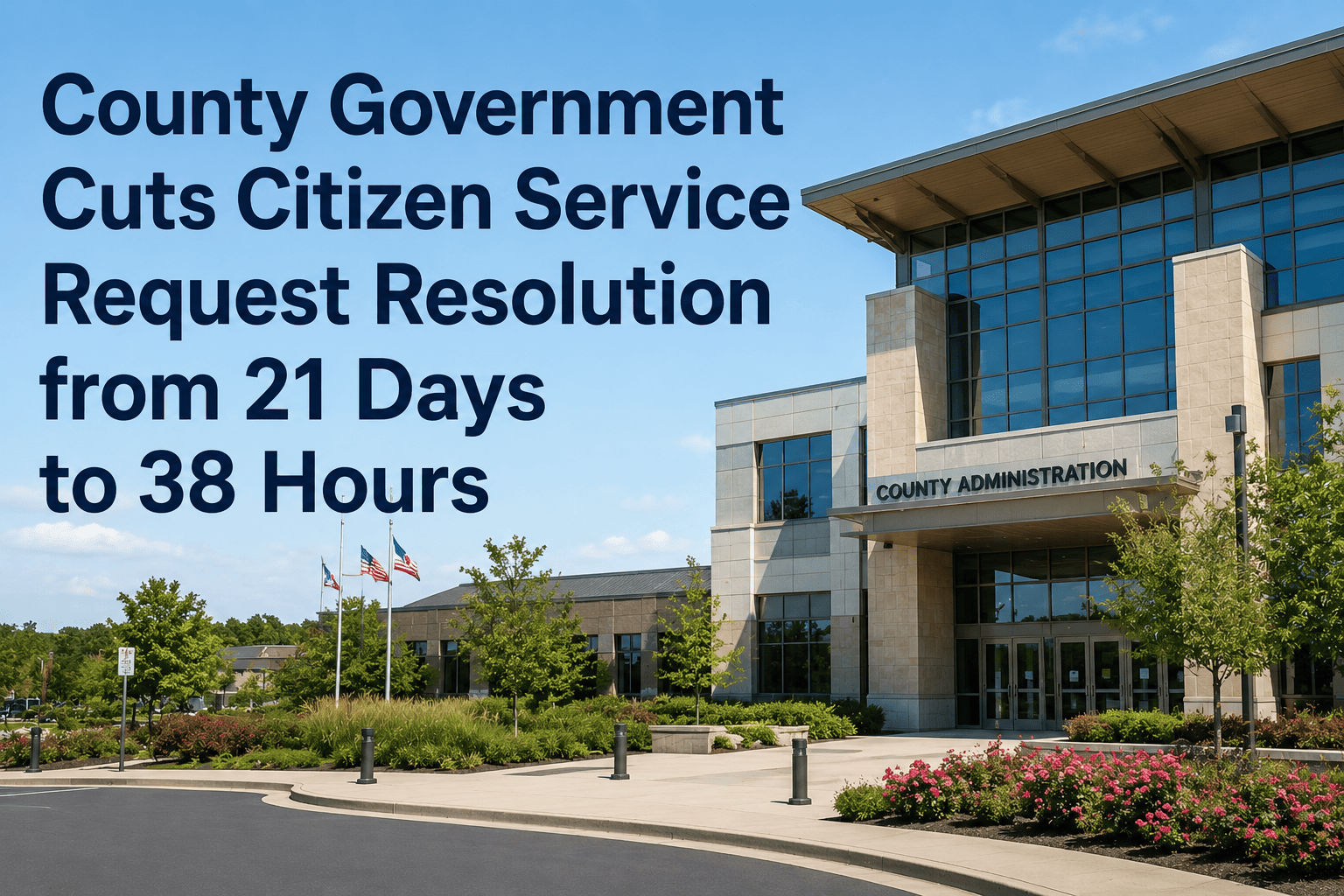
County Government Cuts Citizen Service Request Resolution from 21 Days to 38 Hours
How a mid-size county deployed a citizen portal and unified CMMS to eliminate the gap between resident requests and public works action — reducing average resolution time by 92% and cutting 311 call volume nearly in half.
A County Where Every Request Got Lost
The county managed public works, parks, roads, and facilities for a population of 180,000 residents. Citizen requests arrived through four disconnected channels — 311 phone line, county website form, email to department supervisors, and walk-in requests at the public counter. Each channel fed a different tracking system. None of them talked to each other.
When a resident called to check the status of a pothole repair they reported three weeks earlier, the 311 operator had no way to find the request in real time. Supervisors kept personal spreadsheets. Work crews received jobs verbally or on paper. When a request fell through the cracks, the county learned about it when the resident called their council member.
Four Breakdowns That Created the 21-Day Problem
Requests arriving through different channels were logged — or not logged — by different staff members with no unified ID or tracking system. Duplicates were common. Some requests were never formally recorded. The county had no reliable count of how many open requests existed at any given time.
Even when a citizen request was logged, the path from intake to field crew assignment was manual. A supervisor had to read the request, decide priority, find an available crew, and communicate verbally or by radio. Work order creation was a separate manual step — often delayed by hours or days.
Once a resident submitted a request, they received no confirmation, no status updates, and no completion notice. The only way to know if their issue had been addressed was to drive by the location or call 311 again. Second and third calls about the same issue inflated call volume and wasted operator time on status lookups.
County administrators and council members had no reliable data on service request volume, resolution times, or backlog by department. Monthly reports were assembled manually by supervisors and were typically 2–3 weeks stale by the time they reached leadership — making it impossible to identify bottlenecks before they became public complaints.
What the County Deployed — and How It Was Configured
OxMaint's citizen portal went live as the county's single intake channel — accessible via web browser and mobile. Residents could submit requests with location pin, photo upload, and category selection. Each submission generated an automatic confirmation with a unique tracking ID and estimated response time by category.
Every citizen submission automatically created a work order in OxMaint's CMMS, pre-categorized by service type and routed to the correct department queue — Roads, Parks, Facilities, or Utilities. No manual triage step. The supervisor saw the work order on their dashboard within seconds of citizen submission.
All 84 public works employees received OxMaint mobile access. Work orders were assigned and visible on mobile — with location map, asset history, required equipment, and SLA countdown. Completion was logged on mobile with photo evidence, automatically notifying the submitting resident via email or SMS that their request had been resolved.
311 operators were given read access to the live work order portal — so any resident calling to check status received a real-time update without escalation. County administrators received a live performance dashboard showing resolution times, open request backlog, SLA compliance by department, and weekly trend data by service category.
Before and After — The Numbers That Matter
| KPI | Before OxMaint | After 90 Days | Change |
|---|---|---|---|
| Avg. service request resolution | 21 days | 38 hours | -92% |
| 311 inbound call volume | 2,400 calls/month | 1,272 calls/month | -47% |
| PM compliance rate | 31% | 87% | +56 pts |
| Duplicate/lost requests | Estimated 18% of intake | Zero — all requests tracked | 100% captured |
| Resident status inquiry calls | ~900/month (status checks) | ~120/month | -87% |
| Supervisor manual reporting time | 8–12 hrs/week per dept. | Auto-generated dashboards | ~10 hrs/week recovered |
| Council member escalations | 14–18 per month | 3–4 per month | -78% |
What Government Operations Experts Say
The 21-day resolution time that appears in this case was not unusual before unified digital intake became available — it was the industry average for counties with disconnected request channels. The problem was never that public works teams were slow or uncommitted. The problem was that work instructions arrived through five different pathways, none of which connected to a trackable work order. A pothole that should take a crew 45 minutes to repair was taking 21 days to resolve because the request sat in a supervisor's inbox for 18 of those days before a crew was dispatched. Citizen portal integration eliminates that latency entirely. The request creates the work order automatically. The work order routes to the crew. The crew completes on mobile. The resident gets notified. The entire communication and administrative overhead that previously consumed most of that 21 days collapses to hours. Counties that have made this shift consistently report that the secondary benefit — the 47% drop in 311 call volume in this case — is often larger than the primary outcome in cost terms, because 311 staffing is a significant fixed cost that drops directly to the budget when inbound volume falls.
Book a 30-minute demo. We walk through citizen request submission, automated work order creation, field crew mobile dispatch, and the management dashboard using a county government configuration.
Frequently Asked Questions
How does OxMaint's citizen portal integrate with existing 311 systems?
OxMaint's citizen portal can operate alongside existing 311 phone systems as the digital intake channel, or as the unified system of record that 311 operators access in real time. When a resident calls 311, the operator pulls up the OxMaint portal and can see all submitted requests, open work orders, and resolution status without switching systems. For counties running dedicated 311 software such as CitySourced, SeeClickFix, or Tyler Technologies, OxMaint offers API integration to ingest requests from those platforms into a single CMMS work order queue. Full integration typically completes in 2–4 weeks. Book a demo to review integration options for your existing 311 setup.
How long does it take to deploy OxMaint across a county government of this scale?
For a county with 84 field staff and 620 assets, OxMaint's standard implementation timeline is 6–10 weeks from contract to full rollout. Week 1–2 covers asset data import and work order configuration. Weeks 3–5 cover field staff mobile training and citizen portal customization. Weeks 6–8 cover department-specific workflow configuration and supervisor dashboard setup. The county in this case study was fully operational in 8 weeks. OxMaint provides a dedicated implementation manager and all training resources at no additional cost for government accounts. Start a free trial to explore the government deployment configuration.
Does OxMaint meet government data security and compliance requirements?
OxMaint is hosted on SOC 2 Type II certified infrastructure with AES-256 encryption at rest and in transit. Role-based access controls allow county administrators to restrict data visibility by department, asset type, and user role — ensuring that field crews see only their assigned work orders and that citizen submission data is accessible only to authorized staff. OxMaint supports FedRAMP-aligned security practices and provides data processing agreements for government agencies subject to state-level data privacy requirements. Book a demo to review security and compliance documentation for your county.
Can OxMaint track service request performance by council district or geographic zone?
Yes. OxMaint's location tagging system allows all service requests and work orders to be tagged with GPS coordinates, district boundaries, or custom geographic zones defined by the county. The management dashboard can filter resolution time, backlog, and PM compliance data by district — giving administrators and council members a ward-level view of service performance. This capability is particularly valuable for equity reporting and for identifying geographic areas with systematic service delivery gaps. Start free and configure your county's district mapping.