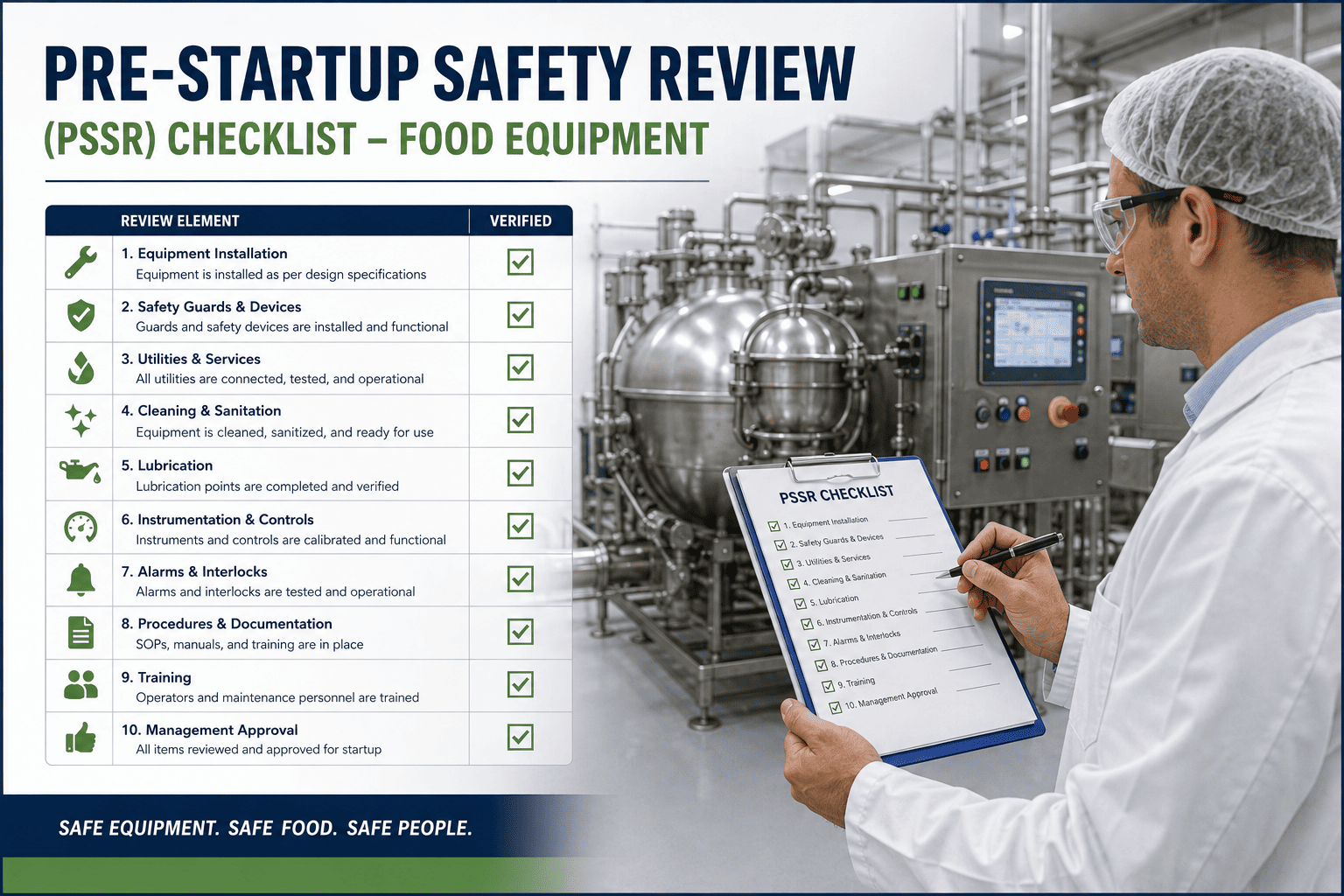
A PSSR checklist for food manufacturing is the structured safety review conducted before any new, modified, or repaired equipment enters production service. Under OSHA's Process Safety Management (PSM) standard (29 CFR 1910.119), a Pre-Startup Safety Review is legally required before introducing highly hazardous chemicals — but food manufacturers apply the same framework more broadly, because commissioning equipment without a verified safety and compliance review is how contamination events, personnel injuries, and costly regulatory findings happen on the first day of operation.
Pre-Startup Safety Review (PSSR) Checklist for Food Manufacturing Equipment
Use this comprehensive PSSR checklist before commissioning any food manufacturing equipment. Prevent contamination events, protect personnel, and build the documentation trail your next audit expects to see.
Oxmaint digitizes your PSSR workflow — QR-scan the equipment, complete the checklist, sign off, and generate the commissioning record that auditors expect to see.
What Is a PSSR Checklist for Food Manufacturing?
A PSSR checklist for food manufacturing is a formal, structured verification conducted before any new, significantly modified, or returned-from-repair piece of production equipment is permitted to start. It confirms that construction or installation is complete per design specifications, safety systems are functional, written operating and maintenance procedures exist, and responsible personnel have been trained — before the equipment ever contacts food, personnel, or utilities at full operating conditions.
In food manufacturing, PSSR applies beyond PSM-regulated operations. Any equipment that handles food product, operates under pressure or high temperature, uses allergens, or requires specific sanitary construction presents startup risk significant enough to warrant systematic pre-commissioning verification. Skipping this review has produced documented consequences: allergen cross-contact events from improperly configured CIP systems, personnel injuries from unguarded moving parts, and product recalls from equipment installed without full food-contact surface verification.
The best PSSR programs are not a one-time paper exercise — they feed directly into the equipment's ongoing asset management record, establishing the baseline maintenance schedule, calibration requirements, and inspection intervals that will govern the asset for its operating life. Oxmaint's inspection management module converts your PSSR checklist into a digital workflow that produces a signed, timestamped commissioning record the moment the last check is verified.
PSSR Checklist: 8 Critical Review Areas for Food Manufacturing Equipment
Each check area below represents a formal verification category. Every item must be confirmed complete before equipment startup authorization is granted. Incomplete items must trigger a documented corrective action — not a verbal promise to address later.
- All mechanical installations complete per engineering drawings and equipment specifications
- Food-contact surfaces verified as appropriate material (316 stainless, food-grade polymers, compliant coatings)
- No dead legs, crevices, or non-drainable sections in product-contact piping or vessels
- All fasteners, fittings, and welds inspected and approved — no improvised connections
- Structural supports, anchoring, and vibration isolation installed per specification
- Equipment accessible for cleaning, inspection, and maintenance without confined-space risk
- Electrical connections installed and verified by licensed electrician; panel labeling complete
- Compressed air supply at correct pressure and quality class (ISO 8573) for food-contact applications
- Water supply verified potable at point of use; backflow prevention installed
- Steam or hot utility at correct pressure; pressure-relief devices installed and tested
- Refrigerant system pressure-tested and leak-checked; food-grade refrigerant verified where applicable
- All utility isolation points (LOTO) identified, labeled, and accessible
- All machine guarding installed per OSHA 1910.212 and 1910.217; no exposed nip points, rotating parts, or cutting hazards
- Emergency stop devices tested and functional at all required locations; clearly labeled
- Lockout/tagout procedures written, verified, and posted at equipment; LOTO hardware available
- Pressure relief valves installed, set to correct pressure, and operationally tested
- Interlocks and safety sensors tested — confirmed to halt equipment on hazardous condition
- Visual and audible warning systems (startup alarms, motion indicators) functioning correctly
- CIP/COP systems validated: correct flow, temperature, and chemical concentration at all surfaces
- Allergen risk assessed; equipment zoning, changeover procedures, and cleaning verification written
- Foreign body risk assessment complete: magnets, screens, sieves, and detection equipment calibrated
- Drains, condensate, and waste collection verified — no cross-contamination pathways identified
- Lubricants verified as food-grade (H1) for all food-zone bearings, chains, and drives
- Equipment registered in food safety plan (HACCP/HARPC); control points assigned and validated
- All monitoring instruments (thermometers, pressure gauges, flow meters, pH sensors) installed and commissioned
- Calibration certificates current and traceable to national standards for all monitoring instruments
- Control system setpoints verified against process specifications; upper and lower alarms set and tested
- Data logging or SCADA connections verified where required; historian capturing correctly
- Metal detection / X-ray equipment sensitivity tests passed with certified test pieces at operating speed
- Calibration schedule added to preventive maintenance programme for each instrument
- Standard Operating Procedure (SOP) for equipment startup, operation, and shutdown written and approved
- Cleaning and Sanitation Procedure (SSP) for equipment written, validated, and available at point of use
- Maintenance procedures (PM tasks, intervals, lubrication map) loaded into CMMS work order system
- Emergency response procedure for equipment failure, spill, or injury posted and communicated
- Equipment manual, engineering drawings, and as-built documentation filed and accessible
- All documentation registered in the asset management record — not in a separate file or email archive
- All operators trained on equipment SOP, startup and shutdown sequence, and emergency stop procedures
- Maintenance technicians trained on LOTO procedure and first-line PM tasks for this equipment
- Food safety training completed for all personnel who will operate, clean, or service the equipment
- Training records documenting competency assessment — not just attendance — on file for each person
- QA personnel trained on CCP monitoring procedures, deviation response, and documentation requirements
- Contact list for emergency maintenance, OEM support, and regulatory response posted at equipment
- All previous checklist categories confirmed complete — no open items without documented corrective action
- PSSR sign-off obtained from: Maintenance Manager, Food Safety/QA Manager, Production Manager, and EHS Representative
- Equipment registered as a named asset in CMMS with installation date, serial number, warranty, and OEM contacts
- First PM work order generated and scheduled in work order management system
- PSSR record (this completed checklist with all sign-offs) filed in asset history — not in a separate binder
- Production startup authorization issued in writing; date and time of first production run recorded
Run this checklist digitally in Oxmaint — every check, every photo, every sign-off stored permanently in the equipment's asset record. Start a free trial or book a demo and we'll configure your food equipment PSSR template.
4 High-Risk PSSR Failures in Food Manufacturing
Oxmaint's digital PSSR workflow prevents all four failures by enforcing completion of every check category before sign-off is possible — book a demo to see the commissioning workflow in action.
How Oxmaint Digitizes the PSSR Process
Paper PSSR vs. Digital PSSR with Oxmaint
| PSSR Element | Paper / Manual Process | Digital — Oxmaint |
|---|---|---|
| Checklist Completion | Paper form; items skipped; no photo attachment | Digital with mandatory photo capture; cannot skip items |
| Failed Item Response | Verbal or email; tracked informally; often unresolved | Auto-generated work order; tracked to verified completion |
| Multi-Party Sign-Off | Paper routing; delays common; signatures lost | Digital sign-off per role; timestamped; permanent record |
| PM Schedule Activation | Loaded separately, often after first breakdown | Auto-activated on PSSR completion; no gap between startup and PM |
| Audit Record Access | Filed in binder; often not found; content incomplete | Permanently attached to asset record; instant retrieval |
| Commissioning Timeline | 3–5 week approval loops; startup delayed by missing signatures | Real-time approval routing; commissioning accelerated by 2–3 weeks |
PSSR Results: What Structured Commissioning Delivers
Calculate your commissioning ROI with the Oxmaint ROI Calculator or book a demo to see the PSSR workflow built for food manufacturing.
Frequently Asked Questions: PSSR for Food Manufacturing Equipment
What triggers a PSSR requirement in food manufacturing — is it only for new equipment?
Who should sign off on a PSSR checklist for food manufacturing equipment?
How does PSSR documentation fit into FDA and GFSI audit requirements for food plants?
Can Oxmaint customize a PSSR checklist template for different types of food manufacturing equipment?
Commission Equipment with Confidence — Not Paperwork Chaos
Oxmaint digitizes your PSSR checklist for food manufacturing equipment — enforcing every check, capturing photo evidence, routing sign-offs, and activating the PM schedule the moment the final authorization is granted. Build your commissioning record correctly the first time, every time.