Packaging Equipment Maintenance Checklist for Food Manufacturing
By Josh Turley on March 25, 2026
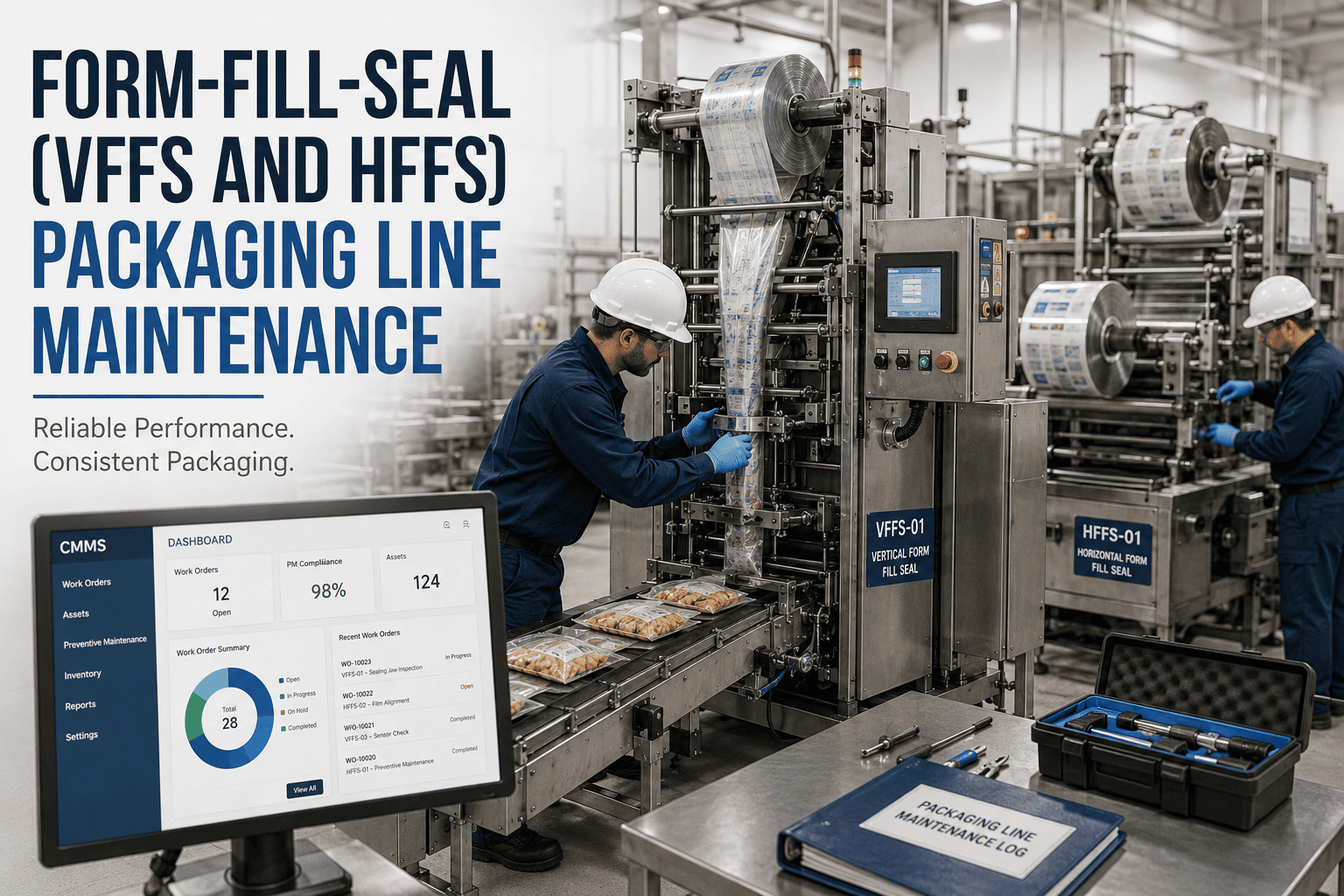
Packaging line failures in food manufacturing don't send advance warnings. A worn form-fill-seal jaw, a misfiring labeler, or an uncalibrated shrink tunnel quietly erodes fill accuracy, label compliance, and throughput — long before an actual breakdown halts the line. Facilities that run structured packaging equipment PM programs report significantly fewer unplanned stoppages, reduced product waste from seal failures, and audit-ready documentation for food safety regulatory reviews. This checklist covers every critical packaging equipment maintenance category — FFS machines, case packers, labelers, shrink wrappers, stretch wrappers, and palletizers — with frequency, priority level, and responsible party defined for every task. Sign up free to load this checklist directly into your packaging line PM schedule.
Automate Your Packaging Equipment Maintenance Program
Schedule PM tasks, assign technicians, and generate audit-ready maintenance records across every packaging line and machine type — from FFS to palletizers.
Reduction in unplanned packaging line stoppages with structured PM programs
6–10 yrs
Average lifespan extension for packaging machinery with documented preventive maintenance
25%
Reduction in packaging material waste from seal and fill accuracy maintenance
FSMA/SQF
Compliance audit trail requirements met by complete packaging equipment maintenance records
Checklist 1 — Daily Packaging Line Pre- and Post-Operation Inspection
Verify machine setpoints and product changeover parameters before first run
Confirm all speed, temperature, fill volume, and seal pressure parameters match the validated production recipe for the scheduled product; incorrect changeover settings are the leading cause of the first-run seal failures and label misregistration events.
CriticalDaily (Pre-op)Line Operator
Inspect all guarding, interlocks, and safety barriers for correct position and function
Confirm every safety guard is in place and interlocked before startup; missing or defeated machine guards on packaging lines are a direct OSHA citation risk and represent the primary injury exposure on high-speed automated equipment.
CriticalDaily (Pre-op)Line Operator / Maintenance
Check lubrication levels on all machine oilers, chain lubers, and grease points
Verify automatic oiler reservoirs are filled with the correct food-grade NSF H1 lubricant grade and that all manual grease points were serviced per the lubrication schedule; dry bearings and chains are the primary cause of noise, vibration, and premature component failure on packaging equipment.
HighDaily (Pre-op)Maintenance Tech
Confirm compressed air supply pressure is within OEM operating range at each machine
Read line pressure at the point-of-use regulator for each machine; pressure below the OEM minimum causes actuator timing faults, weak seal jaw clamping force, and pneumatic reject system misfires that allow non-conforming product to pass downstream.
CriticalDaily (Pre-op)Line Operator
Run first-article verification and retain sample from the first production lot
Inspect the first package produced per shift for correct fill weight, seal integrity, label placement, and print quality; retain the first-article sample as evidence of startup conformance to the production specification.
CriticalDaily (Pre-op)QA / Line Operator
Log all machine faults, stoppages, and alarm events with timestamps and corrective actions
Record every machine fault code, stop event, and operator-initiated hold with the time, machine ID, and action taken; recurring fault patterns are leading indicators of wear that predict unplanned breakdowns within predictable timeframes. Sign up free to automate fault logging and work order generation.
OngoingShift-longLine Operator
Remove product debris, film scrap, and label waste from all machine zones post-run
Clear all product residue, packaging material offcuts, and adhesive buildup from conveyors, seal stations, and label applicator heads; accumulated debris causes sensor false-triggers, jam events, and cross-contamination risk on multi-product lines.
HighDaily (Post-op)Sanitation / Operator
Checklist 2 — Form Fill Seal (FFS) Machine Maintenance
Inspect horizontal and vertical seal jaw surfaces for wear, pitting, and coating damage
Examine jaw contact surfaces under magnification for erosion, non-stick coating delamination, or surface irregularities; a compromised seal jaw surface produces inconsistent seal strength across the jaw width, creating weak seals that fail during distribution handling.
CriticalDailyMaintenance Tech
Calibrate seal jaw temperature against validated production setpoint using a contact thermometer
Measure actual jaw surface temperature across the full jaw width and compare to the validated seal window; temperature deviation greater than ±3°C from setpoint produces seals outside the validated strength range and requires controller recalibration or heater replacement.
CriticalWeeklyMaintenance Tech / QA
Verify film web tension and tracking alignment through all forming stations
Check film roll tension at the unwind station and confirm the web tracks centered through all forming guides without lateral drift; film tracking errors cause diagonal seals, side-gusset collapse, and misregistered print that fails label compliance inspection.
CriticalWeeklyMaintenance Tech
Inspect and clean fill tube, dosing auger, and product contact surfaces
Disassemble fill tube assemblies and inspect for product buildup, scoring, or corrosion at contact points; product residue in fill tubes is a microbiological contamination risk and causes fill weight variation that triggers net content non-conformances.
Check cut-off knife blade sharpness and alignment on cross-seal stations
Test knife cut quality on a film sample and inspect blade edge condition; a dull or misaligned cut-off knife produces ragged bag edges, film tail attachment, and particulate contamination from shredded film material entering the package.
HighWeeklyMaintenance Tech
Perform seal strength pull test on production samples against validated specification
Conduct destructive peel or burst testing on sampled sealed packages using a calibrated tensile tester; seal strength below the validated minimum indicates a jaw temperature drift, dwell time error, or jaw pressure loss requiring immediate correction before additional production.
CriticalPer QA sampling planQA Tech
Checklist 3 — Case Packer and Cartoner Maintenance
Inspect case erector suction cups for cracks, deformation, and vacuum retention
Check each suction cup for cracking, lip deformation, and vacuum hold at operating pressure; a suction cup that fails to maintain vacuum drops the case blank mid-erect, causing a machine jam that stops the entire downstream line.
CriticalDailyMaintenance Tech
Check hot melt glue system temperature, tank level, and nozzle condition
Verify hot melt tank temperature is within the validated application range and inspect nozzle orifices for char buildup or partial blockage; incorrect glue temperature produces adhesive that either strings and contaminates product or fails to bond, creating open-flap cases that reach retail.
CriticalDailyLine Operator / Maintenance
Verify product grouping and lane guide alignment for the current pack pattern
Confirm lane guides, pusher plates, and product grouping fingers are positioned to the correct dimension for the current SKU; a lane guide set to a prior product creates incorrect count groupings that result in short-count complaints or product damage from compression.
HighPer changeoverLine Operator
Lubricate case conveyor chain, cam followers, and guide rail wear strips
Apply food-grade lubricant to case conveyor drive chain and confirm cam follower bearings rotate freely; dry cam followers on case folding mechanisms cause impact noise, erratic flap folding, and accelerate lug wear that changes case timing.
HighWeeklyMaintenance Tech
Inspect cartoner mandrel, tuck-in fingers, and flap compression rails for wear
Check mandrel surface condition and confirm tuck-in finger engagement geometry is within tolerance; worn mandrel surfaces or bent tuck-in fingers produce cartons with open end-flaps or cracked end-panel scores that fail retail presentation standards.
HighMonthlyMaintenance Tech
Clean hot melt glue tank, hose, and nozzle manifold to remove char and degraded adhesive
Flush hot melt system with a compatible purge compound and remove all charred adhesive from tank walls and nozzle manifolds; char buildup contaminates fresh adhesive, blocks nozzle orifices, and introduces a potential foreign body risk in close-proximity primary packaging operations.
HighMonthlyMaintenance Tech
Checklist 4 — Labeling Machine Maintenance
Verify label registration accuracy and placement position on a production sample
Measure label position against the validated placement specification on five consecutive units; placement deviation greater than ±1mm from the validated position constitutes a label non-conformance under FDA 21 CFR Part 101 labeling requirements for food products.
CriticalDaily (Pre-op)Line Operator / QA
Inspect label applicator pad, wipe-down brush, and tamp mechanism for wear
Check applicator pad surface for compressed areas, adhesive buildup, or fraying; a worn applicator pad delivers uneven tamp pressure across the label face, producing bubbles, edge lift, and label adhesion failures that cause retail label complaints.
HighWeeklyMaintenance Tech
Clean label sensor eye and print-and-apply sensor optics
Wipe label gap sensor optics with a lint-free cloth; adhesive contamination on sensor faces causes false label-present readings that advance the web without a label applied, producing unlabeled packages that must be recalled or reworked.
CriticalDailyLine Operator
Check print head pressure and thermal print head condition on thermal transfer labelers
Verify printhead pressure setting against OEM specification and inspect the thermal print element strip for burned-out dots; a failed print element produces white voids in barcodes and lot code text that fail scanner verification and regulatory lot traceability requirements.
CriticalWeeklyMaintenance Tech
Verify barcode and lot code print quality against minimum GS1 scan verification grade
Scan printed barcodes with a GS1-compliant verifier and confirm grade C or better on all codes; barcodes grading below C produce unacceptable scan rates at retail checkout and trigger chargebacks from major retail trading partners.
CriticalPer QA sampling planQA Tech
Inspect label rewind and unwind spindle tension and core locking mechanism
Check unwind brake tension and confirm core locking chuck engages the label roll core without slippage; a loose core causes web tension variation that produces inconsistent label spacing and registration drift across the production run. Book a demo to see how Oxmaint manages labeling PM schedules.
HighMonthlyMaintenance Tech
Checklist 5 — Shrink Wrapper and Shrink Tunnel Maintenance
Verify shrink tunnel temperature profile against validated production setpoint by zone
Measure tunnel air temperature at each zone with a calibrated probe and compare to the validated shrink window; a zone temperature below setpoint produces inadequate shrink with film scalloping, while over-temperature causes film burn-through or product label damage.
CriticalDaily (Pre-op)Line Operator / Maintenance
Inspect tunnel conveyor belt for film residue buildup, wire damage, and tracking alignment
Run the belt and inspect full length for melted film accumulation on mesh wires and check lateral tracking; film-coated belt mesh transfers contamination to product bottom surfaces and creates uneven heat distribution through the belt into the package base.
HighDailyMaintenance Tech
Check seal bar temperature, jaw pressure, and cut-off wire condition on L-bar sealers
Verify seal bar surface temperature uniformity and inspect the cut-off wire for breaks or localized hot spots; a failed cut-off wire segment produces uncut film tails that jam the tunnel conveyor and require a full line stoppage to clear.
CriticalDailyMaintenance Tech
Inspect tunnel blower motor, fan blades, and airflow baffles for obstruction and wear
Check tunnel blower motor current draw and inspect fan blades for film wrap or impact damage; reduced tunnel airflow creates temperature stratification inside the tunnel that produces inconsistent shrink results between top and bottom package surfaces.
HighMonthlyMaintenance Tech
Calibrate tunnel conveyor belt speed against validated production dwell time setpoint
Measure belt speed with a calibrated tachometer and compare to the validated shrink dwell time; a speed deviation of more than 2% changes product time-in-tunnel and shifts the shrink result outside the validated appearance and film integrity specification.
CriticalWeeklyMaintenance Tech / QA
Checklist 6 — Stretch Wrapper Maintenance
Inspect film carriage pre-stretch rollers for wear, slippage, and drive belt condition
Check pre-stretch roller surfaces for rubber wear and confirm the roller drive belt maintains correct tension; worn pre-stretch rollers reduce film elongation efficiency, increasing film consumption per pallet and reducing load containment force below the validated transport specification.
HighWeeklyMaintenance Tech
Verify turntable rotation speed and load containment force against pallet wrap program
Confirm turntable speed, wrap force, and overlap percentage match the validated wrap program for the current pallet configuration; incorrect wrap parameters produce under-contained loads that shift during transport and cause product damage claims.
CriticalWeeklyMaintenance Tech / QA
Lubricate turntable ring gear, mast drive chain, and carriage guide rails
Apply food-safe lubricant to the turntable ring gear teeth and mast vertical guide rails; dry mast guide rails cause jerky carriage travel that creates uneven film wrap tension bands and increases mechanical wear on the mast drive components.
HighWeeklyMaintenance Tech
Inspect pallet height sensor and load profile detection system for correct function
Test height sensor response with a reference pallet and confirm the wrap cycle terminates at the correct pallet top dimension; a misreading height sensor wraps above the load, wastes film, or terminates the wrap cycle short of the load top, leaving the top layer unsecured.
HighMonthlyMaintenance Tech
Checklist 7 — Palletizer Maintenance (Robotic and Conventional)
Inspect robotic arm end-of-arm tooling (EOAT) for suction cup condition and vacuum integrity
Check all suction cup lips for cracking, collapse, or adhesive contamination and verify full vacuum draw at operating pressure; a suction cup leak on a robotic palletizer causes mid-transfer drop events that damage product and create a case debris hazard on the palletizing cell floor.
CriticalDailyMaintenance Tech
Verify robot joint calibration and TCP (tool center point) position accuracy
Run a TCP calibration check against the reference fixture and confirm all joint positions are within the robot OEM tolerance; TCP drift causes layer pattern misalignment that destabilizes the pallet stack and exceeds pallet pattern layer count tolerances.
CriticalWeeklyRobotics Tech
Check infeed conveyor accumulation zone for belt wear, guide alignment, and sensor function
Inspect infeed accumulation conveyor belt for wear tracking and confirm all case presence sensors read correctly across the full accumulation zone; a misread case presence sensor causes the palletizer to attempt a layer pick with incomplete case count, jamming the EOAT against a partial layer.
HighDailyMaintenance Tech
Lubricate robot joint gearboxes and check gearbox oil levels per OEM schedule
Verify gearbox oil level at each robot joint axis and add or replace oil per the OEM lubrication interval; operating a robot joint gearbox below minimum oil level accelerates gear and bearing wear and voids the robot OEM warranty on the affected axis.
HighPer OEM intervalRobotics Tech
Test all safety light curtains, area scanners, and zone entry interlocks for correct function
Break the light curtain beam and confirm robot motion stops within the OEM-specified response time; a palletizer safety system that fails to stop robot motion on zone entry is a Category 3 machine safety non-conformance under ISO 13849 and requires immediate production shutdown. Sign up free to schedule weekly safety interlock tests automatically.
CriticalWeeklyMaintenance Tech / Safety
Checklist 8 — Preventive Maintenance Schedule: Monthly, Quarterly, and Annual
Perform full packaging line deep clean with equipment disassembly per sanitation SOP
Disassemble all product contact zones, seal stations, fill heads, and conveyor systems for full sanitation; incomplete cleaning of product contact surfaces on packaging equipment is one of the most common root causes cited in FDA warning letters for food manufacturers.
HighMonthlySanitation / Maintenance
Review packaging machine OEE data and identify top recurring fault causes
Analyze machine OEE availability, performance, and quality data from the CMMS against the prior period baseline; fault events appearing in the top-5 by frequency or duration are the primary PM priority targets for the next maintenance cycle.
CriticalMonthlyMaintenance Manager / QA
Perform thermographic scan of packaging machine electrical panels and drive enclosures
Scan all VFD enclosures, servo amplifier cabinets, and terminal strip connections using a calibrated IR camera; thermal anomalies greater than 15°C above ambient on electrical connections predict imminent failure events that take high-speed packaging lines offline mid-production run.
HighQuarterlyReliability Tech
Audit packaging machine calibration records against regulatory and customer requirements
Confirm all weigh scales, fill volumeters, seal temperature controllers, and vision system calibrations are current and traceable; expired calibration records on packaging equipment are a direct finding in SQF Level 2 and BRC Issue 9 audits with immediate non-conformance status.
CriticalQuarterlyQA Manager
Review and update critical spare parts inventory for 72-hour emergency coverage
Confirm stock levels for seal jaws, suction cups, print heads, conveyor belts, hot melt nozzles, drive chains, and robot EOAT components; a 4-hour repair that turns into a 4-day wait for a long-lead component is the most preventable form of extended packaging line downtime.
MediumQuarterlyMaintenance Manager
Conduct annual packaging line re-commissioning and production run validation
Execute a full line re-commissioning including all calibration verifications, machine speed trials, seal integrity testing, and a documented production run at rated capacity; annual re-commissioning confirms the packaging line continues to meet its validated production specification across all SKUs.
CriticalAnnualQA Manager / Engineering
Update CMMS asset records with all PM completions, calibration data, and component replacements
Record all PM task completions, calibration as-found and as-left values, and part replacement history in the CMMS immediately after each event; complete packaging equipment maintenance records are the primary audit evidence for FSMA Preventive Controls, SQF, BRC, and customer quality system audits. Book a demo to see Oxmaint's audit-ready PM record system in action.
CriticalAfter every PMMaintenance Tech
Packaging Equipment Maintenance Investment Analysis: Costs vs. Returns
A structured packaging equipment PM program protects fill accuracy, label compliance, and line throughput — while eliminating the regulatory and financial exposure that follows a seal failure, mislabeling event, or foreign body incident on a food packaging line.
Maintenance Investment
Annual Cost
Annual Savings / Risk Avoided
Payback
FFS Seal Jaw and Temperature PM Program
$750 per line
$24,000 avoided seal failure product hold and rework costs
Under 2 weeks
Labeling Machine Calibration Program
$600 per line
$19,000 avoided label non-conformance and retail chargeback exposure
Under 2 weeks
Case Packer Hot Melt and Erector PM
$800 per line
$26,000 avoided open-flap case complaints and customer return costs
Under 3 weeks
Shrink Tunnel Temperature and Belt PM
$700 per line
$21,000 avoided film waste and appearance non-conformance write-offs
Under 3 weeks
Palletizer Safety System and Robotic PM
$1,100 per cell
$48,000 avoided OSHA citation risk and robot repair costs from drop events
Under 2 weeks
CMMS-Automated Packaging PM Scheduling
$1,200 per facility
$58,000 reduction in total reactive packaging maintenance spend per year
Under 3 weeks
Full Annual Packaging Line Re-Commissioning
$4,000 per line
$88,000 extended equipment life and avoided capital replacement costs
Under 6 weeks
A complete packaging equipment PM program including CMMS automation delivers an average 10–14x ROI within 18 months. FFS seal jaw programs and labeling calibration routines pay back within 2 weeks on a single prevented product hold or retail chargeback event.
Automate Every Checklist Task Across Your Entire Packaging Line
Oxmaint maps every packaging equipment PM task to your specific machines, generates work orders at the correct frequency, captures calibration evidence, and produces FSMA, SQF, and BRC-compliant audit documentation — eliminating paper tracking and missed PM intervals across your entire facility.
What does a packaging equipment maintenance checklist for food manufacturing cover?
A complete packaging equipment maintenance checklist for food manufacturing covers daily pre- and post-operation inspection, FFS seal jaw temperature calibration and seal strength testing, case packer hot melt system checks, labeling machine placement verification and print quality grading, shrink tunnel temperature profile verification, stretch wrapper containment force checks, palletizer EOAT inspection and robot calibration, and full preventive maintenance cycles at monthly, quarterly, and annual intervals — each task with frequency, priority, and a defined responsible party.
How often should FFS seal jaw temperature be calibrated?
FFS seal jaw surface temperature should be measured and compared against the validated production setpoint weekly using a calibrated contact thermometer. Any zone deviation greater than ±3°C requires controller recalibration or heater element replacement before further production. Seal strength pull testing on production samples should be performed per the QA sampling plan as continuous verification of seal system performance between calibration events.
What maintenance tasks are most critical for labeling machines in food manufacturing?
The highest-priority labeling machine maintenance tasks in food manufacturing are label placement position verification against the FDA-regulated specification, label sensor optic cleaning to prevent unlabeled package pass-through, print head condition inspection on thermal transfer labelers to maintain barcode integrity, and GS1 barcode scan verification grading. All calibration records must be documented with as-found and as-left values to satisfy SQF and BRC equipment calibration requirements.
How frequently should palletizer safety systems be tested?
Palletizer safety light curtains, area scanners, and zone entry interlocks must be tested weekly to confirm robot motion stops within the OEM-specified response time on zone entry. Any safety system that fails to achieve the required stop response must trigger an immediate production shutdown and corrective maintenance before the cell is returned to service. Safety system test results must be documented in the CMMS as required evidence for machine safety compliance audits.
Can a CMMS manage a full food packaging equipment PM program?
Yes. A food manufacturing CMMS like Oxmaint maps every task on this checklist to specific packaging assets by machine type, line, and production area, auto-generates work orders at the correct PM frequency, captures calibration evidence and inspection records, and produces FSMA, SQF, and BRC-compliant maintenance documentation — eliminating paper-based PM tracking and ensuring no PM interval is missed across a multi-line facility.
document.querySelectorAll('.pk-chk input[type="checkbox"]').forEach(function(cb){
cb.addEventListener('change',function(){
var title=this.closest('.pk-cl-item').querySelector('.pk-cl-title');
if(title) title.classList.toggle('pk-struck',this.checked);
});
});