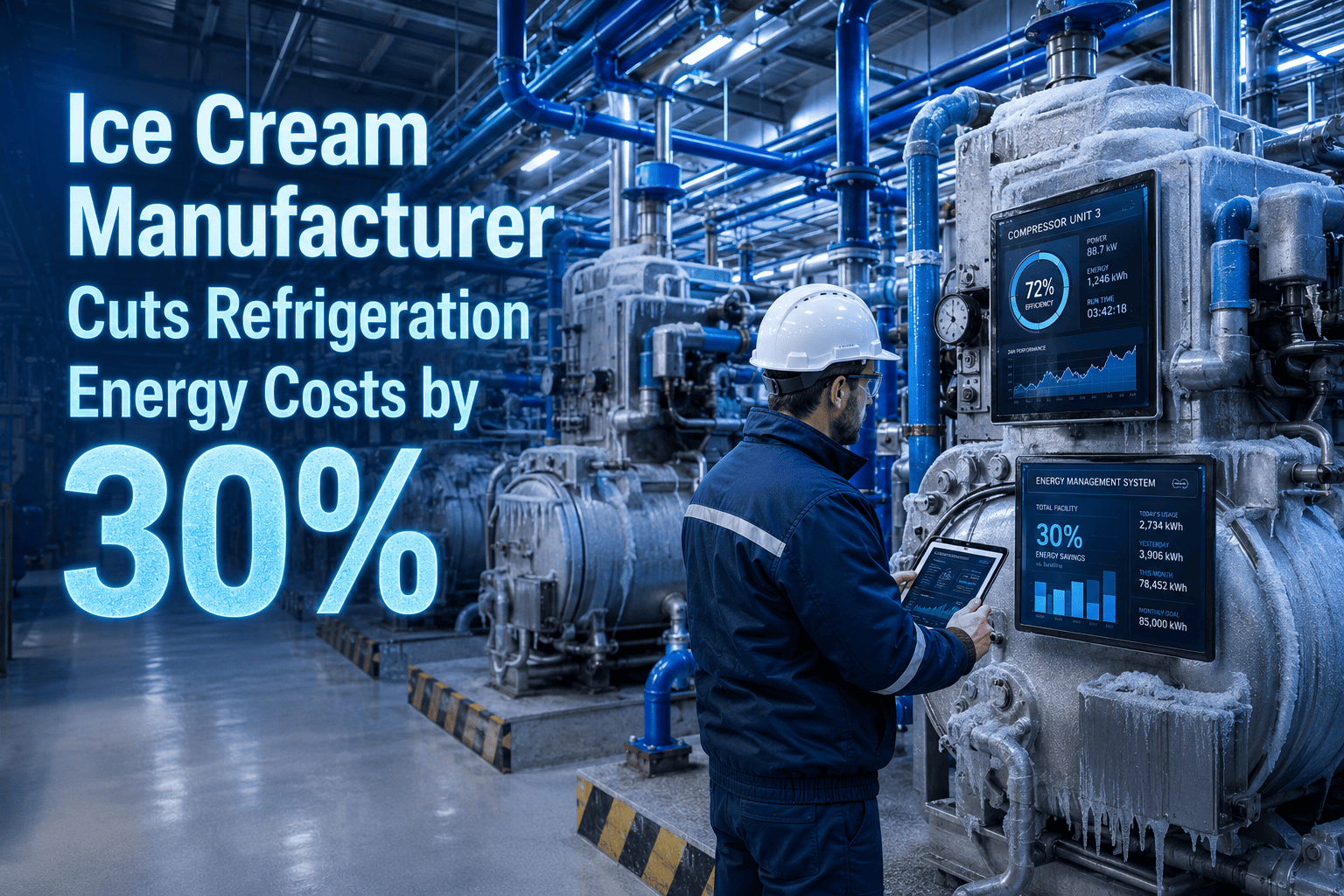
Ice Cream Manufacturer Reduces Refrigeration Energy Costs by 30%
By Josh Turley on May 27, 2026
Refrigeration accounts for 40 to 60 percent of total energy spend at a typical ice cream manufacturing facility — and most of that cost runs invisibly. Compressors cycling harder than they should because a condenser coil hasn't been cleaned in six months. Evaporator fans running at full load in a hardening tunnel that's actually holding temperature fine. A blast freezer door seal that's been leaking cold air for three weeks while the compressor compensates, silently running the electricity bill up. For a regional ice cream producer running four hardening tunnels, two blast freezers, a continuous freezer line, and a spiral blast system, refrigeration energy had climbed 18% year-over-year for three consecutive years with no clear cause. After deploying OxMaint's IoT-CMMS integration across all refrigeration assets, the facility cut total refrigeration energy costs by 30% in 11 months — not by replacing equipment, but by finally being able to see what the existing equipment was actually doing. This is the story of how that visibility translated into action, and how the same framework applies to any dairy or frozen food operation where refrigeration is the single largest controllable cost on the utility bill with OxMaint CMMS.
Ice Cream Manufacturing · IoT-CMMS · Energy Optimisation · Case Study
Ice Cream Manufacturer Cuts Refrigeration Energy Costs by 30% with IoT-CMMS
A regional ice cream producer watched refrigeration energy climb 18% annually for three straight years. OxMaint's IoT-CMMS integration gave them real-time visibility across every compressor, condenser, and evaporator — and the 30% energy reduction followed within 11 months.
No heavy implementation · Live in days, not months · Works across multi-site cold chains
Refrigeration Energy — Before vs After OxMaint
Hardening Tunnels
88%
Hardening Tunnels
61%
Blast Freezers
92%
Blast Freezers
66%
Spiral Blast
79%
Spiral Blast
55%
BeforeAfter OxMaint% of rated capacity load
30%
Refrigeration energy cost reduction in 11 months — no equipment replacement required
$410K
Annual energy savings recovered from compressor efficiency and defrost optimisation
18%
Year-over-year energy cost growth that prompted the OxMaint deployment
4.8×
Higher cost of reactive compressor failure versus planned condenser cleaning intervention
The Problem
Why the Energy Bill Kept Climbing and Nobody Knew Why
The maintenance team at the facility were not incompetent — they were operating without data. The refrigeration plant had a SCADA system that showed current temperature in each tunnel and freezer, but it showed nothing about how hard the compressor was working to hold that temperature. A tunnel sitting at minus 28°C looks identical on a temperature dashboard whether it's being held efficiently with a clean condenser at 60% load, or desperately held at the same temperature with a fouled condenser and a door seal leak running the compressor at 94% load. The cost difference between those two scenarios is enormous. The first step OxMaint took was not fixing anything — it was making the invisible visible. Compressor current draw, suction pressure, discharge pressure, condenser fan amps, and defrost cycle duration all started flowing into the OxMaint asset records, and for the first time the facility had a picture of what their refrigeration plant was actually doing. What they found was not comfortable reading. Start a free trial to begin the same visibility exercise on your own refrigeration plant, or book a demo and we will walk through what baseline data collection looks like on your specific equipment.
What the Data Revealed
The 6 Energy Waste Sources OxMaint Found in the First 30 Days
Thirty days of baseline data collection across the refrigeration assets surfaced six recurring waste patterns — none of them visible on the temperature SCADA dashboard, all of them directly addressable with structured maintenance interventions.
01
Fouled Condenser Coils
High Impact
Discharge pressure on three compressors running 12-18% above baseline — consistent with condenser coil fouling. A single cleaning event per compressor reduced discharge pressure and cut those units' energy draw by an average of 9%.
02
Door Seal Leaks
High Impact
Compressor runtime analysis on blast freezer 2 showed 22% longer duty cycles than blast freezer 1 — identical spec, adjacent location. Thermal camera inspection found three failed door seals. Replacement cost: $340. Annual energy saving: $28,000.
03
Over-Frequency Defrost Cycles
Medium Impact
Hardening tunnel 3 was running defrost every 4 hours on a fixed timer regardless of actual frost load. IoT evaporator sensors showed the coil only needed defrost every 7-8 hours under typical production. Extending the cycle cut associated energy load by 14%.
04
Compressor Valve Wear
High Impact
Suction pressure on the spiral blast compressor trending 8% above design curve for six weeks — consistent with discharge valve wear. A planned valve replacement at scheduled downtime prevented a full compressor failure and recovered the efficiency loss.
05
Evaporator Fan Over-Run
Medium Impact
Four evaporator fans in hardening tunnel 1 running at full speed during low-production periods when the tunnel was at stable temperature. OxMaint work orders restructured fan scheduling around actual production load — 11% energy reduction on that tunnel.
06
Refrigerant Charge Drift
Medium Impact
Subcooling data on the continuous freezer compressor showed gradual refrigerant charge reduction over eight months — a slow leak invisible to temperature monitoring. Recharge and leak seal restored full efficiency and prevented eventual compressor damage.
Technology Layer
How OxMaint Connects IoT Sensors to Maintenance Action
The energy savings came from action, not monitoring. OxMaint takes sensor data from every refrigeration asset and converts threshold deviations into maintenance work orders automatically — so the 9% compressor efficiency drop from a fouled condenser becomes a cleaning work order, not a line item on a monthly energy report that arrives after the damage is done. Book a demo to see how OxMaint's IoT integration maps to your specific refrigeration plant.
IoT Sensors
Pressure, current, temperature, vibration, and runtime sensors on every compressor, condenser, evaporator, and freezer door
OxMaint Asset Engine
Sensor data streams into asset condition records. Deviation from baseline triggers threshold rule evaluation in real time
Work Order Created
Threshold breach generates a priority work order — condenser clean, door seal inspect, valve check — routed to the right technician within seconds
Energy Recovered
Maintenance action restores compressor efficiency. Energy reduction confirmed against baseline. OxMaint logs the saving against the asset and work order
Before vs After
Reactive Refrigeration Management vs OxMaint IoT-CMMS
Operating Metric
Before OxMaint
After 11 Months on OxMaint
Refrigeration energy cost (annual)
Baseline + 18% YoY growth
30% below baseline — growth reversed
Condenser coil cleaning frequency
Calendar-based, often skipped
Condition-based — triggered by discharge pressure rise
Compressor valve wear detection
Only on complete failure
Suction pressure trend — 6 weeks in advance
Defrost cycle optimisation
Fixed timer — 4 hours regardless of load
IoT frost sensor — 7-8 hours at actual need
Door seal failure detection
Visible damage or tenant complaint
Compressor duty-cycle comparison — days in advance
Refrigerant charge monitoring
Annual service check only
Continuous subcooling data — drift flagged within weeks
Reactive emergency repair ratio
71% of maintenance spend
18% of maintenance spend
Annual utility savings confirmed
None measurable
$410K — tracked per asset per work order
Financial Outcomes
Where the $410K in Annual Savings Came From
The energy savings were not evenly distributed — they came from a handful of specific, traceable interventions. OxMaint tracked every saving back to the work order that produced it, giving the operations director a line-item justification for continued investment. Start a free trial to begin building the same asset-level savings record on your facility.
$182K
Condenser Cleaning Programme
Three compressors cleaned on a condition-based schedule — average 9% efficiency recovery per unit, sustained across the full year.
$96K
Defrost Cycle Optimisation
IoT frost sensors on hardening tunnels extended defrost intervals from 4 hours to 7-8 hours — 14% energy load reduction on affected tunnels.
$78K
Door Seal Replacement
Three blast freezer door seal failures identified via compressor duty-cycle comparison. Total parts cost $340. Annual energy saving $78,000.
$54K
Compressor Valve Maintenance
Spiral blast compressor valve replaced at planned downtime — six weeks ahead of likely failure — recovering 8% efficiency and avoiding an unplanned shutdown.
"
We had been running the same refrigeration plant for eleven years. We thought we knew it well. OxMaint showed us that we knew what temperature it was holding — we had no idea what it was costing to hold it. Those are not the same thing.
Operations Director · Regional Ice Cream Producer · 2025
See what your refrigeration plant is actually costing
OxMaint connects IoT sensors to structured maintenance work orders — giving you compressor efficiency, defrost performance, and door seal integrity in real time across every cold asset.
IoT-CMMS for Ice Cream and Frozen Food Refrigeration
01
What IoT sensors does OxMaint use to monitor refrigeration compressors?
OxMaint integrates with current transformers for compressor amp draw, pressure transducers for suction and discharge pressure, vibration sensors for bearing wear detection, and temperature sensors for subcooling and superheat measurement. Sensors from major manufacturers including Emerson, Danfoss, and IoT-native vendors connect via standard API and Modbus connections directly into OxMaint asset condition records.
02
How does OxMaint detect a door seal failure before it shows up as a temperature problem?
OxMaint compares compressor duty cycles across identical or similar refrigeration units running in similar conditions. When one compressor runs 15 to 25% longer duty cycles than its paired unit without a corresponding temperature difference, the system flags it as a probable infiltration event — typically a door seal, gasket failure, or structural air leak — and generates an inspection work order before energy cost has materially increased.
03
Can OxMaint integrate with our existing refrigeration SCADA system?
Yes. OxMaint integrates with major refrigeration SCADA and BMS platforms via OPC-UA, BACnet, Modbus, and API connections. Temperature, pressure, and runtime data from your existing SCADA feeds directly into OxMaint asset records alongside IoT sensor data — eliminating manual data entry and giving maintenance teams the full picture in one dashboard.
04
How quickly does OxMaint deploy at an ice cream or frozen food facility?
Most frozen food manufacturers complete the asset hierarchy build and initial IoT sensor connections in two to three weeks. Baseline data collection runs for the first four weeks without changing any maintenance procedures — the data itself identifies where the quick wins are. Full condition-based maintenance programme typically stabilises within three months, with energy savings confirmed against the baseline within the first quarter.
Your refrigeration plant. Your 30%.
Stop Paying for Refrigeration Inefficiency You Cannot See
OxMaint connects IoT sensors on every compressor, condenser, evaporator, and freezer door to structured maintenance work orders — catching efficiency losses weeks before they compound into serious energy bills. No equipment replacement. No heavy implementation. Live in days, not months.