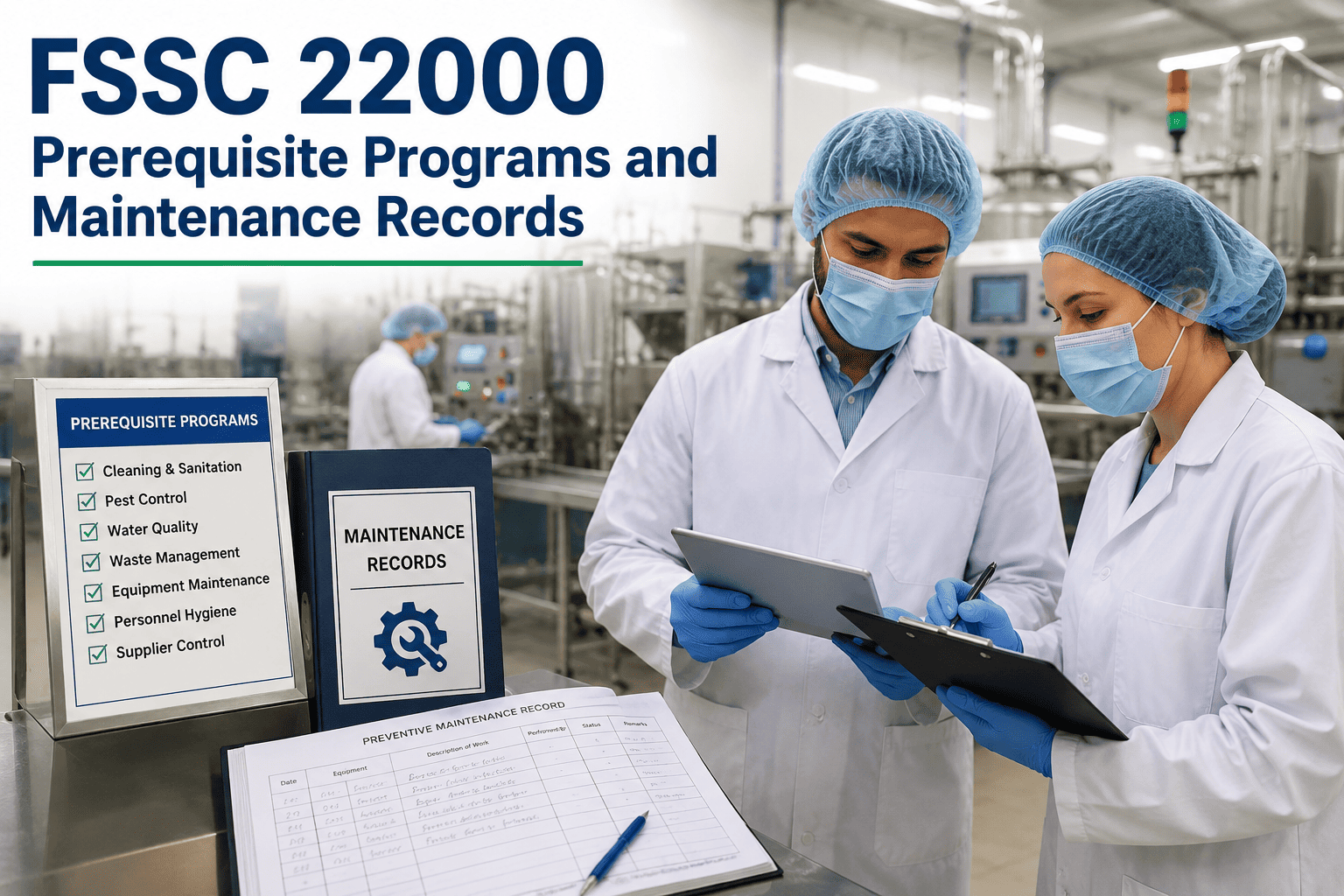
A snack food manufacturer in Germany lost a $2.4 million retailer contract for ninety days after failing its FSSC 22000 surveillance audit. The equipment itself was fine — fourteen packaging line components had actually been serviced on time. What failed was the paperwork: undated logs, missing technician signatures, no traceable link between the PM schedule and the work performed. The plant spent 340 hours rebuilding records that should have already existed. This is not a rare story. Most FSSC 22000 maintenance nonconformities trace back to documentation gaps, not broken machines. See how OxMaint builds FSSC 22000-ready maintenance records automatically, or book a demo to walk through your plant's compliance gaps.
HACCP Compliance / FSSC 22000
FSSC 22000 Prerequisite Programs and Maintenance Records: What Auditors Actually Trace
FSSC 22000 does not evaluate your maintenance programme with a single checklist. It traces one continuous thread — from the PM schedule, through execution and sign-off, to calibration logs and management review — and a broken link anywhere in that chain becomes a finding.
72%
of FSSC maintenance nonconformities come from documentation gaps, not equipment failure
150+
countries where FSSC 22000 is recognised across the GFSI-benchmarked supply chain
14
additional V6 requirements sitting above ISO 22000, including equipment management
3 yrs
certificate validity, with an annual surveillance audit reviewing your records each cycle
Three Layers, One Audit Trail
FSSC 22000 is not one document — it is three layers stacked on top of each other, and maintenance sits inside all three at once. An auditor moves between them without warning, which is exactly why gaps go unnoticed until certification is on the line.
Layer 1
ISO 22000:2018
The food safety management system backbone. Clause 9.3 requires maintenance trend data — breakdown frequency, PM completion, open corrective actions — as a formal input to management review, not a side conversation.
Layer 2
ISO/TS 22002-1 PRPs
The sector-specific prerequisite programme for food manufacturing. It defines equipment maintenance, calibration, and lubricant management as core hygiene conditions the auditor checks against physical assets.
Layer 3
14 FSSC Additional Requirements
Equipment Management became its own explicit V6 clause, separate from the PRP maintenance section. Auditors now expect a measurable, managed programme with defined KPIs — not just proof that tasks happened.
V6 remains the active scheme. V7 publishes in May 2026 with a twelve-month transition window, so facilities certified under V6 keep operating on it well into 2027 while gap-analysing against the updated PRP series.
Where the Six Threads of the Audit Actually Point
An FSSC auditor does not stop at a PM schedule. They follow it forward through six connected checkpoints, and a break at any single point produces the same result — a nonconformity.
1
PM Schedule
Risk-based, not just calendar-based, for every food-contact asset
2
Execution Record
Dated, signed, tied to the technician who performed the work
3
Calibration Log
Metal detectors, thermometers, scales, and pH meters verified on interval
4
Temporary Repair
Logged with a firm timeline to a permanent fix, never left open-ended
5
Lubricant Record
H1 food-grade certification confirmed at the point of application
6
Management Review
PM completion rate and breakdown trends reviewed and minuted by leadership
Top Maintenance Nonconformities in FSSC 22000 Audits
Ranked by how often each pattern shows up across FMCG certification and surveillance audits — and what closes the gap for good.
| Finding |
Why It Happens |
Audit Consequence |
| Unsigned or undated PM records |
Work completed, but paper log left incomplete |
Treated as unverified work — major nonconformity |
| Calendar-only PM scheduling |
Critical and non-critical assets scheduled identically |
No risk-based justification for intervals |
| Expired calibration certificates |
Detectors, thermometers, and scales tracked manually |
Automatic major nonconformity across GFSI schemes |
| PM overdue 30 to 90 days |
No automatic escalation when a task is missed |
Immediate finding, extensive corrective action |
| Undocumented temporary repairs |
No fixed timeline recorded for the permanent fix |
Flagged as an unmanaged food safety hazard |
Rebuilding 340 hours of maintenance records after a nonconformity is the expensive way to learn this. Set up a system that generates the audit trail automatically, before the certification body ever schedules a visit.
How OxMaint Maps to Every FSSC 22000 Maintenance Requirement
OxMaint does not just log work orders. It builds the exact documentation structure FSSC auditors evaluate, generated automatically as your team completes daily maintenance work.
Food-Contact Asset Hierarchy
Every asset registered with food-contact classification, criticality tier, and a PM frequency assigned by risk, not guesswork.
Risk-Based PM Scheduling
Tasks triggered by runtime, production cycles, or calendar, with overdue alerts and escalation before 30 days becomes 90.
Calibration Tracking
Detectors, thermometers, scales, and pH meters flagged 30 and 60 days before certificates expire — never caught reactively.
Digital Sign-Off
Technician identification, date, and completion checklist captured at the point of work — no blank fields to explain later.
Lubricant and Sanitation Records
H1 food-grade lubricant use and post-maintenance sanitation checkpoints logged against every food-contact asset.
Management Review Reports
PM compliance, overdue rates, and failure trends compiled automatically as ready-made input for the next review meeting.
What Structured Maintenance Records Change
Facilities that move from paper logs to a connected system see the difference in the same places auditors look first.
92%
Fewer Maintenance Nonconformities
Auto-generated, timestamped, signed records close the documentation gaps auditors cite most
95%
PM Completion Target
Below this threshold, PM execution alone becomes a standing audit finding
1 wk
Asset Registry Onboarding
Most food plants have their first PM schedule live within the opening week
3 yrs
Record Retention Window
Surveillance auditors typically pull twelve months, and up to three years for trend review
Frequently Asked Questions
Does FSSC 22000 V6 treat equipment maintenance differently from earlier versions?
Yes. V6 added Equipment Management as its own explicit additional requirement, separate from the PRP maintenance clauses. Auditors now expect a managed programme with defined KPIs and trend monitoring, not just a record of completed tasks.
Start a free trial to structure this from day one.
How far back do FSSC 22000 auditors review maintenance records?
Surveillance audits typically pull the last twelve months of records, and auditors may request up to three years for trend analysis. Initial certification audits require at least three months of implemented programme evidence.
What happens to a temporary repair on food-contact equipment under FSSC 22000?
A temporary repair is allowed, but it must be documented with a firm timeline to a permanent fix and cannot introduce a new food safety hazard while in place. Left undocumented, it becomes a standing nonconformity.
Why does V7 matter if my facility is still certified under V6?
V7 publishes in May 2026 with a twelve-month transition, so V6 stays valid through 2027. It adopts the newer ISO 22002 PRP series, so V6 facilities should gap-analyse early rather than wait for the deadline.
Book a demo to plan the transition.
What maintenance KPIs go into FSSC 22000 management review?
PM completion rate, mean time between failures, and open corrective action counts are the three metrics auditors expect to see minuted as reviewed and acted on by leadership, not assembled after the fact.
Build Your Audit Trail Before the Auditor Asks
Your Next FSSC 22000 Audit Will Trace Every PM Record, Signature, and Calibration Log
OxMaint registers every food-contact and safety-critical asset, schedules PM by risk instead of guesswork, tracks calibration before certificates expire, and turns daily maintenance work into the exact documentation your certification body will ask for.