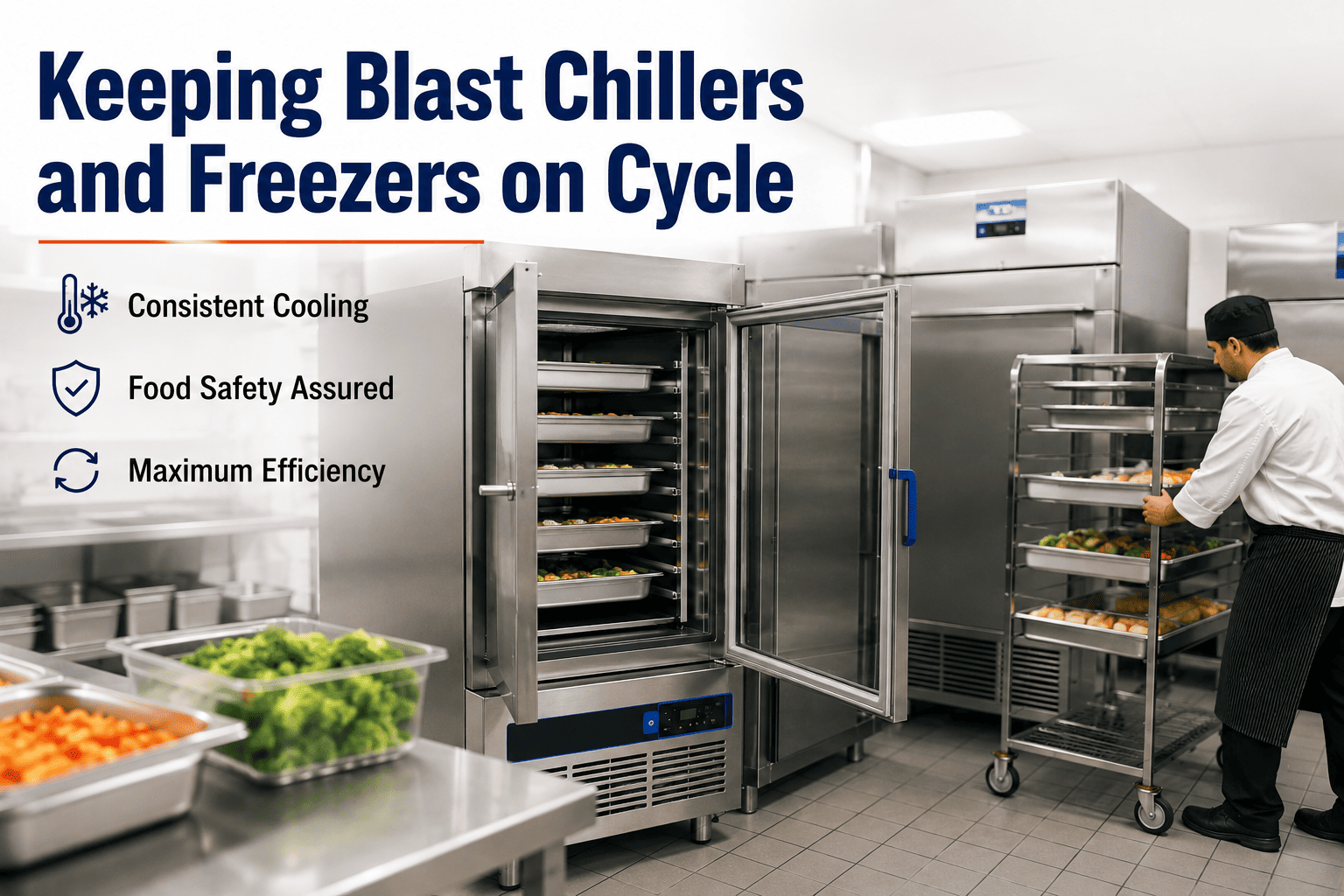
Frozen food processing equipment maintenance is one of the most operationally demanding disciplines in modern food manufacturing. Whether you manage an IQF tunnel in Ontario, a spiral freezer line in Birmingham, a blast freezer facility in Frankfurt, or a cold storage complex in Dubai, your maintenance program directly determines production uptime, energy consumption, product quality, and regulatory compliance. IQF freezers, spiral freezers, blast freezers, and plate freezers share a common vulnerability: thermal efficiency degrades silently until a critical failure occurs. This guide gives frozen food plant engineers the structured maintenance framework to prevent that outcome.
Streamline Your Frozen Food Plant Maintenance
Leading frozen food processors use CMMS platforms to schedule defrost cycles, track refrigerant handling, and maintain cold chain compliance across every shift.
Why Frozen Food Equipment Maintenance Demands a Dedicated Strategy
Frozen food processing environments operate under conditions that accelerate equipment degradation in ways that ambient-temperature facilities never experience. Continuous thermal cycling, high-humidity condensation, ice accumulation, corrosive cleaning agents, and the mechanical stress of refrigeration compressors running at sustained load create a maintenance challenge profile unlike any other food processing environment.
The consequences of maintenance failure are asymmetric. A single unplanned compressor shutdown can compromise an entire production batch, trigger cold chain integrity concerns, and generate a product recall scenario. In regulated markets — including those governed by BRCGS, SQF, and IFS Food standards — documented maintenance programs are a certification requirement, not merely an operational best practice.
Facilities across the UK, Canada, Germany, and the UAE that have implemented structured preventive maintenance programs for their freezing and cold storage assets consistently report 15–30% reductions in energy consumption and measurable reductions in unplanned downtime. The investment in a robust cold chain maintenance platform pays back in reduced emergency repair costs, extended equipment life, and audit-ready documentation.
IQF Freezer Maintenance: Tunnel, Bed, and Fluidized Systems
Individual Quick Freezing (IQF) tunnels are the workhorses of frozen vegetable, seafood, poultry, and prepared food lines. Their operational principle — suspending individual product pieces in a high-velocity cold airstream — creates specific maintenance vulnerabilities that demand targeted inspection and service protocols.
Evaporator Coil Condition and Defrost Management
Evaporator coils in IQF tunnels accumulate ice and frost continuously during production runs. Inadequate defrost management is the single most common cause of thermal efficiency loss in IQF systems. As frost bridges between coil fins, airflow resistance increases, reducing product freezing rate, extending dwell time, and driving up compressor energy consumption.
A structured IQF defrost management program defines defrost trigger criteria — either time-based or differential-pressure-based — and verifies that hot gas defrost, electric defrost, or water defrost cycles are completing to a clean coil state. Defrost completion logs should capture cycle start time, end time, drain temperature confirmation, and technician sign-off before production restart.
Belt and Conveyor System Maintenance
IQF tunnel belts — whether wire mesh, plastic modular, or woven — operate in continuous wet, cold, and chemically aggressive environments. Belt tension, tracking alignment, and splice integrity must be inspected at defined intervals. Misaligned belts cause product fallthrough, mechanical damage to belt edges, and conveyor drive motor overload. Documented belt inspection records are required evidence under food safety management standards including BRCGS Issue 9 and IFS Food Version 8.
Bearing lubrication in IQF conveyor systems requires food-grade lubricants rated for low-temperature operation. Standard lubricants thicken or fail at sub-zero temperatures, causing premature bearing failure. Lubrication schedules should specify the lubricant grade, application method, quantity, and re-lubrication interval at operating temperature — not ambient temperature. Book a demo to see how automated lubrication schedules are managed in OxMaint.
Airflow and Fan System Checks
IQF tunnel fans drive the high-velocity cold air that enables individual quick freezing. Fan blade condition, motor current draw, bearing temperature, and airflow velocity must be verified at each scheduled maintenance interval. Imbalanced fan assemblies generate vibration that accelerates bearing wear and creates fatigue cracking in fan blade roots — a failure mode that causes catastrophic fan assembly damage if left undetected.
Spiral Freezer Maintenance: Drum, Belt, and Refrigeration System Requirements
Spiral freezers are the dominant freezing technology for continuous-flow products including bakery goods, ready meals, breaded proteins, and portioned meat. Their multi-tier belt architecture and enclosed drum system create a maintenance environment with limited access points and high consequence if belt or drum components fail during production.
Drum Drive and Belt Tension Management
The central drum drive in a spiral freezer applies friction force to the belt stack through the rotating drum surface. Belt-to-drum friction must remain within the manufacturer's specified range — too low and belts slip, causing product distortion and belt pileup; too high and belt edge wear accelerates, shortening belt replacement intervals. Drum surface condition should be inspected for wear, scoring, or contamination buildup that reduces friction uniformity around the drum circumference.
Belt tension monitoring is a continuous process in spiral freezers. Modern spiral freezer control systems include belt tension sensors that trigger alarms if tension drops outside safe operating limits. Plants operating older spiral freezer models without integrated tension monitoring should implement manual tension measurement at defined intervals using manufacturer-specified measurement methods.
Spiral Freezer Sanitation and Maintenance Integration
Spiral freezer sanitation requires complete freezer shutdown, defrost, warm-up, cleaning, and return-to-temperature sequences — a process that can span 8 to 16 hours depending on freezer size and target product temperature. Maintenance activities — belt inspection, lubrication, fan bearing checks, coil inspection — should be integrated into the sanitation window to minimize total production downtime. A well-structured CMMS platform for frozen food plants schedules these maintenance tasks automatically within sanitation windows and generates work order completion records without manual coordination overhead.
Refrigerant Charge and Leak Detection
Spiral freezers operating on ammonia (R-717) or HFC refrigerants require documented refrigerant charge verification and leak detection protocols. Refrigerant loss degrades freezer thermal performance before mechanical failure symptoms appear. In facilities across the UK and Germany, environmental regulations mandate refrigerant handling records, leak detection system calibration, and qualified technician certification for all refrigerant work. An ammonia leak in a spiral freezer enclosure is a life safety event — leak detection sensor function must be verified on a defined schedule with records maintained and available for regulatory inspection.
Blast Freezer Preventive Maintenance: High-Demand Cycles and Structural Integrity
Blast freezers apply extremely high-velocity cold air at temperatures typically between -30°C and -40°C to rapidly freeze large product batches or trolleys. Their intermittent batch operation — repeated thermal cycling between loading at ambient and freezing at -35°C — creates structural and mechanical stresses that continuous-operation systems do not experience at the same intensity.
Door Seal and Gasket Maintenance
Blast freezer door seals are subject to repeated compression and thermal cycling. Degraded door gaskets allow warm, moist air infiltration that accelerates evaporator coil icing, increases defrost frequency, and raises compressor load. Door seal integrity should be inspected at every defrost cycle using a visual inspection protocol and verified with a thermal camera scan at defined intervals. Gasket replacement should be scheduled proactively based on service life data rather than reactively on failure. Sign up free to track gasket service life and schedule replacements automatically.
Structural Integrity of Blast Freezer Panels
Insulated panel joints in blast freezer rooms are vulnerable to moisture infiltration if sealant integrity degrades. Moisture ingress into panel cores causes insulation value collapse — a progressive failure that increases energy consumption over months before becoming visible as surface condensation or panel buckling. Annual infrared thermography surveys of blast freezer panel surfaces identify thermal bridging and moisture ingress before structural panel failure occurs.
Cold Storage Maintenance: Long-Term Asset Management for Temperature-Controlled Warehouses
Cold storage facilities — whether holding frozen product at -18°C or chilled product at 0–4°C — represent substantial capital investment in refrigeration plant, insulated structure, and temperature monitoring infrastructure. Their maintenance requirements extend beyond refrigeration equipment to encompass building fabric, floor integrity, rack systems, and temperature data logging.
Refrigeration Plant Preventive Maintenance
Cold storage refrigeration plants — typically screw compressor or reciprocating compressor systems on ammonia or HFC refrigerant — require monthly oil analysis, quarterly compressor valve inspections, semi-annual heat exchanger cleaning, and annual refrigerant charge verification. Oil contamination or refrigerant migration into the oil circuit causes rapid compressor wear and is a leading cause of unplanned cold storage refrigeration failures in facilities across Canada, Germany, and the UAE.
Floor Heating Systems in Frozen Storage
Frozen storage floors below -10°C require active under-floor heating to prevent ground freezing and frost heave that causes floor slab cracking and structural damage. Under-floor heating system function — whether electric trace heating or glycol circulation — must be verified at defined intervals with recorded temperature sensor readings. A under-floor heating failure in a facility in Ontario or Alberta during winter months can result in floor damage costing hundreds of thousands of dollars in repair and production interruption.
Temperature Monitoring and Alarm System Maintenance
Temperature data logger calibration, alarm threshold verification, and remote alarm notification testing are maintenance activities with direct food safety and regulatory implications. In BRCGS-certified and SQF-certified cold storage facilities, temperature monitoring records must demonstrate continuous cold chain integrity. Calibration certificates for temperature sensors must be current, traceable to national standards, and available for audit. A missed temperature excursion caused by a failed alarm sensor is a direct audit finding under all major food safety certification schemes. Book a demo to see how OxMaint keeps calibration records audit-ready.
Defrost Cycle Management: The Core of Frozen Food Energy Optimization
Defrost cycle management is the highest-leverage maintenance discipline for frozen food energy efficiency. Every degree of excess frost accumulation on evaporator coils increases refrigeration system energy consumption. Every unnecessary defrost cycle wastes energy and adds thermal cycling stress to refrigerant circuits. Optimizing defrost — running cycles only when required, completing them efficiently, and confirming clean coil return before resuming refrigeration — is the single most impactful energy optimization action available to frozen food plant engineers.
Demand-Based vs. Time-Based Defrost Control
Time-based defrost control — running defrost on a fixed schedule regardless of actual frost accumulation — is the least energy-efficient approach. Demand-based defrost control uses differential pressure sensors across evaporator coils to trigger defrost only when frost accumulation has reached a threshold that measurably impairs airflow. Facilities in Germany and the UK that have converted from time-based to demand-based defrost control typically report 8–15% refrigeration energy reductions with no increase in coil maintenance requirements. Sign up free to start managing defrost cycles with real-time data.
Defrost Termination Verification
Premature defrost termination — ending a defrost cycle before the coil has fully cleared — leaves residual ice that freezes harder in the next production cycle, compounding over successive cycles into a coil ice blockage that requires extended defrost or mechanical cleaning to clear. Defrost termination sensors (coil drain temperature sensors or coil surface temperature sensors) must be calibrated at defined intervals and their setpoints verified against the equipment manufacturer's specification.
Refrigerant Handling in Food Processing: Compliance and Safety Requirements
Refrigerant handling in frozen food processing facilities is subject to overlapping regulatory frameworks: environmental regulations governing refrigerant emissions, food safety standards requiring food-grade lubricants and contamination prevention, and workplace safety legislation governing ammonia and high-pressure HFC systems. Plant engineers in the UK, Canada, Germany, and UAE each operate under distinct regulatory regimes, but the underlying maintenance requirements converge on the same core disciplines.
Ammonia Refrigeration System Maintenance
Ammonia refrigeration systems — common in large-scale frozen food processing in Canada, Germany, and the UK — require technician F-Gas or equivalent qualification, annual pressure vessel inspection by a notified body, oil drain and analysis at defined intervals, and leak detection system calibration records. Ammonia concentration monitoring in machine rooms and freezer spaces must be continuous, with alarm levels set below IDLH (Immediately Dangerous to Life or Health) thresholds. Maintenance records for ammonia systems must satisfy both food safety auditors and regulatory inspection bodies. Book a demo to see how OxMaint manages refrigerant compliance records in one place.
HFC and HFO Refrigerant Compliance
Facilities operating HFC refrigerants (R-404A, R-507, R-134a, and their HFO replacements) must maintain refrigerant purchase and recovery records, leak check frequency documentation based on system charge size, and leak repair completion records. In the European Union — applicable to facilities in Germany and across the EU — F-Gas regulations require certified technicians for all refrigerant handling and prohibit the use of certain high-GWP refrigerants in new installations. An automated maintenance management system tracks refrigerant handling records, technician certification expiry, and regulatory inspection due dates in a single audit-ready repository.
How AI Vision Enhances Frozen Food Equipment Maintenance
AI Vision — computer vision technology deployed through smart cameras and automated image analysis systems — is rapidly becoming one of the most practical tools for frozen food plant engineers seeking to close the gap between scheduled maintenance intervals and real-time equipment condition visibility. Freezing environments, by their nature, limit human access during production. AI Vision extends continuous monitoring into environments where manual inspection is physically impractical or operationally disruptive.
The business value for frozen food plant engineers is concrete: AI Vision replaces costly periodic third-party inspection services, generates continuous condition monitoring evidence between scheduled PM visits, and provides quality and maintenance directors with real-time visibility into equipment status across every shift — without requiring additional headcount in challenging cold environment conditions. Ready to see it in practice? Start your platform journey with a free trial today.
Frozen Food Maintenance Software: CMMS and Digital PM Platforms Compared
Managing preventive maintenance for IQF tunnels, spiral freezers, blast freezers, and cold storage refrigeration plants across multiple shifts requires more than paper-based work order systems. The complexity of tracking calibration due dates, defrost performance logs, refrigerant handling records, and belt replacement intervals simultaneously demands a dedicated CMMS or maintenance management platform.
| Platform Feature | Basic CMMS | Food-Industry CMMS | AI-Powered Maintenance Platform |
|---|---|---|---|
| Preventive Maintenance Scheduling | Time-based only | Time + meter-based | Time, meter, and condition-based triggers |
| Defrost Cycle Logging | Manual entry only | Structured forms | Automated sensor integration + alerts |
| Refrigerant Handling Records | Not included | Basic log templates | Compliance-linked records with technician cert tracking |
| Calibration Due Date Management | Manual spreadsheet | Asset register with dates | Automated reminders + certificate storage |
| Food Safety Audit Trail | Limited | Module-based records | Audit-ready export for SQF, BRCGS, IFS, FSSC 22000 |
| Energy Consumption Trending | Not available | Manual data entry | Automated meter integration + trend reporting |
| Mobile Technician Access | Web browser only | Basic mobile app | Offline-capable mobile with barcode/QR asset scanning |
| Multi-Site Management | Single site | Limited multi-site | Full multi-site with consolidated reporting |
Frozen Food Energy Efficiency: Maintenance-Driven Optimization Strategies
Energy cost is typically the largest operational variable in frozen food processing. Refrigeration systems in a mid-sized frozen food plant can consume 2–5 million kWh annually. A 10% improvement in refrigeration system efficiency through maintenance-driven optimization represents a six-figure energy cost reduction — achievable without capital equipment replacement.
Condenser Cleaning and Heat Rejection Optimization
Air-cooled condenser coils accumulate dust, biological growth, and debris that reduces heat rejection efficiency, forcing refrigeration compressors to operate at higher condensing pressure and higher energy consumption. A condenser cleaning schedule calibrated to local environmental conditions — quarterly for facilities in dusty industrial zones, semi-annual for cleaner environments — maintains condensing pressure within the manufacturer's design range and prevents the compounding energy penalty of fouled condensers.
Compressor Suction and Discharge Pressure Trending
Daily logging of compressor suction and discharge pressures — compared against baseline values established during equipment commissioning — provides an early warning system for refrigeration system performance degradation. Rising discharge pressure at stable ambient conditions indicates condenser fouling. Falling suction pressure at stable product load indicates evaporator icing or refrigerant shortage. Both conditions increase compressor energy consumption and accelerate wear. An automated CMMS for frozen food plants captures this data, generates trend charts, and alerts engineers when pressure readings deviate from established baselines.
Hot Gas Bypass and Capacity Control Maintenance
Refrigeration systems with hot gas bypass or variable-speed compressor capacity control require periodic verification that capacity modulation systems function correctly across the full load range. Stuck capacity control valves or failed variable-speed drive components force compressors to cycle on and off rather than modulate — a significantly less energy-efficient operating mode that also increases compressor mechanical stress and reduces service life.
Plate Freezer Maintenance: Contact Freezing Systems for High-Throughput Applications
Plate freezers — used for block fish, portion-controlled proteins, and flat packaged products — make direct thermal contact with product surfaces to achieve rapid freezing without airflow. Their maintenance requirements differ fundamentally from tunnel and spiral freezer systems, centering on hydraulic plate pressure systems, plate surface integrity, and refrigerant distribution uniformity.
Hydraulic System Maintenance
Plate freezers use hydraulic cylinders to apply uniform pressure across freezing plates. Hydraulic fluid condition, cylinder seal integrity, and pressure uniformity across all plates must be verified at defined intervals. Uneven hydraulic pressure produces non-uniform product contact and inconsistent freeze times — a product quality failure mode that manifests as variable product texture and incomplete freezing in thick product sections.
Plate Surface Inspection and Repair
Freezing plate surfaces must be maintained free of corrosion, mechanical damage, and sealant degradation around refrigerant manifold connections. Any leak in a plate freezer refrigerant circuit can result in direct product contamination — a critical food safety failure. Plate surface inspection should be conducted at every deep-clean interval with records noting plate condition, any repair actions taken, and reinspection confirmation before return to production.
Common Frozen Food Equipment Maintenance Challenges and Solutions
Challenge 1: Ice Build-Up Blocking IQF Coils
Problem: Ice gradually blocks airflow through evaporator fins. By the time it's noticeable, freezing performance has already dropped and energy use has gone up.
Solution: Add pressure sensors across the coils and set alerts at 10–15% above normal. If defrost cycles are taking longer each week, that's your early warning sign — inspect and clean at the next sanitation stop.
Challenge 2: Spiral Freezer Belt Slipping
Problem: Belts slowly stretch and lose tension over time. Without monitoring, the first sign is often a slip event — which means a sudden shutdown, product loss, and an unplanned repair.
Solution: Fit tension sensors on older spiral freezers. Measure belt length regularly and track it against the original spec. Order replacement belts ahead of time — don't wait for a failure to trigger the purchase.
Challenge 3: Missing Refrigerant Records
Problem: Gaps in refrigerant logs — expired tech certifications, unrecorded top-ups, overdue leak checks — put facilities in the UK, Germany, and Canada at regulatory and audit risk.
Solution: Store all refrigerant records in one digital system. Set automatic reminders for certification renewals and leak check due dates. Every refrigerant addition should be logged instantly — date, amount, technician, and reason.
Challenge 4: Maintenance Gaps Across Shifts
Problem: In 24/7 frozen food plants, tasks done on one shift often go unrecorded or get repeated on the next. This creates gaps that auditors catch quickly.
Solution: Use a mobile CMMS so every technician can see what's been done — regardless of shift. Require digital sign-off on key checks like defrost verification and temperature sensor tests. Paper logs leave room for error; digital records don't.
Best Practices for Frozen Food Plant Maintenance Programs
Manage Your Frozen Food Plant Maintenance with Confidence
OxMaint's AI-powered maintenance platform helps frozen food plant engineers schedule IQF defrost cycles, track refrigerant handling records, manage spiral freezer belt inspection programs, and generate audit-ready cold chain maintenance documentation — all in one system, across every shift.
Frequently Asked Questions
How often should IQF freezer evaporator coils be defrosted?
There's no single fixed answer — it depends on your product type. Wet or high-moisture products like seafood may need defrost every 6–12 hours. Dry products can go longer. The best approach is pressure-based defrost: run a cycle when sensors detect restricted airflow, not just on a timer. Track how often defrost is needed each week — if the frequency keeps rising, your coil or refrigerant circuit needs attention.
What are the most critical maintenance activities for spiral freezers?
Focus on three things above all else: belt tension (to prevent slip and pileup), drum drive surface condition (to keep belt movement even), and evaporator defrost performance (to maintain freezing capacity). Beyond these, check refrigerant leak detection, fan bearings, and door seals regularly. Schedule all of it during sanitation windows so you're not losing extra production time.
What refrigerant handling records are required for food safety audits?
Auditors under BRCGS, SQF, and IFS typically ask for technician qualification certificates, leak check logs, refrigerant addition records (date, amount, reason), and system inspection reports. In the UK, Germany, and Canada, regulations also set how often leak checks must happen based on system size. Keep everything in one place — missing a single document is a common audit finding.
How does a CMMS help with frozen food plant PM programs?
A CMMS schedules your PM tasks automatically, sends work orders to technicians, and records completion with timestamps and sign-offs. It tracks spare parts, flags overdue tasks, and keeps all your maintenance history in one place. For frozen food plants, the biggest win is mobile access — technicians log work directly from the floor, so records are accurate across every shift without extra paperwork.
What is the recommended maintenance interval for blast freezer door seals?
Visually check door gaskets at every defrost cycle, and do a proper compression test monthly. If a gasket doesn't spring back to its full shape after being compressed, replace it — don't wait for a visible gap to appear. High-use doors (10+ open/close cycles per shift) need checking more often. Keep a replacement log with dates and reasons — it's straightforward evidence that auditors ask for.