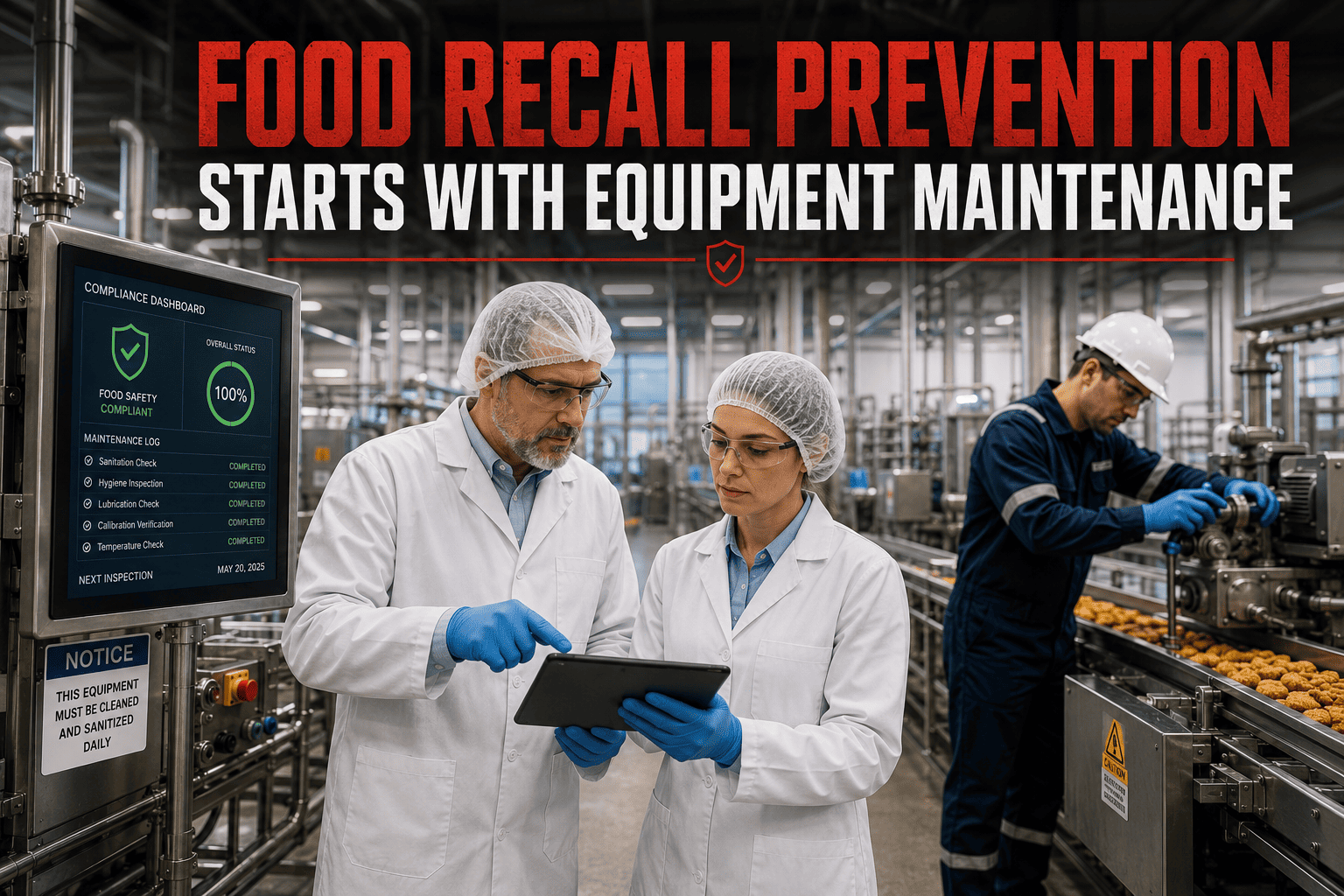
The average Class I food recall in the United States costs the manufacturer $10 million in direct costs — product destruction, logistics, customer notification, and regulatory response. That figure does not include the brand damage that can cut category shelf space for two to four years afterward. What makes that number painful is not just its size but its preventability: in 71% of Class I recalls, the root cause traces directly to a maintenance failure — a seamer that drifted out of tolerance, a metal detector sensitivity that had degraded below validated levels, a retort thermocouple that had not been calibrated on schedule, a cleaning protocol that was completed in 18 minutes when the validated time was 35. The equipment did not fail catastrophically. It failed quietly, incrementally, and without a system to catch the drift before it reached product. A CMMS program that treats Critical Control Points as monitored assets — not calendar reminders — is the structural difference between a food manufacturer that prevents recalls and one that investigates them. Start a free trial on OxMaint to see how your CCP maintenance programme would map.
71%
of Class I recalls trace to a maintenance failure at a Critical Control Point
$10M
average direct cost of a single Class I food recall
4.8×
higher cost of reactive critical equipment repair vs planned maintenance
83%
of food manufacturers with structured CMMS programmes report zero recall events annually
Why most food recalls are maintenance failures in disguise
The equipment maintenance failures hiding inside every recall investigation
A food recall investigation almost never starts with maintenance. It starts with a positive allergen test, a consumer complaint, a laboratory finding, or a regulatory inspection result. The investigation works backward and finds the contamination point — and at that contamination point, in the majority of cases, there is a maintenance record gap. A seamer check that was supposed to happen every 240 minutes and happened every 480. A pH electrode that had not been cleaned in 41 days against a 7-day validated cycle. A metal detector that had been running at 80% of validated sensitivity for three weeks because someone noted the degradation on a paper log that nobody reviewed. Equipment maintenance is the first line of defence in food safety not because it sounds good in an audit document but because equipment failures are what actually cause the contamination events that become recalls. Start a free trial to see how OxMaint structures CCP maintenance as first-class monitored assets, or book a demo and we will walk through your specific CCP map.
High Recall Risk
Reactive maintenance programme
CCP tasks tracked on paper checklists not tied to production batch records
Calibration records stored in folders separate from asset maintenance history
Metal detector sensitivity checks logged but results not reviewed against threshold trend
Changeover cleaning completed faster than validated protocol under production pressure
No batch release gate — product ships without confirmation all CCPs were checked that window
vs
Recall Prevention
Structured CMMS programme
CCP tasks are live work orders — timestamped, operator-assigned, tied to the batch record
Calibration certificates stored on the asset record with expiry tracking and 60-day renewal alerts
Metal detector sensitivity trended over time — degradation flagged before threshold is reached
Validated cleaning time built into work order as a hard gate — step cannot close before time elapses
Batch release blocked in CMMS until every mandatory CCP check for that production window is confirmed closed
The five maintenance failure modes that cause recalls
Where the gap between maintenance record and recall event actually lives
Recalls are not caused by missing maintenance budgets or under-equipped plants. They are caused by five repeating structural failure patterns — all of which are addressable with a properly configured CMMS programme. Understanding these patterns is how a maintenance director makes the case to a quality director that maintenance is not just a cost centre in food safety but the primary prevention mechanism.
01
CCP tasks completed but not verified at point of activity
Paper logs allow backdating, abbreviation, and omission. CMMS work orders require operator ID, timestamp, and outcome at the moment the task is done — creating a non-repudiable record the auditor and the recall investigator can both rely on.
02
Calibration records disconnected from the production line they protect
When the metal detector calibration certificate lives in a binder and the metal detector lives on Line 4, nobody can confirm in real time whether the instrument protecting today's production run has a valid, current calibration. CMMS asset records close this gap permanently.
03
Cleaning protocols shorter than validated minimums under production pressure
The validated 35-minute allergen changeover that gets done in 18 minutes because the next production run is waiting is one of the most common root causes in allergen recall investigations. Time-gated work order steps make this structurally impossible rather than procedurally discouraged.
04
Instrument sensitivity degradation caught only at complete failure
Metal detectors, pH probes, thermocouples, and seam measurement equipment all degrade gradually. A trend-based approach — tracking each reading against historical baseline rather than just pass/fail threshold — catches the early degradation stage weeks before it becomes a recall risk.
OxMaint for food safety
Turn your CCP maintenance tasks into live monitored assets
OxMaint treats every Critical Control Point as a first-class asset — with structured PM schedules, time-gated cleaning work orders, calibration certificate tracking, and batch release gates that make protocol bypasses structurally impossible. Used by food manufacturers managing thousands of production assets across single and multi-site operations.
The four maintenance pillars of recall prevention
What a recall-prevention maintenance programme actually looks like in practice
Recall prevention through maintenance is not a single intervention — it is four overlapping disciplines running continuously. Each pillar addresses a different pathway by which a maintenance gap becomes a contamination event. A CMMS that handles all four creates a maintenance environment where a recall would require multiple simultaneous, independent failures — which is exactly the defence-in-depth model that food safety auditors look for.
Pillar 1
CCP Asset Monitoring
Every CCP is a live asset with a scheduled maintenance record
Seamers, retorts, metal detectors, pH stations, thermocouples, and filler nozzles all live in the CMMS asset hierarchy with their own PM schedules, monitoring thresholds, calibration cycles, and corrective action workflows. When a metal detector's test-piece challenge result trends toward the threshold rather than just passing it, a work order is created before the threshold is crossed.
OxMaint capability — CCP asset hierarchy with condition scoring and threshold-triggered work orders
Pillar 2
Cleaning Validation
Validated cleaning protocols enforced by the work order, not by operator memory
Every CIP cycle, allergen changeover, and sanitation protocol runs as a structured work order with minimum validated times built in as hard gates. The operator cannot mark the step complete before the time has elapsed. ATP swab results are entered against the specific surface and equipment record — not on a general paper log — and a positive result locks the line and creates an escalation work order automatically.
OxMaint capability — time-gated cleaning work orders, allergen matrix integration, swab-to-asset evidence trail
Pillar 3
Calibration Control
Instrument calibration tied to the asset, the production line, and the batch record
Calibration certificates stored on the asset record in the CMMS with expiry date tracking and 60-day automated renewal alerts. Every instrument reading logged as a structured work order outcome — not a paper entry. Out-of-tolerance readings trigger immediate corrective action work orders and, if the instrument is protecting a CCP, a batch hold flag. Calibration history is always searchable by instrument, by line, by date range, and by product batch.
OxMaint capability — calibration certificate management, expiry tracking, out-of-tolerance corrective action triggers
Pillar 4
Batch Release Gates
Production cannot start until every CCP check for that window is confirmed complete
The CMMS batch release gate is the structural link between maintenance completion and production authorisation. Before a batch can start, the system confirms that every mandatory CCP maintenance task for the relevant production window is closed with an acceptable result and the appropriate sign-off. No exceptions, no manual overrides without named director-level authorisation recorded in the system. This is the last line of the maintenance defence and the one most commonly missing from food manufacturing operations.
OxMaint capability — batch release gate control with mandatory CCP completion confirmation and escalation log
Compliance trajectory
How CCP maintenance compliance typically builds over 90 days on OxMaint
The pattern below reflects the CCP maintenance compliance trajectory across food manufacturing deployments. The early weeks are slow by design — they are spent building the asset hierarchy, mapping CCPs to work order schedules, and configuring thresholds. Real compliance movement begins when operators are trained and the batch release gate goes live. The journey from undocumented to audit-ready typically takes 60 to 90 days depending on facility complexity.
CCP hierarchy and work orders configured
Week 1 to 4
Operator training and batch release gate live
Week 5 to 8
First BRC or FSMA audit on OxMaint evidence
Day 90 target
What auditors are actually checking
The maintenance evidence your BRC, FSMA, and SQF auditor will ask for
Food safety auditors do not arrive to inspect whether your CCP maintenance happened. They arrive to inspect whether you can prove it happened — and the difference between those two things is the difference between a clean audit and a corrective action finding. The table below maps the most common food safety audit evidence requests to the OxMaint records that fulfil them.
| Auditor evidence request |
What most plants produce |
What OxMaint produces |
| Metal detector challenge log — last 90 days | Paper log, may have gaps | Digital work order history, timestamped, by operator |
| Allergen changeover records — batch specific | Paper checklist, not batch-linked | Work order tied to batch record, time-gated completion |
| Retort calibration certificate and last verification date | Binder, may be expired | Asset record with live cert and expiry alert |
| Seamer check frequency and out-of-tolerance history | Paper log, frequency uncertain | Scheduled WO history, every deviation flagged |
| pH electrode cleaning compliance for last 30 days | Undocumented or partial | 100% WO completion rate with operator sign-off |
| Corrective action log for any CCP failure | Separate binder, inconsistent | Auto-generated work order on every threshold breach |
| Proof that batch X was released after all CCP checks passed | Cannot be produced | Batch release gate log — exportable in under 5 minutes |
Common questions
Frequently asked questions about CMMS-based recall prevention
01
Does a CMMS actually prevent recalls or just help with documentation after the fact?
A properly configured CMMS prevents recalls by making the underlying maintenance failures structurally impossible. Time-gated cleaning work orders prevent protocol shortcuts. Threshold-based alerts catch instrument degradation before it reaches the contamination threshold. Batch release gates prevent production from starting on an incomplete maintenance record. Documentation is a by-product of the preventive mechanism — not the primary function.
02
How long does it take to configure OxMaint for a food manufacturing CCP programme?
Most food manufacturers have their CCP hierarchy configured and first work orders live within two to three weeks. The CCP map imports from existing HACCP documentation, equipment assets load from plant lists, and cleaning protocol time gates configure in a single setup session. The batch release gate typically goes live at the end of week four, once operators are trained and the CCP schedule has been validated in parallel with existing procedures.
03
Can OxMaint handle multi-site food manufacturing with different CCPs at each site?
Yes. OxMaint's asset hierarchy runs Portfolio, Property, System, Asset, and Component across all sites simultaneously. Each site maintains its own CCP configuration while sharing a common allergen matrix and compliance reporting dashboard. A quality director can see real-time CCP compliance across every site from a single dashboard — and identify which site, which line, and which specific asset is the source of any compliance gap.
04
What food safety certifications does OxMaint support evidence for?
OxMaint produces audit-ready evidence for BRC Global Standard, BRCGS Food Safety Issue 9, SQF Level 2 and 3, FDA FSMA, USDA, AAFCO, GFSI, ISO 22000, FSSC 22000, and Codex Alimentarius inspection. The evidence export filters by certification type, date range, asset class, or production batch and generates a complete time-stamped package in under 10 minutes — turning pre-audit binder construction from a three-week project into an afternoon review.
05
What is the ROI of a recall prevention CMMS programme versus the cost of a single recall?
A single Class I recall averages $10 million in direct costs. OxMaint platform cost for a mid-size food manufacturing facility is a small fraction of that figure annually. Even accounting for implementation time and internal resource cost, a single prevented recall delivers 20 to 50 times the programme investment. The more defensible ROI calculation — because recalls are low-probability events — is the audit finding prevention, compliance staff time reduction, and reactive emergency repair cost avoided by shifting CCP maintenance from reactive to planned.
Start your recall prevention programme today
Your next audit starts with your maintenance records
Every BRC, FSMA, and SQF auditor who walks into your facility will ask to see maintenance evidence. OxMaint makes that evidence continuous, automatic, and exportable in under 10 minutes — because it is built into every work order, every CCP check, and every batch release gate as a by-product of the work, not a separate documentation exercise. No heavy implementation. Live in days, not months.