How Food Plants Should Prepare for Unannounced FDA Inspections
By OxMaint Team on June 16, 2026
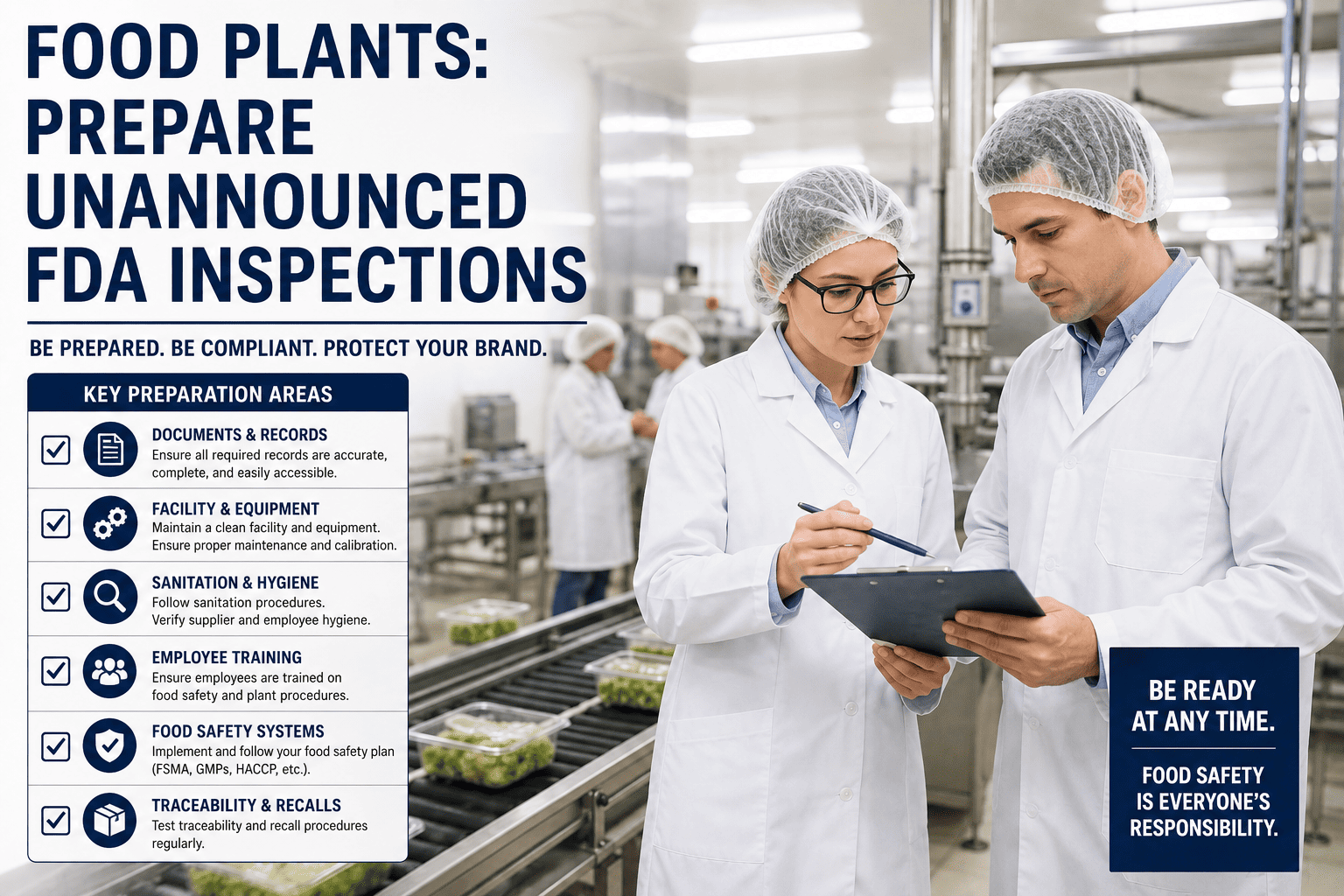
Food plant FDA inspection preparation is no longer a periodic project — it's a permanent operational posture. The FDA conducts approximately 12,000 domestic inspections per year, the vast majority unannounced, and food facilities that fail to maintain continuous audit readiness face warning letters, production shutdowns, and the reputational fallout of a public 483 observation. If your documentation system relies on paper binders and manual logs, you are already behind where FDA expects you to be today.
FDA Compliance · Food Manufacturing
How Food Plants Should Prepare for Unannounced FDA Inspections
The FDA issues roughly 12,000 domestic food facility inspections annually — nearly all unannounced. Plants that pass consistently aren't lucky; they've built systems that make every day inspection day. This guide shows you exactly how to build that system.
12,000
FDA domestic inspections per year — nearly all unannounced
74%
of 2024 inspections received "No Action Indicated" — the target for your facility
73%
surge in FDA warning letters in H2 2025 — enforcement is accelerating
<2%
of inspections result in "Official Action Indicated" — avoidable with proper systems
See how Oxmaint keeps food plants always audit-ready — with zero scramble when the inspector walks in.
✓ Real-time maintenance and inspection documentation✓ Auto-generated FSMA-compliant audit trails✓ Instant record retrieval during live inspections
Trusted by food manufacturers managing 10,000+ assets · Live in days, not months.
Food plant FDA inspection preparation is the set of ongoing systems, documentation practices, and team protocols that ensure a facility can pass an unannounced FDA visit at any moment — not just when an audit has been scheduled. It covers everything from real-time maintenance logs and sanitation records to equipment calibration trails and corrective action documentation, all organized so any authorized team member can produce them within minutes of an inspector's arrival.
Under the Food Safety Modernization Act (FSMA), FDA now conducts routine inspections more frequently and without prior notice. Investigators from the Office of Inspections and Investigations (OII) evaluate whether your facility's written food safety plan, hazard analysis, preventive controls, and monitoring records match what is actually happening on the production floor. The gap between what's written and what's practiced is the most common source of 483 observations.
The facilities that consistently receive "No Action Indicated" rulings don't prepare for inspections — they operate in a state of continuous inspection readiness. That means digital records, structured workflows, live equipment status, and documented corrective actions available on demand. Oxmaint's inspection management module builds exactly this infrastructure, so the FDA inspector's arrival changes nothing about how your team operates.
"Between July and December 2025, FDA warning letters increased 73% — food facilities are the primary target of accelerating enforcement."
6 Pillars of Always-Ready FDA Inspection Readiness
01
Live Digital Documentation
Every maintenance log, sanitation record, and calibration certificate stored digitally and retrievable in under 60 seconds. Paper binders and email threads fail the moment an inspector asks for records spanning the last 12 months.
02
Preventive Control Documentation
Written evidence that every FSMA-required preventive control — sanitation, allergen, process, and supply chain — is being actively monitored, corrected when deviations occur, and verified by a qualified individual.
03
Equipment Maintenance Records
Complete service history for every piece of food-contact equipment: last PM date, calibration status, filter changes, gasket replacements. Inspectors look for evidence that preventive maintenance is real, not theoretical.
04
Corrective Action Trails
Every deviation — temperature excursion, sanitation failure, equipment breakdown — must have a documented corrective action with a timestamp, responsible party, and verification that the root cause was resolved.
05
Inspection Response Protocol
Designated escort team, a single point of contact for inspector requests, a documentation retrieval procedure, and front-line staff trained to respond calmly and correctly from the moment the investigator arrives at reception.
06
Mock Inspection Programme
Unannounced internal audits that simulate FDA visit conditions, test record retrieval speed, identify documentation gaps, and expose the difference between written procedures and actual floor practice before the real inspector does.
Ready to automate the documentation backbone of all six pillars? Start a free trial or book a demo to see how Oxmaint structures this for food facilities.
4 Documentation Failures That Trigger FDA Action
Missing Equipment PM Records
FDA investigators routinely request preventive maintenance logs for food-contact equipment. If your CMMS shows a work order was scheduled but no completion record exists, that gap is documented as a 483 observation — regardless of whether the maintenance actually happened. Digital PM records with technician sign-off and timestamps close this gap.
Undocumented Corrective Actions
A temperature deviation that was corrected is not an FDA problem. A temperature deviation that was corrected but not documented is. Every corrective action must be captured in real time with root cause, immediate response, and verification. Retroactively filling in paper logs during an inspection is visible to investigators and treated as falsification.
Floor Practice vs. Written Procedure Gaps
Investigators observe production alongside reviewing paperwork. If the sanitation SOP says a surface is cleaned at shift change but technicians are observed skipping steps, the discrepancy becomes a 483 item. Digital inspection checklists with photo capture enforce procedure compliance in real time, not after the fact.
Calibration Records Out of Date
Every monitoring instrument — thermometers, pH meters, scales, pressure gauges — must have a current calibration certificate. Equipment with lapsed calibration invalidates all monitoring data collected since the last valid calibration date. Automated calibration scheduling through your asset management system eliminates this gap entirely.
Oxmaint eliminates all four failure categories with automated scheduling, digital logs, and real-time corrective action tracking — book a demo to see the food manufacturing workflow.
How Oxmaint Builds Your Always-Ready Inspection System
Automated PM Scheduling
Oxmaint automatically generates and assigns preventive maintenance work orders for every food-contact asset on a defined schedule. Technicians complete tasks via mobile app with timestamp, photos, and sign-off — producing the FDA-ready record trail in real time, every time.
Digital Inspection Checklists
Configurable inspection forms enforce FSMA preventive control checks on every shift. Results are captured digitally with GPS timestamp and technician ID. Any failed check triggers an automatic corrective action work order — with documentation of what happened, who responded, and when it was resolved.
Instant Audit Record Retrieval
When an FDA investigator asks for the last 12 months of equipment maintenance records, your quality manager can produce a filtered, timestamped export in under two minutes — from any device. No binder search, no email thread archaeology, no gaps. Oxmaint's reporting engine is built for exactly this moment.
AI-Powered Predictive Maintenance
Oxmaint's predictive maintenance engine monitors equipment sensor data to flag failures before they occur — preventing the unplanned breakdowns that create the emergency repairs, documentation gaps, and sanitation failures that show up as FDA observations. 94% AI prediction accuracy means fewer surprises, fewer observations.
Safety & EHS Compliance Tracking
OSHA and food safety compliance documentation — PPE verification, lockout/tagout records, allergen control logs, sanitation sign-offs — all centralized and timestamped. Oxmaint's compliance module maintains the audit trail FDA expects to see across every regulatory requirement simultaneously.
QR-Scan Work Orders on the Floor
Every piece of equipment carries a QR code. Technicians scan to create, claim, or close work orders on the spot — no paperwork, no back-and-forth, no lost records. FDA investigators see a continuous, unbroken service record for every asset on the floor, not a reconstructed paper trail.
"Facilities with digital maintenance management systems retrieve audit records in under 2 minutes — vs. an average 47 minutes for paper-based systems. FDA investigators notice the difference."
Reactive Scramble vs. Always-Ready: What FDA Sees
Documentation Area
Reactive / Paper-Based
Always-Ready / Oxmaint
PM Record Retrieval
30–90 min search through binders; gaps common
Under 2 min filtered digital export, complete and timestamped
Corrective Actions
Often verbal; documented retroactively or not at all
Auto-triggered, timestamped, linked to the triggering deviation
Calibration Status
Checked manually; lapsed certificates discovered during audit
Auto-alerts before expiry; always current at inspection time
Inspection Checklists
Paper forms; missing signatures common; no photo evidence
Scattered across spreadsheets, email, and vendor invoices
Complete asset record: every work order, every tech, every date
Floor Procedure Compliance
Assumed; discovered gaps during live observation
Enforced by digital checklist; deviations auto-escalated
FDA Inspection Outcome
483 observations likely; OAI risk elevated
NAI target achievable; full record trail demonstrates control
Inspection Readiness ROI: What's at Stake
62%
less downtime
Reduction in unplanned downtime with AI-driven preventive maintenance — the same equipment failures that trigger emergency repairs and documentation gaps
$15K–$500K
Typical cost range of an FDA warning letter response — legal fees, remediation, production impact, and consent decree risk
74%
of FDA food inspections in 2024 resulted in No Action Indicated — the achievable baseline for facilities with structured documentation systems
Days
Time to go live with Oxmaint in a food facility — not months. Your inspection-ready documentation system can be operational before the next FDA cycle.
Calculate what improved inspection readiness means for your bottom line — use the Oxmaint ROI Calculator or book a demo and we'll walk through it with you.
Frequently Asked Questions: FDA Inspection Preparation for Food Plants
What records does FDA typically request during an unannounced food plant inspection?
FDA investigators most commonly request your written food safety plan, hazard analysis, preventive control monitoring records, corrective action logs, verification records, and supplier control documentation. They also frequently request equipment maintenance and calibration histories for food-contact equipment, sanitation records, and employee training documentation. The key is that all of these must be retrievable quickly and cover at least the previous 12–24 months without gaps. Digital systems like Oxmaint make this a one-click retrieval rather than a document search that can take hours and reveal missing records in the process.
How much advance notice does FDA give for a food plant inspection?
For domestic food facilities, FDA provides no advance notice in the vast majority of cases. Inspectors arrive at your facility and present credentials — the inspection begins immediately. Only in specific circumstances (such as needing to confirm that certain personnel or records will be available) does FDA provide any prior notification, and even then, facilities cannot negotiate the timing. This is exactly why "always-ready" systems matter: the inspector's arrival should trigger no scramble whatsoever if your documentation is current and digital.
What is a Form 483 and how do you respond to one after a food plant inspection?
FDA Form 483 lists observations made by an investigator where the facility's practices appear to violate FDCA requirements. Receiving a 483 does not mean a warning letter will follow — your response matters enormously. You have 15 business days to submit a written response that acknowledges each observation, explains root cause, and commits to specific corrective actions with realistic timelines. A well-organized response supported by documented corrective actions already underway typically results in a more favorable FDA classification. Facilities using Oxmaint already have corrective action records and maintenance documentation that can be attached to the 483 response immediately.
How does a CMMS like Oxmaint help food plants pass FDA inspections?
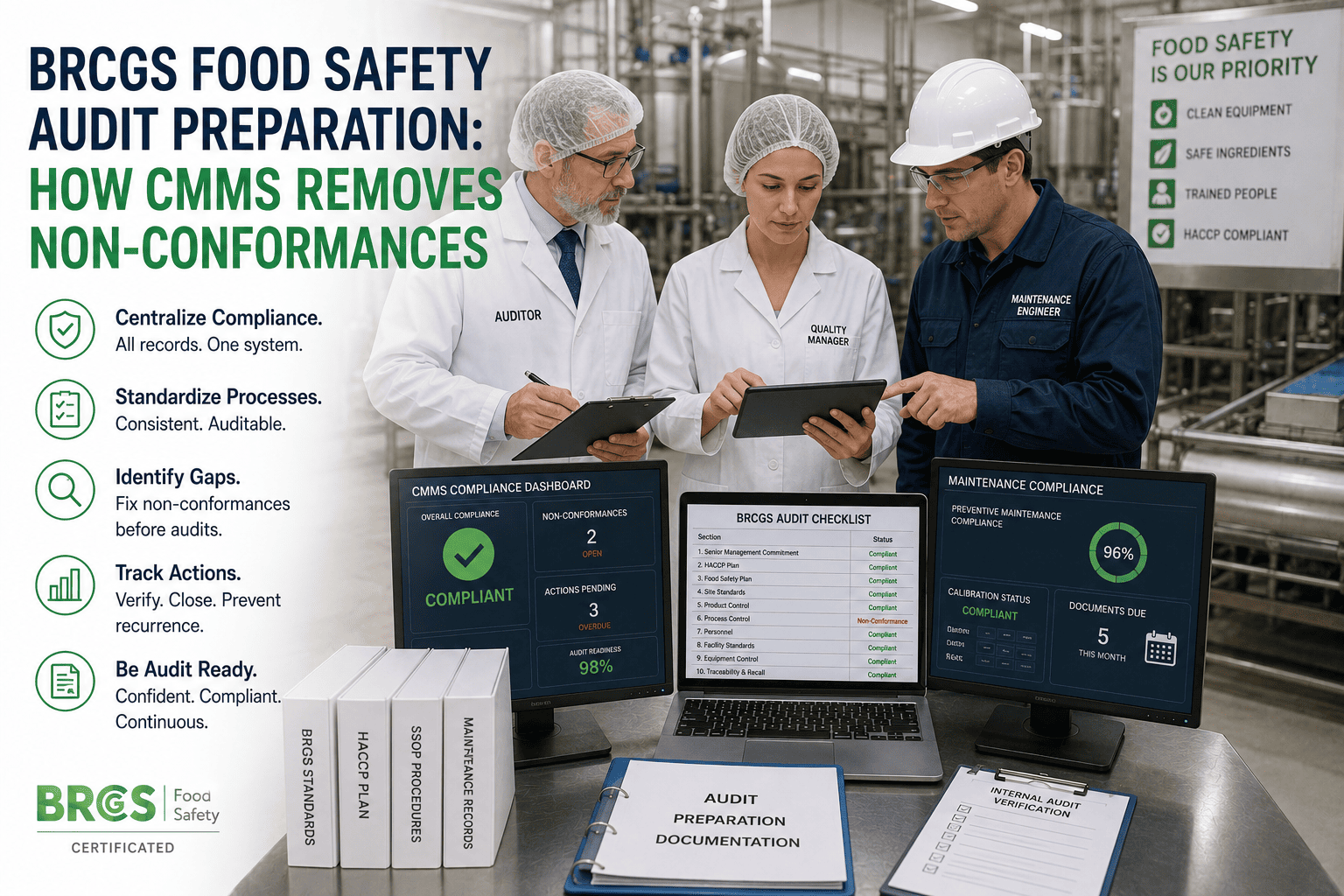
A CMMS built for food manufacturing addresses the documentation failures most commonly cited in FDA 483 observations: missing PM records, undocumented corrective actions, lapsed calibration certificates, and gaps between written procedures and floor practice. Oxmaint automatically schedules and documents preventive maintenance, creates digital inspection checklists that enforce FSMA preventive controls, generates timestamped corrective action records for every deviation, and produces complete audit-ready reports instantly. For food facilities specifically, Oxmaint also integrates with safety and compliance workflows to maintain OSHA and GMP documentation in the same system. The result is a facility where FDA documentation is a live operating record, not a periodic filing project.
Food Plant FDA Inspection Preparation · CMMS · Compliance Automation
Stop Scrambling When FDA Arrives
Oxmaint gives your food facility the digital maintenance records, inspection documentation, and corrective action trails that FDA expects to see — organized, timestamped, and retrievable in minutes. Build your always-ready food plant FDA inspection preparation system today.
✓ Automated PM scheduling with complete digital records✓ Real-time corrective action documentation and audit trails✓ Instant FSMA-compliant report export for live inspections
Trusted by 1,000+ facilities across food manufacturing, facility management, and regulated industries · Live in days