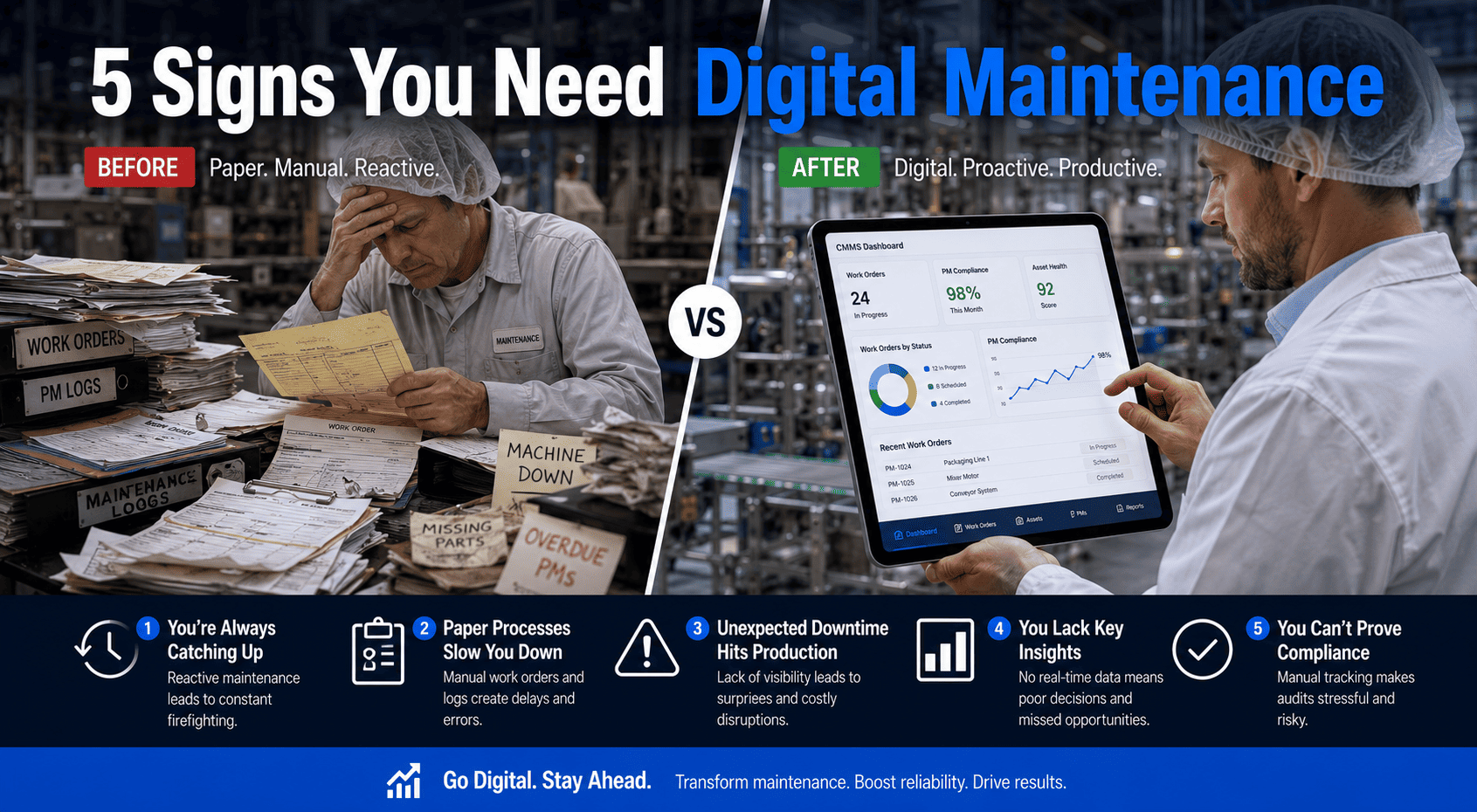
If your food plant still tracks maintenance with paper work orders, whiteboards, and spreadsheets, you've already outgrown the system — you just haven't felt the full cost yet. Paper-based maintenance in food manufacturing isn't a preference, it's a liability: missed PM cycles, untraceable equipment histories, and zero audit readiness the moment an FDA inspector walks in. This guide covers the five warning signs that your food plant has outgrown its paper maintenance system and what the switch to a CMMS actually delivers in downtime, compliance, and labor savings. Start a free trial of Oxmaint to see digital maintenance running on your assets — or book a 30-minute demo and we'll show you exactly what you're leaving on the table.
Food Manufacturing Digital Transformation
5 Signs Your Food Plant Has Outgrown Its Paper Maintenance System
Paper work orders, shared spreadsheets, and whiteboard PM boards seem manageable — until a line goes down, an audit hits, or a technician leaves. These are the warning signs that signal your maintenance operation is flying blind.
62%
less unplanned downtime for food plants that move from paper to AI-driven CMMS
80%
less time spent on manual inspection logging when AI Vision Camera automates detection
4–5×
higher emergency repair cost vs. planned work — the tax every paper-based plant pays
1,000+
clients managing assets across food manufacturing, facility, and industrial sectors on Oxmaint
When Should a Food Plant Switch to Digital Maintenance Software?
Paper-based maintenance systems in food manufacturing don't fail all at once — they fail incrementally, in ways that are easy to explain away individually. A missed PM here. A work order that fell through the cracks there. An audit finding that got closed with a corrective action plan. The cumulative cost of these small failures is what most plants never calculate — until a major breakdown or a food safety incident forces the conversation.
The switch from paper to digital maintenance software (a CMMS) isn't about technology preference. It's about whether your maintenance operation can actually protect food safety, reduce unplanned downtime, and demonstrate compliance without heroic effort from your team every time something goes wrong. The five signs below are the clearest indicators that your current system has hit its ceiling.
6 Core Concepts: What Changes When You Go Digital
01
Real-Time Work Order Visibility
Every open task, assigned technician, and completion status is visible in real time — from the floor or the office. No more morning huddles to find out what got done overnight.
02
Automated PM Scheduling
Preventive maintenance triggers automatically based on calendar, runtime hours, or sensor readings — eliminating the manual calendar-checking that paper systems rely on.
03
Complete Equipment History
Every repair, PM, part used, and technician note is attached to the asset record — accessible in seconds during FDA audits, not buried in a filing cabinet.
04
Mobile-First Technician Tools
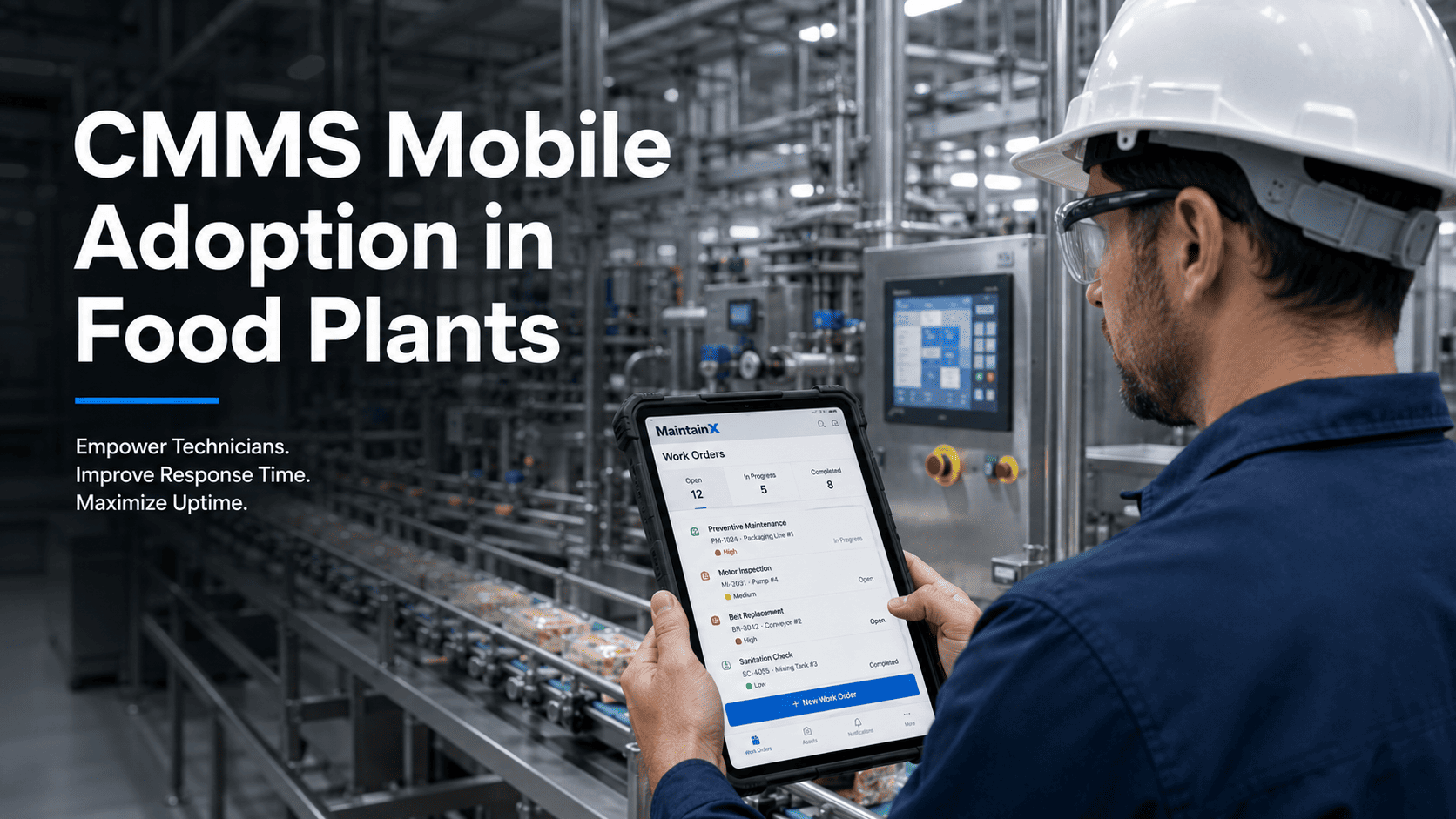
Technicians create, update, and close work orders from a phone or tablet at the equipment — no paper forms, no transcription delays, no lost job cards at shift end.
05
Compliance Documentation Auto-Trail
Every inspection, sanitization, and PM generates a timestamped digital record automatically — producing the audit trail FDA and food safety certifiers require without extra administrative work.
06
Parts & Inventory Control
Spare parts are tracked against work orders — no more emergency purchasing because someone forgot to reorder. Auto-reorder triggers ensure critical parts are always in stock before a breakdown creates urgency.
The average food plant running paper-based maintenance spends 20–40% of its maintenance budget on reactive, unplanned repairs — a cost that drops sharply within 90 days of CMMS deployment.
The 5 Warning Signs Your Food Plant Needs a CMMS
01
You Can't Answer "Why Did That Line Go Down?" Without Digging Through Paper
When a conveyor fails or a filler goes down and your root cause analysis requires hunting through handwritten job cards from the last three months, your maintenance data is not working for you — it's working against you. Digital maintenance software creates a searchable repair history per asset, so you can identify repeat failure modes in minutes rather than days. Plants that can't quickly trace failure history tend to fix the same equipment repeatedly instead of solving the underlying cause — paying reactive repair costs on a loop.
02
Your PM Completion Rate Is Below 85% and Nobody Knows Why
Paper PM schedules have no enforcement mechanism. If a technician is pulled to fix an emergency, the scheduled PM gets skipped — and there's often no formal record of the skip or any rescheduling. In food manufacturing, missed PMs on critical equipment (heat exchangers, refrigeration compressors, conveyor drives) directly increase the risk of an unplanned failure during peak production. A
digital preventive maintenance system auto-escalates overdue PMs, tracks skip reasons, and reschedules automatically — turning PM completion into a managed KPI rather than a guess.
03
You Dread FDA or SQF Audits Because Your Records Aren't Organized
Food safety auditors ask for equipment maintenance records, calibration histories, and sanitization logs — and they expect them on demand, not after a 30-minute search. Paper-based systems make this painful: documents are misfiled, missing, or illegible. Oxmaint's
inspection and compliance module generates GMP-compliant digital records automatically with every work order close-out, creating the audit trail that food safety certifications require without any extra administrative work from your team.
04
A New Technician Takes Months to Get Productive Because Knowledge Lives in People's Heads
When your experienced technicians carry all the institutional knowledge about your equipment — quirks, recurring issues, unofficial workarounds — your maintenance operation is one resignation away from a significant productivity hit. Paper systems make this worse because there's no structured repository for that knowledge. Digital maintenance software captures every repair note, parts used, and procedure followed against the asset record — so new technicians can onboard against a real equipment history, not just from shadowing a veteran tech who may not be available when things break at 2 AM.
05
Your Parts Stockroom Is Either Overstocked with Obsolete Parts or Out of Critical Spares
Paper-based parts management is a guessing game. Without visibility into which parts are used against which assets, at what frequency, and what's currently on hand, food plants typically oscillate between emergency purchasing (overpaying on critical spares when a line is down) and overstocking (tying up capital in parts that sit for years).
Oxmaint's parts and inventory management ties parts consumption directly to work orders — enabling automated reorder triggers so critical spares are always available without overstocking.
Recognizing more than two of these signs? Your plant is ready for a CMMS — start a free trial and see Oxmaint running on your asset list, or book a demo to map the transition to your current workflow.
Paper Maintenance vs. Digital CMMS: Side-by-Side Comparison
| Capability |
Paper-Based System |
Oxmaint CMMS |
| Work order creation speed |
Manual form fill, physical delivery to technician |
QR scan creates and assigns work order in seconds |
| PM schedule enforcement |
Manual calendar; skips go unrecorded |
Auto-trigger + escalation for overdue PMs |
| FDA audit readiness |
Hours of document hunting; missing records common |
Digital records retrievable in seconds per asset or date range |
| Parts inventory accuracy |
Manual counts; emergency purchases common |
Auto-tracked against work orders; AI-triggered reorders |
| Technician onboarding |
Verbal knowledge transfer; weeks to full productivity |
Full asset history and procedure library from day one |
| Downtime root cause analysis |
Paper dig required; slow and incomplete |
Instant asset repair history; AI identifies repeat failure modes |
| Cross-shift communication |
Whiteboard + verbal handover; gaps are common |
Digital shift logbook with all open work orders and notes |
Food plants that complete the move to digital maintenance software typically recoup the CMMS investment within 6–12 months through reduced reactive repair costs and emergency purchasing alone.
What Food Plants Gain After Switching to Oxmaint
62%
Less unplanned downtime
Oxmaint client average after AI-driven CMMS deployment replaces reactive paper-based maintenance
80%
Less inspection time
AI Vision Camera automates equipment monitoring — reducing manual inspection rounds by up to 80%
Days
To go live
Oxmaint deploys in days — no multi-month implementation projects or expensive consultants required
94%
Prediction accuracy
AI predictive maintenance flags equipment failures weeks before breakdown — not after the production loss
See how the numbers map to your facility — use the Oxmaint ROI calculator, then start a free trial or book a demo to walk through your specific transition plan.
Frequently Asked Questions: Digitizing Food Plant Maintenance
How long does it take to switch from paper to digital maintenance software in a food plant?
Oxmaint is designed to be live in days, not months — no heavy implementation project or external consultants required. Most food plants can upload their asset list, configure PM schedules, and have technicians creating digital work orders within the first week. Full adoption — including historical data migration and advanced reporting configuration — typically completes within 30–60 days depending on facility size and asset count.
Does a CMMS help food plants pass FDA and SQF audits?
Directly. FDA GMP regulations and SQF Code both require documented maintenance records, equipment histories, and evidence that PM schedules are being followed. A CMMS like Oxmaint creates these records automatically with every work order and inspection — generating a complete, timestamped digital audit trail that can be retrieved per asset, date range, or technician in seconds during an audit. This is a significant improvement over paper records, which are frequently incomplete, misfiled, or missing at inspection time.
What's the ROI of switching from paper to digital maintenance software in food manufacturing?
The primary ROI drivers are reduction in unplanned downtime (emergency repair costs run 4–5× higher than planned work), reduction in emergency parts purchasing, and time saved on administrative tasks like work order transcription and record retrieval. Oxmaint clients report 62% less unplanned downtime on average. For a mid-size food plant spending $500,000 annually on maintenance, a 30% shift from reactive to planned work typically saves $60,000–$90,000 per year in direct repair costs alone — well inside a 12-month payback period.
Will food plant maintenance technicians actually use a CMMS app on the floor?
Adoption is the most common concern — and Oxmaint's mobile-first design specifically addresses it. Technicians create work orders by scanning a QR code on the equipment, which takes under 30 seconds. There are no complex navigation menus or desktop-only functions. Because the app reduces the administrative burden on technicians (no paper forms, no end-of-shift transcription), adoption rates on Oxmaint tend to be high — particularly when technicians see that it also surfaces their work history during performance reviews.
Food Plant Maintenance Digitization
Stop Paying the Paper Maintenance Tax on Every Breakdown
Every reactive repair your team scrambles to fix costs 4–5× more than a planned one. Every FDA audit your records aren't ready for is a corrective action plan waiting to happen. Oxmaint replaces paper maintenance with AI-driven CMMS that goes live in days — not months.
- AI-driven PM scheduling and predictive failure alerts — no more missed maintenance cycles
- Digital compliance records for FDA, SQF, BRC, and FSSC 22000 — audit-ready always
- QR-scan work orders on mobile — technicians adopt it in hours, not weeks
Trusted by 1,000+ food manufacturing and facility teams · Live in days · No implementation consultants required