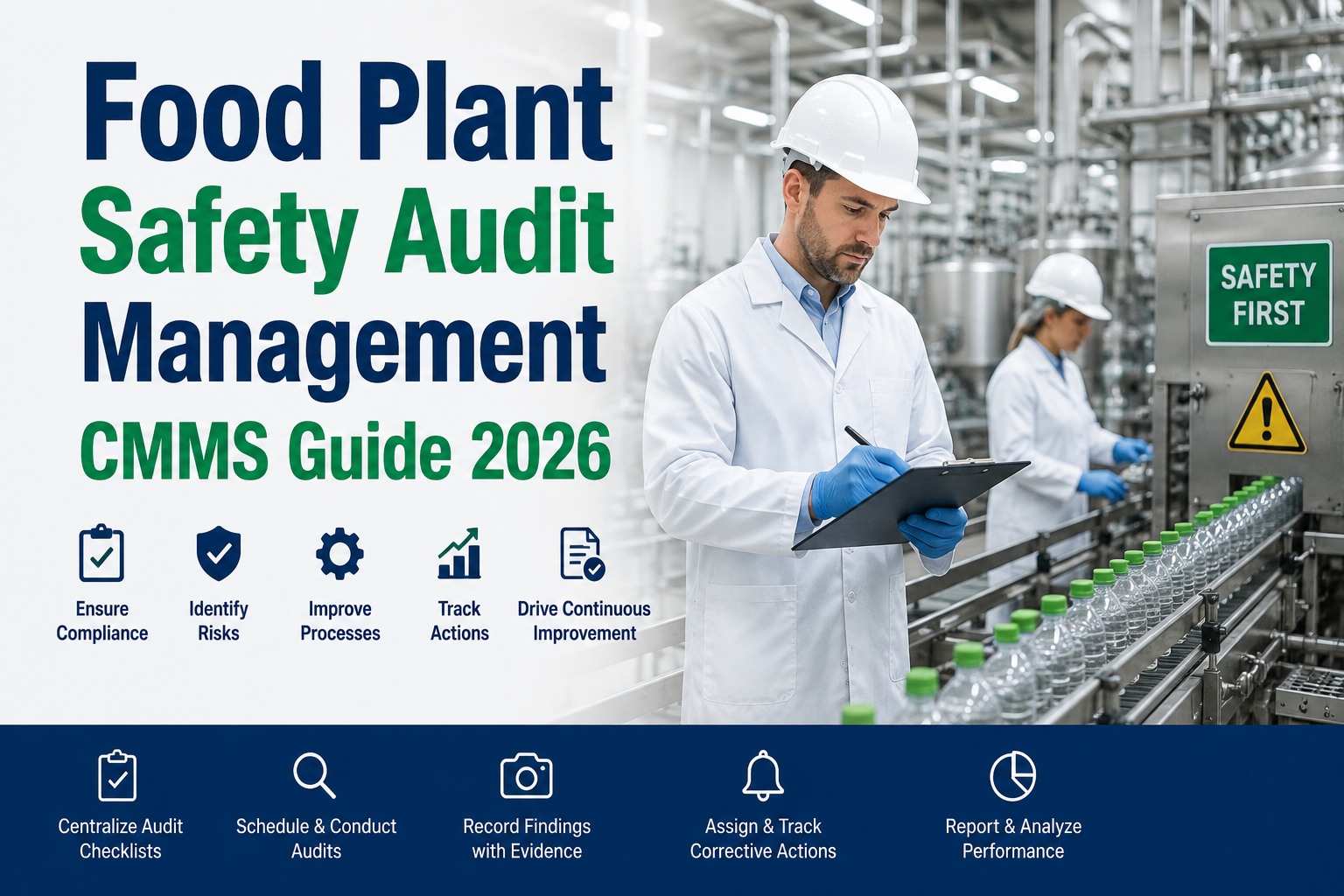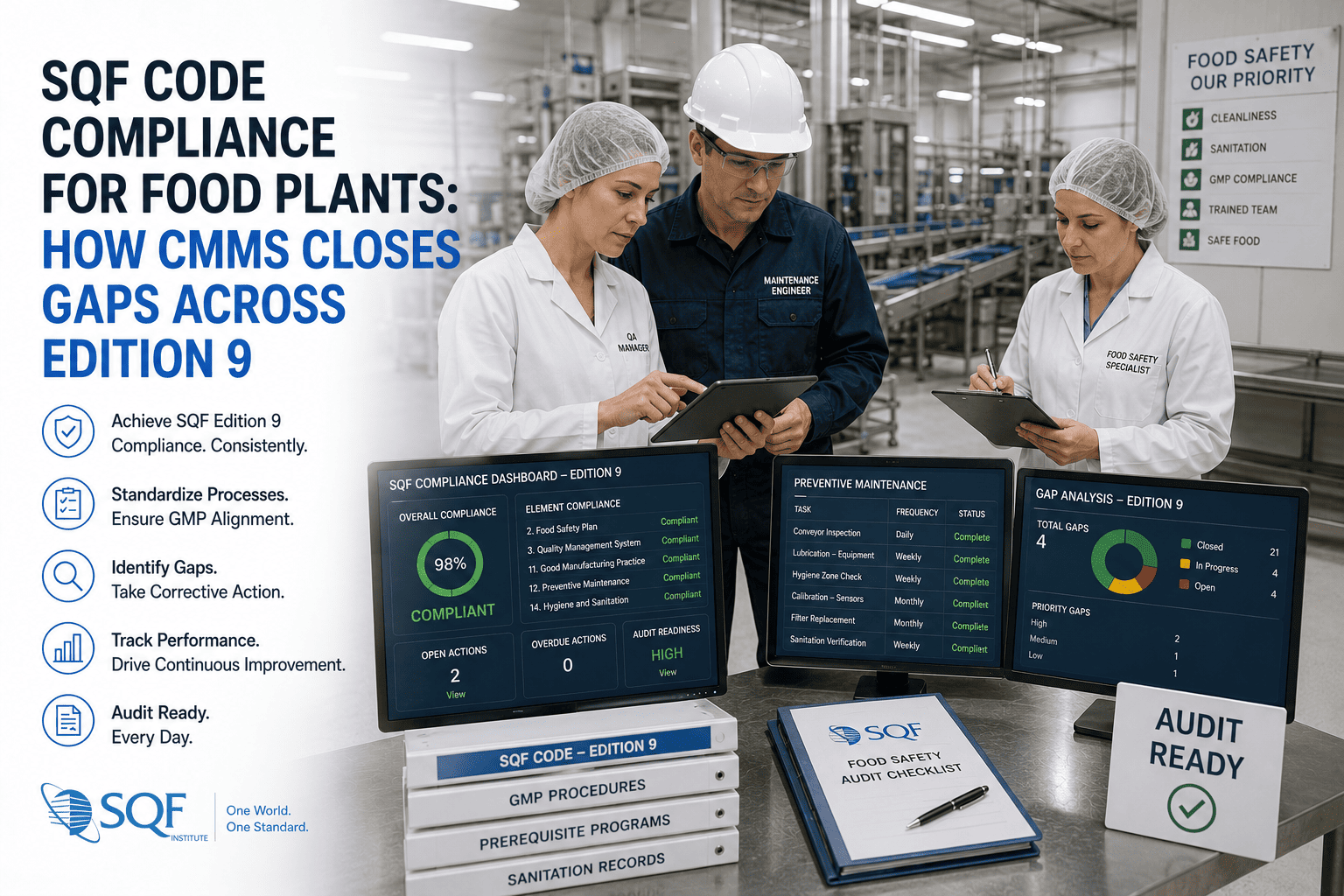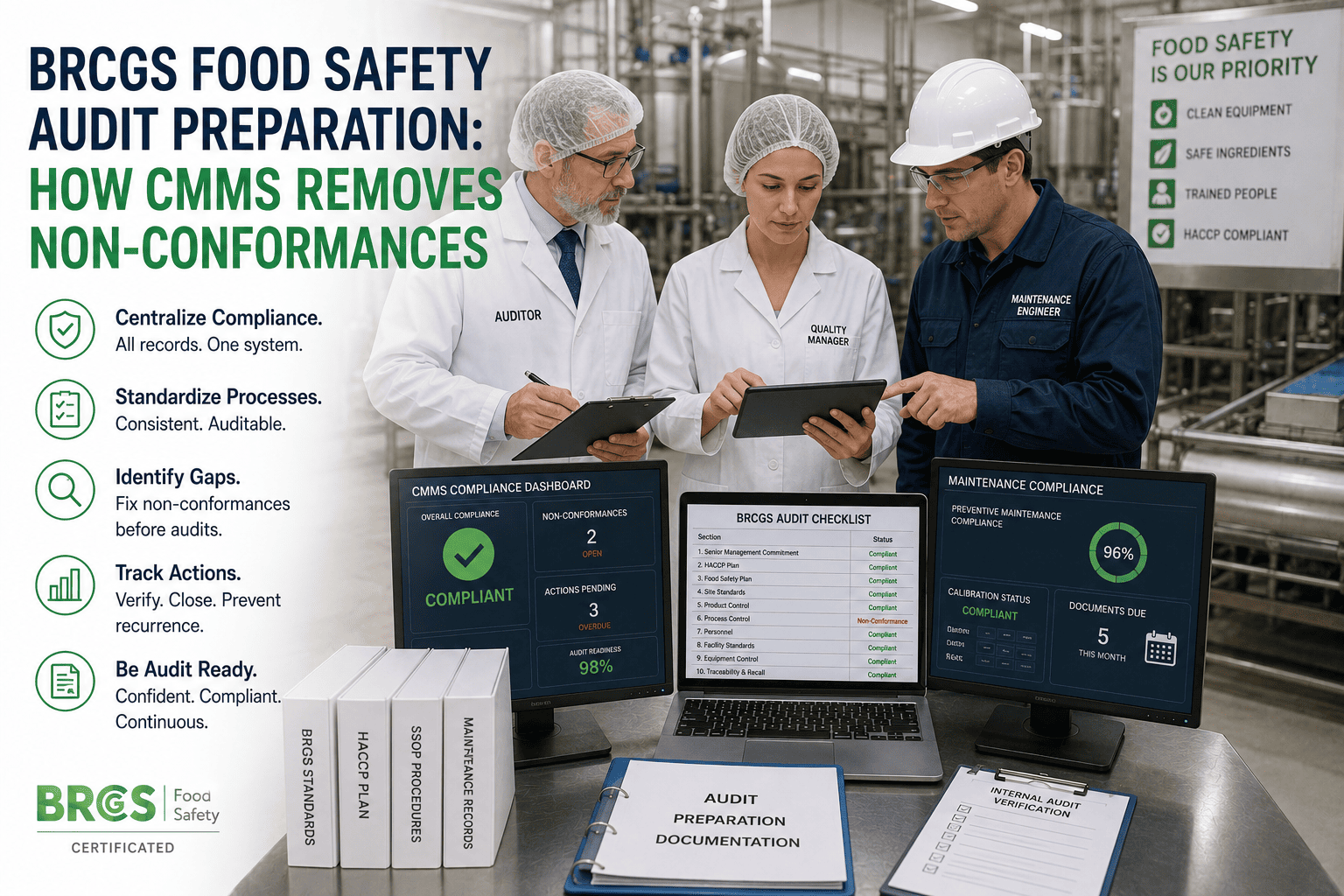
FSMA 21 CFR Part 117 maintenance compliance with a CMMS isn't optional for food manufacturers — it's the difference between walking out of an FDA inspection clean and receiving a Form 483 observation that triggers a warning letter, a recall, or a facility shutdown. Under FSMA's Preventive Controls for Human Food rule, maintenance teams aren't just responsible for keeping equipment running; they're responsible for generating the specific, attributable, contemporaneous records that prove their PM programs were executed as written. Start a free trial to see how OxMaint's CMMS captures every FSMA-required maintenance record automatically, or book a demo and we'll map your current documentation workflow against 21 CFR Part 117 requirements.
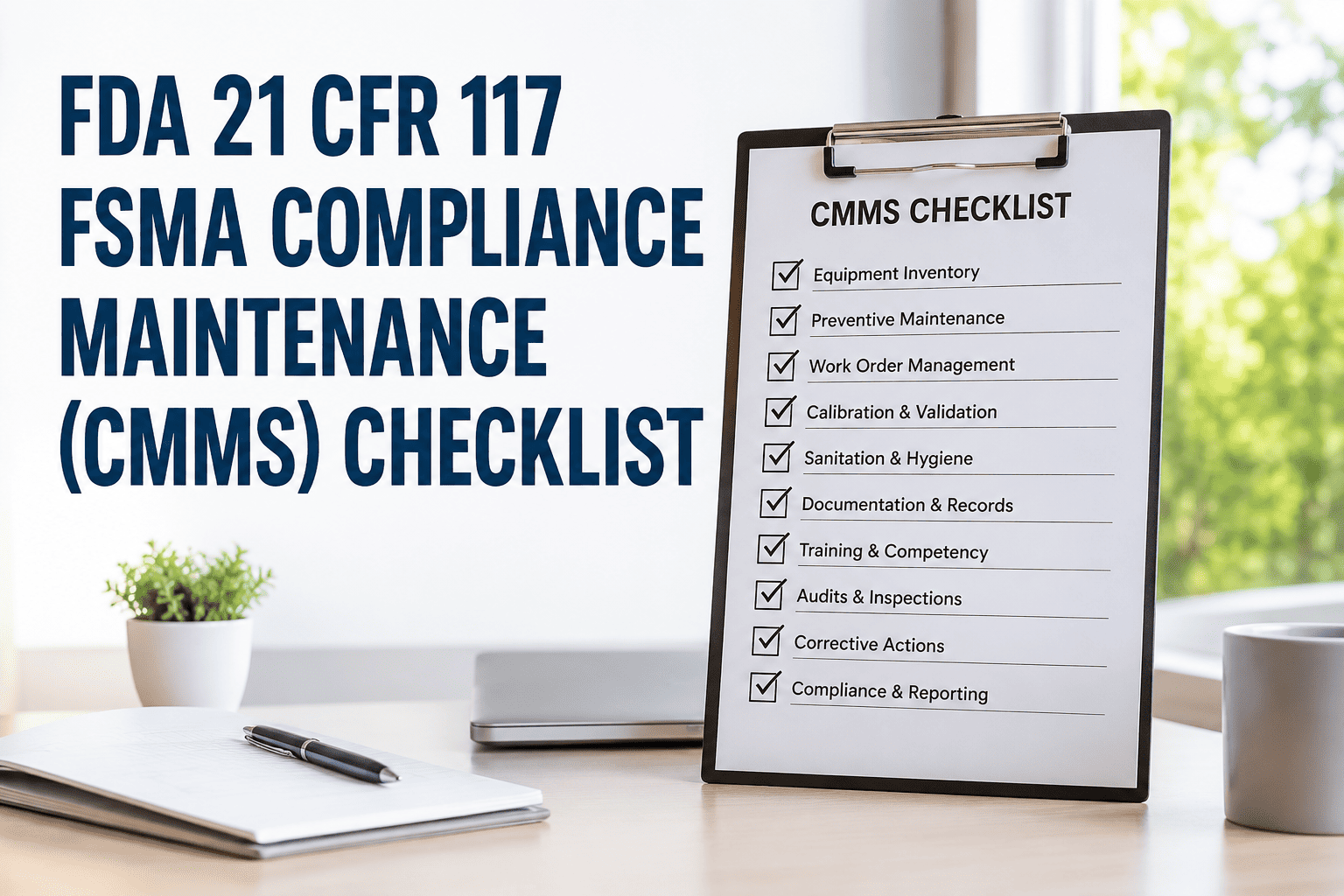
FDA 21 CFR Part 117 Maintenance Compliance Checklist
A CMMS-driven audit checklist for food plant maintenance managers — covering every documentation requirement FDA investigators verify when reviewing your preventive controls program under FSMA.
See how OxMaint captures every FSMA 21 CFR Part 117 maintenance record — contemporaneous, attributed, tamper-evident, and retrievable in under 2 minutes.
- Timestamped PM completion records with technician sign-off — satisfying 21 CFR § 117.305
- Calibration records for CCP instruments auto-linked to equipment IDs
- Two-year tamper-evident audit trail meeting FDA 21 CFR Part 11 requirements
Trusted by food manufacturing teams managing 10,000+ assets · Live in days, not months.
What Is FSMA 21 CFR Part 117 Maintenance Compliance?
FSMA 21 CFR Part 117 — the Preventive Controls for Human Food rule — requires food manufacturers to identify equipment-related hazards in their Food Safety Plan, implement maintenance programs that address those hazards, and maintain records demonstrating the program is being executed as written. It is the most prescriptive FDA food safety regulation on maintenance program content ever issued, and it fundamentally changed what "doing maintenance" means in a regulated food facility.
For maintenance teams specifically, 21 CFR Part 117 creates three layers of obligation: the maintenance activities themselves must be defined in written procedures; those activities must be performed and documented contemporaneously (recorded at the time of performance, not later); and the records must be attributable to identified individuals, indelible, legible, accurate, and retrievable for a minimum of two years from creation. A CMMS — properly configured and validated under 21 CFR Part 11 for electronic records — is the most reliable mechanism for meeting all three layers consistently.
FDA investigators reviewing FSMA compliance don't just check whether a PM schedule exists. They verify execution: Was each PM performed on the scheduled date? Who performed it? Was the sanitation step completed after maintenance on food-contact equipment? Were deviations documented and corrective actions taken? CMMS records that answer all four questions instantly — without paper hunting or database exports — are what separate clean FDA inspections from Form 483 findings. Use OxMaint's inspection management to link maintenance activities directly to your HACCP verification schedule.
FSMA 21 CFR Part 117 Maintenance Compliance Checklist: 8 Requirements, CMMS Edition
This checklist maps each core FSMA maintenance documentation requirement to the specific CMMS record that satisfies it. Use it to audit your current system gaps before an FDA inspection finds them for you.
Where Food Plants Fail FDA Inspections: 4 Maintenance Record Gaps
Technicians completing paper PM records hours or days after the work was done — or CMMS entries backdated — violate 21 CFR § 117.305(d). FDA investigators review system audit trails and metadata. Records without real-time timestamps generate immediate findings regardless of whether the maintenance was actually performed.
A metal detector calibration record missing the as-found value, or a pasteurizer PM with no technician signature, is not a complete record under 21 CFR § 117.305(f). Investigators look specifically at CCP-linked equipment first. Gaps here escalate from observations to warning letters faster than any other finding category.
Under 21 CFR § 117.150, missed or delayed preventive controls require documented corrective action — not just rescheduling. A PM that was 3 weeks overdue and then completed, with no record of why it was delayed or what was done in the interim, is a corrective action gap. FDA expects proof that you identified, addressed, and verified resolution of every deviation.
If your CMMS uses electronic records in lieu of paper to satisfy FDA requirements, those records must meet Part 11: individual user authentication, audit trails, electronic signatures, and controls against record alteration. Using a CMMS that lacks Part 11 validation — or that was never validated for its intended use — means your electronic records may not be legally acceptable regardless of their content.
These gaps are preventable with the right system in place — start a free trial to evaluate OxMaint's Part 11-compliant maintenance records, or book a demo and we'll show you exactly how the audit trail works during a simulated FDA review.
How OxMaint Automates FSMA 21 CFR Part 117 Maintenance Compliance
OxMaint maps your PM schedule directly to your HACCP control points. CCP-linked equipment carries elevated priority flags, shorter PM intervals, and mandatory pre-restart verification steps — enforced in the system, not just documented in a policy. See how preventive maintenance scheduling integrates with your food safety plan.
Technicians scan equipment QR codes to open and complete work orders on the floor. The timestamp is applied at closure, not at entry. Individual login ensures attribution. Records are immediately tamper-evident and retrievable — no paper collection lag, no backdating risk.
OxMaint automatically generates a sanitation work order after every maintenance task on food-contact equipment. The sanitation record — method, chemical, contact time, rinse verification — is permanently linked to the maintenance record, creating the full documentation chain FDA investigators expect to see in a single retrieval.
When a PM is missed, delayed, or completed out of spec, OxMaint auto-creates a corrective action work order. Root cause, corrective measure, and verification fields are enforced — the record can't be closed without them. No manual CAPA log to maintain separately from your CMMS. Explore OxMaint EHS management for integrated corrective action tracking.
Any record — PM completion, calibration, sanitation, corrective action — is retrieved in under 2 minutes by equipment ID, technician, date, CCP, or batch number. When an FDA investigator asks for the last 24 months of pasteurizer maintenance records, you pull them in real time, not across a two-day retrieval scramble.
Paper-Based vs. CMMS Compliance: What the Difference Costs
| Compliance Area | Paper / Spreadsheet System | OxMaint CMMS (Part 11 Compliant) |
|---|---|---|
| Record contemporaneity | Technician fills paper log after shift — timestamp gap | Timestamp applied at equipment location at closure |
| Technician attribution | Handwritten signature — illegible or missing on audit | Individual authenticated login — Part 11 compliant |
| CCP calibration tracking | Separate spreadsheets by instrument — gaps inevitable | Auto-scheduled, linked to each asset ID, auto-escalated when overdue |
| PM deviation documentation | Typically not documented — deviation never recorded | Auto-generated corrective action record with root cause |
| Record retrieval on audit | 2–5 days searching filing cabinets or shared drives | Any record retrieved by equipment or date in under 2 min |
| 2-year retention guarantee | Physical records lost, damaged, or misfiled | Cloud-retained with immutable audit trail for full period |
| FDA Form 483 risk | High — most common source of maintenance-related observations | Minimized — records satisfy all § 117.305 requirements by design |
FSMA Compliance Outcomes: What CMMS-Driven Programs Deliver
Use the OxMaint ROI Calculator to estimate what one prevented FDA finding is worth to your facility, then book a demo to see the compliance record system in a live environment.
FSMA 21 CFR Part 117 Maintenance Compliance: Frequently Asked Questions
What maintenance records does FSMA 21 CFR Part 117 require food plants to maintain?
Does a CMMS need to be validated to satisfy FDA 21 CFR Part 11 for food manufacturing?
What happens if a scheduled PM is overdue under FSMA 21 CFR Part 117?
Can OxMaint satisfy FSMA maintenance documentation requirements for multi-site food operations?
OxMaint for Food Manufacturing Compliance
FSMA 21 CFR Part 117 Compliance Starts With the Right CMMS Maintenance Record System
FDA investigators don't accept "we were busy" as an explanation for missing PM records. OxMaint's CMMS captures every maintenance activity with contemporaneous timestamps, individual attribution, tamper-evident audit trails, and instant retrieval — satisfying every 21 CFR Part 117 documentation requirement automatically, on every shift, at every site.
- Part 11-compliant records: attributed, contemporaneous, immutable, retrievable in under 2 minutes
- Auto-linked sanitation records and corrective action documentation — no separate logs to maintain
- HACCP-integrated PM scheduling prevents CCP gaps before they become FDA findings
Trusted by 1,000+ food manufacturing and regulated facility teams · FDA-inspection-ready from day one.