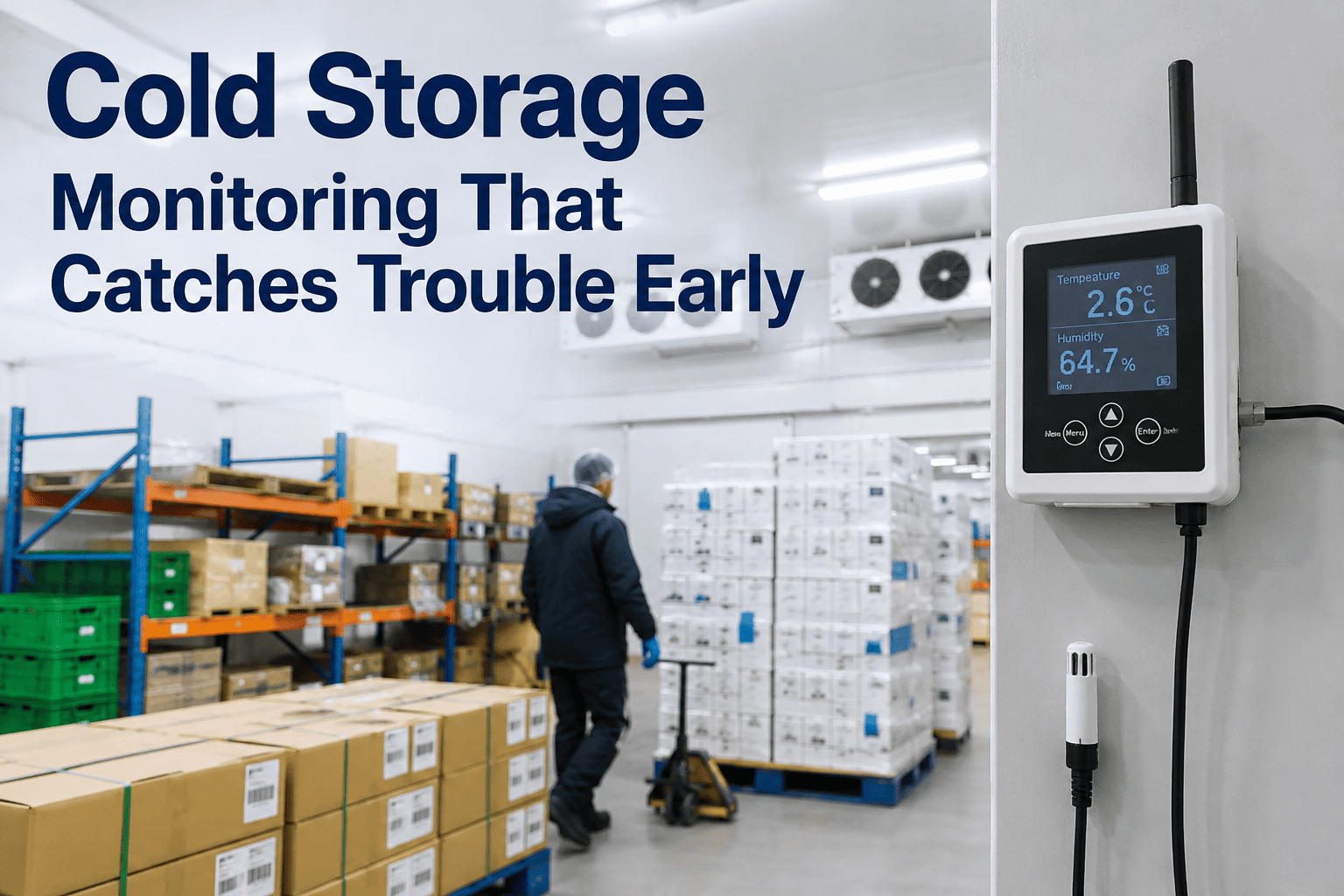
Predicting cooling capacity loss before it becomes a deviation is where cold storage compressor predictive maintenance either delivers real value or stays theoretical. By leveraging run-time trend analysis, sensor-based compressor performance monitoring, and CMMS-integrated predictive maintenance (PdM), reliability teams can catch cooling degradation weeks before excursions cross into a Critical Control Point (CCP) deviation. This compressor guide for food and cold storage operations breaks down capacity trending, AI-driven alert mechanisms, and the exact CMMS workflows that prevent product loss. See how OxMaint can modernize your maintenance program when you Start Free Trial today.
What if you could predict a CCP deviation 3 weeks before the alarm ever triggers?
Run-time trend analysis and AI capacity monitoring catch cooling degradation early. Stop reacting to compressor failures and start preventing food loss with a CMMS built for predictive maintenance.
Why cooling capacity loss goes undetected until it's a deviation
In most cold storage facilities, compressors are monitored by threshold alarms set to trigger only when temperature crosses a defined limit. By the time that alarm sounds, the compressor has already lost significant cooling capacity, and the system is minutes or hours away from a Critical Control Point (CCP) deviation. The root cause is rarely sudden—it is a slow degradation in performance caused by valve wear, refrigerant leakage, fouled condensers, or oil dilution that compounds over weeks.
Without a predictive CMMS tracking run-time trends, maintenance teams are blind to the slow decline. A compressor guide for food facilities must account for the reality that legacy monitoring only captures the end-state, not the trajectory. Cold storage compressor predictive maintenance changes the paradigm by continuously analyzing performance data—amperage draw, head pressure, suction temperature, and run hours—to forecast capacity loss before it impacts product safety.
How to monitor compressor performance for early capacity loss
Effective compressor performance monitoring requires tracking specific variables that correlate directly with cooling capacity. Rather than waiting for a temperature spike, reliability teams use sensor-based prediction to measure the efficiency curve of the refrigeration cycle in real-time. Here is the timeline of how predictive maintenance catches degradation weeks in advance.
Baseline performance established
The CMMS ingests historical run-time data and establishes a baseline cooling capacity curve for each compressor. Metrics like kWh per ton of refrigeration and compressor sweep efficiency are locked in as the healthy benchmark.
Micro-trends detected by AI
Sensors detect a 2-3% drop in cooling efficiency. Discharge temperatures rise slightly while amperage increases to maintain the same load. The CMMS AI engine flags this as an anomaly worth tracking, though no alarms are triggered on the floor.
Predictive alert generated
Capacity trending confirms a sustained downward trajectory. The CMMS food AI compressor alert system predicts a CCP deviation risk within 14 days and automatically generates a priority work order for inspection and corrective maintenance.
Corrective action prevents deviation
Technicians address the root cause—often a fouled condenser or leaking discharge valve—during planned downtime. Cooling capacity is restored to baseline, and the excursion is prevented entirely without product loss or audit failures.
The CMMS-integrated PdM approach for cold storage
A spreadsheet cannot predict a compressor failure, and a standalone SCADA system cannot automatically dispatch a maintenance technician. The gap between detecting an anomaly and fixing it is where cold storage compressor predictive maintenance either succeeds or fails. Integrating PdM directly into a CMMS bridges this gap, turning sensor data into automated work orders, parts reservations, and compliance-ready audit trails.
The core predictive metric tracks the deviation from baseline efficiency over time:
When this value exceeds 5% for 3 consecutive days, the CMMS triggers a predictive work order. If it exceeds 10%, an urgent critical alert is escalated to the maintenance manager.
| Maintenance Approach | Detection Point | Average Advance Warning | Product Loss Risk |
|---|---|---|---|
| Reactive (Run-to-Failure) | After temp deviation | 0 days | Severe |
| Preventive (Time-Based) | Scheduled inspection | Variable (often too late) | Moderate |
| Predictive (CMMS-Integrated) | AI trend analysis | 14-21 days | Near Zero |
A 180-asset cold storage facility prevents a $240K product loss
The Situation
A regional food distribution center operating 180 refrigerated assets was spending $42K annually on emergency compressor rebuilds. During a summer heatwave, two ammonia compressors began losing cooling capacity. Without predictive monitoring, the team would have discovered the issue only when the high-temp alarm sounded—by which point $240K of frozen inventory would have entered the danger zone.
The OxMaint Outcome
By deploying CMMS cold storage compressor predictive monitoring, the facility's maintenance team received an AI-driven alert 18 days before the projected deviation. The system automatically generated a work order, reserved the necessary spare parts (valve plates and gaskets) from inventory, and scheduled the repair during a low-load period. The compressors were restored to 98.6% efficiency with zero product loss and zero overtime labor costs.
How OxMaint predicts cooling capacity loss before it becomes a deviation
OxMaint is an AI-powered CMMS and EAM platform designed to move maintenance teams from reactive firefighting to predictive precision. For cold storage compressor predictive maintenance, OxMaint connects directly to your sensor infrastructure to automate trend analysis, work order generation, and parts management—ensuring no capacity degradation goes unnoticed.
AI-Powered Capacity Trending
OxMaint continuously analyzes compressor performance metrics against historical baselines. The AI detects micro-trends in amperage, head pressure, and cooling efficiency, predicting capacity loss up to 21 days before a CCP deviation occurs.
Outcome: Eliminate unplanned temperature excursionsAutomated Predictive Work Orders
When the predictive engine flags a degradation trajectory, OxMaint automatically generates a priority work order, assigns it to the right technician, and reserves the necessary spare parts from inventory—all without manual intervention.
Outcome: Cut unplanned downtime by 30-50%Real-Time Asset Performance Tracking
Track every compressor, evaporator, and condenser in a single dashboard. OxMaint maps asset health hierarchies and links run-time data to maintenance history, giving you full visibility into cooling capacity across your entire facility.
Outcome: 100% audit-ready compliance recordsIntegrated Spare-Parts Inventory
Never get caught waiting for a critical compressor part again. OxMaint links predictive alerts directly to your inventory management system, automatically reserving valve plates, refrigerants, and gaskets before the work order begins.
Outcome: Reduce emergency parts spend by 25%See OxMaint predict cooling loss on your compressors
Book a 30-minute demo and watch how our AI-powered CMMS catches capacity degradation weeks before it threatens your cold storage CCPs.
Cold storage compressor predictive maintenance FAQs
What is cold storage compressor predictive maintenance?
Cold storage compressor predictive maintenance uses sensor data, run-time trend analysis, and AI to forecast when a compressor will lose cooling capacity or fail. Instead of relying on time-based schedules or threshold alarms, a predictive CMMS like OxMaint continuously monitors performance metrics—such as amperage draw and discharge temperature—to detect degradation weeks before a CCP deviation occurs. You can see this in action when you Book a Demo.
How does a CMMS predict cooling capacity loss?
A CMMS predicts cooling capacity loss by establishing a baseline efficiency curve for each compressor and then tracking real-time sensor data against that baseline. When metrics like kWh per ton of refrigeration deviate by more than 5% over a sustained period, the CMMS AI engine generates a predictive alert and automatically creates a work order for inspection and corrective maintenance before the deviation happens.
How much advance warning does predictive maintenance provide for compressor failures?
With a properly configured CMMS cold storage compressor predictive system, maintenance teams typically receive 14 to 21 days of advance warning before a critical cooling capacity loss crosses into a CCP deviation. This window provides enough time to order parts, schedule downtime, and execute repairs without risking product integrity or triggering compliance failures.
Can OxMaint integrate with our existing cold storage sensor infrastructure?
Yes. OxMaint is designed to connect with standard industrial IoT sensors, PLCs, and building management systems (BMS) commonly used in cold storage facilities. The platform ingests real-time data from pressure transducers, temperature probes, and power meters to feed its predictive algorithms, meaning you do not need to rip and replace your existing hardware to start predicting capacity loss.
Is a predictive CMMS cost-effective for small cold storage operations?
Absolutely. Even a single CCP deviation can cost $250K or more in lost product, making the ROI of a predictive CMMS compelling for operations of any size. OxMaint scales from small facilities to enterprise multi-site networks, and preventing just one major excursion per year typically pays for the entire system. You can explore pricing and features when you Start Free Trial.
Stop reacting to compressor failures. Start predicting them.
Join the maintenance teams using OxMaint to prevent cooling capacity loss, eliminate product deviations, and cut emergency repair costs by up to 38%.
Free 14-day trial · No credit card