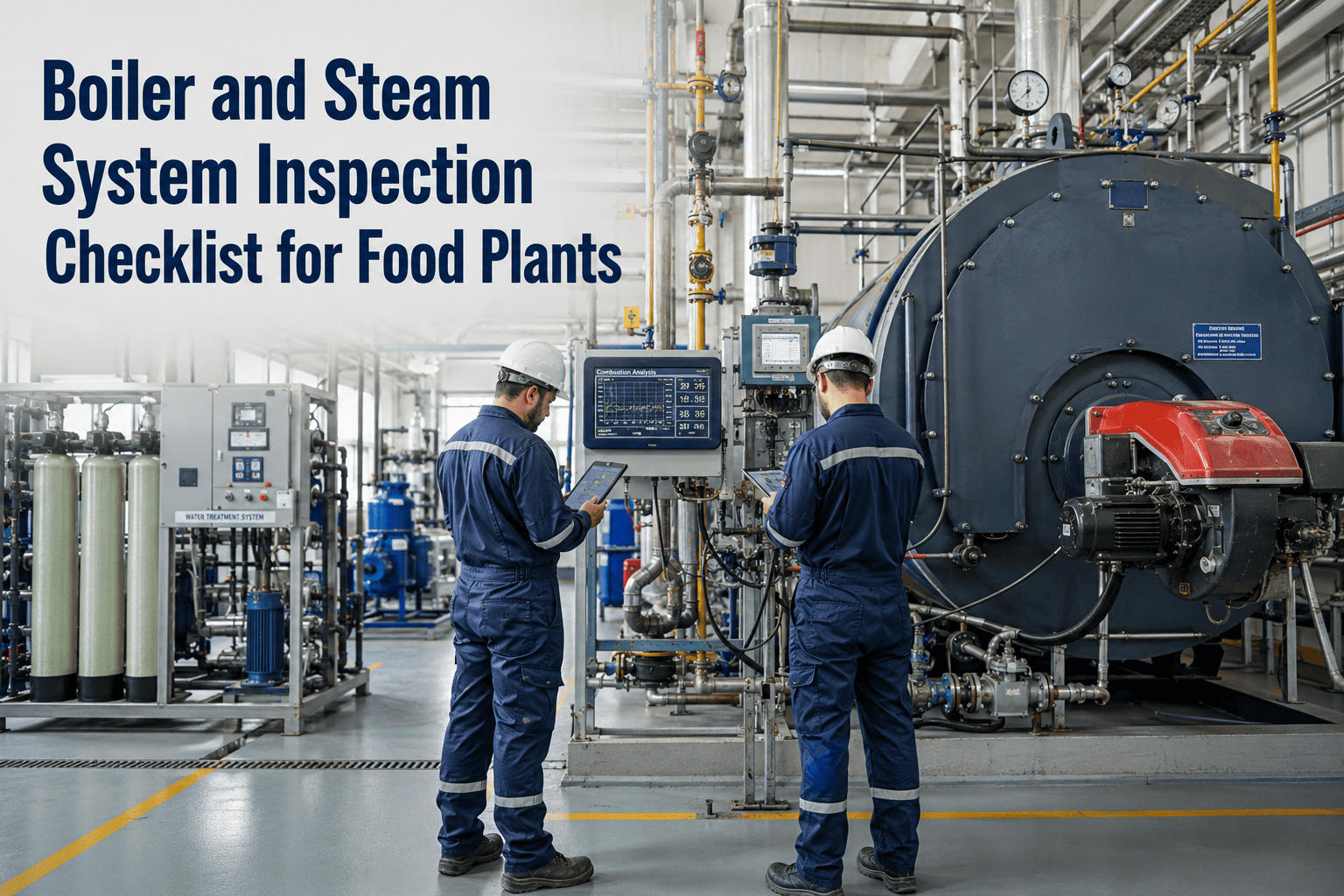
Boiler and steam system maintenance in food manufacturing facilities is a mission-critical discipline that intersects regulatory compliance, production uptime, and food safety assurance. Plant engineers managing steam generation assets — from fire-tube and water-tube boilers to complex condensate return networks and steam trap arrays — must implement structured preventive maintenance programs that satisfy both boiler inspection regulations and food-grade steam quality requirements. Whether you're building your first boiler PM schedule or optimizing an existing steam system in a high-throughput food processing facility, this guide provides the technical depth and actionable framework you need. Sign up for OxMaint to connect your boiler and steam system maintenance program to a compliance-ready CMMS built for food plant engineers.
Automate Boiler PM Scheduling with a Food Plant CMMS
OxMaint helps plant engineers schedule boiler inspections, track steam trap maintenance, log water treatment readings, and stay audit-ready — all in one platform designed for food manufacturing compliance.
Why Boiler Maintenance Is Critical in Food Manufacturing
Steam is the workhorse utility of food processing — driving pasteurization, cooking, sterilization, CIP sanitation circuits, and HVAC systems across the facility. A boiler failure in a food manufacturing plant is never just a maintenance event; it is a production stoppage with direct food safety implications when temperature-sensitive processes lose their thermal energy source. Regulatory bodies including FDA and USDA require documented boiler maintenance records as part of facility inspections, and food safety certifiers under SQF, BRC, and FSSC 22000 frameworks review steam system maintenance histories as part of prerequisite program audits.
The financial exposure from neglected boiler and steam system maintenance extends well beyond repair costs. Boiler scale buildup of even 1mm thickness reduces heat transfer efficiency by up to 10%, translating directly to fuel cost increases on continuous steam generation equipment. Steam trap failures — both open-blow and closed-failure modes — disrupt process temperatures and inflate energy consumption. Sign up free to see how OxMaint helps food plant engineers build proactive boiler PM programs that deliver measurable fuel savings and avoid costly emergency repairs.
Fire-Tube vs. Water-Tube Boilers: Maintenance Implications for Food Plants
Understanding the fundamental design differences between fire-tube and water-tube boilers is essential for structuring appropriate inspection and maintenance intervals. Each boiler type presents distinct maintenance access requirements, failure modes, and inspection protocols that plant engineers must account for in their boiler PM food manufacturing schedules.
| Maintenance Factor | Fire-Tube Boiler | Water-Tube Boiler |
|---|---|---|
| Design Principle | Combustion gases pass through tubes submerged in water-side shell | Water circulates through tubes exposed to combustion gases |
| Primary Failure Modes | Tube corrosion, scale accumulation, tube sheet joint integrity | Tube erosion at high-velocity points, refractory degradation, steam drum internals |
| Annual Inspection Focus | Full draining, tube brushing, chemical descaling for heat transfer efficiency | Burner management system testing, safety valve certification, steam purity analysis |
| Feedwater Sensitivity | High — suspended solids and dissolved oxygen accelerate tube pitting | Very high — requires tighter water quality control at elevated pressures |
| Key PM Activities | Continuous blowdown, chemical oxygen scavenging, deaerator maintenance | Refractory inspection, moisture separator verification, drum internal inspection |
| Food-Grade Steam Suitability | Suitable with GRAS-approved chemical treatment programs | Preferred for high-pressure direct steam injection food processing applications |
| Steam Pressure Range | Typically up to 250 psig; common in small-to-mid food plants | High pressure capable; preferred for large food manufacturing campuses |
Steam Trap Maintenance: The Highest-ROI Steam System Activity
Steam trap maintenance is the single highest-return maintenance activity in any food plant steam system because steam trap failures generate immediate, continuous energy losses and process reliability problems that compound every operating hour they go undetected. A mid-size food processing facility with 200 steam traps can lose $50,000 to $150,000 annually in wasted steam energy from failed-open traps alone — losses that a structured steam trap inspection and maintenance program eliminates at a fraction of that cost. Book a demo to see how OxMaint automates steam trap survey scheduling and work order generation for food manufacturing facilities.
Open-Blow (Passing) Steam Trap Failure
A steam trap that has failed open passes live steam continuously into the condensate return system, wasting energy, pressurizing condensate headers, and causing water hammer events in return piping. Ultrasonic testing and infrared thermography are the primary diagnostic tools for identifying open-blow steam trap failures during operational surveys. Failed-open traps on process heating equipment also cause temperature control instability that affects product quality in cooking and pasteurization applications.
Closed (Blocked) Steam Trap Failure
A steam trap that has failed closed causes condensate to back up in the steam supply piping and process equipment, dramatically reducing heat transfer efficiency and creating water hammer risk as accumulated condensate is entrained in high-velocity steam flow. Closed steam trap failures on food processing heating equipment cause process temperature drop, extended heat-up times, and reduced production throughput. Annual mechanical inspection combined with quarterly ultrasonic surveys provides the detection frequency needed to catch closed-failure traps before production impact occurs.
Steam Trap Inspection and Replacement Scheduling
Steam trap maintenance programs for food manufacturing facilities should include complete population surveys using ultrasonic acoustic testing and infrared thermography on a quarterly cycle for critical process steam traps and a semi-annual cycle for utility steam distribution traps. Trap replacement decisions should be based on failure type, trap age relative to expected service life, and steam pressure class. Maintaining a stocked spare trap inventory sized to 10-15% of the installed population enables same-shift replacement of failed traps on critical process lines.
Boiler Water Treatment: Protecting Steam System Integrity
Boiler water treatment is a non-negotiable component of any food plant steam system maintenance program because untreated or improperly treated feedwater causes scale, corrosion, and carryover that simultaneously destroys boiler assets, reduces efficiency, and compromises food-grade steam quality. Plant engineers must maintain documented water treatment records that demonstrate consistent chemical control within ASME, FDA, and food safety certification program requirements. Get started free to log daily water treatment readings directly to boiler asset records inside OxMaint's compliance-ready CMMS.
| Water Treatment Parameter | Target Range | Risk if Uncontrolled | Monitoring Frequency |
|---|---|---|---|
| pH (Boiler Water) | 10.5 – 11.5 | Acidic corrosion, caustic gouging | Daily |
| Total Dissolved Solids (TDS) | <3,500 ppm (varies by pressure) | Carryover, foaming, scale | Daily / Continuous |
| Dissolved Oxygen | <0.007 mg/L (post-deaerator) | Pitting corrosion of tubes and drums | Weekly |
| Hardness (Feedwater) | <0.5 ppm as CaCO₃ | Scale formation, reduced heat transfer | Daily |
| Sulfite / Oxygen Scavenger Residual | 30–60 ppm (sodium sulfite) | Dissolved oxygen corrosion | Daily |
| Steam Purity (Conductivity) | <0.5 µS/cm (food-grade steam) | Chemical contamination of food product | Weekly |
Food-Grade Steam Compliance: What Plant Engineers Must Know
Food-grade steam compliance is a distinct and elevated requirement for boiler and steam system maintenance in food manufacturing facilities where steam directly contacts food products, food contact surfaces, or food processing equipment during cooking, pasteurization, sterilization, or CIP operations. FDA 21 CFR and international food safety standards including CODEX Alimentarius define food-grade steam as steam that is free from contaminants, non-food-grade chemical additives, and excessive dissolved solids that would render it unsuitable for direct food contact applications.
Achieving and maintaining food-grade steam compliance requires a systems approach that addresses boiler chemical treatment programs — limiting boiler treatment chemicals to GRAS (Generally Recognized as Safe) compounds — steam separator and moisture trap maintenance to eliminate condensate carryover, steam distribution piping integrity, and documented steam purity testing on a scheduled basis. Plant engineers should integrate food-grade steam compliance documentation into their CMMS boiler scheduling workflows to ensure testing records are automatically linked to equipment records and accessible during regulatory inspections.
Schedule Boiler Inspections and Steam Trap Surveys in OxMaint
OxMaint gives food plant engineers a centralized platform to manage boiler PM schedules, water treatment logs, steam trap inspection records, and food-grade steam compliance documentation — with automated work order generation that closes the loop from inspection to corrective action.
Condensate Return System Maintenance for Food Plants
Condensate return system maintenance is frequently underinvested in food manufacturing steam programs despite the fact that effective condensate recovery directly reduces boiler feedwater costs, lowers chemical treatment consumption, and decreases blowdown heat losses. A condensate return rate of 80-90% is achievable in well-maintained food plant steam systems; facilities operating below 60% condensate return are losing significant operational value to flash steam losses, steam trap failures, and condensate receiver inefficiencies.
Condensate Receiver Tank Inspection
Condensate receiver tanks accumulate oxygen from flash steam venting and are susceptible to internal corrosion that introduces iron oxide into the feedwater system. Annual internal inspection, corrosion measurement, and vent condenser performance verification protect both the receiver and downstream boiler assets from accelerated corrosion damage caused by contaminated feedwater.
Condensate Return Pump Maintenance
Condensate return pumps operate in a challenging environment — handling near-saturated hot condensate at temperatures that promote cavitation when pump inlet pressure is insufficient. Scheduled mechanical seal inspection, impeller clearance verification, and cavitation damage assessment at 6-month intervals maintains condensate return pump reliability that sustains high condensate recovery rates.
Return Piping and Insulation Integrity
Condensate return piping in food manufacturing facilities is susceptible to internal corrosion from dissolved oxygen and carbonic acid. Ultrasonic thickness testing of condensate piping at high-corrosion-risk locations — low points, after control valves, at drip legs — on an annual cycle identifies wall thinning before pipe failures cause production interruptions and facility damage.
Deaerator Performance Maintenance
Deaerator performance directly determines dissolved oxygen levels in boiler feedwater — the primary driver of tube pitting and boiler corrosion in food plant steam systems. Spray nozzle condition, tray integrity, vent valve operation, and level control instrumentation must be verified during scheduled maintenance outages to maintain dissolved oxygen removal efficiency within specification.
Boiler Inspection Requirements and Regulatory Compliance
Boiler inspection compliance in food manufacturing facilities is governed by state boiler inspection laws, ASME Boiler and Pressure Vessel Code requirements, insurance carrier inspection schedules, and food safety regulatory frameworks that collectively require documented inspection records spanning internal, external, and safety device certifications. Plant engineers must maintain a boiler inspection calendar integrated with their CMMS boiler scheduling system that automatically generates preparation work orders ahead of inspection dates.
Safety valve testing and certification is among the most time-sensitive boiler inspection compliance requirements. ASME CSD-1 and most state boiler codes require safety valve pop testing at annual intervals, with documentation that verifies set pressure accuracy within ±3% of nameplate. Safety valve failures during compliance inspections generate immediate operational restrictions — making proactive safety valve maintenance scheduling a top priority in any food plant boiler PM program. Book a demo to see how OxMaint tracks safety valve certification deadlines and auto-generates preparation work orders before each inspection window.
CMMS Integration for Boiler and Steam System Maintenance Scheduling
CMMS boiler scheduling integration transforms steam system maintenance from a reactive, calendar-managed activity into a structured, condition-aware maintenance program that closes the loop between inspection findings, corrective actions, and compliance documentation. Plant engineers who manage boiler assets in a CMMS gain the ability to link water treatment readings to equipment records, attach inspection reports to boiler asset histories, and automatically generate PM work orders that ensure no inspection interval is missed regardless of personnel changes or scheduling disruptions.
Automated PM Work Order Generation
Preconfigured boiler PM templates trigger work orders on daily, weekly, monthly, quarterly, and annual schedules — covering blowdown procedures, water treatment sampling, safety valve testing, and annual internal inspections — without manual scheduling intervention.
Water Treatment Log Integration
Daily water treatment readings — pH, TDS, dissolved oxygen, hardness, chemical residuals — logged directly to boiler asset records in the CMMS create the continuous water quality documentation trail that regulatory inspectors and food safety auditors require to verify treatment program compliance.
Steam Trap Survey Management
Complete steam trap population records — trap type, location, age, last test result, and replacement history — maintained in CMMS asset registers support systematic survey scheduling, failure trend analysis, and replacement budget forecasting that improves steam system efficiency year over year.
Compliance Documentation and Audit Readiness
Automated boiler inspection record archiving, safety valve certification tracking, and regulatory inspection scheduling ensures complete compliance documentation is instantly accessible during state boiler inspections, insurance audits, and food safety certifier reviews — eliminating last-minute record compilation scrambles.
Building a Boiler and Steam System PM Program: Phase Roadmap
A structured, phased implementation approach allows food manufacturing plants to build a comprehensive boiler and steam system maintenance program systematically — delivering measurable efficiency and compliance improvements at each stage rather than attempting a complete program overhaul simultaneously.
Boiler Compliance Baseline and Safety Device Certification
Establish complete boiler asset records in your CMMS including nameplate data, inspection history, safety valve certification status, and boiler water treatment program documentation. Complete any overdue state inspection certifications and safety valve pop tests before advancing to operational optimization phases. Regulatory compliance must be the foundation of every boiler maintenance program in food manufacturing.
Water Treatment Program Optimization and Monitoring
Implement systematic daily water treatment monitoring with CMMS-logged readings and automated out-of-range alerts. Verify chemical feed equipment calibration, deaerator performance, and blowdown control settings. Engage your water treatment supplier for a comprehensive system audit that establishes validated target ranges for your specific boiler operating conditions and food-grade steam requirements.
Steam Trap Population Survey and Remediation
Conduct a complete steam trap population survey using ultrasonic and infrared thermography tools to establish baseline trap condition across the facility. Create a complete trap asset register in the CMMS, document all identified failures, and implement a replacement priority list based on failure mode, process criticality, and estimated energy loss. Establish a recurring quarterly survey schedule for critical process traps.
Condensate Return Optimization and Energy Performance Monitoring
Implement condensate return rate monitoring, flash steam recovery analysis, and distribution piping integrity assessment to maximize steam system energy efficiency. Integrate boiler fuel consumption, steam production, and condensate return data into energy performance dashboards that demonstrate sustainability progress and identify further efficiency opportunities. Book a demo with OxMaint to see how your steam system data feeds a fully integrated food plant maintenance platform.
Frequently Asked Questions
How often should boilers in food manufacturing plants be inspected?
Boiler inspection frequency in food manufacturing facilities is governed by state boiler inspection laws, which typically mandate annual internal and external inspections by a licensed boiler inspector. In addition to statutory inspections, insurance carrier requirements often include separate annual certification visits. Plant engineers should also implement internal monthly operational inspections covering safety device function, water level controls, combustion performance, and blowdown system operation to maintain boiler reliability between formal regulatory inspections.
What is food-grade steam and why does it matter for compliance?
Food-grade steam is steam that meets purity standards suitable for direct contact with food products, food contact surfaces, and food processing equipment. FDA and international food safety standards require that steam used in direct food contact applications be free from non-GRAS boiler treatment chemicals, excessive dissolved solids, and microbial contamination. Maintaining food-grade steam compliance requires using approved boiler chemical treatment formulations, controlling steam purity through regular conductivity testing, and ensuring steam separator and distribution system integrity prevents condensate carryover into food contact steam supply lines.
What are the most common causes of boiler failures in food plants?
The most common causes of boiler failures in food manufacturing facilities are feedwater quality problems — scale buildup from inadequate softening, pitting corrosion from dissolved oxygen — low water events caused by feedwater control system failures or operator error, safety valve malfunction due to deferred maintenance, and burner management system faults. Each of these failure modes is preventable through structured boiler water treatment programs, daily operational inspections, safety device testing, and CMMS-scheduled preventive maintenance that ensures no inspection interval is missed.
How does steam trap maintenance reduce energy costs in food processing?
Steam traps that have failed open discharge live steam into condensate return systems continuously, wasting the energy invested in steam generation. A single failed DN25 steam trap at 7 bar pressure can waste 400-600 kg of steam per hour depending on orifice size and pressure differential. Across a food plant with hundreds of installed traps, even a 10% failure rate generates substantial annual energy losses. Quarterly ultrasonic trap surveys that identify and replace failed traps typically achieve 3-6 month simple payback periods through energy savings alone, making steam trap maintenance food manufacturing's highest-ROI steam system activity.
How should CMMS boiler scheduling be structured for food manufacturing?
Effective CMMS boiler scheduling for food manufacturing should organize PM work orders across daily, weekly, monthly, quarterly, and annual frequencies. Daily tasks include blowdown procedures, water treatment readings, and safety control checks. Weekly tasks cover chemical feed system verification and combustion analysis. Monthly tasks include safety valve manual testing and heat transfer surface inspection. Quarterly tasks encompass steam trap ultrasonic surveys and deaerator performance checks. Annual tasks cover internal boiler inspection preparation, safety valve pop testing, and regulatory certification renewal. Integration of water treatment logs, inspection records, and corrective action work orders within the CMMS creates the complete compliance documentation trail food plant auditors require.