Multi-Plant Maintenance Standardization for FMCG Corporations
By Jacob miller on March 18, 2026
Two plants in the same FMCG corporation — identical equipment, same production volume, same headcount — were spending $2.3M and $890,000 per year on maintenance. A 2.6x cost gap with no OEE difference. The high-cost plant had a reactive ratio of 71%. The low-cost plant had 22%. Same corporation. Completely different maintenance cultures — because nobody had standardised how maintenance was planned, executed, or measured across the portfolio. This is the defining challenge of multi-plant FMCG maintenance: variance between plants is not random. It is the direct consequence of allowing each site to develop its own PM schedules, KPI definitions, and reporting formats — which looks like local autonomy until you aggregate the numbers.
Stop the Plant-to-Plant Performance Gap
Oxmaint gives corporate teams standardised PM procedures, live benchmarking, and centralised reporting across every site in your portfolio.
typical maintenance cost gap between best and worst plants in same FMCG portfolio
35%
average maintenance cost reduction when best-practice plant procedures are standardised across portfolio
18 months
typical time to full portfolio standardisation when deployed with a corporate CMMS platform
4.2x
ROI on corporate CMMS deployment across a 10+ plant FMCG portfolio within 24 months
Corporate maintenance standardisation — built for multi-plant FMCG portfolios
Oxmaint gives corporate maintenance teams a single platform to deploy standardised PM procedures, centralised KPI reporting, and live plant-to-plant benchmarking across every site in the portfolio.
Why Multi-Plant Maintenance Variance Persists — and Why It's So Expensive
Maintenance variance across a corporate FMCG portfolio is not a competence problem. The plant managers at underperforming sites are not less capable than those at high performers. The variance exists because maintenance is inherently local in its execution and historically invisible at the corporate level. Each plant inherited its maintenance approach from whoever ran it first, layered on whatever each successive maintenance manager added, and was never measured against a common standard — because the common standard didn't exist and the data to enforce it wasn't aggregated. The result is a portfolio where every plant believes it is doing reasonable maintenance, and nobody can prove otherwise until someone audits every site and aggregates the numbers.
Without Multi-Plant Standardisation
xPM schedules written independently per plant — no common task standards
xKPIs defined differently at each site — "OEE" means different things at different plants
xSpare parts purchased separately — no leverage across portfolio volumes
xCorporate reporting relies on manual data collection from each site monthly
xBest practices at Plant A are unknown to Plant B — wheel reinvented every failure
xUnderperforming plants have no external reference point to benchmark against
With Oxmaint Multi-Plant Platform
+Corporate PM library deployed to all sites — updated centrally, applied everywhere
+Identical KPI definitions and calculation methods across every plant in portfolio
+Consolidated spare parts inventory — portfolio-wide contracts and stock visibility
+Real-time corporate dashboard — live KPIs from every plant, no manual reporting
+Best-practice PM procedures flow from top-performing plants to the whole portfolio
+Plant-to-plant benchmarking surfaces underperformance with specific, actionable data
The Five Pillars of Multi-Plant Maintenance Standardisation
Standardising maintenance across a multi-plant FMCG portfolio requires five interconnected pillars deployed in sequence. Each pillar builds on the previous — you cannot standardise reporting without standardised KPI definitions, and you cannot deploy meaningful benchmarking without consistent data from standardised processes. The sequence matters as much as the content.
01
Corporate Asset Registry Standard
A uniform equipment hierarchy, asset classification taxonomy, and nameplate data standard applied across every plant. Without this, "pumps" at Plant A are categorised differently from "pumps" at Plant B and cross-plant comparison becomes impossible. The corporate registry standard is the foundation every subsequent pillar requires.
Asset register completeness per site
Equipment hierarchy depth compliance
Criticality classification coverage
02
Standardised PM Procedure Library
A corporate library of PM task standards by equipment type — developed from the best-performing plant's procedures and validated by reliability engineering. Each standard specifies task steps, frequency, required skills, tools, and pass/fail criteria. Plants access the library through the CMMS and can supplement (not replace) corporate standards with site-specific additions.
PM library coverage by equipment type
Corporate standard adoption rate per site
PM task quality score vs standard
03
Unified KPI Definitions & Measurement
Corporate-mandated KPI definitions that are calculated identically at every site. OEE components, MTBF, MTTR, PM compliance rate, reactive/planned ratio — all must use the same numerators and denominators or cross-plant comparison is meaningless. Oxmaint enforces consistent calculation methods automatically across the portfolio.
KPI definition compliance per site
Automated vs manual data entry ratio
Reporting lag (days from period close)
04
Centralised Reporting & Corporate Dashboard
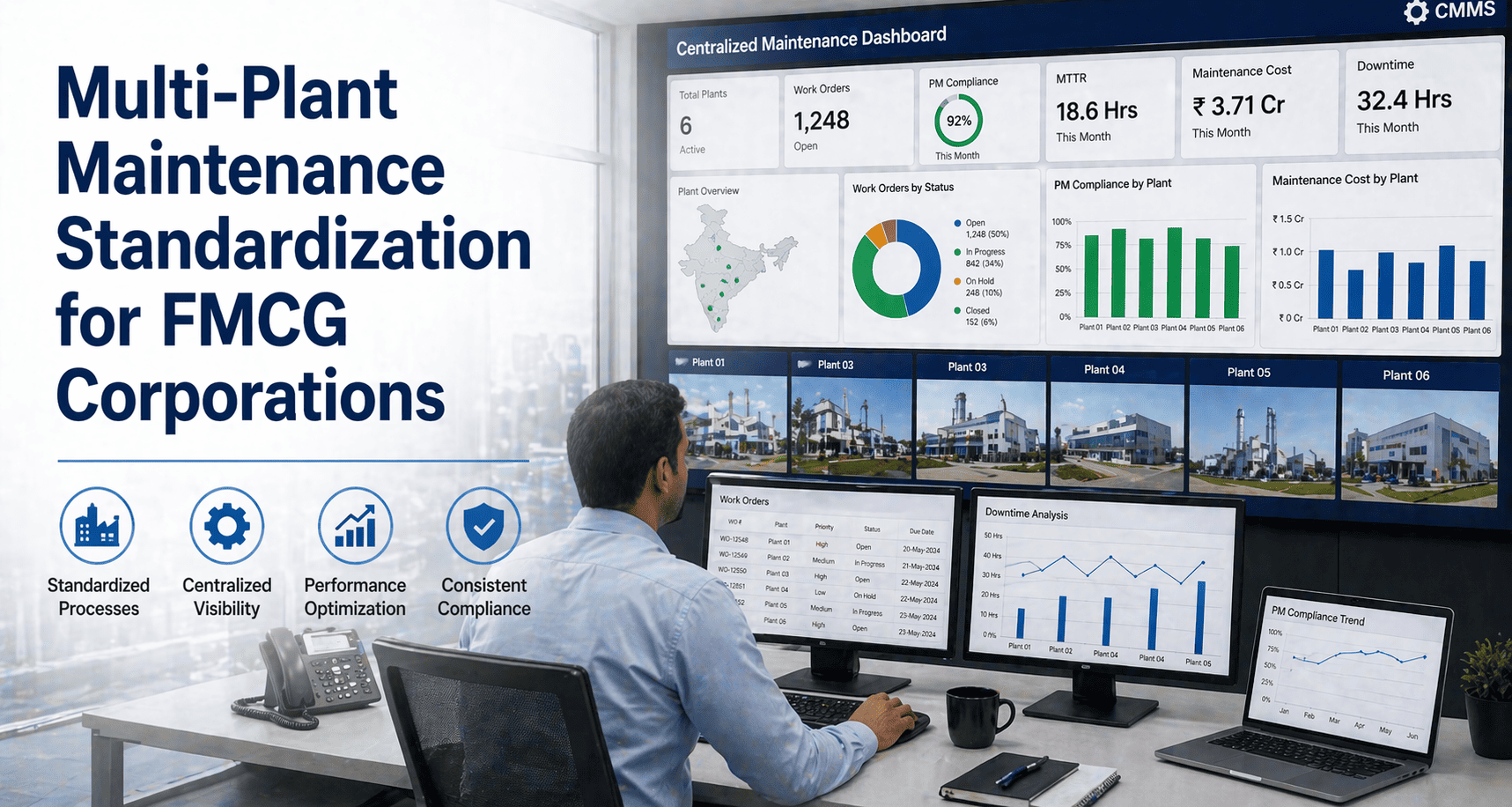
A live corporate dashboard that aggregates KPIs from every plant in real time — no monthly reporting pack, no manual spreadsheet consolidation. Corporate maintenance leaders see OEE, PM compliance, reactive ratio, and cost per RAV for every site simultaneously, with drill-down capability into any plant's work order detail. Exceptions are surfaced automatically.
Dashboard data freshness (hours)
Automated exception alert response time
Manual reporting hours eliminated
05
Plant-to-Plant Benchmarking Engine
Automated cross-plant performance ranking and gap analysis. Every plant sees where it ranks on each KPI relative to peers. Underperforming plants receive automatically generated improvement recommendations based on what the top-quartile plants are doing differently. Best practices identified at one plant are flagged for deployment across comparable sites.
Portfolio KPI rank per plant
Gap to top-quartile plant (per KPI)
Best-practice adoption velocity
06
Consolidated Spare Parts & Procurement
Portfolio-wide spare parts visibility and consolidated procurement. When Plant A has critical stock that Plant B urgently needs, the corporate platform surfaces it in real time — eliminating emergency purchases that the consolidated inventory already holds. Portfolio-level supplier contracts negotiate on total volume rather than individual plant purchases, typically reducing parts cost by 12–22%.
Inter-plant stock transfer utilisation
Portfolio procurement savings vs individual
Critical stockout events across portfolio
The Plant-to-Plant Benchmarking Framework: What to Measure and How
Benchmarking across a multi-plant portfolio is only valid when every plant is measuring the same things the same way. The seven KPIs below are the core benchmarking set for FMCG corporate maintenance — each defined precisely to ensure cross-plant comparability. Plants are ranked on each metric independently, and a composite score is calculated to identify overall portfolio leaders and laggards.
Corporate Portfolio Benchmarking KPIs — FMCG Multi-Plant Standard
Definitions, targets, and what each metric reveals about plant maintenance maturity
KPI
World-Class Target
What It Reveals
OEE — Availability × Performance × Quality
≥85%
Overall equipment effectiveness — the aggregate output of all maintenance effort
PM Compliance Rate
≥90%
Discipline of scheduled maintenance execution — leading indicator of future OEE
Planned vs Reactive Maintenance Ratio
≥70:30
Maturity of the maintenance programme — high reactive = fundamentally reactive operation
Maintenance Cost / Replacement Asset Value
2.0–2.5%
Cost efficiency of maintenance spend — the primary financial benchmark
Mean Time Between Failures (MTBF)
Improving trend
Reliability trajectory — declining MTBF signals deteriorating asset base
Mean Time To Repair (MTTR)
≤2 hrs critical
Repair efficiency — reveals spare parts availability and technician skill gaps
Repeat Failure Rate
≤5%
Root cause analysis quality — high repeat failures = fixing symptoms, not causes
Each KPI uses the same formula, the same data sources, and the same calculation period across all plants. KPI definitions are locked in the CMMS corporate configuration — plant-level users cannot modify calculation methods.
The Benchmarking Matrix: How It Looks in Practice
The corporate benchmarking matrix ranks every plant on every KPI simultaneously. The visual output immediately identifies which plants are performing above and below portfolio average, which KPIs show the widest variance, and which improvement actions will close the gap fastest. Corporate maintenance leaders use this matrix to prioritise where to direct technical support resources, and plant managers use it to identify which peer plants to learn from.
Plant
OEE
PM Compliance
Reactive Ratio
Cost / RAV
Portfolio Rank
Plant Pune
87%
93%
18%
2.1%
#1
Plant Jakarta
79%
88%
31%
3.4%
#2
Plant Bangkok
76%
84%
38%
4.1%
#3
Plant Karachi
61%
71%
68%
7.8%
#4
This matrix updates in real time in the Oxmaint corporate dashboard. Plant managers see their own rank and the gap to the portfolio leader on each KPI — creating the data-driven accountability that drives voluntary improvement without requiring central mandates.
Corporate Dashboard — Oxmaint
See Every Plant's Performance. In One Dashboard. In Real Time.
Oxmaint's corporate portfolio dashboard aggregates live KPIs from every plant, ranks performance automatically, and surfaces improvement opportunities — no manual reporting, no spreadsheet consolidation.
The Financial Case: What Portfolio Standardisation Is Worth
The value of multi-plant maintenance standardisation is not theoretical — it is the arithmetic of closing the gap between your worst-performing plants and your best. Every percentage point of OEE improvement at a single plant translates directly into recovered production capacity. Multiply that across a 10–15 plant portfolio and standardisation becomes one of the highest-return corporate investments available to an FMCG operations leader.
OEE lift — bottom quartile plants (5pp average)
$1.85M/yr
Maintenance cost reduction (25% on laggard plants)
$680K/yr
Spare parts consolidation savings (15% on portfolio)
$420K/yr
Manual reporting elimination (8 hrs/plant/month)
$190K/yr
Emergency inter-plant parts transfers (reduced stockouts)
Year 1 total value — 10-plant FMCG portfolio$3.27M+
4.2x ROI in Year 1 — Compounding to 7–9x by Year 3 as Standards Embed Across Portfolio
The Standardisation Playbook: 18-Month Deployment Across a Multi-Plant Portfolio
Deploying maintenance standardisation across a multi-plant FMCG portfolio requires a sequenced programme — not a simultaneous rollout that overwhelms every plant at once. The 18-month playbook below has been validated across FMCG portfolios of 6–22 plants, delivering consistent standardisation without disrupting ongoing production at any site.
Month 1–3
Foundation: Portfolio Audit and Corporate Standard Definition
Conduct maintenance audit at every plant — current OEE, PM compliance, reactive ratio, maintenance cost/RAV. Identify the top-performing plant as the benchmark reference. Define corporate KPI standards. Build the first version of the corporate PM procedure library from the benchmark plant's best practices. Deploy Oxmaint corporate configuration with shared asset taxonomy and locked KPI definitions. Go live at the benchmark plant first.
Month 4–6
Pilot Cohort: Deploy to 3–4 Plants and Validate Standards
Roll out Oxmaint to the 3–4 plants with the largest gap to the benchmark. Focus on asset registry alignment, PM standard adoption, and live KPI reporting. Capture feedback on corporate standard applicability — some PM standards will need site-specific adaptations for local equipment variants. Establish the corporate dashboard with live data from all pilot plants. Run first benchmarking review with plant managers.
Month 7–12
Portfolio Rollout: Remaining Plants and Spare Parts Consolidation
Deploy to all remaining plants using the validated standards from the pilot cohort. Launch portfolio-wide spare parts visibility — every plant's critical stock visible to all sites and to corporate procurement. Negotiate consolidated supplier contracts on portfolio volume. Begin monthly corporate benchmarking review with all plant managers. Identify and package best practices from top-performing plants for portfolio-wide deployment.
Month 13–18
Optimisation: Continuous Improvement and Corporate Standard Refinement
Full-portfolio KPI review against baseline. Update corporate PM library with improvements discovered during rollout. Deploy predictive maintenance pilots at top-performing plants and package for portfolio rollout. Establish annual corporate maintenance excellence award programme — public recognition of top-ranked plants drives voluntary improvement more effectively than mandates. Set Year 2 targets and launch next improvement cycle.
Common Standardisation Failures — and How to Avoid Them
Most multi-plant standardisation programmes fail not from technical problems but from change management failures. The six patterns below account for the majority of corporate maintenance standardisation initiatives that stall at pilot stage or fail to sustain gains after initial deployment.
Six Failure Patterns in Multi-Plant Standardisation — and the Fix
Mandating standards without involving plant maintenance teams in development
PM standards developed exclusively by corporate and pushed down to plants are perceived as bureaucratic overhead — not tools. The fix: involve the maintenance manager from the top-performing plant in standard development, and include one technician from a mid-performing plant to test applicability. Standards that practitioners helped write get executed. Standards that arrive from headquarters get ignored.
Deploying the CMMS without migrating existing data
The biggest deployment failure: going live on a new platform with a blank asset register while all historical failure data sits in spreadsheets and paper records. Historical data is the only source of plant-specific failure mode patterns. Migrating even 12 months of historical work order data into the new CMMS before go-live makes every subsequent reliability analysis dramatically more accurate.
Publishing benchmarks without context — creating shame, not improvement
Raw KPI rankings without explanatory context trigger defensiveness, not improvement. When Plant Karachi sees it ranked last on OEE, the response is not "how do we improve?" — it is "the equipment here is older" or "we run more product changeovers." The fix: publish rankings alongside the specific action that would close the gap fastest, drawn from what the top-ranked plant does differently. Data plus prescription beats data plus judgement every time.
Standardising PM schedules without validating equipment variants
A corporate PM standard for "filling machine monthly service" written from Plant A's Krones equipment may specify the wrong procedure for Plant B's Tetra Pak line. Before deploying any corporate PM standard, a maintenance engineer must validate it against the actual equipment installed at each site — noting variations, adding site-specific steps, and flagging incompatible procedures for revision.
Measuring compliance without measuring quality
PM compliance rate (% completed on time) is the most commonly tracked metric — and the most easily gamed. A plant can report 95% PM compliance while technicians are signing off tasks without completing them. Corporate standards must include quality verification — photo evidence, measurement records, and pass/fail criteria that prove the work was done correctly, not just that it was closed in the CMMS.
Treating standardisation as a project rather than an operating model
Standardisation programmes that succeed at launch often regress within 18 months because they were treated as a one-time project rather than a permanent operating model. The fix: assign a corporate maintenance standards owner whose role is ongoing — updating the PM library quarterly, running the monthly benchmarking review, managing the corporate asset taxonomy, and ensuring new plants are onboarded to the standard from day one of acquisition.
Frequently Asked Questions
How long does it take to standardise maintenance across a 10-plant FMCG portfolio?
For a portfolio of 8–14 plants, full standardisation — consistent KPI definitions, common PM procedures on all critical equipment, and live corporate reporting — typically takes 14–18 months with a structured deployment programme. The first 3 months are the most critical: defining corporate standards and getting the first pilot plants live. Plants 5 through the remainder typically go faster than the pilot cohort because the standards are validated and the deployment process is refined. Portfolios that attempt simultaneous deployment to all plants typically take longer, not shorter, because the coordination overhead overwhelms the corporate team.
How do we handle plants that have unique equipment not covered by corporate PM standards?
The corporate PM library should cover equipment types, not specific models. A "conveyor belt monthly PM" standard can be written to cover the common tasks applicable to all conveyor belt types, with a local supplement process for site-specific requirements. In Oxmaint, plant-level users can add site-specific tasks to corporate PM templates without modifying the corporate standard itself — the corporate tasks are locked and the local additions are separately tracked. This maintains standardisation on the critical shared tasks while allowing necessary local adaptation.
What is the right structure for a corporate maintenance team managing a multi-plant portfolio?
Best-practice corporate maintenance structures for 8–20 plant FMCG portfolios typically include: a Corporate Maintenance Standards Manager (owns PM library, KPI definitions, and benchmarking process), a Reliability Engineering lead (conducts RCM analysis and failure investigation at underperforming plants), and a Corporate Maintenance Analyst (owns the Oxmaint dashboard, reporting, and exception management). This three-person corporate team can manage a 15-plant portfolio effectively — because the CMMS automates the data collection, aggregation, and reporting that previously required a much larger team. Plant-level maintenance teams remain site-owned and site-funded.
How does Oxmaint handle access permissions across a multi-plant deployment?
Oxmaint's multi-plant deployment uses a three-tier permission structure: Corporate Admin (full visibility and configuration rights across all plants), Plant Manager (full visibility and operational rights within their plant only, read-only access to anonymised benchmarking data from peer plants), and Technician (work order execution rights for their assigned plant and asset scope only). Corporate PM library updates are pushed from the corporate admin level and become available to all plants simultaneously. Plant-level users cannot modify corporate-locked PM standards or KPI definitions.
How do we make plant managers engage with benchmarking rather than resist it?
The most effective approach is to frame benchmarking as a learning tool, not an accountability tool — at least initially. In the first 6 months, share rankings only alongside the specific actions that top-ranked plants use to achieve their scores. Give every plant manager direct access to the Oxmaint work order procedures and PM schedules of the top-performing plants in the portfolio — make it easy to copy what works, not just know you're behind. Once plant managers have seen that the data helps them improve (rather than just being used to criticise them), voluntary engagement with the benchmarking process becomes self-reinforcing. The annual excellence recognition programme accelerates this shift significantly.
Oxmaint Multi-Plant
Your Portfolio Has a Best Plant. Every Other Plant Should Run Like It.
The performance of your top plant is achievable across your entire portfolio. Oxmaint gives corporate maintenance teams the platform to deploy those standards everywhere — and the benchmarking data to hold every site accountable.
35%
maintenance cost reduction
4.2x
portfolio ROI
18 mo
full standardisation
Get started in 3 steps
1
Portfolio audit and benchmark baseline
Identify your best plant and your biggest gaps
2
Deploy corporate standards to pilot plants
3–4 sites live with standardised KPIs in 90 days
3
Roll out across full portfolio
Full standardisation in 18 months with compounding ROI