A modern dairy plant is not one process. It is four interlocking processes running in continuous sequence — HTST pasteurization, cream separation, spray drying, and clean-in-place (CIP) — where the upstream output becomes the downstream input within minutes. A US Grade A milk plant in Wisconsin, a European EHEDG-certified powder facility in the Netherlands, and a GCC dairy operation in Saudi Arabia all share the same operational reality: when any one of the four stages drifts, the next three feel it within an hour. HTST plate-pack fouling raises heating-section temperature by approximately 1 degree C between CIP cycles; cream-separator imbalance changes fat-content delivery to downstream tanks; spray-dryer atomizer wear shifts particle-size distribution and pushes the dryer toward the ATEX-classified explosion-risk envelope; CIP cycle weakness compounds across every preceding asset within twelve hours. The plants that hold OEE above 88% across all four stages have stopped maintaining HTST, separator, dryer, and CIP as four independent asset groups and started maintaining them as a single instrumented process chain. Operations leaders start a free trial or request a demo to see how Oxmaint operationalizes dairy plant maintenance as a connected stage workflow across US PMO, EU EHEDG, and Gulf GSO standards.
FMCG · Dairy Plant Maintenance
Four Stages. One Process Chain. Zero Hidden Handoffs.
HTST pasteurization, cream separation, spray drying, and CIP treated as connected stages of one instrumented dairy process — with PM cadence, condition monitoring, and PMO/EHEDG/GSO compliance records flowing across all four.
CONTINUOUS DAIRY PROCESS · MILK LINE · 18,000 L/HR
01
HTST
Plate Pasteurizer
72°C · 15 sec hold
▶
02
SEPARATOR
Centrifugal Cream
8,000 RPM disc stack
▶
03
SPRAY DRYER
Atomizer + Chamber
200°C inlet · ATEX
▶
04
CIP
Caustic + Acid Loop
75°C · conductivity verified
PMO · EHEDG · GSO COMPLIANCE TRACKED AT EVERY STAGE › ONE AUDIT EXPORT
OEE benchmark separating top-quartile dairy operations from the rest of the industry
~1°C
heating-section temperature rise from HTST plate fouling between CIP cycles
2x/yr
minimum cream-separator maintenance cadence recommended by OEMs across all regions
€1.2M
average annual recovery for mid-size dairy plant from integrated four-stage workflow
What Dairy Plant Maintenance Actually Requires Across the Process Chain
Dairy plant maintenance is the structured set of asset-linked PMs, calibration verifications, hygienic-design audits, and CIP cycle records that hold the entire four-stage process — pasteurization, separation, drying, cleaning — within US PMO, EU EHEDG, and Gulf GSO compliance every production day. Each stage carries its own dominant failure mode: HTST loses heat-transfer efficiency to plate-pack fouling and divert-valve drift; cream separators lose throughput to bowl-imbalance, disc-stack wear, and gearbox failures at 8,000 RPM; spray dryers degrade through atomizer wear, baghouse fines accumulation, and ATEX-classified explosion-risk exposure; CIP weakness compounds across every upstream asset within hours.
Where most dairy plants lose value is in maintaining the four stages in functional silos. The HTST team books pasteurizer PMs, the rotating-equipment team handles separator PMs, the powder-line team owns the spray dryer, the sanitation team runs CIP — and each team's CMMS view stops at the asset boundary of the next team. A working program treats the four stages as one connected process chain: when CIP runs weak, downstream sanitation records for the HTST flag immediately; when the separator vibration trends up, the HTST output flow is checked for emulsion variance. Teams that start a free trial can configure their first connected dairy asset chain in under an hour.
The Six Dairy Plant Sub-Systems That Drive OEE
Inside the four-stage process, six sub-systems cover the substantial majority of dairy-plant maintenance demand. Each has its own PM cadence, condition-monitoring inputs, and regulatory documentation requirement.
01
HTST Plate Heat Exchanger
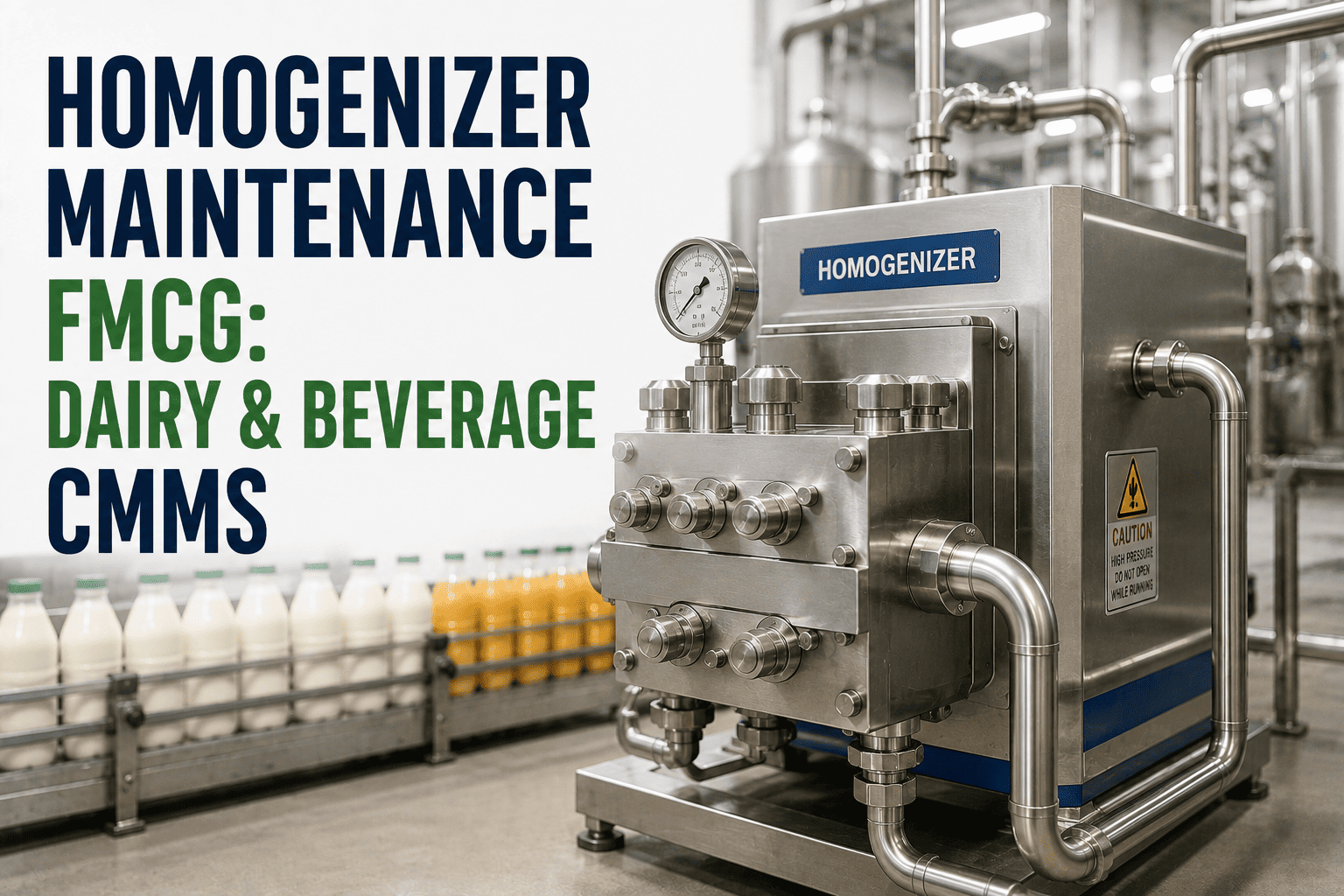
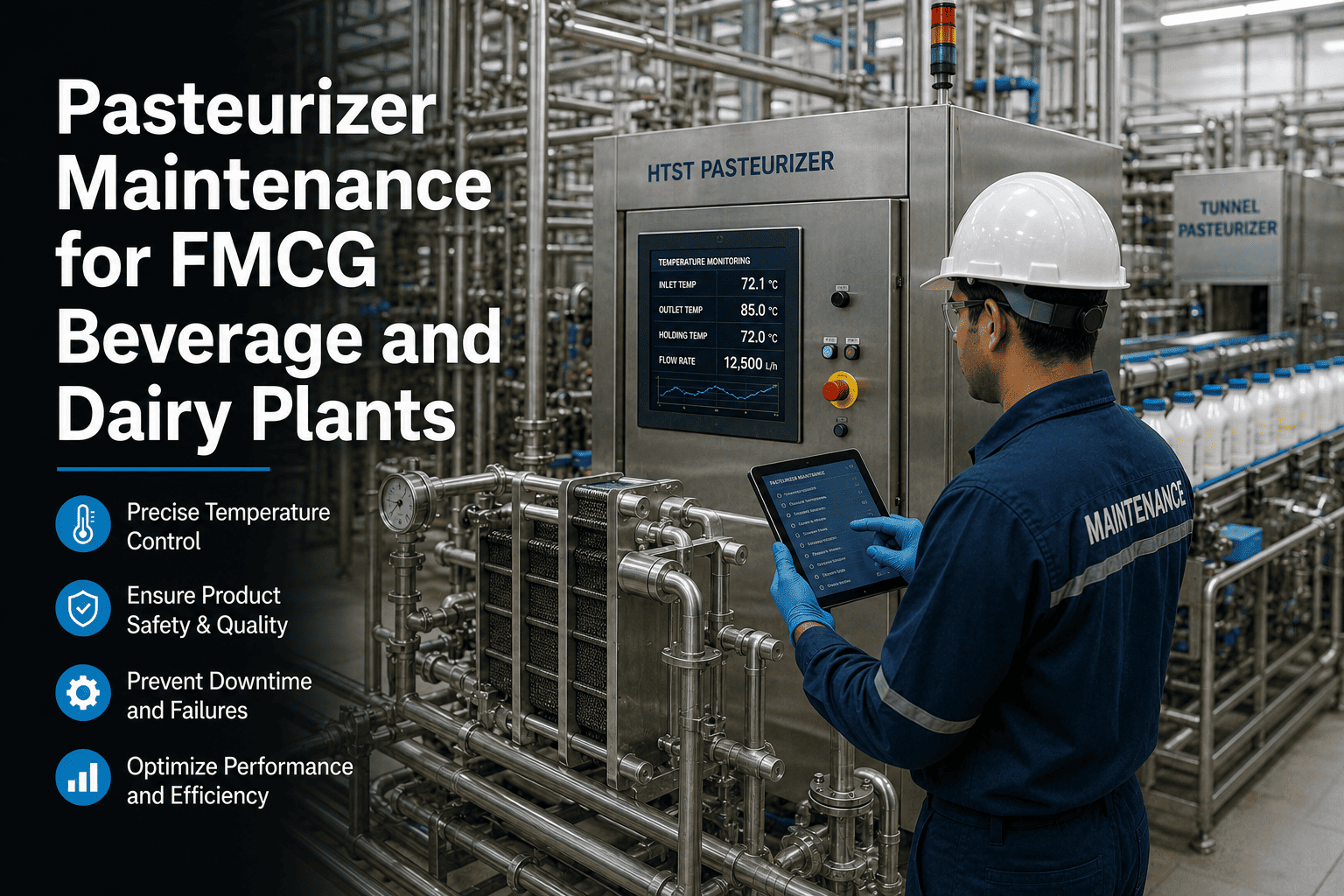
Stacked plate-pack with regeneration, heating, and cooling sections. Fouling at 65-80 degrees C drives heat-transfer-coefficient degradation. Plate-pack disassembly every 6 to 12 months. Divert-valve function check monthly under PMO and EHEDG.
PM cadence: monthly + 6-mo disassembly
02
Centrifugal Cream Separator
Disc-stack centrifuge running at 7,500 to 8,500 RPM. Bowl-imbalance vibration, disc-stack wear, gearbox condition, and bearing temperature trend continuously. OEM-recommended major service twice yearly across all regions.
PM cadence: weekly vibration · 6-mo service
03
Spray Dryer Atomizer
Rotary atomizer wheel or pressure nozzle delivering atomization for particle-size control. Atomizer wear shifts particle size distribution; replacement at OEM-defined hours. Vibration trending plus particle-size lab data drives PM.
PM cadence: hourly run + 2,000 hr OEM service
04
Dryer Chamber & Baghouse
Drying chamber liner inspection, ATEX-rated explosion-protection systems (DRIVENT, COTECTOR, suppression panels), fines-recovery baghouse with sock integrity checks. Fire-safety inspections monthly per NFPA 654 and ATEX 2014/34/EU.
Caustic and acid recirculation, conductivity sensors, dosing pumps, return-temperature verification. CIP-cycle records per loop with concentration, temperature, flow, and duration logged. Recovery-vs-single-use design choice drives sub-system complexity.
PM cadence: weekly cycle audit · monthly skid PM
06
Cross-Stage Instrumentation
Temperature recording controllers (PMO-validated in US, ISO 17025 in EU, ESMA in UAE), flow meters, conductivity probes, pH sensors. Annual calibration with traceability certificate stored against each instrument asset.
Each sub-system needs its own asset record while linked across stages. Request a demo to see Oxmaint's dairy-plant module configured against your specific HTST, separator, dryer, and CIP architecture.
12 hours
— is the typical window in which a weak CIP cycle compounds across HTST, separator, and dryer assets. By the next shift, three teams are looking at three different symptoms of the same root cause.
Where Dairy Plant Maintenance Actually Breaks Down
Dairy plants do not fail at OEE because their teams cannot maintain individual assets. They fail because the four-stage process gets maintained as four independent silos. Four patterns repeat across most operations.
A
Stage Teams in Functional Silos
HTST PMs sit in one team's queue. Separator PMs sit in another's. Spray-dryer in a third. CIP in a fourth. When upstream CIP weakness causes downstream HTST fouling acceleration, no team sees the connection because no shared view exists.
B
Spray Dryer ATEX Inspections on Paper
Monthly ATEX explosion-protection inspections (DRIVENT actuators, COTECTOR sensors, suppression panel function) get logged on paper forms. The EU notified body asks for the last twelve, finds two missing — production halts until re-verification is complete.
C
Separator Service Tracked in OEM Email
Twice-yearly OEM cream-separator service is scheduled via email between operations and the Alfa Laval or GEA service technician. The next-due date lives in someone's calendar. When that person changes roles, the next service slides — and disc-stack wear advances unmeasured.
D
CIP Cycle Variance Untrended
A caustic-dosing pump weakens by 8% one shift. The CIP cycle completes "successfully" because the time-based program ran to length. Two days later, HTST plate-pack fouling accelerates. Five days later, dryer atomizer carries milk-protein burn-on. Nobody connects the three.
Each pattern is a workflow integration gap that a connected four-stage asset chain closes — start a free trial to see how Oxmaint ties HTST, separator, dryer, and CIP into one workflow.
How Oxmaint Operationalizes Four-Stage Dairy Plant Maintenance
Oxmaint's dairy-plant module models the entire process as one connected chain. CIP records link to downstream HTST sanitation; separator vibration trends link to HTST output emulsion checks; dryer ATEX inspections link to insurance and regulatory exports — all in one workflow aligned with US PMO, EU EHEDG, and Gulf GSO standards.
Connected Process-Chain Tree
HTST, separator, dryer, and CIP modeled as connected assets with cross-stage relationships defined. Upstream CIP failure flags downstream pasteurizer sanitation. Separator imbalance flags HTST output check.
Stage-Specific Condition Monitoring
HTST heat-transfer trending. Separator bowl vibration analysis. Dryer atomizer hour-tracking and particle-size correlation. CIP conductivity, temperature, flow verification per cycle. Each stage's inputs feed the process-chain view.
ATEX & Fire-Safety Compliance
Spray-dryer ATEX inspections (NFPA 654 in US, ATEX 2014/34/EU in EU, GCC equivalent), DRIVENT and COTECTOR function checks, suppression-panel verifications all logged in-app with photo evidence and timestamps.
Separator OEM Service Tracking
Alfa Laval, GEA, and Tetra Pak separator service schedules built into the asset record. Next-due dates with 30-day soft block on production scheduling. OEM service reports attached to the asset.
CIP Cycle Verification & Cascade
Every CIP cycle logged with caustic and acid concentration, conductivity, return temperature, and duration. Out-of-spec cycles cascade re-verification work orders to every downstream asset in the chain before next production.
Multi-Region Compliance Export
One-click export aligned with US FDA Grade A PMO, EU EHEDG and 3-A, GCC GSO 9 dairy standards. Audit-ready document packs covering all four stages from one query.
Six integration gaps closed in one connected dairy workflow — request a demo to map the configuration against your plant's specific four-stage architecture.
Siloed Four-Stage Tracking vs Oxmaint Connected Chain
The difference between maintaining HTST, separator, dryer, and CIP in functional silos and maintaining them as one connected process chain shows up in OEE, in audit prep, and in scrap-rate.
Operational Dimension
Siloed Stage Tracking
Oxmaint Connected Chain
Asset relationships
Independent silos per team
Cross-stage process chain
CIP-to-downstream cascading
Manual phone calls
Auto re-verification work orders
Separator OEM service tracking
Email with vendor
Asset record with due-date block
ATEX inspection records
Paper forms in binder
In-app log with photo evidence
Heat-transfer trending
Operator memory
Calculated continuously
Cross-stage root-cause analysis
Quarterly post-mortem
Auto-pattern detection
PMO / EHEDG / GSO audit prep
5 to 7 business days
Under two hours
Outcomes Reported by US, European, and Gulf Dairy Operators
Results from dairy plants across North America, Europe, and the GCC that adopted Oxmaint's connected four-stage workflow within the past 12 to 18 months.
+6 pts
average OEE improvement across HTST-separator-dryer-CIP chain
€1.2M
average annual recovery per mid-size dairy plant from integrated workflow
38%
reduction in unplanned CIP and pasteurization downtime events
92%
reduction in cross-region audit-prep effort for multi-site dairy operators
Connected dairy workflows pay back inside one operational quarter — request a demo to model the recovery profile across your four-stage chain.
Frequently Asked Questions
Does Oxmaint support major dairy equipment manufacturers
Yes. Pre-configured asset templates ship for Tetra Pak, GEA, Alfa Laval, SPX Flow APV, Caloris, Niro, Fristam, Waukesha Cherry-Burrell, and Sani-Matic. Full coverage spans HTST plate exchangers, cream separators, spray dryers, evaporators, membrane systems, and CIP skids — for both legacy and current-generation models.
How does cross-stage cascading work in practice
Asset relationships are defined during configuration. When a CIP cycle fails specification (conductivity, temperature, duration, or concentration), Oxmaint automatically creates re-verification work orders for every downstream asset that received the failed CIP loop. Operators see the cascade in their work-order queue before the next production batch starts. The same logic applies to upstream root-cause from downstream symptoms — separator vibration triggers an HTST output emulsion check.
Is the spray dryer ATEX module suitable for US NFPA 654 and EU ATEX 2014/34/EU
Yes. The spray-dryer module captures explosion-protection function checks aligned with US NFPA 654 (Standard for Combustible Particulate Solids), EU ATEX 2014/34/EU directive, and equivalent GCC standards. DRIVENT venting, COTECTOR suppression, fire-safety system verifications, and dust-explosion-risk documentation are stored against the dryer asset with audit-export ready by default.
Can Oxmaint integrate with our existing dairy plant DCS or PLC
Yes. Tetra Pak PlantMaster, GEA Codex, SPX Flow APV control platforms, Siemens DCS, Rockwell PlantPAx, and ABB 800xA systems integrate via OPC-UA, PROFINET, or EtherNet/IP. Temperature trends, flow rates, separator RPM, dryer inlet/outlet temperatures, and CIP cycle parameters flow into asset records continuously for cross-stage trending.
HTST · Separator · Dryer · CIP — one process chain
Stop Running a Connected Dairy Process as Four Silos
Oxmaint connects HTST pasteurization, cream separation, spray drying, and CIP into one workflow where upstream events cascade to downstream re-verification, where every PM is anchored to a stage in the chain, and where US PMO, EU EHEDG, and Gulf GSO audit exports flow from a single query. From Wisconsin milk plants to Dutch powder facilities to Saudi dairy operations.