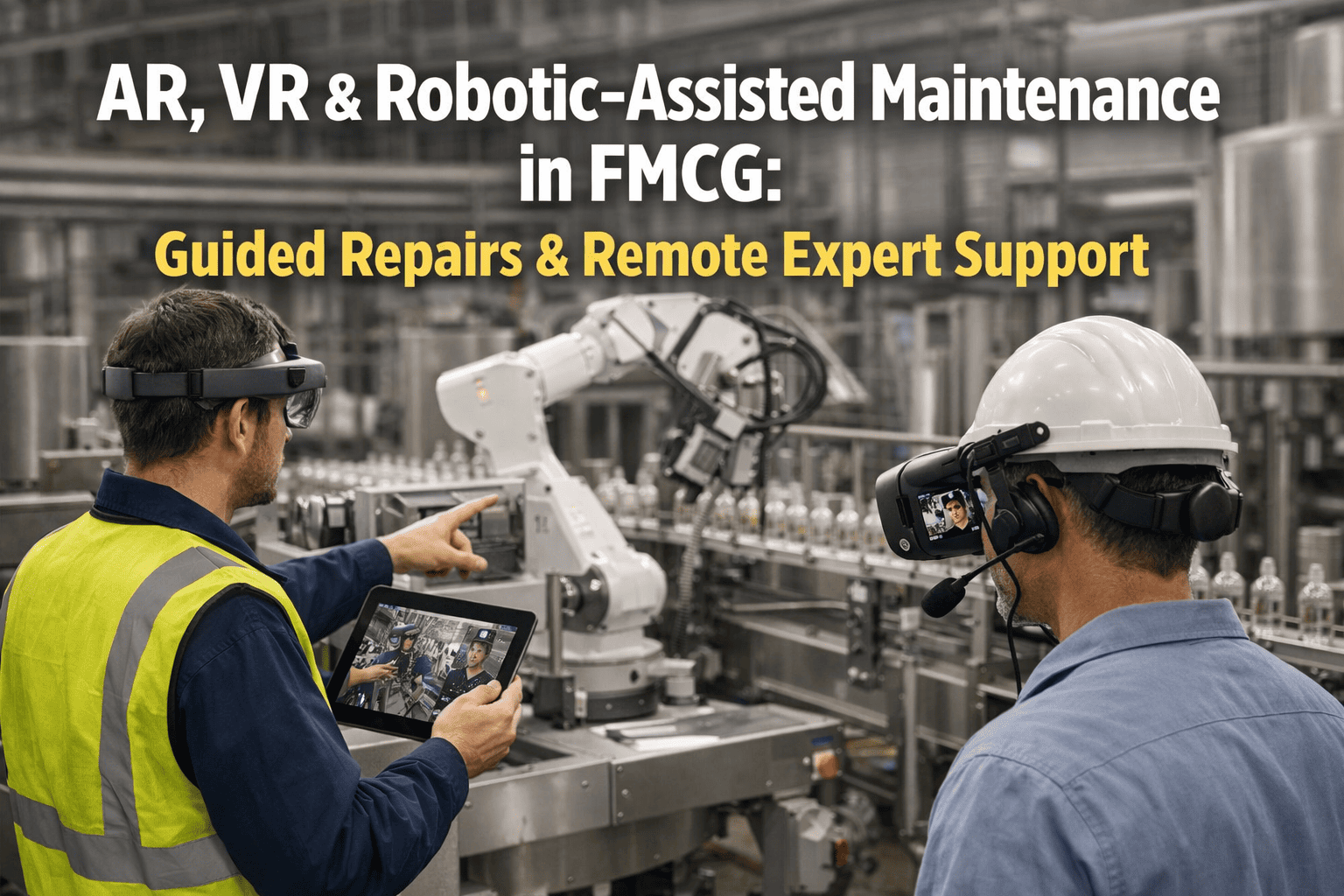
A maintenance technician at a biscuit plant in Pune receives an alert on her tablet: Filling Station 3 is reporting abnormal torque on the depositor head. She has never seen this specific fault before — but before she reaches the machine, an AR overlay on her smart glasses has already pulled the correct procedure from the knowledge base, highlighted the exact component to inspect, and connected her to a remote expert in Germany who can see exactly what she sees. The repair is completed in 22 minutes. Without AR-assisted guidance, the same fault took an average of 94 minutes to resolve from alert to restart. AR, VR, and robotic-assisted maintenance are no longer pilot projects for FMCG manufacturers — they are the fastest proven route to compressing Mean Time to Repair (MTTR), eliminating dependency on scarce expert availability, and building maintenance capability at scale across multi-site operations. Every hour of unplanned downtime on a high-speed FMCG line costs between $10,000 and $30,000 in lost output. The technology to cut that exposure exists and is deployable today. Oxmaint's AR integration and knowledge base features connect guided repair workflows directly to your asset and work order data. Book a demo to see how it works for your facility.
Oxmaint's AR integration overlays step-by-step repair instructions directly onto equipment — reducing MTTR and eliminating paper-based procedure lookups on the plant floor.
25%
Average MTTR Reduction Achieved with AR-Guided Repair Assistance in Manufacturing
3.5×
Faster Onboarding of New Maintenance Technicians with VR Simulation Training
40%
Reduction in First-Time Fix Failures When AR Step-by-Step Guidance is Used
60%
Fewer Unnecessary Expert Site Visits Replaced by Remote AR-Assisted Support
Why FMCG Maintenance Needs AR, VR, and Robotic Assistance Now
FMCG maintenance operations face a compounding capability crisis. The average age of experienced maintenance technicians in Indian FMCG manufacturing is rising — and the tacit knowledge those technicians carry (machine-specific fault patterns, non-documented diagnostic sequences, equipment-specific workarounds accumulated over years of operation) is leaving the workforce faster than it can be transferred to new hires. Traditional knowledge transfer — shadowing, printed manuals, classroom training — is too slow, too passive, and too dependent on the simultaneous availability of the experienced technician and the trainee at the moment of a live fault event.
Simultaneously, FMCG production lines are becoming more complex. High-speed packaging equipment, servo-driven filling systems, vision-guided labelling machines, and collaborative robot integrations require diagnostic skills that take years to develop through traditional experience. The result is an expanding gap between the maintenance complexity that modern FMCG lines demand and the practical capability that the available workforce can deliver — a gap measured directly in MTTR, in first-time fix rate failures, and in unplanned downtime costs that accumulate shift by shift. AR, VR, and robotic assistance close this gap by making expert knowledge available at the moment of need — regardless of whether the expert is physically present.
Augmented Reality Guided Repairs: How It Works in FMCG
Augmented reality maintenance guidance overlays digital information — procedural steps, component annotations, torque specifications, wiring diagrams, video clips — directly onto the technician's view of real equipment, either through a smart glasses device or a tablet held in front of the machine. When a fault occurs, the technician opens the relevant procedure in the AR platform. The system uses the equipment's visual markers, QR codes, or IoT sensor data to identify the specific asset and its current fault state, then renders step-by-step instructions that are spatially anchored to the actual components the technician needs to interact with.
Fault Detection
Alert Triggers Procedure
Sensor data or operator report triggers a work order in the CMMS. The AR platform automatically matches the fault code to the correct guided repair procedure from the knowledge base. The technician receives a notification on their device with the procedure pre-loaded — no manual search required.
Equipment Recognition
Asset Identified via Marker
The technician points their device at the machine. The AR system recognises the asset via QR code, NFC tag, or visual marker and confirms the correct procedure is loaded for that specific machine, serial number, and configuration — eliminating procedure mismatch errors that cause repeat failures.
Guided Procedure Execution
Steps Anchored to Components
Step-by-step instructions appear as overlays anchored to the specific bolts, panels, sensors, and components involved. Arrows indicate exact locations. Video clips show the correct technique for critical steps. Torque and measurement specifications appear adjacent to the component being worked on.
Verification & Sign-Off
Completion Recorded in CMMS
Each completed step is confirmed with a photo or sensor read. The AR system records the completion timestamp, technician identity, and any deviation notes directly into the work order in the CMMS. The signed-off procedure becomes part of the asset's permanent maintenance record — audit-ready with no additional paperwork.
Remote Expert Support — Eliminating the Geography Constraint
One of the highest-value applications of AR in FMCG maintenance is remote expert assistance. When a technician encounters a fault that exceeds their current capability — an unusual failure mode, a newly installed equipment type, a critical asset with no locally available specialist — the traditional solution is to wait for an expert to travel to the site. That wait, combined with travel time, can extend downtime by days. With AR-enabled remote support, the technician shares their live view of the equipment with a remote expert who can see exactly what they see, annotate objects in the technician's field of view, draw on the screen, and guide the repair in real time from any location in the world.
Traditional Expert Visit
Response Time
1–5 days for specialist travel — production stopped or degraded throughout
Cost Per Visit
$1,000–$3,500 including travel, accommodation, and day rates
Knowledge Transfer
Technician watches — but retains limited procedural detail without documented steps
Documentation
Verbal handover — no automatic update to knowledge base or procedure library
Scalability
Expert availability is the bottleneck — cannot support multiple sites simultaneously
AR Remote Expert Support
Response Time
Under 15 minutes to connect — expert sees live equipment view immediately
Cost Per Session
$25–$100 in platform costs — no travel, no accommodation, no delays
Knowledge Transfer
Session recorded — expert's annotations and instructions become a new procedure in the knowledge base
Documentation
Session auto-logged to work order — technician steps, expert annotations, repair outcome captured
Scalability
One expert supports multiple sites concurrently — geography is no longer a constraint
Remote AR Support Payback: A single avoided expert site visit recovers the entire monthly platform cost
VR Maintenance Training — Building Capability Before Touching the Machine
Virtual reality training creates an immersive simulation of maintenance procedures that allows technicians to practise complex, high-risk, or rarely-occurring maintenance tasks without any risk to equipment, product, or personal safety. For FMCG facilities, VR training is particularly valuable for high-stakes procedures — LOTO execution on complex multi-energy systems, CIP/SIP chemical handling, confined space entry, and major planned shutdowns where every technician must be proficient before the shutdown window begins. The training environment replicates the actual equipment at the facility — not a generic machine — so the procedural muscle memory built in the VR simulation transfers directly to the real machine.
LOTO Procedure Training
Safety Critical
Practise full lockout/tagout sequences on simulated multi-energy equipment — including sequence errors and their consequences — without any risk to equipment or personnel. Competency verified before live procedure authorisation.
Planned Shutdown Preparation
Downtime Reduction
Every technician runs through their assigned shutdown tasks in VR before the production window closes — identifying procedure gaps, sequencing conflicts, and tooling requirements before they become real-time problems that extend the shutdown.
New Equipment Familiarisation
Onboarding
Technicians build procedural fluency on newly installed equipment before it enters production — reducing early-operation maintenance errors and the dependency on OEM engineer support during the critical commissioning and ramp-up period.
Cross-Training Multi-Skill
Workforce Flexibility
Operators trained to perform basic maintenance tasks on their own line equipment using VR — reducing response time for minor faults and building the maintenance capability of the broader workforce without removing technicians from active duties.
Rare Fault Scenario Drills
Diagnostic Readiness
Simulate fault conditions that occur infrequently but carry high downtime risk when they do — high-pressure seal failures, bearing seizures, servo drive faults — so technicians are prepared when they encounter them live rather than diagnosing from scratch under production pressure.
Compliance & Audit Readiness
Regulatory
VR training completions are automatically recorded with scores, timestamps, and competency assessments — providing audit-ready evidence that technicians were trained and assessed on critical procedures before being authorised to perform them live.
Robotic-Assisted Maintenance in FMCG Facilities
Beyond AR and VR guidance tools, a new category of maintenance technology is emerging in advanced FMCG facilities: robotic systems that assist with or autonomously perform maintenance tasks. These range from inspection robots that patrol production areas capturing visual and thermal data, to robotic arms that perform repetitive maintenance actions in hazardous or confined areas, to collaborative robots (cobots) that work alongside technicians to handle heavy components or maintain precise alignment during assembly tasks. The value proposition is not replacement of maintenance technicians — it is augmentation of their capability and safety in environments where human physical limitations create risk or quality constraints.
Autonomous Inspection Robots
Condition Monitoring
Mobile robots equipped with thermal cameras, vibration sensors, and ultrasonic probes patrol production areas on scheduled routes — capturing machine condition data that would require a technician to access elevated, confined, or hazardous locations. Anomalies are flagged automatically in the CMMS.
Cobot Maintenance Assistance
Technician Augmentation
Collaborative robots hold heavy components in precise position during reassembly, apply consistent torque to fastener sequences, and maintain alignment tolerances that exceed human consistency — reducing reassembly errors and eliminating strain injuries from repetitive heavy lifting during maintenance tasks.
Pipeline & Tank Inspection Robots
Hazardous Access
Crawler and swimming robots inspect the interior of processing pipelines, CIP tanks, and pressure vessels — identifying corrosion, fouling, and structural defects without requiring confined space entry. Inspection data is logged directly to the asset record in the CMMS for trend analysis.
Automated Lubrication Systems
PM Automation
Centralised automated lubrication systems deliver precise quantities of lubricant to defined lubrication points on schedule — eliminating missed lubrication PMs, reducing bearing failures from under-lubrication or over-lubrication, and freeing technician time from repetitive PM tasks for higher-value diagnostic work.
Oxmaint AR Integration — Connecting Guided Repairs to Asset Data
The value of AR-guided maintenance is maximised when the AR platform is connected to the CMMS — so that guided procedures are informed by real-time asset data, and completed AR-guided repairs automatically update the asset's maintenance record. Oxmaint's AR integration creates this closed loop: when a technician opens a guided repair procedure in the AR platform, the system pulls the asset's current maintenance history, last calibration date, open work orders, and fault history — ensuring the procedure is tailored to the actual condition of that specific machine, not a generic template.
Oxmaint connects AR-guided repair completions directly to work order sign-off — every step performed is captured in the asset record with technician ID, timestamp, and photo evidence.
Six Implementation Barriers — and How to Overcome Them
AR, VR, and robotic maintenance adoption in FMCG is accelerating — but several structural barriers repeatedly slow or stall deployments. Understanding these barriers before beginning an implementation programme is the difference between a successful rollout and a pilot that never scales beyond a single line. Book a demo to see how Oxmaint's AR integration is designed to address these adoption barriers from day one.
Procedure Content Creation
Implementation Barrier
AR-guided repair requires structured digital procedures for every covered fault scenario — and most FMCG plants start with procedures in PDF, paper, or undocumented tacit knowledge. Start by digitising your top 20 highest-frequency or highest-downtime procedures. Use remote expert sessions to capture undocumented procedures as they are performed live — the session recording becomes the first draft of the procedure.
Technician Adoption Resistance
Change Management
Experienced technicians often perceive AR guidance as implicit criticism of their existing competence. Frame the technology as amplification of their expertise — particularly the remote expert feature, where their knowledge is the resource being shared with less-experienced colleagues. Involve experienced technicians in procedure creation; their input validates the tool rather than threatening their status.
Connectivity on the Plant Floor
Infrastructure Barrier
Real-time AR overlay and remote video streaming require stable, low-latency connectivity — which many FMCG plant floors lack due to metal enclosures, equipment interference, and legacy wireless infrastructure. Conduct a connectivity audit before deployment. Most implementations require a Wi-Fi 6 or private 5G upgrade in production areas — budget this as part of the AR infrastructure investment, not an afterthought.
CMMS Integration Complexity
Technical Barrier
The operational value of AR-guided maintenance is significantly reduced if completed procedures are not automatically reflected in the CMMS work order — requiring technicians to complete the AR procedure and then separately log the work order closure. Choose AR platforms with native CMMS integration or published APIs. Oxmaint's AR integration handles this automatically — AR completion triggers work order sign-off with no duplicate entry.
Hardware Cost and Ruggedness
Cost Barrier
Smart glasses capable of industrial-grade AR overlay cost $1,800–$5,000 per unit — and standard consumer devices are not rated for the temperature, humidity, and contamination exposure of FMCG production environments. Tablet-based AR (using ruggedised industrial tablets) offers a lower entry point at $300–$750 per device while delivering most of the guided-repair and remote-support functionality. Start with tablets, prove ROI, then invest in smart glasses for high-frequency users.
Procedure Maintenance Burden
Sustainability Barrier
AR procedures must be updated whenever equipment is modified, upgraded, or replaced — and the resource required to keep procedures current is consistently underestimated. Assign ownership of each procedure to a named technician or engineer. Use the CMMS change management workflow to trigger automatic procedure review when a modification work order is closed on the relevant asset.
ROI of AR, VR, and Robotic-Assisted Maintenance
The financial case for AR and VR maintenance investment in FMCG is built primarily on three value drivers: MTTR reduction (every minute of downtime saved has a direct revenue equivalent), expert travel cost elimination (each avoided site visit generates immediate, quantifiable savings), and capability building speed (technicians reaching full proficiency faster means fewer costly errors during the learning period). These drivers compound — a technician who reaches full capability in 4 months instead of 12 generates 8 months of reduced error risk, and every hour of reduced MTTR across a multi-line operation accumulates into significant annual value. Start your free trial to see how Oxmaint's AR and knowledge base features quantify this impact for your facility.
MTTR Reduction Value
25% average MTTR reduction across 8 lines — based on $15,000/hour average downtime cost and current MTTR baseline
$580K–$1.15M/yr
Expert Site Visit Avoidance
60% of OEM and specialist visits replaced by AR remote support — average $2,200 per avoided visit, 18 visits/year
$237K/yr
First-Time Fix Rate Improvement
40% reduction in repeat repair events — each avoided repeat costs 1.8× the original repair time in additional downtime
$170K–$265K/yr
Onboarding Acceleration
3.5× faster technician capability ramp — 8 months of reduced early-career error cost per new hire, 2 new hires/year
$96K–$192K/yr
Safety Incident Reduction
VR LOTO training reduces procedure errors — each avoided LTI saves $10,000–$30,000 in direct and indirect costs
$120K–$300K/yr
AR/VR Programme Investment
Platform licences, hardware (tablets + 2 smart glasses), procedure creation, connectivity upgrade, and integration
$22K–$42K Year 1
Net Annual Value of AR/VR Maintenance Programme
$1.2M+ Typical payback: 4–7 months
The largest single ROI driver is MTTR reduction — which compounds across every line and every shift. A 25% MTTR reduction on a plant running 3 shifts, 350 days per year, across 8 lines translates directly into recovered production capacity that costs nothing in capital and requires no additional headcount to realise.
Frequently Asked Questions
Do we need smart glasses for AR-guided maintenance, or can we use tablets?+
Tablets are fully capable of delivering AR-guided maintenance and are the recommended starting point for most FMCG facilities. Industrial ruggedised tablets (IP65 rated, drop-resistant) handle the plant floor environment, cost significantly less than smart glasses, and require no technician adjustment period. Smart glasses add hands-free operation — which is genuinely valuable for procedures where both hands must be on the equipment throughout — but most repair tasks involve natural pauses where a technician can refer to a tablet. Start with tablets, measure the MTTR improvement, then invest in smart glasses for the highest-frequency and most complex repair scenarios where hands-free operation delivers clear additional value.
How many AR procedures do we need before the investment is worthwhile?+
The 80/20 rule applies strongly to maintenance procedures: 20% of fault scenarios account for 80% of downtime. For most FMCG facilities, digitising the top 15–25 highest-frequency or highest-downtime procedures is sufficient to capture the majority of available MTTR reduction value. Begin with the procedures where technician variability is highest — where different technicians take significantly different times to complete the same repair — because these represent the largest opportunity for AR standardisation to compress. The remote expert feature delivers value from day one, before any procedures are created, because it can be used for any fault without pre-built content.
How does AR maintenance guidance integrate with Oxmaint?+
Oxmaint's AR integration works in both directions. When a fault triggers a work order in Oxmaint, the AR platform is automatically notified and pre-loads the relevant guided procedure for that asset and fault type — the technician arrives at the machine with the procedure already loaded. When the AR-guided repair is completed, each confirmed step is written back to the Oxmaint work order with the technician's identity, completion timestamp, and any photos or measurement readings captured during the procedure. The work order is closed automatically upon AR procedure completion — eliminating the duplicate data entry that typically results in incomplete work order records.
Is VR training compliant with regulatory training requirements for FMCG facilities?+
VR training completion records are fully acceptable as evidence of training for regulatory compliance purposes when the training content is validated against the relevant procedure or standard. The training record must include the technician's identity, the specific procedure trained, the date of completion, the assessment score (if applicable), and the version of the procedure used — all of which modern VR training platforms capture and can export in formats compatible with quality management systems. For safety-critical procedures (LOTO, confined space, chemical handling), VR training should be documented as one component of a competency programme that also includes supervised live execution before independent authorisation.
What is the minimum connectivity requirement for AR remote support to work on an FMCG plant floor?+
AR remote support (sharing a live video feed with annotation capability) requires a sustained upload bandwidth of 2–5 Mbps with latency below 150ms for acceptable performance, and 8–15 Mbps for high-definition video that allows the remote expert to read component labels and serial numbers. Most legacy plant floor Wi-Fi networks do not reliably deliver this — particularly in areas with dense metal equipment that creates RF interference and dead zones. A connectivity site survey should be conducted before AR deployment, mapping signal strength and throughput at every maintenance access point. Where existing Wi-Fi is inadequate, Wi-Fi 6 access point upgrades or a private 4G/5G small cell deployment is the standard solution. Budget $10,000–$25,000 for connectivity infrastructure as part of the AR programme.
How do we keep AR procedures accurate when equipment is modified or upgraded?+
Procedure currency is the most commonly underestimated operational challenge in AR maintenance programmes. The most reliable approach links AR procedure review to the CMMS change management workflow: whenever a modification work order is closed on an asset in Oxmaint, the system automatically flags all AR procedures associated with that asset for review by the assigned procedure owner. The procedure owner has a defined window (typically 14 days) to validate or update the procedure before it is marked as unreviewed and temporarily removed from the active library. This approach ensures procedures are reviewed when changes actually occur — rather than on a fixed calendar schedule that may miss changes or create unnecessary review burden when no changes have been made.
AR Integration & Knowledge Base
Guided Repairs. Remote Experts. Every Procedure in Every Technician's Hands.
Oxmaint connects AR-guided repair workflows to your CMMS — so every fault triggers the right procedure, every completed step is recorded in the work order, and every remote expert session becomes a permanent knowledge base entry. Reduce MTTR 25% without adding headcount.
AR Guided Repair Procedures Anchored to Real Equipment Components
Remote Expert Live View with Real-Time Annotation on Equipment
Auto Work Order Sign-Off on AR Procedure Completion
Knowledge Base That Captures Every Expert Session as a Future Procedure
Asset-Specific Procedures Pulled from CMMS Data at Point of Fault
VR Training Completions Recorded as Audit-Ready Competency Evidence