Transmission and Drivetrain Maintenance for Fleet Vehicles
By Alex Jordan on March 28, 2026
Transmission and drivetrain failures are among the highest-cost, longest-downtime events in any commercial fleet. A failed automatic transmission does not produce a warning light three days before it fails — it produces a vehicle on the shoulder of a motorway with a driver who has a delivery SLA breach and a $6,000 repair bill developing simultaneously. The difference between a fleet that treats transmission PM as a line item and one that treats it as a risk management programme is measured in thousands of dollars per vehicle per year. Fluid degradation, solenoid wear, bearing pre-load drift, and U-joint play all progress on predictable timelines — they are not random failures, they are scheduled failures waiting for a maintenance programme to intercept them. OxMaint's CMMS schedules every drivetrain service event automatically — ATF changes, differential fluid, driveshaft greasing, transfer case oil — per vehicle, per component, per interval, without dispatcher involvement.
Fleet Maintenance · Article · 2026
Transmission and Drivetrain Maintenance for Fleet Vehicles
Automatic, manual, and AMT transmissions — differentials, driveshafts, U-joints, CV joints, and transfer cases — with CMMS-scheduled PM intervals, OBD monitoring, and predictive maintenance protocols for commercial fleet operations.
$6,200Average automatic transmission replacement cost in commercial fleet
47×Transmission replacement cost vs. scheduled ATF service event
68%Of transmission failures are preventable with correct fluid service intervals
94%PM compliance achievable with CMMS-automated drivetrain scheduling
The 6 Drivetrain Systems — What Each Requires and Why It Fails
Commercial fleet drivetrains are not single assemblies — they are six interdependent systems, each with distinct failure modes, service intervals, and monitoring requirements. Most fleet PM programmes track engine oil. Fewer than one in three track differential fluid. Even fewer track transfer case oil, U-joint lubrication intervals, or CV boot condition. The six systems below account for 94% of all drivetrain-related downtime in commercial fleets — and every one has a defined PM interval that, if followed, converts the failure from unplanned to planned. OxMaint creates a PM template for each drivetrain component per vehicle — so no component slips past its service window without a work order generated.
Automatic Transmission
High Failure Cost
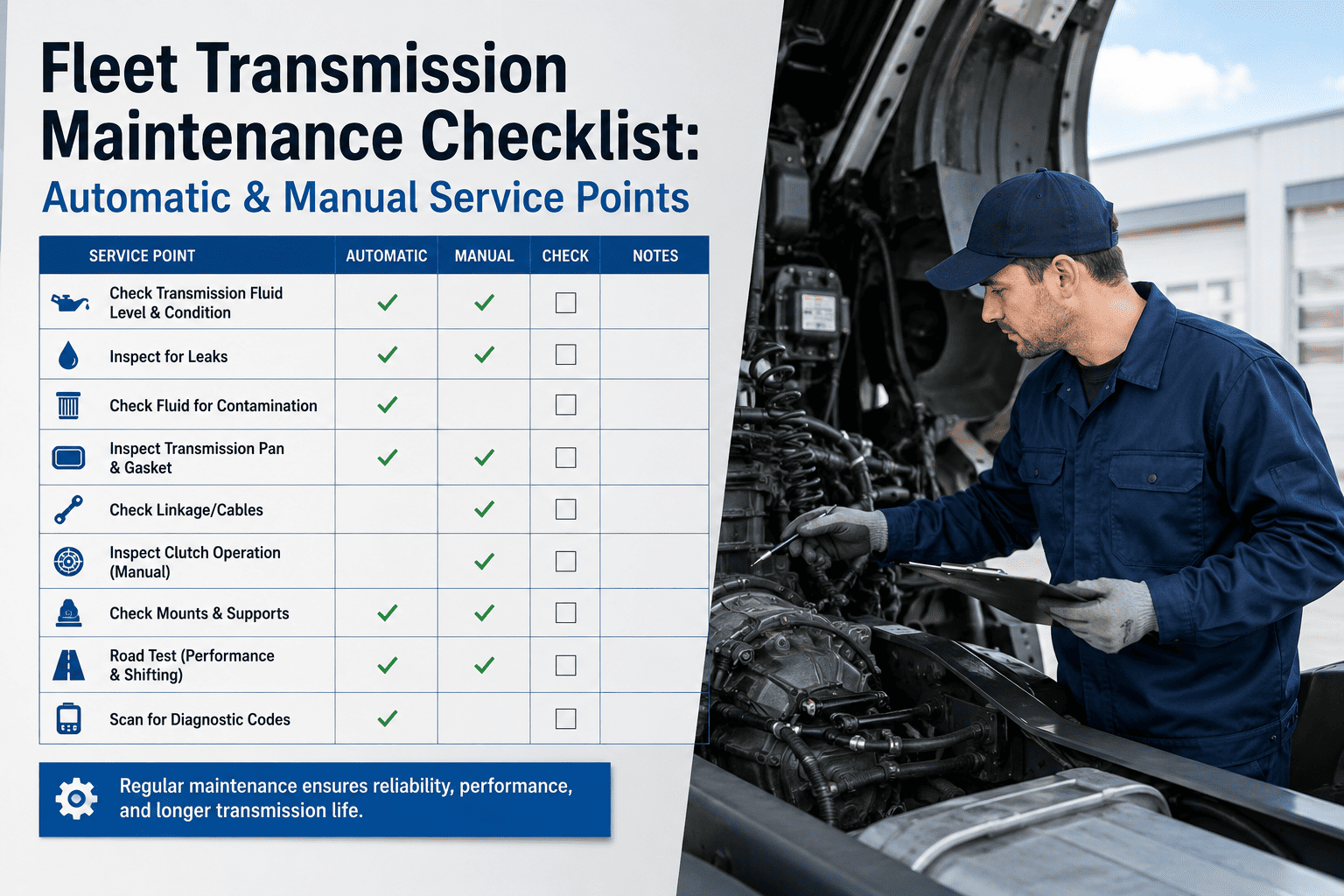
ATF degradation, torque converter clutch wear, and solenoid failure drive 80% of automatic transmission breakdowns. ATF change at 30,000–60,000 mi is the primary prevention lever. OBD slip ratio and temp monitoring catches developing faults 2–6 weeks before failure.
Manual Transmission
Driver-Sensitive
Synchroniser wear and clutch plate degradation are load and driver-behaviour dependent. Gear oil change every 30,000–50,000 mi. Clutch wear monitoring via clutch slip data on OBD-equipped vehicles. Gear selection force increase is the primary early failure indicator.
AMT / Automated Manual
PLC + OBD Monitored
Clutch actuator cycle count, gear selection accuracy, and electrohydraulic pump pressure are AMT-specific failure points. PLC data logs actuator cycles — a threshold trigger generates a CMMS work order before actuator failure. Software calibration required at each fluid service.
Differential Assembly
Temperature-Tracked
Front and rear differential oil degrades from heat and water ingress. Fluid change at 30,000–50,000 mi on standard duty; 15,000–20,000 mi on severe duty. Bearing pre-load and pinion seal inspection at each fluid service. Gear whine is the primary early failure audible indicator.
Driveshaft & U-Joints
Vibration-Detected
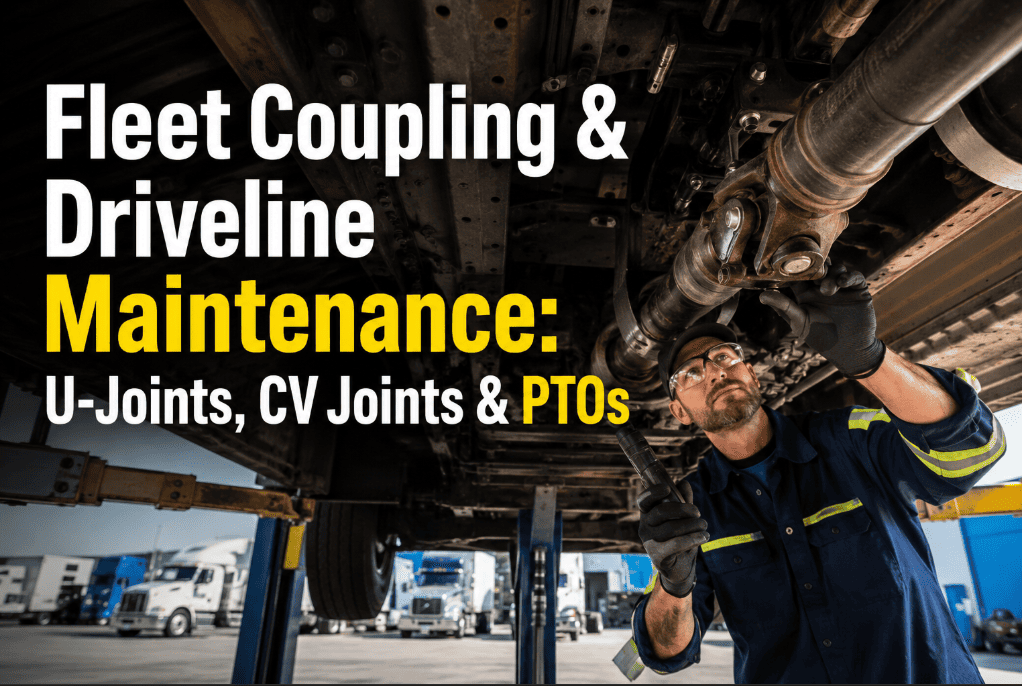
U-joint wear progresses from greaseable wear to needle bearing failure. Lubrication at every PM event; replacement typically at 50,000–100,000 mi depending on duty. Vehicle vibration at speed — especially load-dependent — is the primary U-joint wear indicator before mechanical failure.
CV Joints & Transfer Case
Multi-Component
CV boot failure accelerates CV joint destruction — catch the boot, prevent the joint. Transfer case oil change every 30,000 mi; 4WD engagement test at each service. CV boots inspected at every PM event. Clicking on turns is CV joint failure approaching — not driveshaft vibration.
The Cost of Delay: Planned Service vs. Reactive Repair
The financial case for drivetrain PM is built on a single insight: every transmission failure was a scheduled service event that didn't happen. ATF that should have been changed at 45,000 miles continues to degrade. The clutch pack that needed inspection at 60,000 miles continues to wear. The U-joint that needed greasing at 10,000 miles continues to run dry. Each of these deferred events follows a predictable cost escalation — a small service cost becomes a moderate repair, then a major rebuild, then a full replacement. The gradient chart below shows the actual cost difference across each level for a typical commercial fleet automatic transmission event. OxMaint's PM scheduling eliminates the deferred service pathway entirely by firing work orders before any interval expires.
Transmission Maintenance Cost by Service Stage — Commercial Fleet (Per Unit)
Transmission replacement
$3,800–$8,500
Major rebuild (late stage)
$2,400–$4,200
Component repair (caught early)
$800–$1,600
OBD-triggered inspection
$240–$480
CMMS planned ATF service
← 47× cheaper than replacement
$180–$320
Drivetrain Failure Risk Scoring — Where Is Your Fleet Right Now?
Not all drivetrain PM gaps carry the same risk. A differential that is 5,000 miles past its fluid change on a light-duty urban vehicle carries a different risk profile than a transmission that is 25,000 miles past service on a fully-loaded long-haul tractor. The scoring framework below lets fleet maintenance engineers rate each drivetrain component per vehicle — generating a risk priority list that directs technician time to the highest-consequence gaps first rather than the most accessible service bays.
Drivetrain PM Compliance & Failure Risk Scoring
Score 5 = fully protected · Score 1 = immediate failure risk · Assess per component per vehicle
5
PM Current — All Fluids Fresh
ATF within interval, OBD clear, no vibration, gear oil fresh. All seals intact. Transfer case fluid current. Driveshaft greased at last PM.
Action: Maintain schedule. No intervention. Confirm next service date in CMMS.
4
Approaching Service — Minor Wear
Within 5,000 miles of next ATF interval. OBD advisory codes possible. Slight gear oil discolouration. No performance changes. U-joint play within spec.
Action: Schedule at next PM window. No route restrictions required. Monitor OBD daily.
3
Overdue — Fluid Degradation Visible
Past service interval by 5,000–15,000 miles. ATF or gear oil dark. OBD advisory codes active. Possible minor vibration or gear engagement hesitation noted.
Action: Accelerate service within 2 weeks. Restrict heavy load routes until serviced.
2
High Risk — Performance Degradation
Over 20,000 miles past service. Elevated operating temp. OBD fault codes logged. Slipping, shifting hesitation, or gear whine detected during driver DVIR.
Action: Immediate service. Pull from heavy routes. Inspect for component damage before fluid change.
1
Critical — Failure Imminent or Active
Active OBD fault codes. Slipping, grinding, overheating, or loss of drive reported by driver. Potential contamination or internal damage.
Action: Ground vehicle immediately. Emergency inspection. Do not clear codes and return to service.
Technology Integration: OBD, Digital Twin, AI Camera, and SAP
Modern drivetrain maintenance is moving from calendar-based fluid changes to condition-based monitoring. OBD-II and J1939 telematics feed real-time ATF temperature and slip ratio data into OxMaint — generating alerts 2–6 weeks before fault codes become breakdown events. AI Digital Twin models learn each vehicle's load profile to predict ATF degradation more accurately than fixed mileage intervals. AI Camera Vision identifies undercarriage fluid leaks and CV boot damage overnight before dispatch. SAP, ERP, and PLC integrations connect CMMS drivetrain work orders to procurement and financial systems automatically.
OBD-II / J1939
94%
ATF fault detection before breakdown
Real-time thermal + slip data. Predictive alert lead time: 2–6 weeks before failure event.
Undercarriage scans overnight. CV boot + ATF leak work orders before next-day departure.
SAP / ERP + PLC
96%
PO automation — parts arrive before service
ATF + gear oil pre-ordered from CMMS work orders. PLC logs AMT actuator cycles as threshold triggers.
"
We had three automatic transmission failures in a single quarter — each one a $4,800–$6,200 repair. We deployed OxMaint, set ATF intervals per vehicle, and connected our Samsara telematics for temp monitoring. We haven't had a transmission failure since. That's 18 months without a single event in a 44-vehicle fleet.
PM Compliance Impact — Three Fleet Profiles Compared
The measurable difference between a CMMS-managed drivetrain programme and a reactive fleet is not subtle — it is visible in failure frequency, cost-per-vehicle, and vehicle availability data within two maintenance cycles. The three fleet profiles below represent real-world outcomes from fleets of comparable size and vehicle mix, distinguished only by their drivetrain PM discipline. The fourth stat shows the statistical correlation between drivetrain PM compliance and failure rate reduction across 200+ monitored commercial fleet vehicles.
Repair at breakdown only — no drivetrain PM programme in place
ATF ✗OBD ✗Diff ✗
r = 0.88
Statistical Correlation
Drivetrain PM compliance rate vs. failure rate reduction — across 200+ monitored commercial fleet vehicles. Each 10% compliance improvement = 14% fewer drivetrain failures.
Frequently Asked Questions
How often should ATF be changed in a commercial fleet transmission?
Standard duty: 45,000–60,000 miles. Severe duty (frequent stops, towing, high temp): 25,000–30,000 miles. OxMaint sets intervals per vehicle duty cycle — not a one-size-fits-all calendar date.
What OBD parameters indicate transmission problems before failure?
ATF temperature exceeding 110°C, torque converter slip ratio deviation, solenoid performance codes (P0700–P0799), and transmission range sensor errors — all detectable 2–6 weeks before catastrophic failure on OBD-connected vehicles.
Should differential and transfer case fluid be on the same interval as ATF?
Not necessarily — differentials on severe duty (off-road, high load) may need fluid changes every 15,000–20,000 miles, half the transmission interval. OxMaint tracks each component separately with independent intervals and work order triggers.
How does SAP integration help with drivetrain parts procurement?
CMMS work orders trigger automatic purchase orders in SAP for ATF, gear oil, and filter kits — parts arrive before the vehicle enters the service bay. Eliminates the 4.2-hour average parts wait that drives unplanned downtime cost.
Schedule Every Drivetrain PM — Before the Fleet Schedules Itself.
OxMaint tracks every transmission, differential, and driveshaft per vehicle — automated intervals, OBD alerts, and zero missed services. Free to start.