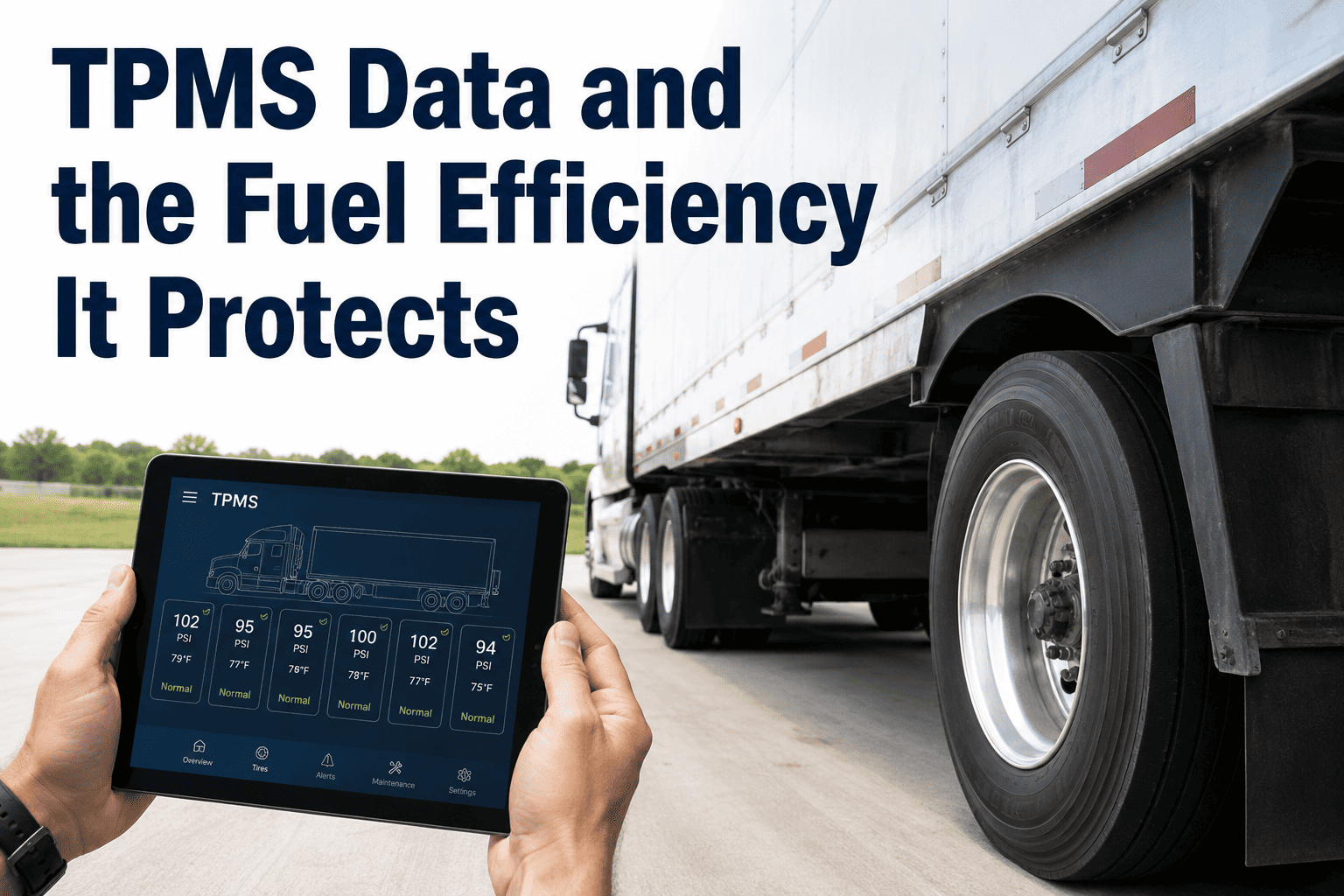
Underinflation is the single most common source of avoidable tire and fuel cost in commercial fleets — the U.S. DOT estimates that underinflated tires waste roughly 5 million gallons of diesel every day nationwide. A commercial tire run 10 PSI below placard pressure quietly loses about 1% of fuel efficiency and 10% of its usable life, and by the time a driver notices a soft tire, the casing has often already begun to break down. TPMS (Tire Pressure Monitoring System) sensors on each wheel measure pressure and temperature continuously and push those readings to a cab display, a telematics platform, or directly into a CMMS work queue. This guide breaks down the three tiers of TPMS deployment, the ROI math behind a 100-truck fleet, and how to convert raw pressure data into automatic work orders. You can Start Free Trial to see live tire thresholds in Oxmaint today.
A 10 PSI drop costs you 1% fuel and 10% tire life — quietly, on every axle.
Pressure Systems International, Doran, and PressurePro sensors feed live pressure and temperature per tire into your maintenance platform. Threshold breaches become work orders — not just dash warnings a driver has to remember to notice.
Underinflation is a quiet, compounding leak
A tire does not fail when it drops 10 PSI — it simply runs hotter, flexes more, and burns more fuel every mile until someone writes a work order.
1% efficiency lost per 10 PSI
A commercial tire underinflated by 10 PSI loses roughly 1% fuel efficiency. Across 100 trucks averaging 100,000 miles a year at 6.5 mpg, that is close to 15,000 gallons of diesel burned for nothing — about $60,000 at $4.00/gal.
10% tire life surrendered
The same 10 PSI deficit removes 10% of usable tread life. On a 1,800-tire fleet replacing casings at $450 each, that is the equivalent of 180 premature tire purchases — a six-figure drag hidden inside routine spend.
Casing breakdown starts early
Low pressure increases sidewall flex, which builds heat. Heat degrades the casing long before the tread looks bald, killing retread eligibility and turning a $120 recap into a $450 new tire purchase.
DOT pre-trip exposure
FMCSA pre-trip inspection guidance treats visibly underinflated tires as an out-of-service condition. A single roadside violation easily costs $1,000–$3,000 in fines, tow, and downtime — more than a year of TPMS sensor cost.
Three tiers of TPMS — pick the one that actually closes the loop
The difference between a basic system and a full-integration system is not the sensor. It is whether a low-pressure reading becomes a work order automatically.
Basic TPMS
Valve-cap sensors transmit live pressure to a cab display. The driver sees the reading and must manually decide to flag the tire, find air, and report it. Good for driver awareness — weak for maintenance throughput.
- Valve-cap or flow-through sensor per tire
- Cab display or mobile app readout
- Driver-initiated resolution
Integrated TPMS
Sensor data flows into the telematics platform, generating alerts to dispatch and maintenance when pressures fall out of spec. The shop sees the breach in real time, even if the driver does not report it.
- Pressure + temperature streamed to telematics
- Threshold alerts to dispatch and shop
- Trend visibility per asset
Full-Integration TPMS
Alerts push directly into the CMMS. A tire below threshold generates an automatic work order, pressure trending feeds replacement forecasting, and every event is written to that tire's lifecycle record.
- Automatic CMMS work-order generation
- Predictive tire replacement forecasting
- Full tire lifecycle record integration
A 100-truck fleet recovers $70K–$140K per year with a 5 PSI improvement
The arithmetic is direct: better pressure compliance means less fuel burned and fewer tires purchased. Here is the worked example for a typical 100-power-unit fleet running 18 tires per truck.
A 5 PSI improvement in average fleet pressure compliance restores roughly 0.5% fuel efficiency. On 100 trucks averaging 100,000 miles a year at 6.5 mpg and $4.00 diesel, that is $30K–$60K of diesel that stops being burned for nothing.
A 5 PSI swing in average compliance also recovers roughly 5% of usable tread life across 1,800 tires. At $450 per replacement casing, that is another $40K–$80K avoided — and protects retread eligibility on casings that would otherwise overheat.
| Lever | Annual Fuel Impact | Annual Tire Impact | Combined Low–High |
|---|---|---|---|
| 5 PSI compliance gain | $30,000 – $60,000 | $40,000 – $80,000 | $70,000 – $140,000 |
| 10 PSI compliance gain | $60,000 – $120,000 | $80,000 – $160,000 | $140,000 – $280,000 |
| Full CMMS auto work orders | + reduced roadside downtime | + casing retread eligibility preserved | Compounding year over year |
How TPMS data flows into the CMMS work order
A pressure reading only creates value when it triggers an action. Here is the path from sensor to closed work order, and the three commercial TPMS vendors that integrate with the major telematics providers.
Sensor reads pressure + temperature per tire
Valve-cap or flow-through sensors on each of the 18 wheels sample pressure and temperature continuously and transmit over RF to the cab receiver.
Telematics gateway streams readings to the cloud
The cab unit forwards per-tire data to the telematics provider, where thresholds are evaluated and dispatch/maintenance alerts are generated when a tire drops out of spec.
CMMS auto-generates a work order on breach
Oxmaint receives the threshold breach, creates a work order tied to the specific asset and tire position, and routes it to the shop — no manual entry, no driver phone call required.
Trend data feeds predictive replacement
Pressure trending per tire is written to that tire's lifecycle record. Slow leaks get flagged before failure, and replacement forecasting uses the trend — not just tread depth — to schedule swaps.
Pressure Systems International
Commercial TPMS and automatic tire inflation systems with deep telematics integrations across major providers.
Doran
Valve-cap and flow-through pressure monitoring systems with cab displays and cloud alerting for fleet-wide visibility.
PressurePro
Sensor-based monitoring with telematics-friendly output, supporting both driver-facing and shop-facing alert workflows.
We were replacing casings six months early and could not figure out why. The TPMS trend data showed three drive-axle positions running 12 PSI low on one route. Once those readings hit the CMMS as automatic work orders, our tire spend dropped almost 9% inside two quarters.
Stop letting 5 PSI cost you six figures a year
Stream live pressure and temperature per tire into Oxmaint, set thresholds, and let breaches open their own work orders.
Fleet TPMS questions, answered straight
How much fuel does a 10 PSI underinflation actually cost per truck?
Roughly 1% of fuel efficiency per 10 PSI under placard pressure. For a single truck running 100,000 miles a year at 6.5 mpg and $4.00 diesel, that works out to about $600 per year in wasted fuel — before you count the tire life you also lose. Multiply across a 100-truck fleet and the number becomes real money fast.
What is the difference between basic TPMS and full-integration TPMS?
Basic TPMS shows pressure on a cab display and depends on the driver to act. Integrated TPMS sends alerts to dispatch and the shop via telematics. Full-integration TPMS — the tier Oxmaint supports — pushes threshold breaches straight into the CMMS as automatic work orders and writes pressure trends to each tire's lifecycle record. You can Book a Demo to see the full loop in action.
Which TPMS vendors integrate with Oxmaint?
Pressure Systems International, Doran, and PressurePro all offer commercial TPMS solutions that integrate with the major telematics providers Oxmaint connects to. As long as your telematics gateway can stream per-tire pressure and temperature, Oxmaint can turn those readings into threshold-based work orders.
How quickly does a TPMS deployment pay back?
For a 100-truck fleet with 1,800 tires, a 5 PSI improvement in average pressure compliance typically recovers $30K–$60K in fuel and $40K–$80K in tire spend annually — $70K–$140K combined. Sensor and installation cost for the same fleet usually clears payback inside the first 6–9 months of full deployment.
Does TPMS help with DOT pre-trip and roadside compliance?
Yes. FMCSA guidance treats visibly underinflated tires as an out-of-service condition, and a single roadside violation can cost $1,000–$3,000 in fines, tow, and downtime. Continuous TPMS monitoring catches low-pressure tires before the truck leaves the yard, and the automatic work-order record gives you a defensible audit trail that the issue was addressed.
Turn every pressure reading into a work order
Stream TPMS data into Oxmaint, set thresholds per axle, and let breaches open their own tickets — no driver phone calls, no manual entry.
Free 14-day trial · No credit card

-for-commercial-fleets.png)


.png)