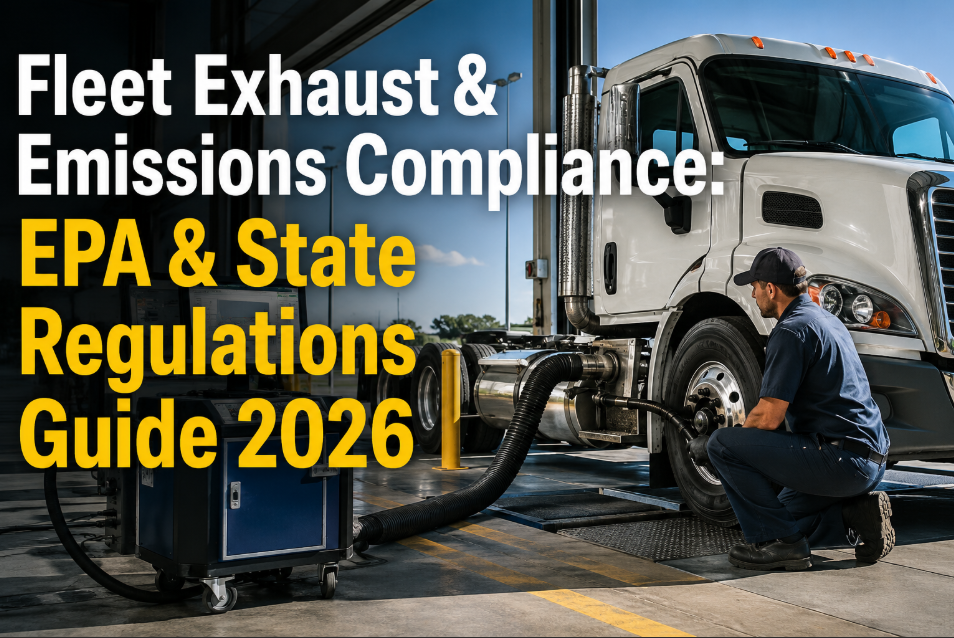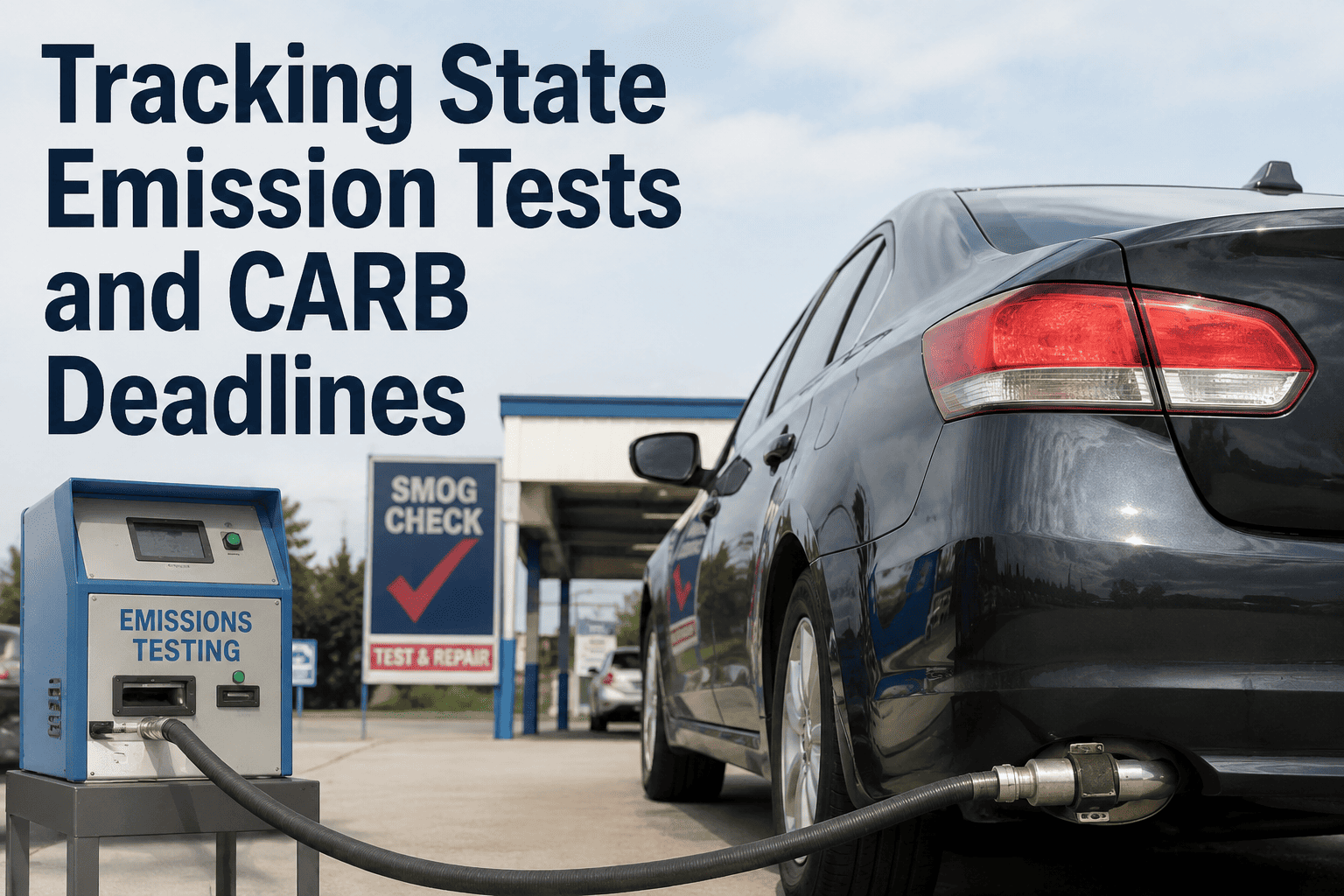
State emission test fleet compliance has become one of the most operationally complex and financially risky maintenance responsibilities for commercial fleet operators. The California Air Resources Board (CARB) enforces the nation's strictest heavy-duty emission regulations, and more than a dozen other states have adopted parallel standards—meaning a single interstate tractor can fall under multiple jurisdictions in one shift. This 2026 emission guide explains how to track state-specific deadlines, DPF service intervals, and CARB reporting obligations without relying on spreadsheets. If you manage assets across state lines, you can configure automated compliance alerts by starting a Start Free Trial of OxMaint or booking a personalized walkthrough.
CARB COMPLIANCE & EMISSION GUIDE 2026
Are your out-of-state trucks ready for the next CARB deadline?
California's Advanced Clean Fleets rule and Periodic Smoke Inspection Program now touch every diesel vehicle over 6,000 lbs GVWR that enters the state—regardless of where it is domiciled. Missing a reporting deadline or DPF service window can trigger registration denial and per-vehicle-per-day penalties that compound silently until an audit.
STATE-BY-STATE JURISDICTIONS
Which states require heavy-duty emission testing in 2026?
At least 12 states have active heavy-duty emission testing or compliance programs that mirror parts of California's CARB framework—covering OBD readiness, DPF function, and aftertreatment verification.
Advanced Clean Fleets (ACF), Truck & Bus Rule, PSIP. 2010+ engine standard required. ZEV phase-in 2024–2042. Annual self-inspection for diesels >6,000 lbs GVWR.
Adopts California emission standards. Requires periodic inspection and compliance with CARB-equivalent diesel rules for in-state operation.
Heavy-duty diesel inspection program aligned with CARB-like requirements. DPF and aftertreatment function verified during scheduled testing.
Follows California low-emission vehicle and heavy-duty guidelines. Periodic smoke opacity testing for applicable diesel fleets.
CARB-aligned emission standards. Diesel vehicles subject to opacity and aftertreatment system compliance verification.
Adopts California heavy-duty emission regulations. OBD readiness and DPF compliance required for registered commercial diesels.
Implements CARB-equivalent rules for heavy-duty diesel operations. Periodic emission testing and reporting required.
Heavy-duty diesel inspection aligned with California standards. Aftertreatment and smoke opacity checks enforced.
Diesel emission standards mirror CARB. Fleet operators must track engine model year compliance and DPF service records.
Adopts California emission standards for heavy-duty vehicles. Periodic testing and ZEV program alignment underway.
Diesel inspection program with opacity limits and aftertreatment verification. State-specific reporting deadlines apply.
States continue adopting CARB-aligned rules. If your fleet crosses state lines, assume the strictest applicable standard governs your operation.
CORE CARB REQUIREMENTS
What CARB compliance demands from your fleet
CARB's regulatory stack covers four pillars. Every diesel vehicle over 6,000 lbs GVWR operating in California—whether domiciled there or not—must satisfy all four simultaneously.
Truck & Bus Regulation
Diesel vehicles must meet 2010 or newer engine emission standards to operate in California. Older engines require verified retrofit or replacement. Non-compliant vehicles face registration denial and operation bans.
Periodic Smoke Inspection (PSIP)
Annual self-conducted visual smoke inspection required for every diesel vehicle over 6,000 lbs GVWR. Records must be retained for two compliance cycles and produced during CARB audits.
Advanced Clean Fleets (ACF)
Progressive ZEV conversion for medium- and heavy-duty fleets from 2024 through 2042. Mandatory fleet reporting began in 2024—CARB can identify non-compliance without a roadside stop.
DPF & Aftertreatment
Diesel particulate filters must function correctly and be serviced on schedule. OBD emission monitor readiness is verified during testing. Ash cleaning cycles and filter health must be documented per vehicle.
INTERSTATE COMPLIANCE SCENARIO
How out-of-state fleets get caught by CARB
A common misconception is that vehicles domiciled outside California are exempt. They are not. Any vehicle entering California must meet CARB standards while operating there.
A 120-tractor regional fleet domiciled in Reno, NV. Eighty tractors run dedicated routes into Southern California three times per week. Average engine model year: 2012.
Although the trucks are registered in Nevada, CARB jurisdiction applies the moment they cross into California. All 80 tractors must meet 2010+ engine standards, maintain current PSIP records, and comply with ACF reporting.
If even 15 of those 80 tractors miss their annual PSIP deadline or have overdue DPF ash-clean records, the fleet faces up to $7,500 per vehicle per day—potentially over $100,000 in accumulated penalties before a roadside inspection ever occurs.
Centralized per-vehicle, per-jurisdiction compliance tracking with automated alerts for PSIP due dates, DPF service intervals, and ACF reporting windows eliminates the spreadsheet blind spot.
COMPLIANCE TRACKING CHECKLIST
Fleet CARB compliance checklist: what to track per vehicle
For every vehicle that operates in California or any CARB-aligned state, your maintenance system must track these six data points—updated continuously, not at audit time.
Engine Model Year
Confirm 2010+ compliance for California operation. Flag pre-2010 engines for retrofit or replacement scheduling.
Emission Certification
Store EPA/CARB executive order numbers and certification documents per VIN for instant audit retrieval.
DPF Service History
Track ash-clean intervals, filter replacements, and regeneration events. Link each service to a work order with timestamps.
PSIP Test Dates
Record annual smoke inspection results per vehicle. Set automated 90-day, 30-day, and 7-day alerts before each deadline.
Operating Jurisdictions
Map each vehicle to every state it enters. Apply the most restrictive standard—usually California—automatically.
ACF Reporting Status
Track fleet-level ZEV phase-in milestones and mandatory reporting submissions. Maintain proof of filing per compliance period.
JURISDICTION COMPARISON
State emission testing requirements at a glance
Use this comparison to understand how state-specific emission tests and CARB compliance deadlines vary—then map each vehicle accordingly in your CMMS.
| State | Diesel Test Type | Frequency | GVWR Threshold | Enforcement |
|---|---|---|---|---|
| California | PSIP smoke + OBD readiness | Annual | >6,000 lbs | Registration denial, $500+/day |
| New York | Diesel emission inspection | Annual | >8,500 lbs | Registration suspension |
| New Jersey | Smoke opacity + DPF check | Annual | >18,000 lbs | Registration block |
| Massachusetts | CARB-aligned opacity test | Biennial | >10,000 lbs | Registration denial |
| Oregon | DEQ diesel inspection | Annual | >16,000 lbs | Operation restriction |
| Washington | Ecology diesel test | Annual | >16,000 lbs | Registration denial |
HOW OXMAINT HELPS
How OxMaint automates state emission compliance
OxMaint is an AI-powered CMMS and EAM platform that tracks state emission compliance per vehicle, per operating jurisdiction—so no CARB deadline or DPF service interval falls through the cracks.
Per-Vehicle, Per-Jurisdiction Tracking
Map every asset to the states it operates in. OxMaint automatically applies the strictest applicable standard—so a Nevada tractor entering California inherits full CARB requirements without manual configuration.
Automated Deadline Alerts
Configure cascading alerts for PSIP due dates, DPF ash-clean intervals, and ACF reporting windows at 90, 30, and 7 days out. Alerts route to the assigned technician and fleet manager simultaneously.
Audit-Ready Documentation
Every PSIP result, DPF service record, and emission certification is stored against the asset record with timestamps, technician signatures, and attached documents. Generate a CARB audit packet in one click.
Predictive DPF Maintenance
AI-driven analytics on regeneration frequency, exhaust backpressure, and fault-code patterns predict DPF degradation before it fails an emission test—scheduling ash cleans proactively, not reactively.
Stop tracking CARB deadlines on spreadsheets
See how OxMaint maps every vehicle to its jurisdictions, automates PSIP and DPF alerts, and builds audit-ready records—book a 30-minute demo on your fleet data.
FREQUENTLY ASKED QUESTIONS
State emission test and CARB deadline FAQs
What is the CARB deadline for fleet compliance in 2026?
Under the Advanced Clean Fleets regulation, medium- and heavy-duty fleet operators must continue ZEV phase-in reporting and meet progressive milestones between 2024 and 2042. In 2026, the key obligations are ongoing fleet reporting, compliance with the 2010+ engine standard for all diesel vehicles operating in California, and annual PSIP inspections. Drayage and high-priority fleets face earlier ZEV purchase requirements. You can configure OxMaint to send automated alerts for every applicable milestone—start by booking a Book a Demo session.
Do out-of-state trucks need to meet CARB requirements?
Yes. Any diesel vehicle over 6,000 lbs GVWR that enters California—regardless of its home state or registration jurisdiction—must comply with CARB's Truck and Bus Regulation, PSIP, and applicable ACF provisions while operating there. A tractor domiciled in Nevada, Arizona, or any other state running loads into California is fully subject to CARB enforcement, including per-vehicle-per-day penalties for non-compliance.
How often is a PSIP smoke inspection required?
The Periodic Smoke Inspection Program requires an annual self-conducted visual smoke inspection for every diesel vehicle over 6,000 lbs GVWR registered in California or operating there. Results must be documented and retained for a minimum of two compliance cycles. OxMaint stores each inspection result against the asset record and automatically generates the next due-date alert.
What happens if a fleet fails to meet CARB emission requirements?
Non-compliance can trigger California vehicle registration denial, out-of-state operation restrictions, and penalties of $500 or more per vehicle per day. Because ACF reporting makes fleet data visible to CARB without a roadside inspection, violations can accumulate silently. For a fleet with 15 non-compliant tractors, that can exceed $100,000 in penalties before any physical inspection occurs.
Which states follow California emission standards for heavy-duty vehicles?
States with active heavy-duty emission programs aligned with California include New York, New Jersey, Connecticut, Massachusetts, Vermont, Maryland, Delaware, Oregon, Washington, and Colorado. Most adopt CARB-equivalent rules in some form. Fleet operators running interstate routes should track compliance against the strictest jurisdiction each vehicle enters—a configuration that OxMaint handles automatically per asset.
Build your CARB compliance calendar in under an hour
Import your fleet roster, map operating jurisdictions, and OxMaint generates every PSIP deadline, DPF service interval, and ACF reporting milestone automatically—no spreadsheets required.
Free 14-day trial · No credit card