
Emission compliance for commercial fleets is tightening on every front — federal EPA standards, state-level CARB requirements in California, and international equivalents across the EU, UK, Australia, and Canada. EPA civil penalties reach $70,117 per vehicle per day, and CARB can exceed $37,500. The systems that determine compliance — DPF, DEF/SCR, EGR, and OBD — are also the most neglected in reactive maintenance cultures. OxMaint tracks emission PM schedules per vehicle per jurisdiction, flagging DPF, DEF, EGR, and OBD service intervals before violations accumulate.
Emission Compliance for Commercial Fleets: DPF, DEF, EGR, and EPA Standards
Covers DPF regeneration and maintenance, DEF/SCR system care, EGR valve maintenance, OBD monitoring, EPA and CARB standards, state and international emission requirements, and CMMS-tracked emission system PM for commercial fleets.
EPA and Global Emission Standards: What Applies to Your Fleet
Commercial diesel emissions are governed by a hierarchy of standards — federal EPA regulations form the minimum floor, state programmes in California (CARB), New York, and Washington can exceed federal requirements for vehicles operating in those states, and international equivalents (Euro VI in the EU, ADR 80/03 in Australia, BSVI in India, CANADA Phase 2) apply to fleets with cross-border exposure. Understanding the applicability matrix for your fleet is the starting point for building a compliant emission maintenance programme. OxMaint tracks emission system compliance requirements per vehicle per jurisdiction, so maintenance scheduling reflects the strictest applicable standard for each unit in the fleet.
DPF, DEF/SCR, and EGR: The Three Systems That Determine Compliance
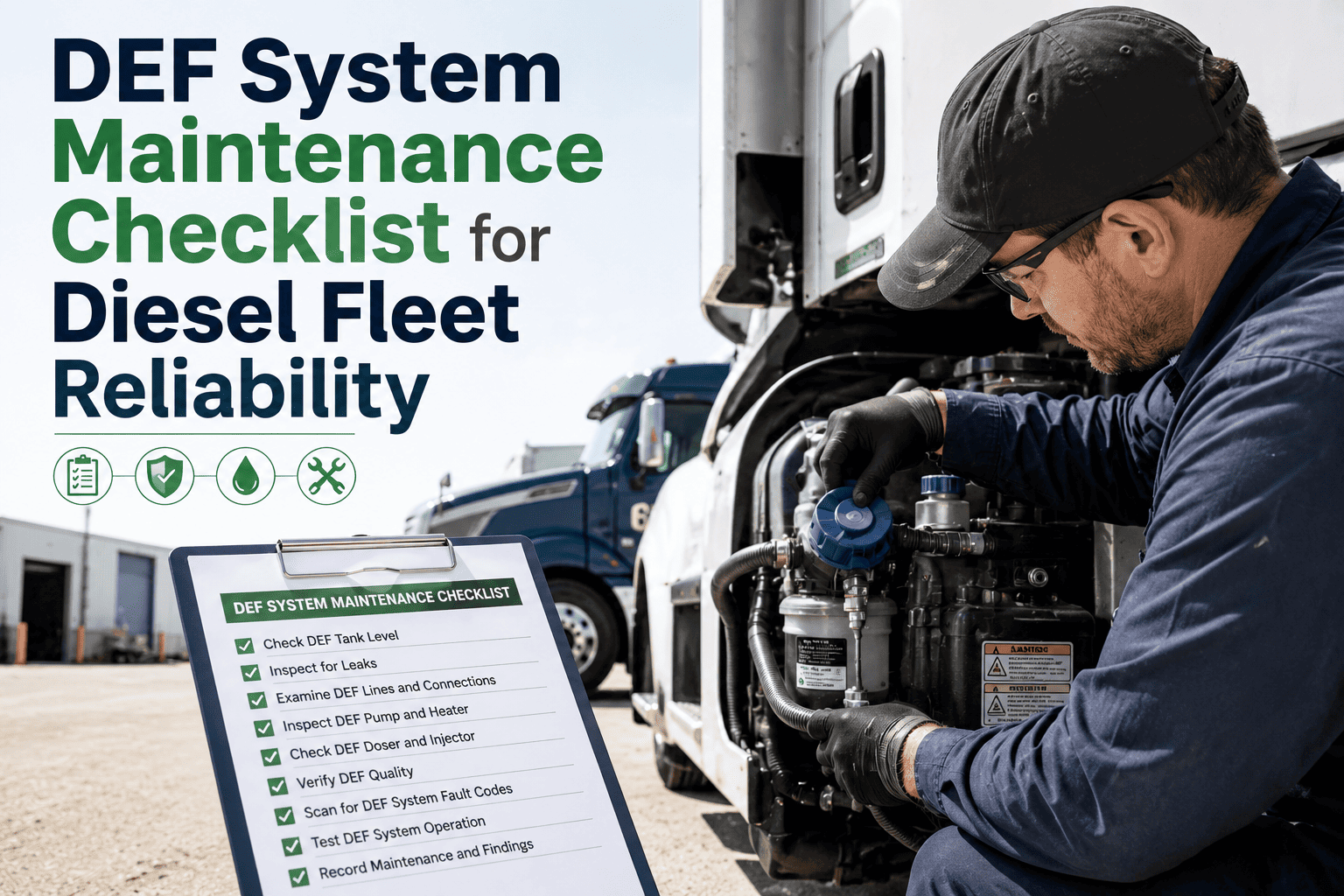
Modern heavy-duty diesel compliance depends on three interconnected aftertreatment systems. The Diesel Particulate Filter (DPF) traps and periodically burns off particulate matter. The Selective Catalytic Reduction (SCR) system uses Diesel Exhaust Fluid (DEF) to convert NOx emissions into nitrogen and water. The Exhaust Gas Recirculation (EGR) valve recirculates a portion of exhaust gases back into the combustion chamber to lower combustion temperatures and reduce NOx formation at source. All three must function together correctly — a failed DPF increases exhaust back pressure that degrades SCR efficiency; a fouled EGR valve increases combustion temperatures that accelerate DPF loading. OxMaint's emission system PM templates cover all three systems with linked service triggers — so a DPF service event also prompts SCR dosing system check and EGR valve inspection on the same work order.
EPA Emission Regulation Timeline: Where Your Fleet Stands
The EPA's tightening of NOx and PM emission standards has followed a clear progression from 2002 through to the 2027 proposed standards. Understanding where your current fleet sits on this timeline determines which aftertreatment systems are required, what OBD monitoring obligations apply, and how soon upcoming standard changes will force equipment replacement or retrofit decisions. Fleets with pre-2010 engines that operate in California already face CARB's In-Use Compliance programme, which may require retrofit or replacement of older units. OxMaint's vehicle record stores emission certification level per unit — so compliance managers know exactly which vehicles are at risk from incoming standard changes.
AI, OBD, and Digital Twin: Predictive Emission Compliance
Emission compliance failures are detectable before they happen. OBD-II and J1939 data streams provide real-time DPF soot load estimates, SCR catalyst conversion efficiency, EGR valve position and flow rate, and DEF quality and level — the exact parameters that predict emission violations 30–90 days before a roadside inspection or emissions test. AI digital twin models each engine's emission system wear trajectory against its certification limits, identifying units approaching non-compliance before the fault code triggers. AI vision cameras at depots detect visible smoke, fluid leaks from DEF lines, and DPF physical damage that would fail a visual compliance inspection. OxMaint integrates OBD emission data into predictive maintenance work orders, automatically generating service alerts when emission system parameters trend toward threshold. SAP PM integration posts every emission service event to the enterprise asset record — building the compliance audit trail that satisfies both EPA inspectors and internal environmental management systems.
Real-time DPF soot load, SCR efficiency, EGR valve flow, DEF level and quality — streamed to CMMS daily. Anomalies trigger service work orders before OBD fault codes escalate to derate events or enforcement exposure.
Models emission system wear against EPA certification limits per vehicle. Weekly compliance risk score per unit — highest-risk vehicles are prioritised for emission service before they generate MIL lamp events or inspection failures.
Daily depot visual inspections detect black smoke, DEF line leaks, DPF external damage, and exhaust weeping — visible emission system defects that would fail a roadside visual compliance check, caught before the vehicle departs.
Emission service completions post to SAP PM automatically — DPF clean records, DEF system service, EGR valve work — building the compliance documentation that satisfies EPA audit requests and internal environmental reporting.
We had three vehicles derates in one month from SCR catalyst issues — all three had OBD fault histories we weren't acting on. After connecting OxMaint to our telematics OBD feed, emission system alerts now auto-generate work orders. We haven't had a derate in eight months and our CARB compliance scores are clean.
Track DPF, DEF, EGR, and OBD Emission Compliance Per Vehicle — Automatically
OxMaint connects OBD emission data to PM work order triggers — DPF soot load, SCR efficiency, EGR faults, and DEF level monitored continuously. Free to start.
Common Emission Compliance Failures and Prevention
Frequently Asked Questions
How often should a DPF be cleaned in a commercial fleet?
Thermal DPF cleaning (ash removal) is typically required every 200,000–300,000 miles, regardless of how frequently active regeneration occurs. Active regen removes soot but not ash — ash accumulates permanently until thermal cleaning. Fleets with high idle ratios or frequent short-trip operations may require cleaning sooner. OxMaint tracks DPF service intervals and regen frequency per vehicle.
What causes a DEF/SCR system to derate the engine?
DEF tank empty, incorrect concentration (diluted or contaminated), dosing injector blocked, NOx sensor failure, or SCR catalyst efficiency below OBD monitoring threshold. All are detectable before derate via OBD fault monitoring. Stage 1 derate reduces power 25%; Stage 2 governs to 5 mph — both are preventable with proactive monitoring.
Does CARB apply to fleets not based in California?
Yes. CARB regulations apply to any vehicle that operates in California, regardless of where the carrier is based. Fleets that make deliveries, haul freight through, or operate in California even occasionally are subject to CARB In-Use Compliance requirements for vehicles meeting applicable GVWR and year thresholds. Book a demo to see how OxMaint tracks multi-jurisdiction emission requirements.
How does a CMMS improve emission compliance for a fleet?
A CMMS improves emission compliance through: OBD fault code integration that triggers service before violations accumulate; DPF/DEF/EGR service interval scheduling per vehicle; compliance documentation stored per unit for EPA/CARB audit; and regen frequency monitoring that flags vehicles with emission system anomalies. OxMaint handles all of these simultaneously — start free today.
Stay Ahead of EPA and CARB — Automatically.
OxMaint tracks DPF, DEF, EGR, and OBD emission PM per vehicle — free to start.


-maintenance-checklist.png)


