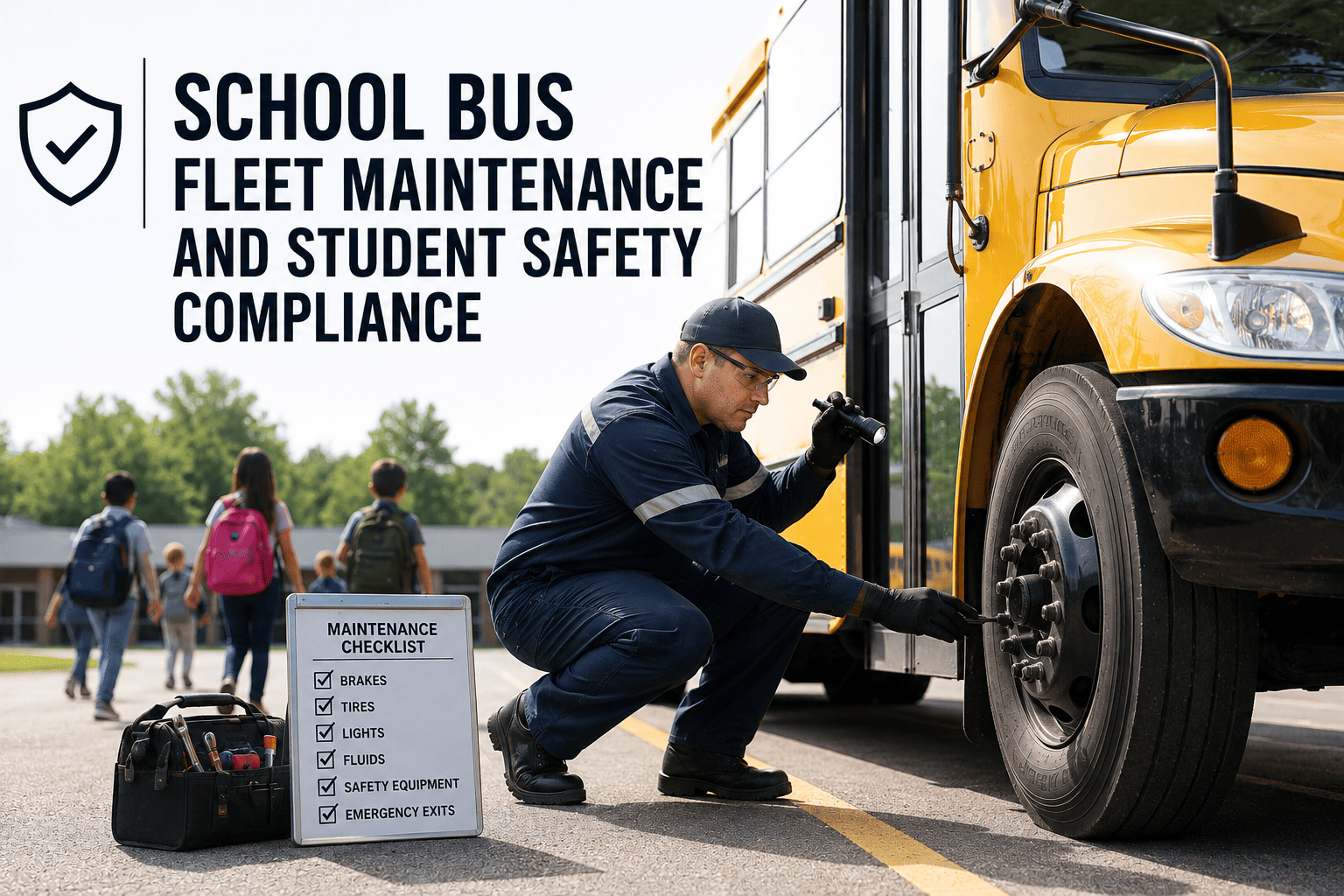
School bus fleet maintenance is the single most safety-critical function in any transportation department because the cargo is children, and regulators hold directors to a higher standard than nearly any commercial application. Under FMCSA passenger-carrying rules—specifically 49 CFR 396.11—every bus requires a daily Driver Vehicle Inspection Report (DVIR) for every trip, regardless of whether defects are found, creating a documentation burden that paper systems simply cannot sustain across a full academic year. This 2026 school bus maintenance guide breaks down the compliance standards, daily pre-trip requirements, and seasonal route changes that demand a modern CMMS, then shows how OxMaint automates DVIR capture, preventive scheduling, and audit-readiness so nothing falls through the cracks. If your team is still tracking inspections on clipboards or spreadsheets, now is the moment to Start Free Trial and see the difference AI-powered fleet maintenance makes.
Is your bus fleet school guide ready for the 2026 compliance crackdown?
FMCSA inspectors can audit any district at any time. A single missed DVIR under 49 CFR 396.11 can trigger vehicle out-of-service orders, route cancellations, and federal fines — not to mention the student-safety risk. OxMaint digitizes the entire inspection-to-repair loop so every trip is documented, every defect is tracked, and every bus is road-ready before the wheels roll.
Why school bus fleet maintenance carries stricter rules than commercial trucking
A typical U.S. school district operates 50–200 buses covering 12,000 to 25,000 miles per vehicle annually. Because passengers are minors, federal and state regulators enforce a documentation standard that exceeds most freight operations — and the cost of non-compliance goes far beyond fines.
Real-world scenario: A 120-bus district relying on paper DVIRs typically loses 8–12% of inspection records per month to legibility issues, misplaced forms, or skipped submissions. When the state DOT audits that district, the missing records count as violations — each one carrying a $1,000–$5,000 penalty and a mandated corrective action plan. OxMaint eliminates paper loss entirely: every digital DVIR is geotagged, time-stamped, and permanently archived, turning audit day from a fire drill into a five-minute report export.
The school bus pre-trip inspection checklist every driver must complete
Under 49 CFR 396.11, a pre-trip DVIR must cover specific vehicle systems before a bus moves. The following checklist mirrors the federal minimum and reflects what a bus fleet school guide should enforce for 2026 compliance — OxMaint digitizes each item so drivers complete and submit the form on a tablet or phone in under four minutes.
- Service door operation and emergency exits
- Mirrors, reflectors, and clearance lights
- Stop arm extends fully and red lights flash
- Body panels, bumper integrity, no sharp edges
- Tire tread depth (minimum 4/32" on steer axle)
- Air pressure build-up time within spec (under 45 sec)
- Parking brake holds on an incline
- Brake pedal feel — no sponginess or excessive travel
- ABS warning lamp off after start-up
- Shocks and air bags — no visible leaks
- Headlamps — high and low beam functional
- Tail, brake, and turn-signal lamps all operating
- Eight-way amber and red flasher sequence correct
- Hazard and backup lights operational
- Dashboard illumination and warning indicators
- Seat belts and child-safety restraint systems intact
- First-aid kit, fire extinguisher, and emergency triangles present
- Exhaust system — no fumes entering cabin
- Heater and defroster operating correctly
- Two-way radio or dispatch device functional
How to align bus fleet maintenance with seasonal route changes in 2026
School bus fleets don't run on a steady-state schedule. Demand spikes in fall, weather stress peaks in winter, and the summer window is your only chance to tackle major overhauls. A fleet bus guide that ignores seasonality guarantees breakdowns at the worst possible time — here is the 12-month PM rhythm OxMaint automates.
Back-to-School Surge
Peak vehicle utilization. Daily DVIR compliance is non-negotiable. Prioritize brake adjustments, tire replacement on worn steer axles, and HVAC checks before heat waves. OxMaint auto-escalates any DVIR flagging brake or tire defects to a critical work order within minutes.
Pre-Winter Hardening
Before first freeze: test coolant concentration (-34°F minimum), inspect block heaters, replace fuel filters, verify battery cold-cranking amps (CCA), and lubricate door tracks to prevent ice binding. OxMaint's predictive engine flags batteries trending below 80% capacity.
Peak Winter Operations
High-defect season. Salt corrosion accelerates undercarriage rust; glow plugs and air dryers fail. Daily air-tank draining becomes critical. OxMaint schedules these recurring tasks automatically and tracks completion so no bus slips through the cracks during the busiest breakdown months.
Spring Recovery & State Inspections
Post-winter chassis wash, suspension inspection for pothole damage, and A/C recharge before summer routes. Most states conduct annual school bus inspections in this window — OxMaint generates a one-click compliance packet for every vehicle showing DVIR history, PM completion, and defect-repair records.
Summer Overhaul Window
The lowest-utilization period — ideal for major engine work, transmission service, frame rust remediation, and reupholstering seats. OxMaint's long-range PM planner queues these projects against parts availability and mechanic capacity so the entire fleet is road-ready by August.
Spreadsheets vs. OxMaint CMMS for school bus compliance
Most districts still track DVIRs on paper and schedule preventive maintenance in Excel. That approach works until it doesn't — and when it fails, the fallout is measured in out-of-service buses, cancelled routes, angry parents, and federal penalties. Here is a side-by-side comparison of what changes when you switch to an AI-powered CMMS built for school bus fleets.
| Compliance Dimension | Paper DVIRs & Excel | OxMaint CMMS |
|---|---|---|
| DVIR submission & storage | Clipboards in the depot; 8–12% of records lost or illegible per month | Digital submission on phone or tablet; 100% geotagged, time-stamped, archived |
| Defect-to-work-order speed | Driver hands paper to supervisor; work order created hours later | Defect auto-generates a prioritized work order in under 60 seconds |
| FMCSA / state audit prep | Days of manual record gathering; gaps frequently discovered | One-click compliance report for any date range, bus, or driver |
| Preventive maintenance scheduling | Excel formulas break; PMs skipped when staff forget | AI-driven auto-scheduling based on mileage, engine hours, and season |
| Spare-parts inventory | Stockouts delay repairs; no consumption tracking | Real-time inventory with auto-reorder points and cost-per-bus analytics |
| Unplanned breakdown rate | Typically 4–7 breakdowns per 100 buses per month | 30–50% reduction within the first full academic year |
OxMaint capabilities that solve school bus fleet maintenance for 2026
OxMaint is an AI-powered CMMS and EAM platform designed to eliminate the exact failure modes that plague school transportation departments. Each capability below maps directly to a student-safety compliance requirement and delivers a measurable, defensible ROI within the first academic year.
Digital DVIR with Auto-Work-Order Generation
Drivers complete a 49 CFR 396.11-compliant inspection on a mobile app in under four minutes. Any defect flagged as "out-of-service" instantly spawns a work order assigned to the right mechanic — no supervisor intermediary, no paper handoff.
AI-Driven Preventive & Predictive Maintenance
OxMaint learns from historical DVIR data, mileage patterns, and engine telematics to predict component failures before they happen. PM schedules auto-adjust for seasonal route intensity, winter weather stress, and summer low-utilization windows.
One-Click Compliance & Audit Reporting
Generate a complete FMCSA, state DOT, or district-level compliance packet in seconds — including every DVIR, work order, PM record, and parts receipt for any bus, driver, or date range. No more scrambling when the auditor shows up unannounced.
Spare-Parts Inventory with Cost-per-Bus Analytics
Track every filter, brake pad, and belt by bus and depot. OxMaint auto-reorders at configurable minimums and surfaces per-vehicle lifecycle cost trends so directors can identify problem buses before they drain the maintenance budget.
What a 150-bus district saves by switching to OxMaint
Consider a mid-sized district operating 150 school buses, spending roughly $1,200 per bus annually on reactive repairs, paper DVIR administration, and FMCSA penalty exposure. Here is how the math works when that district moves to OxMaint's AI-powered CMMS.
| Savings Category | Before OxMaint | With OxMaint | Annual Savings |
|---|---|---|---|
| Reactive repair & towing | $96,000 | $57,600 | $38,400 |
| Paper DVIR admin & audit prep | $34,000 | $12,000 | $22,000 |
| FMCSA penalty exposure | $28,000 | $0 | $28,000 |
| Parts overstock & stockouts | $70,000 | $56,000 | $14,000 |
| Route cancellation / substitute bus costs | $18,000 | $7,200 | $10,800 |
| Total Annual Cost | $246,000 | $132,800 | $113,200 |
"We went from losing DVIR forms every single week to a 100% digital audit trail. When the state DOT showed up for their annual review last March, we handed them a complete report in five minutes. They had never seen anything like it."
See OxMaint on your bus fleet — book a 30-minute demo
Walk through a live DVIR workflow, auto-generated work orders, and one-click compliance reporting tailored to your district's routes and fleet size.
School bus fleet maintenance compliance — answered
What does 49 CFR 396.11 require for school bus DVIRs?
The regulation requires every driver of a passenger-carrying commercial motor vehicle to complete a Driver Vehicle Inspection Report for each day the vehicle is operated, and the report must cover specific items regardless of whether defects are found. The DVIR must be signed, any noted defects must be certified as repaired before the bus returns to service, and the record must be retained for inspection. OxMaint digitizes this entire process so every DVIR is compliant, time-stamped, and permanently archived — you can see it in action when you Book a Demo.
How often should school buses undergo preventive maintenance?
Most OEM guidelines and state regulations call for a Level A inspection every 3,000–5,000 miles or monthly (whichever comes first) and a Level B inspection every 10,000–15,000 miles or quarterly. OxMaint's AI engine auto-schedules these intervals based on actual mileage and engine hours pulled from telematics, then adjusts for seasonal stress factors so winter-critical components are inspected earlier.
Can a school bus legally operate if the driver finds a minor defect on the pre-trip DVIR?
It depends on whether the defect affects safety of operation. Minor non-safety defects (like a faded reflector) can be noted and repaired within 48 hours, while safety-critical defects (brake failure, tire tread below minimum, inoperative stop arm) place the bus out of service immediately until repaired. OxMaint automatically classifies defect severity and routes critical items to an instant work order so there is no ambiguity for the driver or mechanic.
How long must school bus DVIR and maintenance records be retained?
Federal regulations generally require DVIRs and maintenance records to be retained for at least one year, though most states and districts mandate three to five years for liability and audit purposes. OxMaint stores every record indefinitely in a secure, cloud-based archive that is searchable by bus number, driver, date, or defect type — eliminating the physical storage burden of paper forms.
How long does it take to switch from paper DVIRs to OxMaint?
A typical 100–200 bus district is fully live on OxMaint within 2–4 weeks, including bus asset import, driver mobile-app onboarding, PM schedule configuration, and parts inventory setup. Our team handles data migration from spreadsheets or legacy systems at no additional cost — you can Start Free Trial today and be running digital DVIRs by the end of the week.
Make every bus road-ready and every audit effortless
Join the districts using OxMaint to cut unplanned breakdowns by up to 50%, achieve 100% DVIR compliance, and turn FMCSA and state audits into a five-minute report export.
Free 14-day trial · No credit card

.png)