A missed DVIR does not announce itself. No dashboard turns red the moment a driver skips a post-trip inspection — the gap just sits quietly in the record until an FMCSA auditor or a roadside inspector goes looking for it. By then it is too late to fix the process that let it happen. The fleets that never get caught out are not the ones with the strictest policy on paper. They are the ones whose alert system pages the right person, at the right threshold, within minutes of a report going missing — instead of surfacing the gap in a weekly report nobody reads. Sign in to OxMaint to see how a properly tiered DVIR alert workflow is configured.
DVIR Alerts · Notification Workflow · Escalation Tiers · OxMaint
A DVIR Doesn't Have to Go Missing for 3 Days Before Anyone Notices. It Can Page Someone in Under 10 Minutes.
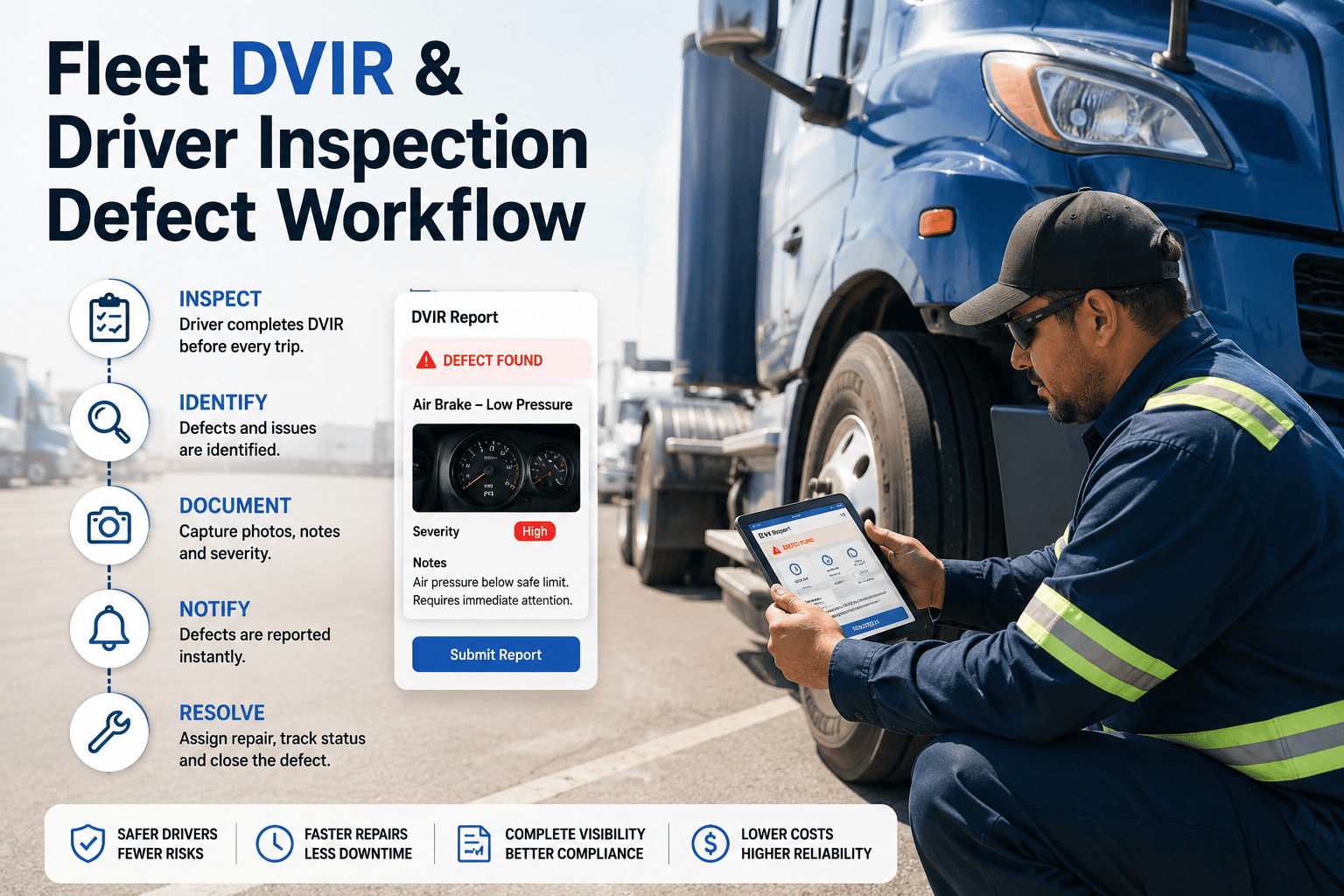
OxMaint's DVIR alert workflow defines exactly who gets notified, on which channel, and how fast the notification escalates when a driver vehicle inspection report is missing, incomplete, or flags a defect that was never certified as repaired.
35–45%
of required inspections go missing in fleets running on paper DVIRs, with completion rates sitting at just 55–65%
3 links
form the DVIR chain — driver report, carrier repair certification, next-driver review — and any one breaking is a citation
$19,277
maximum civil penalty for dispatching a vehicle that should have been placed out of service under an open DVIR defect
The problem is rarely that fleets have no DVIR policy. It's that the policy has no notification behind it.
A driver skips the end-of-day report. Nobody sees it that night. The next driver takes the truck without reviewing a report that was never filed, breaking the review link before it even had a chance to hold. Three weeks later, an auditor pulls the file and finds a pattern — not one missed report, a habit of missed reports, across multiple drivers, that no one at the fleet was ever paged about. A notification workflow with defined thresholds and escalation tiers turns that invisible pattern into a same-day page, catching the second or third miss long before it becomes the kind of pattern an auditor notices first, and giving the fleet a documented record showing the gap was caught and closed internally rather than discovered externally.
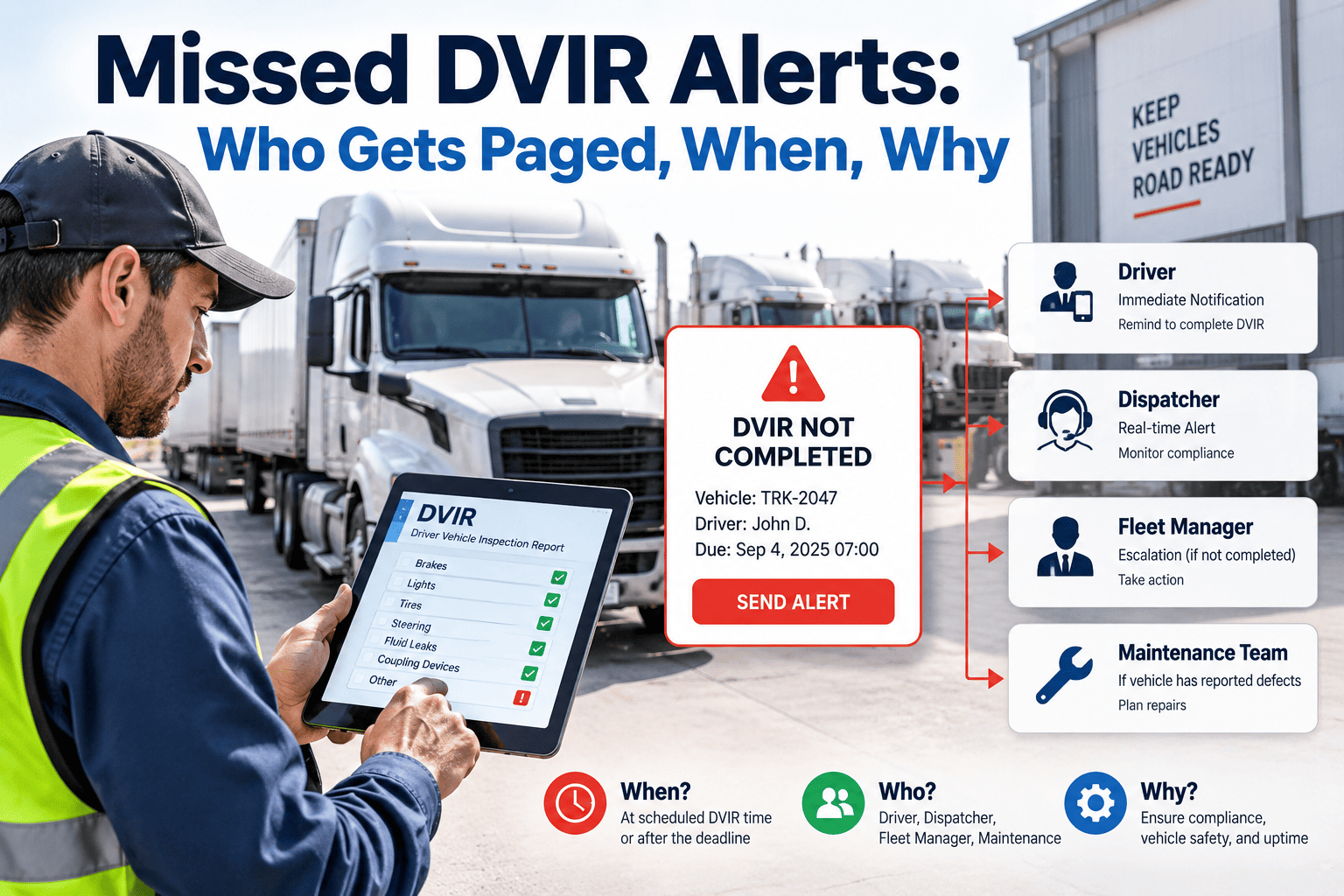
Who Should Actually Get Paged — and at What Point
Tier 1 · Immediate
Driver, on their own device
A push reminder fires at the scheduled end-of-shift window if no DVIR has been submitted for that vehicle that day. This is not a violation yet — it's a nudge before the deadline passes, aimed at preventing the miss altogether rather than reacting to it.
Tier 2 · 30–60 Minutes Late
Dispatcher or shift supervisor
Once the deadline passes without a submitted report, the alert widens to whoever controls that vehicle's next dispatch. This person can hold the vehicle from its next assignment until the report is filed or a manager overrides it with a documented reason.
Tier 3 · 2–4 Hours Late
Fleet or maintenance manager
A missed DVIR that survives two escalation cycles is no longer a one-off — it's a process failure worth a manager's direct attention. The alert here includes the driver's recent inspection completion history, so the manager sees a pattern, not an isolated incident.
Tier 4 · Same-Day Unresolved
Safety director or compliance lead
Anything still open at end of day reaches the person who owns the fleet's CSA score and audit exposure. This is the person who needs to know before FMCSA does — and the one whose name is on the compliance review if the pattern continues. By the time an alert reaches this tier, it should already carry the full history of the vehicle and driver involved, so the safety director isn't starting an investigation from zero.
Three Alert Triggers Beyond "Report Not Filed"
01
Defect Reported, Repair Not Certified
A driver flags a defect and the report exists — but no mechanic has signed off on the repair before the vehicle's next scheduled dispatch. This is a distinct alert from a missing report altogether, and it needs to reach maintenance, not the driver, since the driver has already done their part.
02
Repair Certified, Next-Driver Review Missing
The most commonly missed signature in DVIR audits is the next driver's acknowledgment before operating the vehicle. An alert here should fire to whoever assigns that vehicle next, blocking the handoff until the review is logged.
03
Pattern Across Multiple Days
One missed DVIR is a lapse. Three in two weeks from the same driver, or the same vehicle, is a pattern that predicts a future audit finding. A weekly rollup alert to the safety director surfaces this before it becomes a Compliance Review statistic.
Alert Fatigue Is the Reason Most Notification Systems Get Ignored
What Fails
Every missed field, every low-priority note, and every routine "no defect" filing lands in the same inbox as a genuine safety hold. Within weeks, the fleet manager stops reading DVIR notifications altogether, and the one alert that actually mattered gets buried with the noise.
What Works
Severity-based routing separates a routine late filing from a safety-critical open defect. Only the second kind interrupts someone's day with a push notification or a call; the first waits for a daily digest. The person being paged learns that a page always means something worth stopping for.
| Alert Type | Recipient | Channel | Response Window |
|---|---|---|---|
| End-of-shift reminder | Driver | Push notification | Before deadline |
| Missed DVIR | Dispatcher | Push + in-app | 30–60 minutes |
| Uncertified repair | Maintenance lead | Push + email | Before next dispatch |
| Missing next-driver review | Dispatcher | In-app block | Before handoff |
| Same-day unresolved | Safety director | SMS + email | End of day |
| Multi-day pattern | Safety director | Weekly digest | Weekly review |
What Changes Once Alerts Are Actually Tiered
Minutes
not days, is the typical gap between a missed report and the first person being notified — down from a weekly report that arrived long after the vehicle had already been redispatched
1 chain
of accountability across driver, repair certification, and next-driver review, with each link's owner notified the moment their step is overdue
Fewer pages
reach any one person overall, because severity routing keeps routine filings out of the channel reserved for genuine safety holds
Every Tier Above Is Configurable — Not Fixed
Thresholds, channels, and recipients differ by fleet size, vehicle class, and risk tolerance. OxMaint lets you set the timing and the escalation path once, per vehicle type or per terminal, and then forgets it — the system runs the schedule so nobody has to remember to check.
Common Mistakes Fleets Make When Setting Up DVIR Alerts
Routing Every Alert to One Person
A single fleet manager set as the recipient for every tier quickly becomes a bottleneck and a single point of failure — if that person is on leave or simply misses a notification during a busy week, the entire escalation chain silently stops working until someone notices the backlog.
Setting Thresholds Too Aggressively at Launch
Fleets that start with a 10-minute Tier 1 threshold across the whole operation often see so many false-positive pages in the first week that recipients start ignoring the channel entirely. It's usually better to start with a wider window, confirm the alerts are reaching the right people, and tighten the thresholds gradually.
Treating the Rollout as a One-Time Setup
Driver rosters change, terminals open and close, and vehicle classes shift as the fleet grows — an escalation matrix configured once during onboarding and never revisited eventually pages the wrong person, or nobody at all, for a route or vehicle type that didn't exist when the rules were written.
No Clear Definition of "Resolved"
An alert that fires but has no defined closing condition — a filed report, a certified repair, a documented override — tends to sit open indefinitely in whatever channel it landed in, defeating the purpose of tracking it at all.
We used to find out about missed DVIRs from a Friday report that covered the whole week. By the time we saw a pattern, the driver had already run five more shifts without a completed inspection. Now the dispatcher gets paged within the hour, and the pattern never gets past two days before someone above them knows about it. The difference wasn't a new policy — it was giving the same policy an actual notification behind it.
— Safety Director, Regional Truckload Carrier
Configuring the Matrix by Vehicle Type and Terminal
Standard Freight Trucks
A typical dry-van or flatbed operation runs a four-tier escalation with the standard timing above — a driver nudge before deadline, a dispatcher alert at 30 to 60 minutes, a manager review at two to four hours, and a safety director page if the report is still open at end of day. This baseline works because the compliance exposure per vehicle is moderate and consistent across the fleet.
Hazmat and Placarded Loads
Fleets hauling placarded hazardous materials typically compress every tier — a missed report reaches the dispatcher in 15 minutes instead of 60, and the safety director is looped in at the two-hour mark rather than waiting for end of day, since the consequence of a defect going unaddressed on this vehicle class is materially higher.
Passenger-Carrying Vehicles
School buses and transit vehicles fall under stricter daily DVIR requirements regardless of whether a defect was found, so the alert workflow for this category treats every missed report — not just defect-related ones — as worth an immediate dispatcher notification, with a same-day escalation to the safety director as the default rather than the exception.
Multi-Terminal Operations
A fleet running several terminals benefits from routing Tier 2 and Tier 3 alerts to the local terminal manager rather than a single central dispatcher, so the person closest to the vehicle and the driver is the one making the hold-or-release decision, while the safety director's Tier 4 alerts still roll up across every location for a fleet-wide view.
Configuration Takes One Sitting, Not a Rebuild of Your Compliance Program
Most fleets set their tiers once — by vehicle class, by terminal, or both — and then let the system run without touching it again until something about the operation changes.
Frequently Asked Questions
How fast should a missed DVIR alert reach a dispatcher?
Most fleets set the first escalation at 30 to 60 minutes past the expected filing window. That's late enough to avoid paging over a driver who is simply still finishing their shift, but early enough that the vehicle can be held before its next dispatch. Book a demo to configure your own threshold.
Should every missed DVIR go to the safety director?
No — that's how alert fatigue starts. A single late filing should stay with the dispatcher or shift supervisor. The safety director should only see same-day unresolved cases and multi-day patterns, where the risk has moved from a lapse to a trend.
Can the notification workflow differ by vehicle type?
Yes. Hazmat and passenger-carrying vehicles typically warrant tighter thresholds and an extra escalation tier compared to a standard box truck, since the compliance and safety stakes of a missed inspection are higher for those categories.
What happens if the next driver never reviews a filed DVIR?
This is the most commonly cited break in the DVIR chain during FMCSA reviews. Sign in to OxMaint to see how a dispatch-level block prevents a vehicle handoff until that review is logged.
Does a well-tiered alert system replace manual audits?
No, but it changes what the audit finds. Instead of discovering a three-week-old gap, the audit confirms that the alert workflow already caught and closed it — which is the difference between a routine review and a Compliance Review.
Measuring Whether the Workflow Is Actually Working
Time to First Notification
Track the average gap between a DVIR deadline passing and the first Tier 1 or Tier 2 alert reaching someone. A number that creeps upward over time usually means a notification channel is being missed or ignored, not that the system has stopped working.
Percentage Resolved Before Tier 3
A healthy workflow resolves most missed reports at the dispatcher level within the first escalation window. If a large share of alerts routinely reach the fleet manager or safety director, the earlier tiers may be understaffed or the thresholds set too loosely to catch issues early.
Repeat Offenders Over a Rolling 30 Days
The count of drivers or vehicles that appear in more than one missed-DVIR alert within a month is the clearest early signal of a pattern worth a direct conversation, well before it shows up as a citation on an FMCSA audit.
Stop Finding Out About Missed DVIRs From an Auditor
OxMaint pages the right person at the right threshold — driver, dispatcher, maintenance lead, or safety director — every time a DVIR step goes missing, so the gap closes in minutes, not weeks.