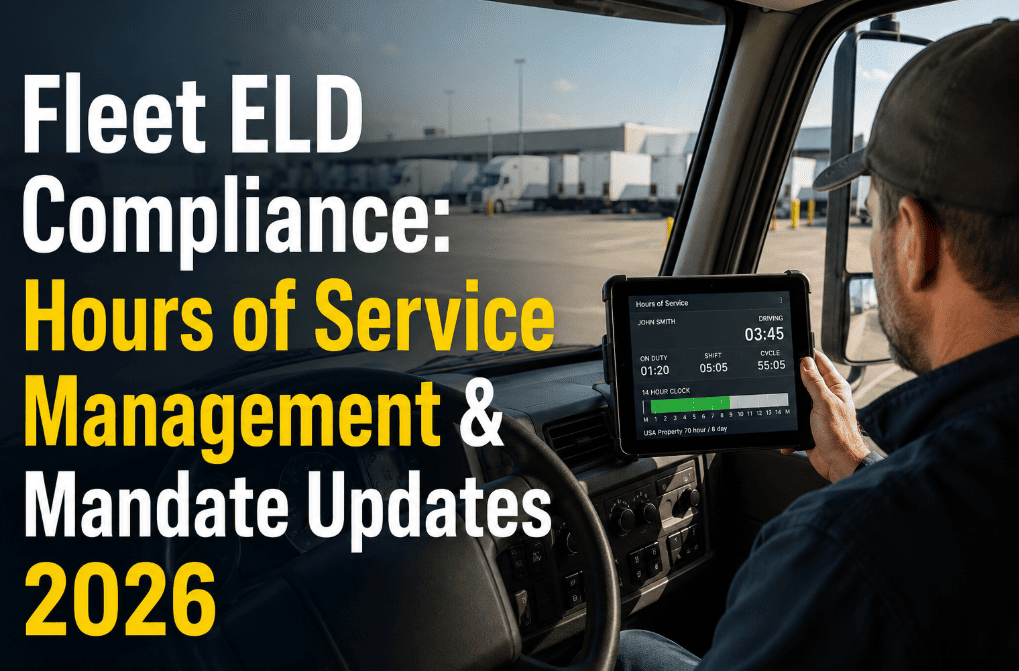
Hours of Service (HOS) Compliance: ELD Rules and Fleet Management Best Practices
By George Rickinson on March 19, 2026
Hours of Service compliance is the regulatory obligation that touches every dispatch decision, every driver assignment, and every delivery window in FMCSA-regulated fleet operations — and in 2026, it is enforced with a precision that paper log audits could never achieve. ELD data uploads to the FMCSA Safety Measurement System within 24 hours of every roadside inspection, HOS violations are automatically flagged, and carriers accumulating HOS citations watch their CSA scores deteriorate to investigation thresholds faster than at any point in the program's history. A single Hours of Service violation carries a civil penalty of up to $16,000 per offense. A pattern of violations that elevates your HOS Compliance BASIC above the 65th percentile triggers targeted investigations that can pull your fleet from operation for weeks. The operational challenge is that HOS compliance is not just a driver responsibility — it is a dispatch planning function. Routes assigned without regard to a driver's available hours will generate violations regardless of driver intent. Real-time HOS monitoring in OxMaint closes this gap by surfacing each driver's current driving time availability, flagging developing violations before they occur, and integrating HOS data directly into dispatch decisions so no assignment is made against a driver who cannot legally complete it.
Fleet Compliance · Blog · 2026
Hours of Service (HOS) Compliance: ELD Rules and Fleet Management Best Practices
Complete guide to HOS compliance in 2026 — driving limits, rest requirements, ELD mandate details, violation prevention strategies, HOS exceptions, and real-time compliance monitoring that keeps your fleet's CSA scores clean and your drivers legally dispatched.
$16KMaximum civil penalty per HOS violation under 2026 FMCSA enforcement
34%Of all DOT citations are HOS-related — the single most cited violation category
65thPercentile threshold — HOS Compliance BASIC above this triggers FMCSA investigation
24 hrsELD violation data upload to FMCSA SMS after roadside inspection report
The Core HOS Rules: Every Limit Compliance Managers Must Know
HOS regulations for property-carrying drivers operate as a set of simultaneous constraints — not a single limit. A driver must satisfy all applicable limits at the same time, and violating any one of them while complying with the others is still a citation. The most common compliance gap is not ignorance of the 11-hour driving limit — most drivers know that rule. The gap is in the overlapping constraints: drivers who reach the 14-hour on-duty window while still within their 11 driving hours, dispatchers who assign a route that requires the driver to exceed their remaining weekly hours, and carriers who miss the 30-minute break requirement because they track cumulative driving time imprecisely.
Core HOS Limits — Property-Carrying Drivers (2026)
11 hrs
Maximum Driving
After 10 consecutive hours off duty. Most commonly cited HOS limit at roadside. ELD tracks cumulative driving minutes — no manual calculation.
Violation trigger: Any driving beyond 11:00 after rest period
14 hrs
On-Duty Window
No driving permitted after 14 consecutive hours on duty following 10 hours off. Off-duty time does not extend or pause this window once started.
Violation trigger: Any driving after 14-hr window closes
30 min
Mandatory Break
Required after 8 cumulative hours of driving time. Must be off-duty or sleeper berth status for the full 30 minutes — no on-duty non-driving credit.
Violation trigger: Driving after 8 hrs without 30-min break
60/70 hrs
Weekly Limit
60 hours in 7 consecutive days or 70 hours in 8 consecutive days. Look-back window makes this the most commonly missed limit in manual log audits.
Violation trigger: On-duty hours exceeding weekly cap
10 hrs
Minimum Off Duty
Consecutive off-duty hours required before a new driving period begins. Must be uninterrupted — split sleeper berth rules apply for team drivers.
Violation trigger: Driving before 10-hr rest is complete
34 hrs
Weekly Reset
34 consecutive off-duty hours resets the 60/70-hour weekly limit. Must include two periods from 1–5 AM to qualify as a valid restart.
Reset qualifier: Two 1–5 AM periods within 34-hr block
HOS Exceptions: When Standard Rules Don't Apply
FMCSA maintains several HOS exceptions that modify or suspend standard limits for qualifying operations. Compliance managers must understand which exceptions apply to their fleet's operations — because using an exception incorrectly generates citations that are more difficult to defend than standard violations, since the carrier has asserted an exemption they cannot substantiate. The most commonly misapplied exceptions are the short-haul exemption (applied to drivers who regularly operate outside the 150-air-mile radius) and the adverse driving conditions exception (applied retroactively to situations that drivers should have anticipated at dispatch).
HOS Exceptions — Qualifying Conditions and Common Misapplications
Short-Haul Exemption
Qualifies: Driver operates within 150-air-mile radius of normal work reporting location, returns to that location within 14 hours, and does not require ELD if all conditions are met daily.
Common misuse: Applied on days when the driver exceeds the 150-mile radius or fails to return within 14 hours — invalidating the exemption for that entire day.
Adverse Driving Conditions
Qualifies: Unforeseen weather, road closure, or accident encountered during the trip that could not have been known at dispatch. Allows up to 2 additional driving hours.
Common misuse: Applied to traffic delays or weather that was forecastable at dispatch. FMCSA requires the condition to be genuinely unforeseen at trip start.
Agricultural Operations
Qualifies: Transportation of agricultural commodities within 150 air miles of the source during planting and harvesting seasons as defined by each state.
Common misuse: Applied outside the seasonal window or beyond the 150-mile radius — both disqualify the exemption and expose the carrier to standard HOS violation penalties.
Emergency Declaration
Qualifies: Federal or state emergency declarations explicitly waiving HOS rules for vehicles providing direct relief assistance to affected areas during the declared period.
Common misuse: Applied to general freight moving near an emergency zone that is not directly providing emergency relief — proximity alone does not qualify.
ELD Mandate: How Electronic Logging Changes Enforcement
The ELD mandate transformed HOS enforcement from a paper audit exercise into a near-real-time data system. Where paper log violations required a skilled inspector to detect discrepancies between log entries, odometer readings, and fuel receipts, ELD data is machine-readable — every driving minute, every status change, every engine-on event is timestamped and uploaded automatically. Fleets that maintained marginal HOS compliance under paper logs are now accumulating CSA citations for violations that would previously have gone undetected. OxMaint's ELD-integrated compliance monitoring reads the same data stream that inspectors access — surfacing violations in the carrier's own system before they reach an inspection report.
Paper Logs vs. ELD — How Enforcement Changed
Enforcement Factor
Paper Logs
ELD (2026)
Violation detection
Manual inspector review — misses up to 40% of violations
Automated — 100% of driving events flagged algorithmically
Upload to FMCSA SMS
Days to weeks — manual data entry after inspection
Within 24 hours of inspection report completion
Falsification detection
Difficult — requires fuel receipt and odometer cross-reference
Automatic — unassigned driving, engine data mismatch flagged
14-hour window tracking
Manual calculation — frequently miscalculated at roadside
Real-time countdown visible to driver and dispatcher
Weekly hours look-back
7-8 day manual log review — most common paper log error
Automated 7/8 day rolling total — always current
Carrier visibility
End-of-trip log submission only — no real-time awareness
Real-time per-driver HOS status visible to compliance team
HOS Violation Prevention: How to Stop Violations Before They Happen
HOS violation prevention is fundamentally a dispatch planning problem, not a driver behavior problem. The violations that generate the most CSA score impact — 14-hour window exceedances and weekly hour overages — are almost always predictable from the dispatch assignment itself. A dispatcher who assigns a 650-mile delivery to a driver with 9 hours of available driving time has created the conditions for a violation before the vehicle leaves the yard. Real-time HOS monitoring converts this from a reactive violation discovery into a proactive dispatch gate: the system shows each driver's available hours before the assignment is made, and flags any assignment that would require the driver to exceed any applicable limit to complete.
Top HOS Violation Types — Root Cause and Prevention Strategy
Violation
Root Cause
Prevention
01
11-Hour Driving Limit
Most cited · High CSA weight
Driver continues driving after 11-hour limit, often by minutes. Dispatchers assign routes without checking remaining available drive time.
Real-time drive-time countdown alert at 30 min remaining. Dispatch gate blocks assignment if route exceeds available hours.
02
14-Hour On-Duty Window
Second most cited · Cannot be extended
Driver accumulates on-duty non-driving time (loading, waiting), then starts driving after the 14-hour window has expired.
14-hour countdown visible from shift start. Alert at 2-hour and 30-minute marks before window closes.
03
30-Minute Break Requirement
Growing citation frequency · ELD detection near 100%
Driver accumulates 8 hours cumulative driving without a qualifying 30-minute off-duty break. Frequently missed on tight delivery schedules.
Break reminder alert at 7h 30min cumulative driving. Route planning builds break windows into delivery sequences.
04
60/70-Hour Weekly Limit
High-impact · Look-back catches manual errors
Carrier fails to track 7/8-day rolling hours — particularly for drivers returning from time off or switching between operations.
Automated 7/8-day rolling total per driver. Dispatch gate flags drivers within 4 hours of weekly limit before assignment.
05
False Record of Duty Status
Severe penalty · Carrier liability beyond driver
Driver manually edits ELD status or fails to reconcile unassigned driving time — creating discrepancy between engine data and logged status.
Unassigned driving time resolution workflow. ELD data cross-referenced with engine records — discrepancies flagged for carrier review.
Real-Time HOS Monitoring: How Compliance Software Prevents Violations
Real-time HOS monitoring is the operational infrastructure that converts a reactive violation discovery process into a proactive compliance management system. Every driver's current HOS status — hours driven today, time remaining in the 14-hour window, cumulative weekly hours, next available reset time — is visible in the dispatch dashboard at all times, updated from ELD data every 60–90 seconds. When a dispatcher is about to assign a route that would require a driver to drive beyond their remaining hours, the system flags it before the assignment is confirmed. OxMaint's real-time HOS compliance dashboard provides this visibility for every driver in the fleet simultaneously.
OxMaint HOS Compliance Dashboard — Real-Time Monitoring Features
Live Drive-Time Countdown
Remaining 11-hour and 14-hour window displayed per driver in real time. Dispatcher view shows all drivers simultaneously sorted by available hours.
Pre-Assignment Violation Check
Every dispatch assignment validated against driver's available hours before confirmation. Routes requiring more time than available are flagged — not blocked, but visible.
Break Requirement Alerts
30-minute break reminder triggered at 7h 30min cumulative driving. Driver and dispatcher both alerted — break window built into next route segment automatically.
Weekly Hours Tracker
Rolling 7/8-day hour totals per driver updated continuously. Drivers within 4 hours of weekly limit flagged in dispatch dashboard before any new assignment.
Unassigned Driving Resolution
ELD unassigned driving time flagged for carrier review within the FMCSA-required 30-day window. Resolution documented and timestamped automatically.
Audit-Ready HOS Records
Complete HOS history per driver retained permanently. DOT audit response for any driver's 6-month record generated in under 60 seconds — not hours.
See Every Driver's HOS Status in Real Time — Before Violations Develop
OxMaint's HOS compliance dashboard shows live drive-time countdowns, pre-assignment violation checks, and break requirement alerts for every driver simultaneously. Free to start.
HOS Compliance and CSA Scores: Understanding the Impact
Every HOS citation at roadside feeds directly into the carrier's HOS Compliance BASIC score in FMCSA's Safety Measurement System. The 2026 SMS weighting methodology assigns higher impact to violations from the most recent 6 months — meaning recent HOS compliance failures escalate CSA scores faster than older violations, and recent improvements reduce scores faster as well. The 65th percentile investigation threshold for property carriers means that a carrier accumulating 3–5 significant HOS violations in a 6-month window can move from below-threshold to investigation eligibility quickly. Shippers and brokers increasingly screen carrier CSA scores before awarding freight contracts — elevated HOS Compliance BASICs are commercially consequential beyond the direct penalty exposure.
HOS Violation → CSA Score Impact Chain
1
Roadside Inspection
Inspector pulls ELD records. HOS violation detected algorithmically — 11-hr, 14-hr, break, or weekly limit exceeded.
2
Citation Issued
Civil penalty up to $16,000 per violation. Driver may be placed out-of-service if violation is severe enough to trigger OOS threshold.
3
SMS Upload (24 hrs)
Inspection data uploaded to FMCSA Safety Measurement System. Violation weighted and added to carrier's HOS Compliance BASIC score.
4
BASIC Score Update
HOS Compliance BASIC percentile recalculated. Recent violations carry higher weight — 6-month window violations impact score most severely.
Can the 14-hour window be paused by taking off-duty time?
No — the 14-hour on-duty window runs continuously from the moment the driver comes on duty and cannot be paused or extended by taking off-duty breaks during the shift. Once 14 hours have elapsed from the start of the on-duty period, no further driving is permitted regardless of how many driving hours remain. The only way to reset the window is to complete 10 consecutive hours off duty. OxMaint's 14-hour countdown displays continuously from shift start so dispatchers and drivers both see the closing window.
What is the difference between an 11-hour violation and a 14-hour violation?
An 11-hour violation occurs when a driver exceeds 11 cumulative hours of actual driving after their rest period. A 14-hour violation occurs when a driver operates after 14 consecutive on-duty hours — even if they have not used all 11 driving hours. Both are citable independently, and a driver can be in violation of the 14-hour rule while still within their 11-hour driving limit. Book a demo to see how OxMaint tracks both limits simultaneously per driver.
How does real-time HOS monitoring reduce CSA score exposure?
Real-time monitoring reduces CSA exposure by preventing violations before they reach a roadside inspection record. When dispatchers can see each driver's remaining hours in real time, assignments that would require a violation to complete are identified before departure. Fewer violations mean fewer citations, fewer citations mean lower BASIC scores, and lower BASIC scores mean no investigation threshold exposure. Sign up for OxMaint free to start monitoring your fleet's HOS status today.
What records must carriers maintain for HOS compliance?
Carriers must retain ELD records for a minimum of 6 months, with supporting documents (bills of lading, fuel receipts, dispatch records) for the same period. Records must be producible on demand during roadside inspections and DOT compliance reviews. OxMaint retains all HOS records permanently by default and generates complete audit packages in under 60 seconds. Sign up free to start building your HOS documentation trail.
HOS Violations Are Preventable. OxMaint Prevents Them.
OxMaint's real-time HOS compliance monitoring shows every driver's available hours live, validates every dispatch assignment before confirmation, alerts on developing violations before they reach inspection records, and maintains permanent ELD documentation for instant audit response — keeping your HOS Compliance BASIC below investigation thresholds every day of the year.
-compliance-eld-rules-and-fleet-management-best-practices.png)