A fleet software rollout can go live on schedule, pass every configuration check, and still fail — not because the platform was wrong, but because drivers quietly go back to the paper log, the group chat, and the whiteboard the moment nobody is watching. Industry survey data shows drivers actively resist vehicle monitoring at a meaningful share of fleets, and change resistance from drivers is one of the most commonly cited reasons adoption rates stall after launch. The gap between a fleet running at partial adoption and one running at full adoption is not a technology gap — it is a trust, training, and enforcement gap that most implementation plans never actually budget time for. This guide breaks down why fleet software adoption fails even when the software itself works, and what a rollout built around driver buy-in actually looks like. See what a driver-first rollout looks like — book a demo with OxMaint.
Guide · Fleet Operations · Change Management
Fleet Software Implementation & Driver Adoption
The best fleet software fails the moment drivers find a workaround. Here is how to roll out fleet software with the training, enforcement, and mobile-first design that gets it used every single shift.
Adoption Rate vs. Data Value
40% adoption
Data gaps, no predictive alerts
100% adoption
Full visibility, predictive maintenance works
The Real Reason Fleet Software Fails (It Is Not the Software)
Every fleet software failure looks the same six months in — drivers logging inspections on paper "just in case," a dispatcher keeping a private spreadsheet because it is faster, a technician who never opened the mobile app past week one. None of that is a platform defect. It is what happens when a rollout treats implementation as a configuration task instead of a behavior-change project. The software gets installed, permissions get set, a training email goes out, and leadership moves on to the next priority — while the actual work of getting people to trust and use the new system every single day never gets a dedicated owner or a follow-up plan.
37%
Of fleet operators report driver resistance to monitoring
Resistance is highest where drivers were never told what the system does for them, not just what it tracks about them. A short, honest explanation upfront consistently does more to lower resistance than any feature the software offers.
48%
Of adoption rates negatively affected by driver change resistance
Change resistance is consistently cited as the single largest factor holding back full fleet technology adoption industry-wide, ahead of cost, integration complexity, or the software's actual feature set.
5 hrs
Lost daily per employee to manual, repetitive fleet tasks
Most of this time is recoverable through software — but only once the team actually uses it instead of working around it, which is exactly the gap a rollout plan needs to close.
The Four Breakdown Points After Go-Live
Adoption rarely fails on day one. It fails in the weeks after launch, at four predictable points that every fleet software rollout should plan around in advance rather than discover the hard way.
01
Unexplained Devices Read as Surveillance
A new app or tracker installed with no explanation of what it does for the driver reads as monitoring, not support. Loose wires and unclear purpose turn a safety tool into a resented one before it is ever used, and that first impression is difficult to undo once it sets in.
02
The Old System Never Actually Retires
If the whiteboard, spreadsheet, or group chat is still running after go-live, staff default back to it under pressure. Adoption fails the moment two systems are tracking the same work, because the easier habit always wins when nobody is enforcing the new one.
03
No Named Owner After Launch
A platform bought by leadership and handed to operations with no named champion has nobody accountable for training, troubleshooting, or enforcing the new process day to day, so small friction points pile up until the whole rollout stalls quietly.
04
Training Happens Once, Then Stops
A single onboarding session does not survive turnover, shift changes, or three months of muscle memory. Without reinforcement, usage quietly drifts back toward whatever was easiest before, and nobody notices until a report comes back full of gaps.
FLEET SOFTWARE · DRIVER ADOPTION · OXMAINT
Rollouts Fail on People, Not Platforms
OxMaint's mobile-first design and role-specific onboarding are built around how drivers and technicians actually work a shift — not how a spec sheet describes a feature list, and not how a slide deck looked in the sales meeting.
One Platform, Three Very Different Daily Jobs
A driver, a technician, and a fleet manager can use the exact same software and still need three different onboarding experiences, because the software touches their day in three completely different ways. Rolling out one generic training session for all three roles is one of the fastest ways to lose a portion of the team before they ever open the app.
Driver / Technician
Daily taskPre-trip inspections, work order updates, condition logging from the vehicle or bay, often between jobs with limited time
What matters mostSpeed — a form that takes 90 seconds gets completed; one that takes 10 minutes gets skipped or backfilled from memory later
Adoption riskFeels like surveillance if nobody explains what the data is used for before the app shows up on their device
Dispatcher / Coordinator
Daily taskAssigning vehicles, routing work orders, tracking status across the whole active fleet in real time throughout the shift
What matters mostA live, trustworthy view — the moment the data looks wrong even once, they revert to a private spreadsheet they trust more
Adoption riskOld habits return instantly if the dashboard lags behind what is actually happening on the ground
Fleet Manager
Daily taskReviewing compliance, cost, and downtime trends to make maintenance and budget decisions across the fleet
What matters mostData completeness — reports are only as reliable as what drivers and technicians actually logged in the field that day
Adoption riskLoses trust in the whole system the first time a report is built on incomplete field data and turns out to be wrong
Why Mobile-First Design Decides Adoption Before Training Even Starts
A driver standing next to a vehicle with grease on their hands will not open a laptop, navigate three menus, and fill out a ten-field form — they will write it on a scrap of paper and enter it later, or more often, never. Mobile-first is not a design preference for fleet software; it is the difference between a form that gets completed in the field and one that gets completed from memory two days later, if at all.
Field-Speed Forms
Pre-trip inspections and condition logs designed for a 60 to 90 second completion time, with large tap targets and minimal required fields, keep the form faster than the workaround it is meant to replace.
Works Without Signal
Offline capture that syncs once connectivity returns means a dead zone in a parking garage or rural route never becomes an excuse to skip logging the work.
One Tap to the Right Screen
A driver opening the app should land on today's task, not a dashboard built for a fleet manager. Matching the interface to the role removes the friction that kills adoption in week one.
Common Driver Objections — And How to Answer Them
Most resistance to fleet software traces back to a handful of recurring objections. Answering them directly and early, before a driver has to ask, removes most of the friction a rollout would otherwise spend months working through.
"This is just a way to track and punish us."
Explain specifically what the data changes for the driver — faster repairs, fewer roadside breakdowns, less time on paperwork — before explaining what leadership sees. Purpose-first framing consistently lowers resistance more than any policy reassurance.
"The old way was faster for me."
If a workaround is genuinely faster, the software has a design problem, not a training problem. Fix the friction in the actual workflow before pushing harder on compliance.
"I don't have signal where I work half the time."
Offline capture that syncs later removes this objection entirely — make sure the team knows the app works without a connection before assuming they simply refuse to use it.
"Nobody showed me how to actually use this."
This is the most common objection of all, and it is entirely preventable with role-specific onboarding and a named champion available in the first weeks after launch.
What Changes When Adoption Actually Sticks
The difference between a fleet stuck at partial adoption and one that pushed through the first ninety days is visible in the daily operating picture, not just in a usage percentage on a dashboard somewhere nobody checks.
Before: Partial Adoption
Inspections logged inconsistently, with gaps that only surface during an audit
Dispatchers keep a private spreadsheet because the system data feels unreliable
Maintenance decisions are made on incomplete history, so predictive alerts rarely fire
Every new hire has to be shown "how we actually do it," undermining the system further
After: Full Adoption
Every inspection and work order is logged from the field the same day, by default
Dispatchers trust the live dashboard enough to retire their old spreadsheet entirely
Complete maintenance history lets predictive alerts catch problems before a breakdown
New hires are trained on the system from day one, with no informal workaround to unlearn
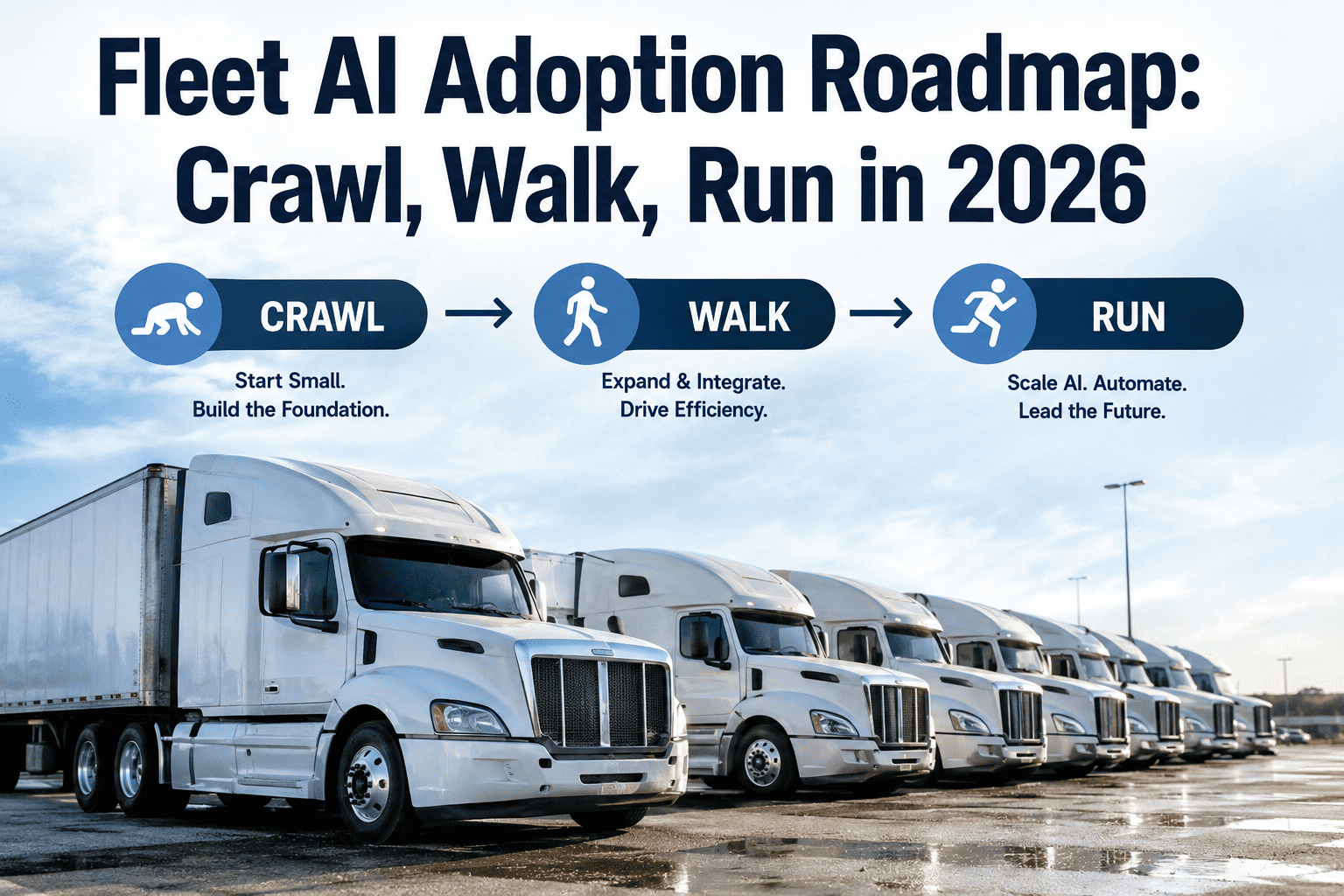
A 90-Day Adoption Roadmap, Not a One-Day Launch
Adoption is not a single go-live event — it plays out over the first ninety days, and fleets that check in at fixed intervals reach full adoption far more reliably than fleets that train once and move on.
Day 1–30
Guided Go-Live
Role-specific onboarding for drivers, technicians, and dispatchers, with a named champion on-site or on-call to answer questions in the first two weeks when habits are still forming and small frustrations can either fade or calcify into a permanent workaround.
Day 30–60
Usage Audit & Retraining
Pull actual usage data — who is logging inspections, who has reverted to old habits — and retrain the specific gaps instead of repeating a generic session for everyone. A targeted five-minute correction for one technician is far more effective than a fleet-wide refresher nobody needed.
Day 60–90
Retire the Old System for Good
Formally shut down the spreadsheet, whiteboard, or paper log that adoption was competing against, so there is no fallback left for anyone to quietly default to under pressure — this single step closes more adoption gaps than almost any other action in the rollout.
Day 90+
Enforce, Then Automate
Make policy violations and gaps visible and acted on, not just recorded — a system that flags a problem nobody addresses quickly teaches the team that the rules do not apply, undoing months of adoption work in a matter of weeks.
The technology is almost never the reason a fleet software rollout fails. I have walked into fleets running excellent platforms at thirty percent adoption because nobody explained the app to the driver before it showed up on their dash, and I have seen mediocre software succeed at ninety-five percent adoption because the fleet manager treated the first ninety days as seriously as the purchase decision itself. The single biggest predictor of adoption is whether someone is accountable for it after launch. If the answer is nobody, the software becomes a passive record instead of an active tool, and within two quarters the team has quietly rebuilt the exact workaround the software was bought to replace. The fleets that get this right almost always share one habit — they measure adoption the same way they measure downtime or cost per mile, as a number that gets reviewed on a schedule, not a feeling that gets assumed. Once adoption becomes a tracked metric instead of an afterthought, it stops slipping.
Priya Nataraj, CFM
Certified Fleet Manager · 14 years leading fleet technology rollouts across commercial and municipal fleets of 40 to 800 vehicles
Frequently Asked Questions
How long does it typically take to reach full driver adoption?
Most fleets reach dependable, day-to-day adoption within 60 to 90 days when training is reinforced at set checkpoints rather than delivered once at launch. Fleets that skip retraining often plateau well below full adoption indefinitely, since nobody ever fixes the specific gaps.
Why do drivers resist fleet software even when it reduces their paperwork?
Resistance is rarely about the paperwork itself — it is about drivers not understanding what the data is used for and assuming the worst. Explaining the purpose upfront consistently lowers resistance more than any single feature of the software itself.
What happens if a fleet only reaches partial adoption?
Below a certain adoption threshold, the data gaps become large enough that predictive maintenance alerts, compliance reports, and cost tracking all become unreliable, since the system is missing a meaningful share of daily activity across the fleet.
Book a demo to see how OxMaint tracks adoption alongside usage.
Should training be the same for every role in the fleet?
No — a driver, a dispatcher, and a fleet manager use the same platform for entirely different daily tasks. Role-specific onboarding gets each person productive faster than one generic session trying to cover every feature at once, and it reduces the early frustration that drives people back to old habits.
How does OxMaint support driver adoption specifically?
OxMaint pairs a mobile-first app built for quick field entry with role-specific onboarding and usage tracking, so fleet managers can see exactly who has adopted the system and retrain the gaps early, before they become permanent habits.
Start free to try the mobile workflow yourself.
FLEET OPERATIONS · ADOPTION · OXMAINT
Software Only Pays Off Once People Actually Use It
OxMaint combines mobile-first design, role-specific onboarding, and usage tracking so your fleet software rollout gets real driver buy-in from week one — not shelfware that quietly loses to a whiteboard by month three, and not a dashboard nobody trusts because the field data underneath it is incomplete.