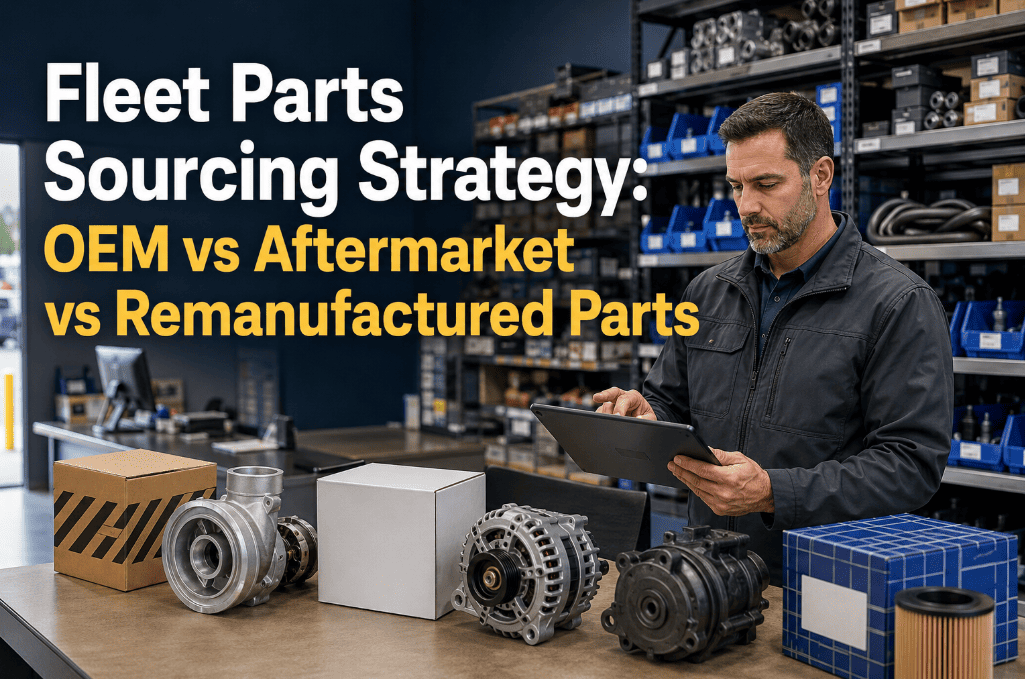
Fleet parts procurement is one of the highest-leverage cost decisions a fleet manager makes — and most organizations make it reactively, vehicle by vehicle, without a documented strategy. OEM parts carry brand assurance but often cost 30–40% more than functionally equivalent alternatives. Aftermarket parts from reputable suppliers can match OEM quality at lower cost. Remanufactured parts offer the deepest savings on high-value components. The right answer is a deliberate, tiered sourcing policy — one that defines which parts require OEM, which accept quality aftermarket, and which warrant remanufactured — backed by a CMMS that tracks parts performance, warranty claims, and supplier reliability. Start a free trial or book a demo to see how Oxmaint manages parts sourcing data across your fleet.
Fleet Parts Sourcing Strategy: OEM vs Aftermarket vs Remanufactured
A documented parts sourcing policy — defining when to use OEM, quality aftermarket, or remanufactured components — can reduce fleet parts spend by 15–30% without compromising vehicle reliability or warranty coverage.
OEM vs Aftermarket vs Remanufactured: What Each Actually Means
The first step in a parts sourcing strategy is understanding what each category delivers — not just in price, but in quality consistency, warranty coverage, availability, and supplier reliability. Most fleet managers have opinions about each; fewer have data to back them.
The Fleet Parts Tiering Decision Matrix
A tiered sourcing policy defines sourcing rules by component category — eliminating case-by-case decisions that create inconsistency and waste. The matrix below is a starting point for most commercial fleets; adjust based on OEM warranty status, duty cycle, and supplier relationships.
| Component Category | Recommended Source | Reason | Typical Savings vs OEM | CMMS Tracking Point |
|---|---|---|---|---|
| Brake pads and rotors | Quality aftermarket (Tier 1) | High turnover, proven alternates, no warranty risk post-expiry | 25–35% | Part number, supplier, install date per axle |
| Air and oil filters | Quality aftermarket or OEM at volume discount | High frequency, low unit cost — quality matters more than brand | 20–30% | Filter type and brand tracked per PM record |
| Turbocharger replacement | Remanufactured from certified supplier | High unit value, reman quality matches OEM at 40–60% saving | 40–60% | Reman supplier, core return, warranty start date |
| Engine components — warranty period | OEM required | Warranty preservation — aftermarket voids coverage | 0% (required) | OEM part number, warranty expiry per vehicle |
| Starter and alternator | Remanufactured | Mature reman market, full warranty, significant cost saving | 45–55% | Reman unit, core return status, warranty date |
| Belts and hoses | Quality aftermarket (branded) | High frequency, wide availability, proven quality brands | 20–35% | Brand, install date, and mileage per record |
| Safety-critical fasteners and structural | OEM or OEM-specified grade | No compromise on structural integrity or torque spec | 0% (required) | Grade specification noted in work order |
| Transmission — out-of-warranty | Remanufactured | High value unit, reman offers 2-year warranty at major saving | 40–50% | Reman supplier, unit serial, warranty terms |
6 Parts Procurement Problems That Inflate Fleet Costs
Each technician or location buys what they prefer. Some default to OEM always. Others use the cheapest available option. Without a policy, spend is inconsistent and uncontrollable across the fleet.
Ordering parts at the point of failure means paying expedite fees, accepting the first available option regardless of quality or price, and extending downtime while parts are located. Emergency orders typically cost 25–40% more than planned procurement.
A brake pad that lasts 40,000 miles costs less per mile than one lasting 25,000 miles — even if the cheaper pad has a lower unit price. Without failure history linked to part number and supplier, fleet managers cannot compare total lifecycle cost between sourcing options.
Installing an aftermarket part in a warranty-period vehicle — even a high-quality one — can void OEM warranty coverage for that system. Without a policy that flags warranty-period vehicles at the point of parts ordering, technicians make this mistake regularly.
Multiple shops ordering independently create duplicate storeroom inventory — same part, different supplier, different quantity, different location. Cross-site visibility into what is already in stock eliminates redundant orders and frees working capital tied up in excess inventory.
Remanufactured parts require return of the old core for a credit that is often $50–$300 per unit. Cores that sit in shop corners unreturned forfeit that credit — and most shops have several thousand dollars in outstanding core credits at any point in time.
How Oxmaint Supports Fleet Parts Procurement and Lifecycle Tracking
Oxmaint connects parts procurement decisions to vehicle maintenance records — so every part installed carries its source, part number, cost, supplier, and warranty terms linked permanently to the asset and the work order. This turns parts data from a purchasing function into a maintenance intelligence asset. Ready to bring structure to your fleet parts strategy? Start a free trial or book a demo.
Every part installed is recorded with OEM/aftermarket/reman classification, supplier, part number, unit cost, and warranty terms — linked to the vehicle and the work order that consumed it.
Work orders for warranty-period vehicles display a warranty alert — prompting technicians to verify OEM sourcing requirements before ordering parts. Prevents costly warranty voids from incorrect part selection.
When a part is replaced, Oxmaint calculates its service life from the original install record — enabling comparison of actual lifespan between OEM, aftermarket, and remanufactured sources on the same application.
Technicians and purchasers see inventory across all storeroom locations before placing an order — reducing duplicate stock, enabling inter-site transfers, and keeping working capital from being tied up in excess parts.
Oxmaint generates parts requirement lists from upcoming PM work orders — giving procurement time to source at planned pricing rather than emergency pricing. Reduces expedite fees and sourcing constraints on high-demand items.
Cores from remanufactured part installations are tracked as an open item on the work order until return is confirmed — ensuring no core credit is forfeited and the reman cost advantage is fully captured.
What a Tiered Sourcing Policy Delivers for a 50-Vehicle Fleet
Shifting 40% of applicable parts spend from OEM to quality aftermarket or reman at average 30% savings on a $150K annual parts budget
PM-triggered advance procurement eliminates most expedited orders — converting emergency pricing to planned pricing on predictable maintenance items
CMMS tracking of open core returns ensures every remanufactured part credit is claimed — recovering $50–$300 per unit that paper-based tracking routinely forfeits
In-warranty vehicle flagging at work order creation prevents aftermarket installation during coverage period — preserving manufacturer warranty on new vehicle assets
Frequently Asked Questions
Does using aftermarket parts void a commercial vehicle warranty?+
How do you identify quality aftermarket suppliers vs low-quality alternatives?+
Which fleet components are best suited to remanufactured sourcing?+
Can Oxmaint enforce sourcing policy at the point of parts ordering?+
A Parts Sourcing Policy Pays for Itself in the First Quarter
The difference between an ad-hoc parts purchasing approach and a documented tiered sourcing policy is typically 15–30% of annual parts spend — recaptured without reducing quality or reliability. Oxmaint gives fleet managers the parts tracking, supplier data, and lifecycle intelligence to make those decisions with evidence rather than habit.