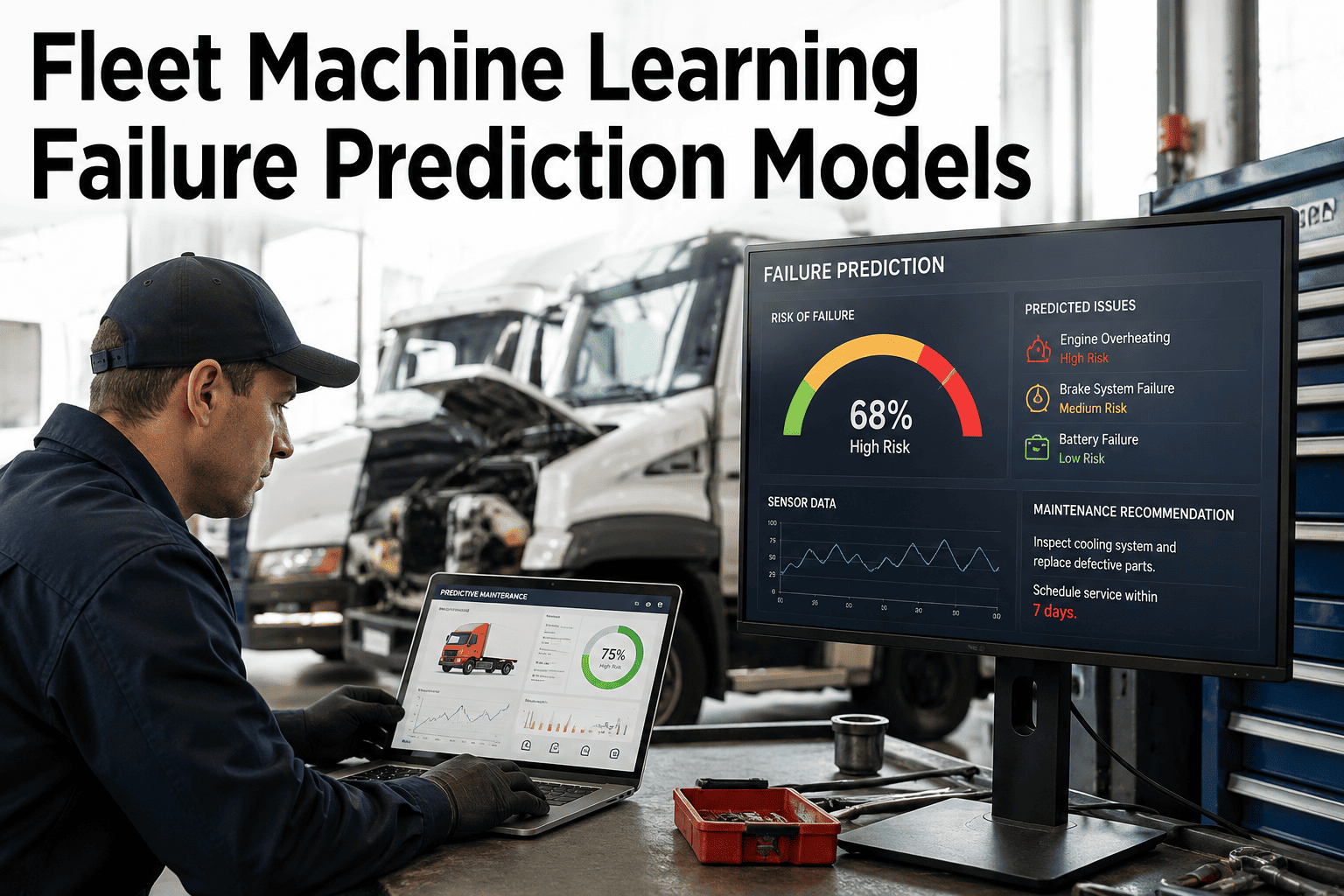
Fleet machine learning failure prediction models turn years of maintenance history into predictive intelligence — but only when the underlying data quality supports model training. Most fleets collect enormous volumes of telematics, sensor readings and repair records yet rarely convert them into actual failure predictions that prevent breakdowns. The gap is almost never the algorithm; it is fragmented data, inconsistent work-order capture and no workflow that turns a model output into a dispatched technician. This guide explains how fleet ML failure prediction works, what data you need, which models fit which failure modes, and how OxMaint provides the CMMS foundation that keeps predictions actionable rather than academic. If you want to see this on your own fleet data, Start Free Trial and connect your first assets in minutes.
Your Fleet Already Collects the Data. Why Isn't It Predicting Failures Yet?
Fleets generate 25GB of data per vehicle per hour from telematics, sensors and diagnostics — yet fewer than 20% of fleet operators use that data to predict failures before they happen. The models exist. The data exists. What's missing is the workflow that connects prediction to prevention.
Why Most Fleet Machine Learning Failure Prediction Projects Fail Before They Start
80% of ML project time is spent on data preparation, not model training. Fleet data teams routinely discover that their maintenance history is too fragmented, inconsistent or incomplete to train a defensible failure prediction model — and the model is only as good as the work orders it learns from.
Inconsistent Failure Codes
One technician logs "engine overheating," another writes "coolant issue," a third leaves the field blank. ML models cannot learn patterns from free-text chaos. You need standardized failure codes, structured work-order fields and enforced data entry — or the training set is noise.
Missing Timestamps & Mileage
A repair record without the vehicle's odometer reading or engine-hour timestamp is useless for time-to-failure modeling. Fleet ML failure prediction requires every work order to capture asset ID, failure mode, date, mileage/hours and parts replaced — consistently, across every technician and every site.
Siloed Telematics & CMMS
Telematics platforms collect DTC codes, temperature spikes and vibration anomalies. Your CMMS holds the repair history. If those two systems don't talk, the ML model sees symptoms without outcomes — and cannot learn which sensor patterns actually preceded which failures.
Which Fleet Failure Prediction Models Work Best for Which Failure Modes
No single ML model predicts every failure type. The right choice depends on the failure mode, the data you have and the lead time you need. Here are the four model families that deliver the highest ROI in fleet maintenance.
| Model Type | Best For | Data Required | Typical Lead Time |
|---|---|---|---|
| Survival Analysis | Component wear-out (brakes, tires, batteries) | Install date, usage hours, failure events | 2–6 weeks |
| Gradient Boosting (XGBoost) | Multi-factor failures (engine, transmission) | Telematics + repair history + operating conditions | 1–4 weeks |
| Anomaly Detection | Sudden failures (electrical, sensor faults) | Real-time sensor streams, DTC codes | Hours to 3 days |
| Recurrent Neural Networks | Degradation trends (vibration, temperature drift) | Continuous time-series sensor data | 1–3 weeks |
Most fleets start with survival analysis on high-wear components because the data requirement is lowest and the payback is fastest — a 180-vehicle fleet spending $42K/year on roadside breakdowns can cut that cost 40–60% in the first year just by predicting brake and battery failures 3 weeks out.
How OxMaint Turns Fleet ML Predictions Into Prevented Breakdowns
OxMaint is the CMMS layer that makes fleet machine learning failure prediction actionable. It captures the structured data models need to train, integrates with your telematics and ML platforms, and converts every prediction into a dispatched work order — so insights become uptime, not just dashboards.
Structured Work-Order Capture
OxMaint enforces standardized failure codes, required fields for asset ID, odometer, engine hours and parts replaced — so every work order becomes clean training data. Fleets using OxMaint see data completeness rise from 40% to 95%+ in 60 days, which is the threshold most ML models need to train reliably.
Telematics & ML Platform Integration
OxMaint ingests DTC alerts, sensor anomalies and ML model outputs via API, then auto-creates prioritized work orders with the predicted failure mode, recommended parts and lead time. No manual handoff, no spreadsheet exports — prediction flows straight to the technician's mobile queue.
Prediction-to-Work-Order Workflow
When your ML model flags a 78% failure probability on Unit 214's turbocharger, OxMaint checks parts inventory, assigns the job to the right tech, schedules it in the next PM window and tracks completion — closing the loop so the prediction actually prevents the breakdown.
Model Performance Analytics
OxMaint tracks which predictions were acted on, which prevented failures and which were false positives — giving your data team the feedback loop to retrain and improve model accuracy over time. Fleets report 30–50% reductions in unplanned downtime within 6 months of closing this loop.
See How OxMaint Feeds Clean Data to Your ML Models
Book a 30-minute demo and we'll show you exactly how OxMaint captures the structured maintenance history your fleet failure prediction models need — and how predictions become dispatched work orders automatically.
The 6-Month Roadmap to Production Fleet ML Failure Prediction
Most fleets can go from reactive maintenance to production ML failure prediction in 6 months — if they follow a disciplined sequence. Skipping the data-foundation phase is the #1 reason projects stall.
Data Foundation
Deploy OxMaint across all maintenance activity. Standardize failure codes, enforce required fields, migrate legacy records. Target: 90%+ data completeness on new work orders. This is non-negotiable — models trained on dirty data produce garbage predictions.
Baseline & Pilot Selection
Pick one high-cost, high-frequency failure mode (e.g. brake systems, batteries, turbochargers). Calculate current cost: a 200-vehicle fleet averaging 12 roadside breakdowns/month at $1,800 each is spending $259K/year — that's your baseline for ROI.
Model Training & Validation
Train your first model (usually survival analysis or gradient boosting) on 12–24 months of OxMaint history plus telematics. Validate on a holdout set. Target: 70%+ precision, 2+ week lead time. Integrate model output into OxMaint via API.
Production & Feedback Loop
Go live: predictions auto-generate work orders in OxMaint, technicians act, outcomes feed back to retrain the model monthly. Track prevented failures, false positives and cost avoided. Expand to the next failure mode.
What Fleet ML Failure Prediction Actually Saves: A Worked Example
A 150-vehicle regional delivery fleet was spending $310K/year on unplanned breakdowns — towing, emergency repairs, missed deliveries and driver downtime. Here's what changed when they deployed OxMaint plus a gradient-boosting failure prediction model.
The model flagged 89 high-risk failures in the first year. Technicians acted on 71 of them during scheduled PM windows — avoiding an estimated $142K in roadside costs. The 18 false positives cost $8K in unnecessary parts. Net ROI: 340%. The fleet expanded the model to transmission and electrical failures in Year 2.
5 Mistakes That Kill Fleet Machine Learning Failure Prediction Projects
Even well-funded fleet ML initiatives fail when they ignore these operational realities. Avoid these traps and your odds of production deployment rise dramatically.
Training on Less Than 12 Months of Clean Data
ML models need seasonal variation and enough failure examples to learn patterns. If you have 8 months of spotty records, wait. Use OxMaint to capture clean data for a full year first — a defensible model in month 13 beats a garbage model in month 6.
No Workflow to Act on Predictions
A model that emails a PDF report nobody reads is worthless. Predictions must auto-create prioritized work orders in your CMMS with parts, labor and scheduling attached. If the prediction doesn't reach a technician's queue, it doesn't prevent the failure.
Ignoring False Positives
A model with 40% false-positive rate will cry wolf until technicians ignore it. Track every prediction's outcome in OxMaint, retrain monthly, and tune the alert threshold. Precision matters more than recall — a missed failure costs less than a demoralized team.
Trying to Predict Everything at Once
Start with ONE failure mode that is high-cost, high-frequency and has clean data. Prove ROI in 6 months, then expand. Fleets that try to model engine, transmission, electrical and HVAC simultaneously in Phase 1 almost always stall.
No Executive Sponsorship for Process Change
ML failure prediction requires technicians to follow new workflows, dispatchers to trust model alerts and planners to schedule around predictions. Without leadership enforcing the change, adoption collapses. Tie model usage to KPIs and make wins visible.
Fleet ML Failure Prediction: Your Questions Answered
How much historical data do I need to train a fleet failure prediction model?
Minimum 12 months of clean, structured maintenance records with at least 50–100 failure examples for the component you're modeling. Survival analysis can work with less; gradient boosting and neural networks need more. OxMaint enforces the structured capture that gets you to training-ready data in 12–18 months.
What's the difference between predictive maintenance and ML failure prediction?
Predictive maintenance uses condition thresholds (e.g. "vibration > 5mm/s = inspect"). ML failure prediction learns complex multi-variable patterns from historical data to forecast failure probability and timing. ML models adapt and improve; static thresholds don't. Both prevent breakdowns, but ML scales to more failure modes with better lead time.
Can I use fleet ML failure prediction without telematics?
Yes — survival analysis and basic gradient boosting can train on work-order history alone (install dates, failure events, mileage/hours, operating conditions). Telematics improves accuracy and lead time, but fleets without sensors still see 30–40% downtime reduction from ML models trained on clean CMMS data. Start Free Trial to begin capturing that data today.
How do I integrate my ML model with OxMaint?
OxMaint accepts predictions via REST API — your model POSTs asset ID, failure mode, probability and recommended action; OxMaint auto-creates a prioritized work order, checks parts inventory and assigns it. Most data teams complete the integration in 2–3 weeks. Book a Demo and we'll walk you through the API and show example integrations.
What ROI should I expect from fleet machine learning failure prediction?
Fleets typically see 40–60% reduction in unplanned breakdown costs, 25–35% lower maintenance spend and 30–50% less unplanned downtime within 12 months. Payback period averages 4–8 months depending on fleet size and breakdown frequency. The ROI is highest for fleets with 100+ assets and $200K+ annual breakdown costs.
Ready to Turn Your Fleet Data Into Failure Predictions?
OxMaint captures the structured maintenance history your ML models need, integrates with your telematics and data platforms, and converts every prediction into a dispatched work order. Start your free trial or book a demo to see it on your fleet.
Free 14-day trial · No credit card · Cancel anytime