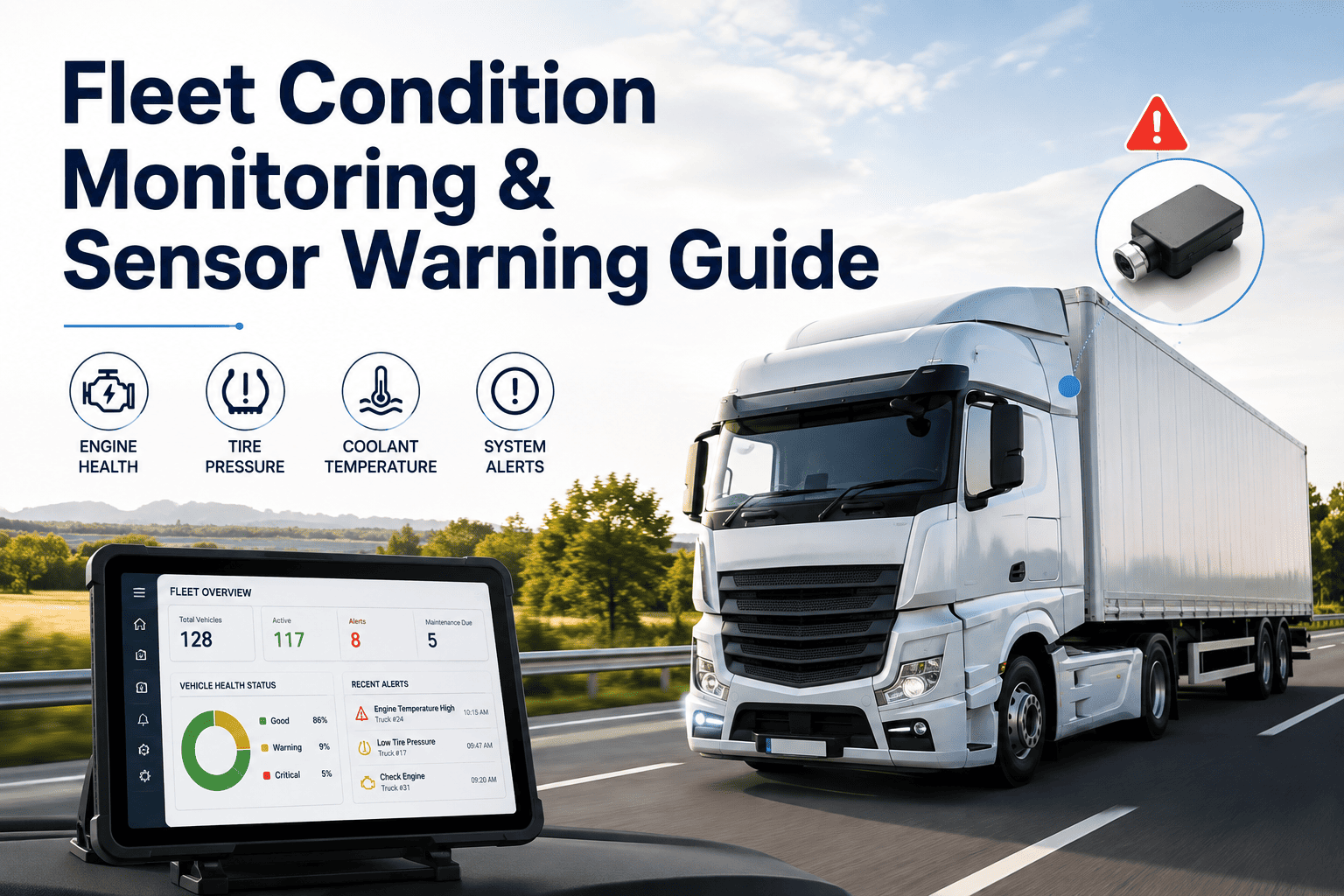
Fleet critical component failure rarely happens without warning — bearings, cooling systems, transmissions, and brakes almost always signal distress days or weeks before a roadside event. Building a fleet critical component failure early warning system means integrating telematics sensor data, setting threshold-based alerts, and trending condition data inside a CMMS so maintenance teams catch faults before they strand a vehicle. This guide breaks down how to deploy component early warning across the four most failure-prone fleet systems, the analytics that predict breakdowns, and how OxMaint helps managers transition from reactive repairs to predictive prevention. Ready to stop chasing breakdowns? Start Free Trial and see the difference on your fleet today.
EARLY WARNING GUIDE
What if you knew about a bearing failure 3 weeks before it stranded a truck?
Fleet critical component monitoring catches the slow-developing failures — bearing wear, coolant loss, transmission degradation — that cause 70% of unplanned roadside events. OxMaint turns telematics data into threshold alerts and condition trends that trigger work orders automatically, before the driver ever notices a problem.
that early-warning condition monitoring gives a maintenance team between first anomaly detection and functional failure on critical rotating components.
THE COST OF REACTIVE
Why fleet component failure warning can't wait
A single roadside breakdown costs a fleet an average of $270 to $1,080 per event in towing, lost revenue, driver detention, and emergency repair markups — before you count the cascading delay on the next load.
The economics are stark: a fleet operating 120 power units averaging 2.3 roadside component failures per month spends roughly $74,000 a year on emergency tows, expedited parts, and downtime alone. Fleet early warning failure detection doesn't just reduce that number — it shifts spend from emergency repair to planned maintenance at a fraction of the cost. OxMaint's AI-powered CMMS ingests J1939/CAN bus telematics, vibration data, and fluid analysis results, then flags deviations against each asset's baseline so a work order opens before the component degrades into a breakdown.
CRITICAL COMPONENT MAP
The four fleet components that warn you first
Not every part fails predictably, but the components responsible for most tow events share a common trait: they degrade gradually and leave measurable evidence — if you're monitoring for it.
Wheel End Bearings
Bearing race spalling generates high-frequency vibration detectable by accelerometers long before heat or noise becomes obvious. Temperature spikes at the hub are a late-stage indicator — by then you have days, not weeks. OxMaint trends bearing vibration RMS and peak values per axle position, alerting technicians when readings deviate 15% above the asset's rolling baseline.
Cooling System
Coolant level drops, thermostat deviations, and fan-clutch engagement patterns reveal leaks, water-pump wear, and radiator blockage well before an overheat event. A coolant temperature running 8°F above baseline at highway cruise is an early red flag. OxMaint's threshold engine fires an alert the moment sustained temperature exceeds the configured delta, auto-generating a cooling-system inspection work order.
Transmission
Slip events, shift-time elongation, and rising fluid temperature indicate clutch-pack wear or solenoid failure. Telematics capturing J1939 TSC1 messages can detect a 0.3-second increase in shift duration — imperceptible to a driver but measurable by OxMaint. Component early warning fleet systems trend these shift metrics and open a transmission diagnostic work order before a no-move event strands a load.
Air Brake System
Compressor cut-in frequency, air-leak decay rates, and brake-pad thickness sensors reveal impending failures before a DOT inspection or CSPV violation. A compressor cycling every 45 seconds instead of its normal 3-minute interval signals a system leak. OxMaint monitors pneumatic pressure trends and triggers a brake-system work order when leak-down rates exceed FMCSA-safe thresholds.
HOW TO BUILD IT
How to deploy fleet component monitoring in 4 phases
Moving from reactive repairs to a fleet critical component monitoring system is a phased rollout — not a rip-and-replace. Here's the 90-day timeline most fleets follow.
Asset & Sensor Baseline
Catalog every critical asset in OxMaint, attach J1939/CAN bus telematics feeds, and establish a 14-day baseline for temperature, vibration, pressure, and fluid parameters. The AI engine needs a baseline to know what "normal" looks like for each unit — a daycab running regional routes has a different thermal signature than a sleeper team running coast-to-coast.
Threshold & Alert Configuration
Set deviation thresholds for each component group — bearing vibration RMS +15%, coolant temp +8°F above baseline, compressor cycle interval below 90 seconds. OxMaint's rule engine lets you configure alerts at two levels: a yellow advisory (open a PM inspection) and a red critical (open an immediate repair work order and flag the unit for next available bay time).
Condition Trending & Validation
Review trended data weekly to validate that alerts are catching real anomalies and not generating false positives. OxMaint's analytics dashboard ranks assets by component risk score, so the maintenance director can see at a glance which 8 trucks out of 120 need attention this week. Fine-tune thresholds based on actual bay findings — if three bearing alerts confirmed real spalling, the threshold is calibrated correctly.
Predictive Automation
Enable OxMaint's predictive maintenance engine to auto-generate work orders when condition scores cross critical thresholds, auto-assign them to the appropriate technician, and reserve required parts from inventory. The system now operates autonomously — a bearing alert at 2 AM generates a work order, checks shelf stock for the part, and schedules the repair for the unit's next planned stop.
REAL-WORLD IMPACT
A 180-truck fleet's first year with early warning
Consider a regional dry-van fleet operating 180 power units across three terminals, averaging 4.1 roadside component failures per month — mostly bearing seizures, cooling leaks, and transmission no-move events.
Annual emergency repair spend — $270 average per roadside event × 49 events/year, plus $448/day downtime on 32 additional units held for follow-up repairs.
Same repair scope, but planned — $96K eliminated from emergency markup, towing, and detention. Component failures caught during scheduled bay visits averaged $580 vs $2,070 reactive.
The fleet deployed OxMaint's CMMS across all 180 units, integrated telematics from their existing GPS provider, and spent 6 weeks calibrating thresholds. By month 4, the predictive engine was catching 8 of every 10 bearing and cooling failures before they became roadside events. The fleet redirected $92,000 in avoided emergency costs into a proactive PM program and still netted a 31% reduction in total maintenance spend year-over-year.
CMMS-INTEGRATED APPROACH
How OxMaint helps build fleet failure early warning
OxMaint is an AI-powered CMMS and EAM platform built for maintenance and reliability teams. Here's how its capabilities map directly to component early warning — and the measurable outcomes each delivers.
Telematics & Sensor Integration
OxMaint ingests J1939/CAN bus data, vibration sensors, pressure transducers, and fluid analysis results via API — no manual data entry. Every reading is timestamped, asset-tagged, and stored against the component's maintenance history.
Threshold-Based Alert Engine
Configure multi-tier alerts (advisory → critical) for each component type per asset class. OxMaint's rule engine evaluates every incoming data point against thresholds and auto-generates a work order — with the correct priority, parts list, and assigned technician — the instant a threshold is breached.
Condition Trending & Predictive Analytics
OxMaint's AI models each asset's unique operating baseline and trends deviation over time, generating a component risk score from 0–100. The analytics dashboard ranks your entire fleet by risk, so you know which 7 trucks need a bay visit this week — and why.
CMMS-Integrated Work Order Automation
Every alert becomes a work order with full traceability — parts reserved from inventory, labor estimated, checklists attached, and history logged against the asset record. FMCSA-compliant documentation is generated automatically for audit readiness.
See OxMaint's early warning on your fleet — book a 30-min demo
We'll connect your telematics feed, configure threshold alerts for your top failure modes, and show you exactly which components the AI would flag today.
FAQ
Fleet critical component failure early warning — your questions answered
What is fleet critical component failure early warning?
It's a predictive maintenance strategy that uses sensor data — vibration, temperature, pressure, fluid analysis — to detect component degradation days or weeks before functional failure. A CMMS like OxMaint ingests this telematics data, trends it against each asset's baseline, and auto-generates a work order when thresholds are breached, turning a potential roadside breakdown into a scheduled bay visit.
How early can fleet component monitoring detect a failure?
Most critical rotating components provide a 10–30 day warning window between first detectable anomaly and functional failure. Bearing race spalling can be detected via vibration up to 21 days before seizure; coolant leaks show in temperature trends 14 days before overheat; transmission shift degradation is measurable 30 days before a no-move event. Book a demo to see OxMaint's detection windows on your asset mix.
What components should I monitor for fleet failure early warning?
The four systems responsible for roughly 70% of unplanned roadside events are wheel-end bearings, cooling systems, transmissions, and air brake systems. These components degrade gradually and leave measurable evidence — vibration, temperature, shift timing, and pressure-trend deviations — making them ideal candidates for condition-based monitoring inside a CMMS.
Does OxMaint integrate with my existing telematics provider?
Yes. OxMaint connects via API to major fleet telematics platforms and ingests J1939/CAN bus data, GPS feeds, and third-party fluid analysis results. If your current provider exposes sensor data through an API or file export, OxMaint's integration layer can consume it — no rip-and-replace of your existing hardware. Start your free trial to test the integration.
How much does fleet component monitoring software cost compared to the savings?
Most fleets achieve payback within 3–4 months. A 180-truck fleet spending $133K annually on emergency component repairs typically reduces that to $41K by shifting failures to planned maintenance — a $92K annual savings. OxMaint's CMMS subscription cost is a fraction of that avoided spend, and the platform includes work orders, PM scheduling, inventory, and analytics so you're not paying for a separate monitoring tool alongside your maintenance software.
Stop chasing breakdowns. Start predicting them.
Join the fleet maintenance teams using OxMaint to catch critical component failures weeks before they strand a vehicle — and turn unplanned downtime into planned maintenance.
Free 14-day trial · No credit card