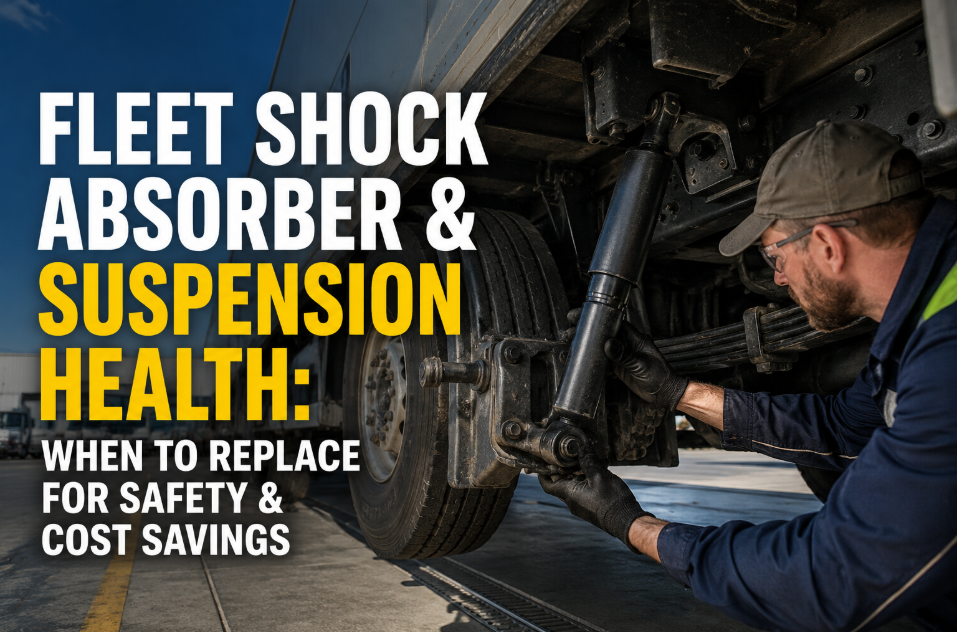
A bulk aggregates hauler running 22 tippers through the UK Midlands had three drivers report "rough ride" and "pulling left" complaints across different vehicles over a six-week period. Each complaint was logged, each vehicle visually inspected — no obvious issues found, each truck returned to service. Six weeks later, one of those three trucks experienced a steering axle leaf spring fracture at highway speed. The investigation found the spring had been cracking progressively for an estimated four weeks before failure. Visual inspection had missed a hairline fracture developing under load. The accident cost the operator a vehicle write-off, a three-month DVSA improvement notice, and an insurance excess larger than a full year of sensor-based suspension monitoring would have cost. If your heavy vehicle fleet still relies on driver reports and visual inspection for suspension health, start a free trial with Oxmaint to see how AI suspension monitoring changes the risk profile, or book a demo today.
AI-Powered Safety / Heavy Vehicle Suspension / Predictive Maintenance
Suspension Monitoring AI for Heavy Vehicle Fleets: Detect Wear Before It Becomes a Safety Incident
Shock absorber fatigue, spring fatigue, and air suspension degradation in heavy vehicles follow measurable patterns — but only if you're collecting the data. Oxmaint AI monitors suspension system health in real time, detecting wear signatures weeks before component failure puts a driver at risk or takes a vehicle off the road.
$500+
daily cost of heavy truck downtime from unplanned failures
$15,000+
average cost of major unplanned heavy vehicle repair
70%
breakdown reduction with AI predictive maintenance deployed
86%
of fleet managers report rising accident risk over 5 years
Safety-First Suspension Intelligence
Stop Finding Suspension Failures at the Roadside. Find Them in the Depot.
Oxmaint AI monitors chassis vibration patterns, air spring pressure, shock absorber response, wheel alignment deviation, and axle load distribution continuously — surfacing the early signatures of suspension degradation weeks before they become safety hazards, DVSA notices, or insurance claims.
What Is AI Suspension Monitoring for Heavy Vehicles?
AI suspension monitoring uses vibration sensors, air pressure transducers, and chassis accelerometers to track the dynamic behavior of a vehicle's suspension system under real operating loads — not just at a stationary inspection. Shock absorbers degrade gradually through oil bypass wear. Air springs lose their pressure curve signature over thousands of cycles. Leaf springs develop micro-cracks invisible to visual inspection but detectable as changed deflection characteristics under load. AI monitoring establishes a behavioral baseline for each vehicle and tracks deviations continuously — generating maintenance alerts on measurable degradation, not time intervals or driver complaints. This is the difference between discovering a cracked spring at a roadside failure and replacing it on a planned workshop visit three weeks earlier. Start a free trial today or book a demo to see suspension monitoring configured for your fleet.
Suspension Wear Progression — The Four Stages Oxmaint Monitors and Acts On
1
New / Baseline
Health: 90–100%
Nominal vibration signature established. All parameters within manufacturer tolerance. Monitoring active, no alerts generated.
2
Early Degradation
Health: 70–89%
Subtle vibration frequency shift detected. Shock absorber response time increasing. Flagged for next scheduled inspection — no urgent action required.
3
Active Wear
Health: 50–69%
Measurable damping loss or air pressure irregularity confirmed. Work order generated for workshop inspection within 7 days. High-load routes restricted.
4
Critical — Immediate Action
Health: Below 50%
Failure probability elevated. Urgent work order escalated. Vehicle restricted to light-duty until inspection completed and component replaced or cleared.
Four Ways Suspension Degradation Hides Until It Becomes a Catastrophe
01
Visual Inspection Misses the Failures That Actually Cause Accidents
Leaf spring hairline fractures, shock absorber oil bypass wear, and air bag micro-ruptures are structurally invisible to a parked-vehicle visual inspection. The components that cause catastrophic failures at highway speed are the ones that look fine standing still — until they don't. Sensor-based monitoring detects the behavioral signature of degradation regardless of what the naked eye can see.
02
Driver Complaint Reporting Comes Too Late — and Misses Too Much
Experienced heavy vehicle drivers normalize rough ride quality gradually as suspension degrades. By the time a driver reports "pulling" or "bouncing," the component is often already past the threshold where planned replacement was the economically optimal intervention. On routes where drivers rotate across vehicles, nobody notices the gradual change at all.
03
Suspension Wear Accelerates Tyre, Brake, and Steering Costs
Degraded shock absorbers increase unsprung mass oscillation, accelerating tyre wear by up to 30% and increasing brake fade events on descents. A failed air spring changes axle load distribution enough to exceed legal axle weight limits on otherwise compliant loads. The secondary costs of unmanaged suspension wear routinely exceed the cost of the suspension repair itself.
04
Unplanned Suspension Failures Cost 4–5x More Than Planned Replacements
A planned shock absorber replacement on a scheduled workshop day costs $600–$1,200 in parts and labor for a heavy axle. The same replacement triggered by a breakdown — with towing, emergency workshop rates, driver accommodation, and load transfer costs — routinely runs $4,500–$7,000 before any compliance notice is factored in.
How Oxmaint AI Monitors Suspension Health Across Heavy Vehicle Fleets
Oxmaint monitors suspension system health through a combination of chassis-mounted vibration sensors, air pressure transducers, and telematics-integrated accelerometer data — building a continuous behavioral model of each vehicle's suspension response under its actual operating loads, routes, and speed profiles. The system learns each vehicle's normal signature and flags deviations that indicate component degradation before they reach safety-relevant thresholds. Start a free 30-day trial or book a demo to walk through the suspension monitoring dashboard.
01
Chassis Vibration Frequency Analysis
High-frequency vibration signatures are captured and analyzed against each vehicle's baseline. Changes in resonant frequency patterns indicate shock absorber oil bypass, spring rate change, or mounting point fatigue — detected as characteristic frequency shifts 3–6 weeks before structural failure would occur under load.
Spring and damper faults detected weeks before visual evidence
02
Air Suspension Pressure Cycle Monitoring
Air bag pressure is tracked through load cycles — both static pressure holding under load and pressure curve signature during compression and rebound. A bag that holds static pressure but shows abnormal curve behavior under dynamic load is flagged before it fails completely, rather than after it settles a vehicle onto its bump stops mid-route.
Air bag failures predicted before route disruption
03
Shock Absorber Damping Rate Trending
Rebound speed analysis measures each shock absorber's actual damping rate against its baseline. Oil bypass wear produces a specific signature — consistent rebound overshoot in the 0.3–0.8Hz band — that Oxmaint models to estimate remaining service life and flag the replacement window before the shock reaches a "no damping" failure state.
Planned replacement replaces emergency breakdown repair
04
Wheel Alignment Deviation Detection
Lateral acceleration asymmetry patterns between axles reveal developing alignment drift before it becomes measurable on a workshop alignment jig — long before it shows in tyre wear. Axle alignment deviation above 0.2 degrees generates a monitoring alert; above 0.5 degrees generates an immediate inspection work order to prevent tyre and steering system damage.
Tyre wear reduced by up to 30% through early correction
05
Axle Load Distribution Monitoring
Air suspension load cells track actual axle weight distribution under loaded and unloaded conditions. Asymmetric loading caused by failed air bags or broken springs pushes individual axle weights above legal limits on technically compliant overall loads — a violation Oxmaint catches before the vehicle leaves the depot rather than at a weigh bridge.
Axle weight violations caught before departure
06
Route-Correlated Degradation Modeling
Vehicles operating on poor road quality routes degrade suspension components faster than motorway cycles. Oxmaint correlates GPS route data with vibration load cycles to produce route-adjusted remaining life estimates — so the maintenance schedule for a vehicle running quarry site access roads reflects actual wear rate, not a fleet-average interval.
Route-specific maintenance intervals replace generic schedules
Reactive vs. AI-Monitored Suspension Maintenance
| Scenario | Reactive / Visual-Based | Oxmaint AI Monitoring | Outcome Difference |
|---|
| Shock absorber failure detection | Driver reports rough ride — component already at or past failure | Damping rate decline detected 3–5 weeks before structural failure | Safety incident prevented |
| Leaf spring fracture risk | Visual inspection at stationary — fractures invisible at rest | Vibration frequency change detected under loaded operating conditions | Roadside failure eliminated |
| Air suspension bag failure | Vehicle settles onto bump stops mid-route — load disruption | Pressure curve anomaly flagged before bag fails to hold load | Route completion protected |
| Repair cost per event | $4,500–$7,000 unplanned (towing, emergency labor, transfer) | $600–$1,200 planned workshop visit on scheduled day | $3,900–$5,800 saved per event |
| Compliance risk | DVSA roadworthiness notice, O-license risk, insurance exposure | Condition-based work order filed before risk threshold reached | Operator license protected |
| Secondary cost prevention | Accelerated tyre wear, brake fade, axle overload undetected | Alignment and load distribution alerts prevent secondary damage | 30% reduction in tyre costs |
What Proactive Suspension Management Delivers to Fleet Operators
70%
Reduction in fleet breakdowns with AI predictive maintenance
Reported by fleet operations deploying condition-based monitoring across all mechanical systems including suspension
$5,800
Average savings per suspension failure event prevented
Unplanned emergency cost vs. planned workshop visit — the margin proactive monitoring consistently delivers on Class 6–8 vehicles
30%
Tyre wear cost reduction through early alignment correction
Alignment deviation flagged before tyre damage occurs — one tyre set saved per corrected vehicle typically covers annual monitoring cost
6–12 mo
Typical time to documented ROI
Most fleets identify a prevented suspension failure or avoided compliance event within the first two quarters of live monitoring
Frequently Asked Questions
What types of heavy vehicles does Oxmaint suspension monitoring support?+
Oxmaint supports suspension monitoring for Class 6–8 rigid trucks, articulated HGVs, tippers, tankers, flatbeds, refrigerated trailers, coaches, and construction machinery with air or mechanical suspension systems. Both air suspension (common on Class 8 trucks and coaches) and conventional leaf spring and coil spring configurations are supported. Trailer suspension monitoring — particularly air bag wear on curtainsiders and refrigerated trailers — is supported through trailer-mounted sensor integration.
Start a free trial to see how monitoring is configured for your specific vehicle types.
How does Oxmaint differentiate between road surface roughness and suspension wear?+
Oxmaint's AI models distinguish between vibration patterns caused by road surface input (route-correlated and shared across vehicles on the same route) and those caused by suspension component degradation (vehicle-specific and persistent across different road conditions). Cross-vehicle comparison on shared routes is used to isolate component-specific signatures. A vehicle showing elevated vibration on routes where other vehicles do not is flagged for suspension investigation — not for road quality recording.
Book a demo to see route-correlated modeling in practice.
Does suspension monitoring help with DVSA roadworthiness and operator licensing compliance?+
Yes. In the UK, DVSA's Earned Recognition scheme and traffic commissioner O-license compliance both require demonstrable systematic maintenance records. Oxmaint's condition-based suspension monitoring generates timestamped work orders for every maintenance event, providing the auditable evidence trail that supports Earned Recognition applications and defends against compliance investigations. Operators who can demonstrate that suspension condition is continuously monitored — not just inspected at statutory intervals — present a substantially stronger compliance case to examiners and traffic commissioners.
How quickly does Oxmaint generate an alert when suspension degradation is detected?+
Monitoring alerts are generated within the same operational shift when a vibration signature or pressure curve deviation exceeds the configured threshold. For gradual degradation (shock absorber oil bypass, spring rate change), the alert typically fires 2–5 weeks before the component would reach structural failure — giving the maintenance team a full planning window. For acute events (sudden air bag pressure loss, axle misalignment from impact), the alert fires within hours. Urgent alerts route to the fleet manager, maintenance planner, and assigned technician simultaneously via dashboard notification and mobile app.
Heavy Vehicle Safety Intelligence — Oxmaint
Find the Failing Spring in the Depot. Not on the Motorway.
Vibration signature analysis, air suspension pressure monitoring, shock absorber damping trending, axle alignment deviation detection, and route-correlated wear modeling — all in one platform. Seventy percent fewer breakdowns start with knowing what's degrading before it fails.
70%
Fewer fleet breakdowns with AI monitoring
$5,800
Saved per prevented failure event
2–5 weeks
Typical alert lead time before failure
30%
Tyre cost reduction from alignment alerts