DOT Compliance for Fleet Managers: A Complete 2026 Regulatory Guide
By Matt Caldwell on March 19, 2026
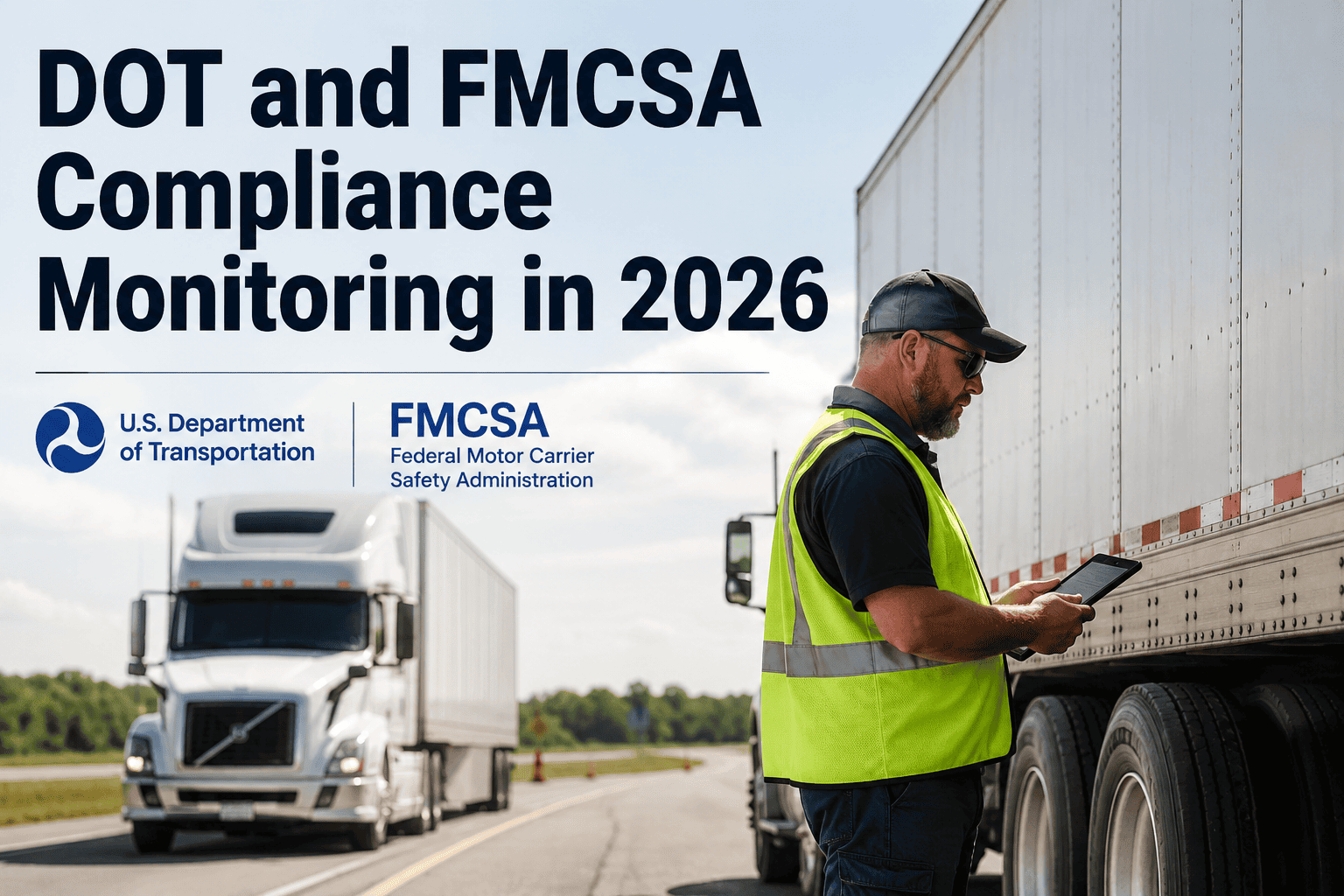
DOT compliance for fleet managers in 2026 is a continuous operational obligation — not an annual checkbox. A single HOS violation carries a civil penalty up to $16,000. Elevated CSA BASIC scores above investigation thresholds can trigger compliance reviews that take your fleet off the road for weeks, inflate insurance premiums by 18–24%, and disqualify you from shipper networks that now routinely screen carrier scores. Manual tracking fails at scale: paper logs, spreadsheet-based qualification files, and reminder-based DVIR workflows create invisible gaps that surface only at roadside inspections or post-accident investigations. CMMS platforms like OxMaint automate the documentation, expiration tracking, and workflow routing that keep fleets permanently audit-ready. This guide covers every major FMCSA requirement in 2026: HOS rules, ELD mandate, DVIR standards, driver qualification files, Drug & Alcohol Clearinghouse, and CSA scoring — with actionable strategies for each.
Fleet Compliance · Blog · 2026
DOT Compliance for Fleet Managers: A Complete 2026 Regulatory Guide
Complete coverage of HOS rules, ELD mandate 2026, DVIR standards, driver qualification files, Drug & Alcohol Clearinghouse, and CSA scoring — with CMMS automation strategies that keep your fleet audit-ready every day of the year.
$16KMaximum civil penalty per HOS violation under 2026 FMCSA enforcement
73%Of DOT audits find violations when fleets use manual compliance tracking
400+Distinct FMCSA requirements applicable to commercial motor carrier fleets
32%Fewer DOT violations in fleets using CMMS-automated compliance documentation
Why DOT Regulatory Compliance Is More Demanding Than Ever in 2026
FMCSA updated its SMS percentile weighting in 2026 to assign greater impact to violations from the most recent six months — meaning recent compliance failures escalate CSA scores faster and reach investigation thresholds sooner. Direct penalties represent only 30–40% of a compliance failure's total cost; the rest comes through insurance increases, freight network disqualification, and administrative remediation. Understanding where violations cluster is the first step toward intercepting them before they reach an inspection record.
DOT Violation Categories by Frequency — 2026 FMCSA Enforcement Data
Hours of Service (HOS)
34%
ELD Non-Compliance
28%
DVIR / Inspection Failures
19%
Vehicle Maintenance Defects
12%
Driver Qualification Gaps
7%
HOS and ELD violations combined account for 62% of all DOT citations — both are preventable with automated tracking
Hours of Service (HOS) Compliance: Core Rules for 2026
HOS regulations are the most-cited DOT requirement category and the most disruptive when discovered at roadside. The 11-hour daily driving limit, 14-hour on-duty window, 30-minute break after 8 hours, and 60/70-hour weekly caps must all be satisfied simultaneously. ELD enforcement means violations are automatically flagged and uploaded to the FMCSA Safety Measurement System within 24 hours of an inspection report — making dispatch workflow compliance more critical than ever.
11 hrs
Maximum Driving Time
After 10 consecutive hours off duty. Most common HOS citation at roadside.
14 hrs
On-Duty Window Limit
No driving after 14 consecutive on-duty hours. Off-duty time does not pause this window.
30 min
Mandatory Break
Required after 8 cumulative driving hours. Must be full off-duty or sleeper berth status.
60/70 hrs
Weekly Driving Limit
60 hrs in 7 days or 70 hrs in 8 days. Exceeding either triggers an automatic look-back violation.
10 hrs
Minimum Off-Duty Rest
Consecutive hours off duty required before a new driving period. Must be uninterrupted.
34 hrs
Weekly Reset Provision
34 consecutive off-duty hours resets the weekly limit. Must include two 1–5 AM periods.
ELD Mandate 2026: What Has Changed
2026 brought updated ELD standards requiring dual data transfer — both wireless telematics and local USB/Bluetooth. Single-method devices are now non-compliant. Every device must appear on FMCSA's active registry, retain 8 days of records on-device, and carry written driver instructions in the cab. The most commonly missed requirement is a documented unassigned driving resolution process — carriers must demonstrate a workflow for resolving unassigned ELD records within 30 days, producible during a compliance review.
Must appear on FMCSA's active registry. Expired registrations render device non-compliant immediately.
Dual Transfer Capability
Both wireless telematics and local USB/Bluetooth required. Single-method devices are non-compliant in 2026.
Written Driver Instructions in Cab
Carrier-provided instruction document must be in the vehicle. Missing docs are independently citable.
8-Day On-Device Retention
ELD must retain 8 days of records on-device and produce them on demand at roadside.
Unassigned Driving Resolution
Documented process for resolving unassigned driving records within 30 days — demonstrable during review.
Malfunction Protocol Documentation
Paper log backup and malfunction reporting docs must be available in the vehicle at all times.
DVIR Requirements: The Three-Party Certification Chain
DVIRs are required under 49 CFR 396.11 and 396.13 after each day of operation. The most common violation is a break in the certification chain — any gap between the reporting driver, repairing mechanic, and reviewing driver creates a citable violation. CMMS platforms like OxMaint solve this with structured digital workflows that cannot advance to dispatch without each party completing their required action.
01
Driver Post-Trip Report
Inspect vehicle, document all defects, sign at end of day.
02
Mechanic Repair & Certification
Repair defects, certify completion in DVIR record before dispatch.
03
Next Driver Acknowledgment
Review prior report, sign acknowledgment before leaving the yard.
04
90-Day Record Retention
All DVIR records retained 90 days minimum. Available on DOT audit request.
Driver Qualification Files: Required Documents and Retention Periods
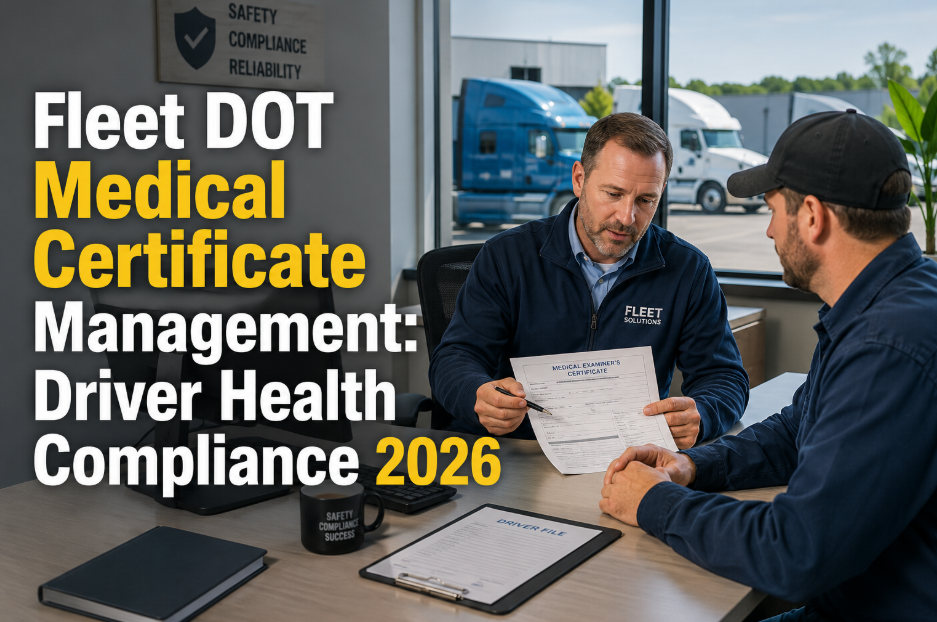
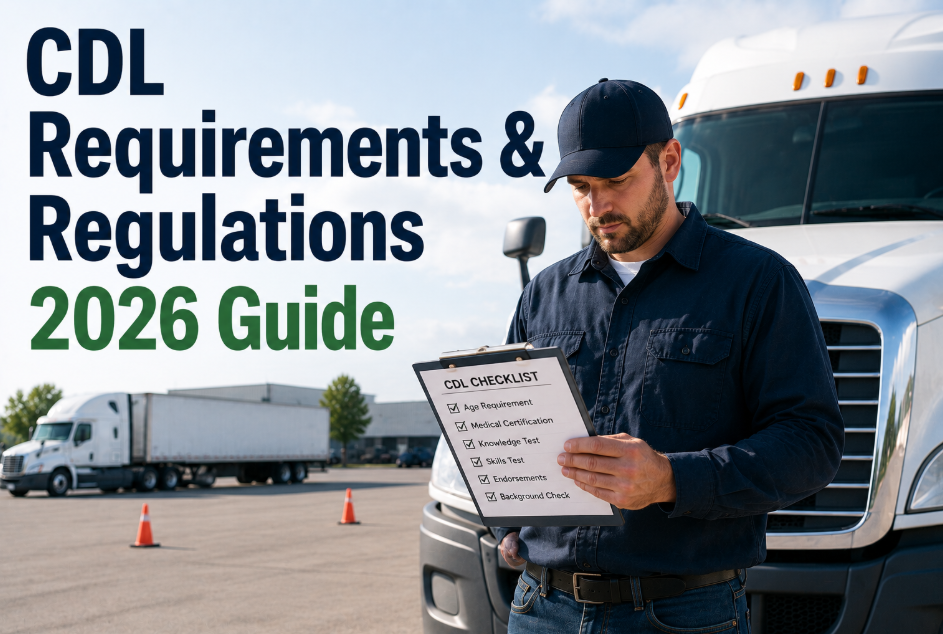
Under 49 CFR Part 391, carriers must maintain a complete qualification file for every CDL driver — with documents required before first dispatch, annual reviews throughout employment, and retention extending three years post-termination. DQ file audits are among the most cited compliance findings — not from missing original documents, but from missed annual updates, expired medical certificates, or records stored across disconnected systems.
Employment Application
Required before first dispatch
3 years post-employment retention
Motor Vehicle Record (MVR)
Annual update required
3 years per record retained
Medical Examiner Certificate
Renewal every 24 months max
Expiry tracked continuously
Road Test / CDL Verification
Before first CMV operation
Permanent retention required
Previous Employer Verification
3-year driving history required
Part of permanent hiring record
Annual Driving Record Review
Every 12 months — documented
3 years per review retained
Drug and Alcohol Clearinghouse: 2026 Requirements
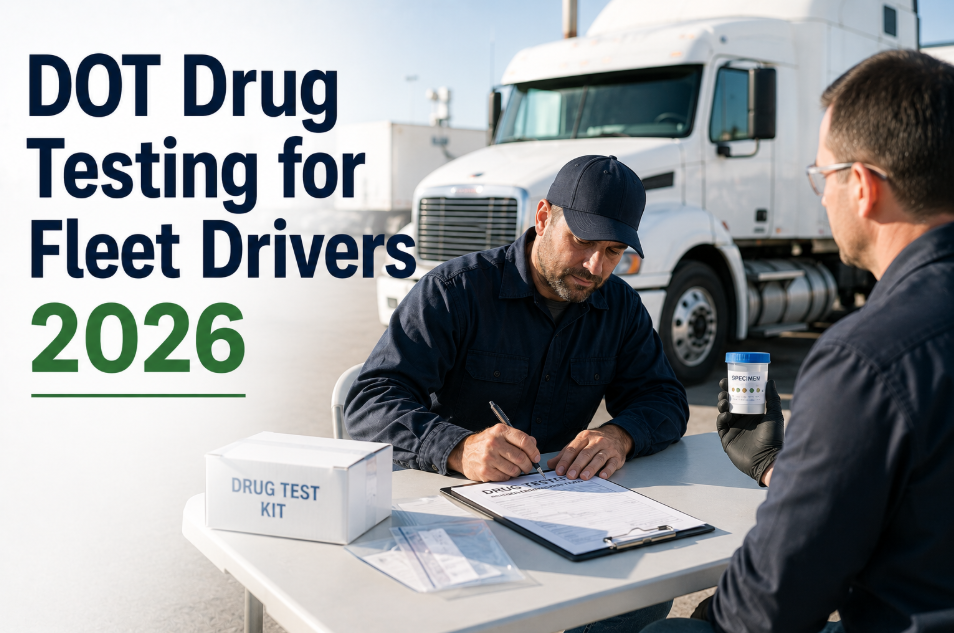
Two distinct query obligations apply: a full query before hiring any CDL driver (requires individual electronic consent), and an annual limited query for every currently-employed CDL driver (general consent on file suffices). Missed annual queries for long-tenured drivers are one of the fastest-growing citation categories in 2026 — discoverable in minutes during a compliance review. Fleet management software with compliance tracking eliminates this by auto-scheduling per-driver query deadlines 30 days in advance.
Pre-Employment Full Query
Required before any CDL driver operates a CMV
Requires driver's electronic written consent
Reveals all violations from January 2020 onward
Active prohibition = cannot operate until RTD complete
Results retained in driver qualification file
Annual Limited Query
Required every 12 months for all CDL drivers
General consent on file — no individual consent needed
Returns flag only — not violation details
Flag returned = full query required immediately
Missed queries are independently citable violations
Carrier Reporting Obligations
Report violations within 3 business days of knowledge
Refusals to test — 3 business days to report
RTD completion and follow-up testing must be reported
Failure to report = independent violation
MRO and SAP dual reporting obligations apply
CSA Scoring 2026: BASIC Categories and Investigation Thresholds
Updated 2026 SMS weighting assigns greater impact to violations from the most recent 6 months. For property carriers, Unsafe Driving and HOS Compliance BASICs reach investigation thresholds at the 65th percentile — a small cluster of recent violations can push a fleet into eligibility for a targeted review. Monitoring each BASIC relative to threshold is now a standard competitive compliance requirement.
How CMMS Eliminates DOT Compliance Gaps Across the Fleet
CMMS converts manual, reminder-dependent processes into automated, system-managed workflows. Each automated process removes an entire violation category — not just improves the odds. DQ expiration alerts, DVIR dispatch gates, and Clearinghouse query schedulers each permanently eliminate their respective violation type rather than managing it more carefully.
Automated DVIR Workflows
Digital DVIR → defect routing → repair certification → pre-dispatch acknowledgment. Complete timestamped audit trail at every step.
DQ File Expiration Tracking
Automated alerts at 60, 30, and 7 days before every medical certificate, MVR, and CDL deadline. Zero expired documents at roadside.
Clearinghouse Query Scheduling
Per-driver annual query deadlines tracked. Work orders generated 30 days in advance. Missed query violations eliminated fleet-wide.
ELD Data Reconciliation
Unassigned driving time flagged and escalated for resolution within the 30-day window before reaching inspection records.
CSA Score Monitoring
BASIC scores tracked monthly with investigation threshold proximity alerts. Issues identified before FMCSA triggers a formal review.
Audit-Ready Record Generation
Every compliance action timestamped and person-attributed automatically. DOT audit response reduced from days to a single system query.
Manual Compliance vs. CMMS: The Operational Comparison
Compliance Factor
Manual / Paper-Based
CMMS (OxMaint)
DQ file expiration tracking
Calendar reminders — depends on individual memory
Automated alerts at 60, 30, 7 days — system-managed
DVIR certification chain
Paper process — chain breaks at mechanic or next-driver step
Digital gate — dispatch cannot proceed without full chain
Per-driver scheduling with 30-day advance work orders
ELD unassigned driving
No process — discovered reactively during audits
Auto-flagged with 30-day resolution workflow
DOT audit response time
Hours to days assembling records across disconnected systems
Minutes — centralized records with instant retrieval
Compliance violation rate
73% of audits find violations — manual-tracking average
32% fewer violations — process failures eliminated
$0
Cost of a prevented DOT violation vs. $16,000 per HOS citation
Most fleets recover CMMS cost within the first prevented violation event.
60+ days
Advance warning before document expirations hit violation status
Multi-tier alerts give teams months to schedule renewals without gaps.
32%
Fewer violations in CMMS-managed vs. manual-tracking fleets
Process-failure violation categories eliminated across the fleet permanently.
3–6 mo
Typical platform payback period for most commercial fleets
One prevented $16,000+ penalty covers 12–18 months of platform cost independently.
Frequently Asked Questions
What violations most commonly lead to driver or vehicle out-of-service orders?
Driver OOS violations are primarily HOS-related — exceeding the 11-hour limit, operating beyond the 14-hour window, or lacking 10 hours off duty. ELD malfunction without paper log backup also triggers OOS. Vehicle OOS violations are led by brake adjustment defects, tire deficiencies, and steering defects. Use the CVSA OOS criteria as your DVIR defect benchmark — any vehicle that would fail CVSA OOS criteria should be pulled before dispatch. OxMaint's DVIR workflows include CVSA-mapped defect categories that flag OOS-status vehicles before they leave the yard.
How do CSA scores affect freight contract eligibility in 2026?
Shippers, brokers, and 3PLs use FMCSA SMS BASIC scores as standard carrier qualification criteria. Carriers with any BASIC above investigation threshold are routinely excluded from approved carrier lists. The Unsafe Driving and HOS BASICs — both at the 65th percentile for property carriers — are the most scrutinized because they signal controllable operational failures. Insurers also use BASIC scores; carriers approaching multiple thresholds can expect 15–30% premium increases at renewal. Automated CSA monitoring has become a standard competitive requirement in 2026.
What records must a carrier produce during a DOT compliance review?
A compliance review will request: complete DQ files for a driver sample (10–20% of roster) including applications, MVRs, medical certificates, and annual reviews; ELD records and unassigned driving resolution documentation for the 6-month period; DVIR records for all vehicles for the prior 90 days with complete certification chains; and Clearinghouse query records for all CDL drivers. CMMS-managed fleets can produce this in under an hour. Manual-record fleets commonly take days — and discover compliance gaps during assembly. Book a demo with OxMaint to see centralized compliance records in practice.
How does CMMS software reduce DOT compliance violations in practice?
The three largest preventable violation categories — document expiration, DVIR chain breaks, missed Clearinghouse queries — all share the same root cause: manual tasks dependent on someone remembering to act. CMMS removes the human dependency. Expiration alerts at 60/30/7 days ensure no certificate lapses unnoticed. DVIR dispatch gates prevent vehicles from leaving without complete chains. Query schedulers generate work orders 30 days before each annual deadline. Fleets averaging 2–5 violations per audit cycle typically reduce to 0–2 after deploying automated compliance documentation. Sign up for OxMaint free to start today.
Every DOT Compliance Gap Is Preventable. OxMaint Prevents Them.
OxMaint automates DVIR workflows, DQ file expiration tracking, Clearinghouse scheduling, ELD reconciliation, and CSA score monitoring — so your fleet stays audit-ready every day. Free to start. No hardware required. Join 1,000+ organizations running automated fleet compliance with OxMaint.


-compliance-checklist.png)

