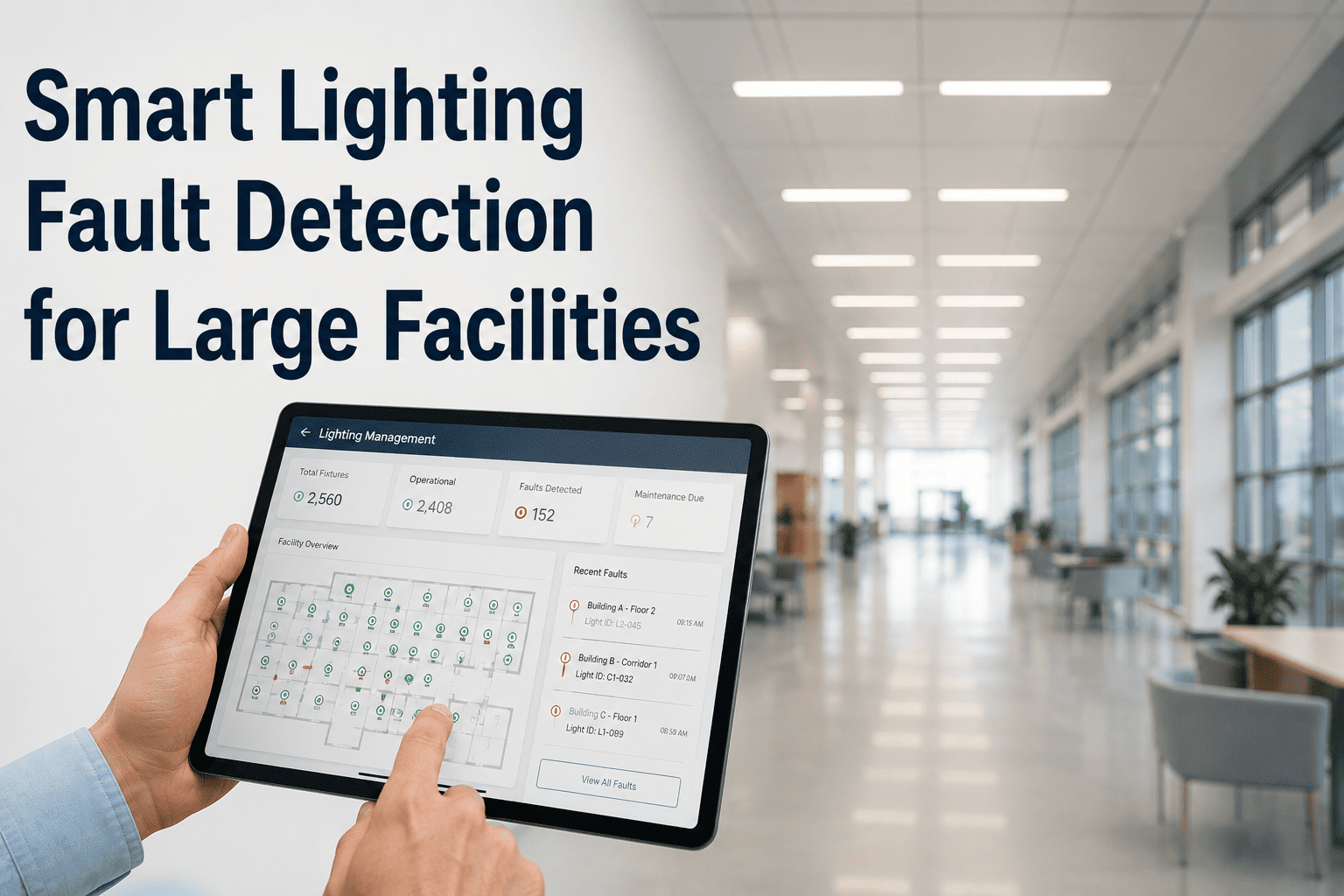
Lighting represents 20–40% of total electricity consumption in large commercial facilities — and a significant share of that energy is wasted through undetected faults, inefficient scheduling, and fixtures running in unoccupied zones. Smart lighting fault detection goes beyond replacing burned-out bulbs: it combines real-time analytics, occupancy data, and predictive failure models to optimize every watt while keeping maintenance costs low.
Why Lighting Faults Go Undetected for So Long
In a large facility, no single person walks every corridor, parking level, and storage area on a daily basis. Lighting faults in low-traffic zones can persist for weeks — accumulating warranty-voiding operating hours on adjacent fixtures, creating safety hazards, and generating complaint-driven maintenance instead of proactive work orders. The table below shows the typical detection lag by fault type without analytics in place.
| Fault Type | Detection Without Analytics | Detection With Smart Monitoring | Annual Energy Impact |
|---|---|---|---|
| Fixture failure (dark lamp) | 14 – 60 days (complaint) | < 4 hours (power draw drop) | Low — but safety risk |
| Driver failure (partial flicker) | Never detected until full failure | Days (power factor deviation) | High — inefficient operation |
| Controls failure (stuck ON) | 30 – 90 days (visual) | Hours (occupancy vs power mismatch) | Very High — 100% waste after hours |
| Daylight sensor failure | Weeks – seasonal change triggers report | Days (expected dim vs actual) | High — artificial light during daylight |
| Zone schedule misconfiguration | Often never detected | Immediate (schedule vs meter audit) | High — systematic waste at scale |
How Smart Lighting Fault Detection Works in Practice
The mechanics of smart lighting fault detection rely on three data layers working together: metered consumption per circuit or zone, occupancy sensor data, and scheduled operating hours from the control system. Deviations between expected and actual energy use in a zone — after accounting for occupancy — are the primary fault signal.
Every zone receives a baseline — expected watt-hours per square foot per occupied hour, calibrated over 2–4 weeks of normal operation. This baseline accounts for natural variation in occupancy and daylight harvesting.
Consumption that drops suddenly (fixture failure), rises persistently (driver degradation or controls fault), or mismatches occupancy patterns (stuck ON or scheduling error) triggers an anomaly flag.
When anomaly thresholds are crossed, OxMaint automatically creates a work order routed to the appropriate technician — with zone location, fault description, and severity level pre-populated. No manual triage required.
Every fault resolution is logged against the asset with energy data before and after repair — generating verifiable savings data for ESG and GHG reporting, tenant sustainability disclosures, and LEED/BREEAM documentation.
Lighting Maintenance and ESG Reporting — The Connection
Scope 2 emissions reporting requires accurate electricity consumption data at the building level. Lighting faults that go undetected for 30–60 days create invisible consumption spikes that inflate reported energy intensity and per-tenant carbon footprints. Facilities with smart fault detection can demonstrate measurable reductions — a compelling asset for green lease negotiations and ESG disclosures.
The gap between facilities teams and ESG reporting teams is almost always a data problem — not an effort problem. Maintenance technicians fix lighting issues every week, but those fixes are never connected to energy savings data because the work order system and the energy metering system do not talk to each other. When you use a platform like OxMaint that links fault detection to work orders and work order completion to energy trend validation, you suddenly have the documentation chain that ESG reporting requires. I have seen building managers go from estimating their lighting energy reduction to demonstrating it with verified before-and-after consumption data — and that difference matters enormously in green lease renewals and GRESB submissions.
Frequently Asked Questions
Turn Your Lighting Data Into Maintenance Action and ESG Evidence
OxMaint connects smart meter anomalies to maintenance work orders — and work order completions to verified energy savings reports. Purpose-built for facility teams managing large commercial buildings.