Smart Building Maintenance with IoT and AI Integration
By shreen on February 27, 2026
Commercial buildings waste up to 30% of their energy due to poorly maintained HVAC systems, aging infrastructure, and reactive maintenance habits that address failures only after tenants start complaining. Facility managers juggle hundreds of assets across multiple floors with spreadsheets and manual walkthroughs that miss early warning signs every single day. IoT sensors and AI-driven maintenance platforms now monitor building health in real time, detecting anomalies in air handlers, elevators, lighting circuits, and plumbing systems weeks before they become costly failures. Sign up for Oxmaint to connect your building systems to an intelligent maintenance workflow that acts on sensor data automatically.
30%
Average energy wasted in buildings with reactive-only maintenance
4,000+
Data points per floor generated daily by a typical IoT sensor network
$12/sqft
Annual maintenance cost that smart buildings reduce by up to 25%
Why Traditional Building Maintenance Falls Short
Scheduled maintenance calendars and tenant complaint tickets cannot keep pace with the complexity of modern commercial buildings. A 20-story office tower contains thousands of mechanical, electrical, and plumbing assets operating around the clock—each degrading at its own rate, influenced by occupancy patterns, weather, and usage cycles that no static schedule can predict. The result is a constant cycle of either over-maintaining healthy equipment or missing failures until they disrupt operations. Facility teams using Oxmaint's smart maintenance platform break this cycle by letting sensor data drive every work order.
HVC
HVAC System Monitoring
IoT sensors track refrigerant pressures, coil temperatures, airflow rates, and compressor vibration across every air handling unit in your building. AI algorithms compare real-time readings against manufacturer baselines and historical performance data to detect filter degradation, refrigerant leaks, and bearing wear weeks before system failure.
What This Detects
Compressor degradation 3-4 weeks before failure
Energy waste from clogged filters or refrigerant loss
ELV
Elevator and Vertical Transport
Accelerometers, door sensors, and motor current analyzers embedded in elevator systems feed continuous health data to your maintenance platform. AI models detect door alignment issues, cable stretch patterns, and motor brush wear that traditional quarterly inspections routinely miss until passengers experience delays or entrapments.
What This Detects
Door entrapment risks before they impact tenants
Motor degradation enabling planned overnight repairs
ELT
Electrical and Lighting Systems
Smart meters and circuit-level monitors track power consumption, voltage quality, and thermal conditions across switchgear, distribution panels, and lighting circuits. AI identifies overloaded circuits, deteriorating connections generating heat, and lighting zones consuming energy during unoccupied hours—turning electrical maintenance from calendar-based to condition-based. Start your free Oxmaint account to manage electrical asset health alongside all other building systems.
What This Detects
Arc flash hazards from deteriorating electrical connections
Phantom energy consumption during unoccupied periods
PLB
Plumbing and Water Management
Flow sensors, moisture detectors, and pressure monitors installed across domestic water lines, fire suppression systems, and drainage networks catch leaks, pressure drops, and backflow events in real time. AI correlates water usage patterns with occupancy data to distinguish normal consumption spikes from pipe degradation or valve failures that lead to flooding and water damage claims.
What This Detects
Hidden pipe leaks saving thousands in water damage claims
Legionella risk conditions in stagnant water zones
Connect Every Building System to One Intelligent Platform
Oxmaint turns IoT sensor data from HVAC, elevators, electrical panels, and plumbing into prioritized work orders your team can act on immediately.
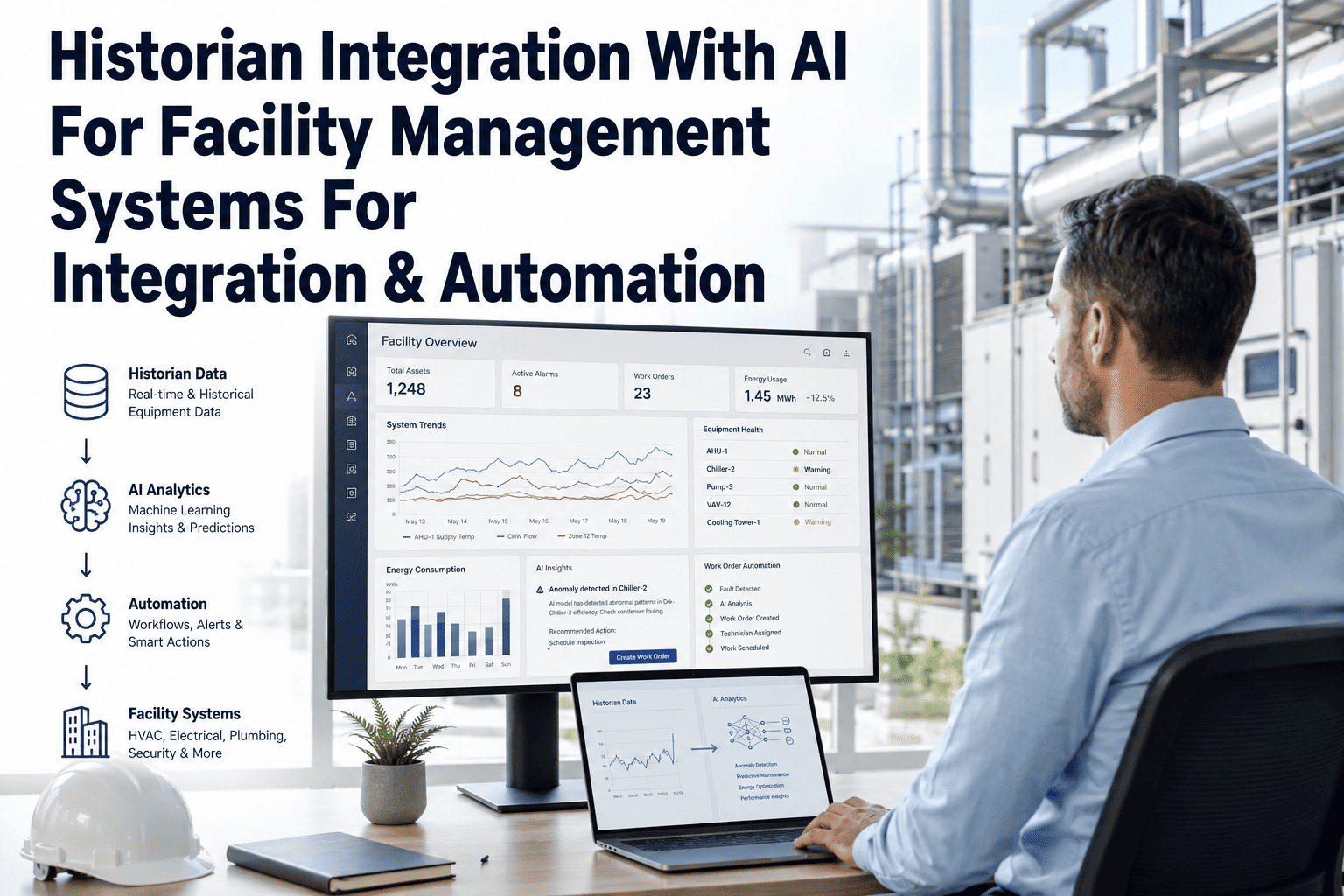
The real advantage of smart building maintenance is not the sensors themselves—it is the closed loop from data collection to completed repair. Here is how that loop works when your building runs on Oxmaint with AI-powered work order automation.
1
Sensors Collect Continuous Data
Temperature, humidity, vibration, current draw, flow rate, and pressure sensors installed across building systems transmit readings every 30 seconds to a centralized IoT gateway.
2
AI Analyzes Against Baselines
Machine learning models compare every reading against asset-specific baselines, seasonal patterns, and manufacturer thresholds. Deviations are scored by severity and urgency.
3
Anomalies Trigger Work Orders
When a reading crosses a configured threshold, Oxmaint auto-creates a work order tagged with asset ID, floor location, sensor evidence, severity level, and recommended corrective action. Book a demo to see auto-ticketing in action.
4
Teams Execute and Close
Technicians receive mobile-optimized work orders with full context—no guessing what is wrong or where. Completion data feeds back into the AI model, improving future predictions for that specific asset.
Paper Checklists vs. IoT-Driven Maintenance
The gap between manual building maintenance and sensor-driven workflows is not incremental—it is a fundamentally different operating model. Facility teams that switch to Oxmaint see the difference immediately.
Traditional Approach
Calendar-based PM schedules ignore actual asset condition
Failures discovered only when tenants report discomfort
Manual walkthroughs miss hidden mechanical deterioration
No data trail for warranty claims or compliance audits
IoT + Oxmaint
Condition-based maintenance triggered by real sensor data
Anomalies caught weeks before tenants ever notice
Continuous monitoring of hidden systems 24/7/365
Complete digital audit trail attached to every asset
Platform Capabilities for Smart Buildings
Oxmaint connects to your IoT infrastructure and transforms raw sensor streams into organized maintenance workflows. These are the core capabilities that make it work for facility management teams.
Auto Work Order Generation
Sensor anomalies automatically create prioritized work orders with asset location, sensor evidence, and recommended repair steps—no manual data entry required.
IoT IntegrationAutomation
Multi-System Asset Registry
Every HVAC unit, elevator, panel, pump, and lighting zone lives in one searchable registry with complete maintenance history, sensor linkages, and warranty records.
Asset ManagementCompliance
Predictive Analytics Dashboard
Trend charts, failure probability scores, and remaining useful life estimates for every connected asset—giving facility managers the foresight to plan maintenance windows around tenant schedules.
AI AnalyticsForecasting
Mobile Technician App
Field teams receive work orders on their phones with floor maps, asset photos, sensor readings, and one-tap completion logging. No more walking back to a desktop to update records.
Mobile-FirstField Teams
Key Insight
Buildings with IoT-connected CMMS reduce emergency maintenance calls by up to 45%
When sensor data drives work order creation instead of tenant complaints, facility teams shift from firefighting to planned maintenance—reducing overtime costs, extending equipment life, and improving tenant satisfaction scores. Sign up for Oxmaint to start building your sensor-driven maintenance program.
Frequently Asked Questions
What types of IoT sensors does Oxmaint integrate with?
Oxmaint connects with any IoT sensor or gateway that outputs data via API, MQTT, or BACnet protocols. This includes temperature and humidity sensors, vibration monitors, current transformers, flow meters, pressure transducers, moisture detectors, and occupancy sensors from major manufacturers. Book a demo to discuss your specific sensor ecosystem.
Do we need to replace our existing BMS to use this?
No. Oxmaint layers on top of your existing Building Management System and existing sensor infrastructure. It ingests data from your BMS via standard protocols and adds the maintenance intelligence layer—work order automation, asset history, predictive analytics—that most BMS platforms lack.
How quickly can we deploy across a multi-building portfolio?
A single building can be fully onboarded in 2-4 weeks, including sensor mapping, asset registry setup, and work order template configuration. Multi-building portfolios typically deploy in rolling phases of 3-5 buildings at a time. Sign up for a free account to start mapping your first building today.
What happens when a sensor reading crosses a threshold at 2 AM?
Oxmaint classifies every anomaly by severity. Critical alerts—like a water leak or electrical fault—trigger immediate push notifications to on-call staff with all context needed to respond. Non-critical anomalies generate scheduled work orders that appear in the next shift's queue, pre-prioritized and ready for action.
Can Oxmaint help with energy compliance and sustainability reporting?
Yes. Every sensor reading and maintenance action is logged with timestamps, creating the audit trail needed for ENERGY STAR benchmarking, LEED recertification, and local energy compliance reporting. Oxmaint generates exportable reports showing how maintenance activities contribute to energy reduction targets. Schedule a consultation to see compliance reporting capabilities.
Your Building Is Talking. Start Listening.
Oxmaint connects your IoT sensors to an intelligent maintenance engine that auto-generates work orders, builds predictive models, and gives your facility team the data-driven advantage they need to keep every system running at peak performance.