Integrated facilities management bundles multiple services — cleaning, security, maintenance, catering, energy management — under a single contract and a single point of accountability, promising simplified vendor management and cost savings of 10–20%. But evaluating whether the IFM model actually fits your portfolio requires a disciplined framework: you need to weigh the efficiency gains of bundling against the risks of vendor lock-in, service-quality dilution, and hidden cost escalators. The integrated facility management model works best for organizations with complex, multi-site portfolios where coordination overhead outweighs the benefits of specialist providers — and the wrong choice can lock you into a 3–5 year contract that underperforms. This guide breaks down the IFM evaluation criteria, risk factors, and decision framework that separate portfolios where integrated FM services deliver real value from those where they don't. Ready to see how a modern CMMS can make your IFM evaluation data-driven? Start Free Trial and put OxMaint to the test on your assets today.
IFM Evaluation Framework
Is the Integrated Facilities Management Model Right for Your Portfolio?
Bundling every service under one provider promises simplicity — but it also risks lock-in, hidden escalators, and service-quality dilution. Use a structured IFM evaluation to separate portfolios where bundling wins from those where it burns money.
Fragmented FM Model
- 5–12 separate vendor contracts to manage
- 300+ hours/year on coordination & invoicing
- No single source of asset data or SLA truth
- Reactive maintenance, 20–30% unplanned downtime
Integrated IFM Model
- One contract, one accountable provider
- 10–20% total cost reduction via economies of scale
- Unified asset register & SLA dashboard
- Preventive & predictive maintenance, 30–50% less downtime
The IFM Value Proposition
What Is the Integrated Facilities Management Model — and When Does It Pay Off?
The integrated facility management model consolidates hard services (HVAC, electrical, plumbing, fire safety), soft services (cleaning, security, catering, landscaping), and strategic services (energy management, space planning, sustainability reporting) under a single IFM contract model. The provider becomes your single point of accountability, backed by a unified SLA framework and — critically — a shared technology stack that gives you visibility across every asset and service line.
The value proposition is real — but it is not automatic. The integrated FM model pays off when your portfolio has enough complexity (typically 5+ sites or 50K+ sq ft) that coordination overhead and data fragmentation are actively costing you money. For smaller, single-site operations, the overhead baked into an IFM provider's margin can exceed the savings. The evaluation framework below helps you quantify both sides of that equation.
IFM Evaluation Criteria
The 6-Point Integrated Facilities Management Evaluation Framework
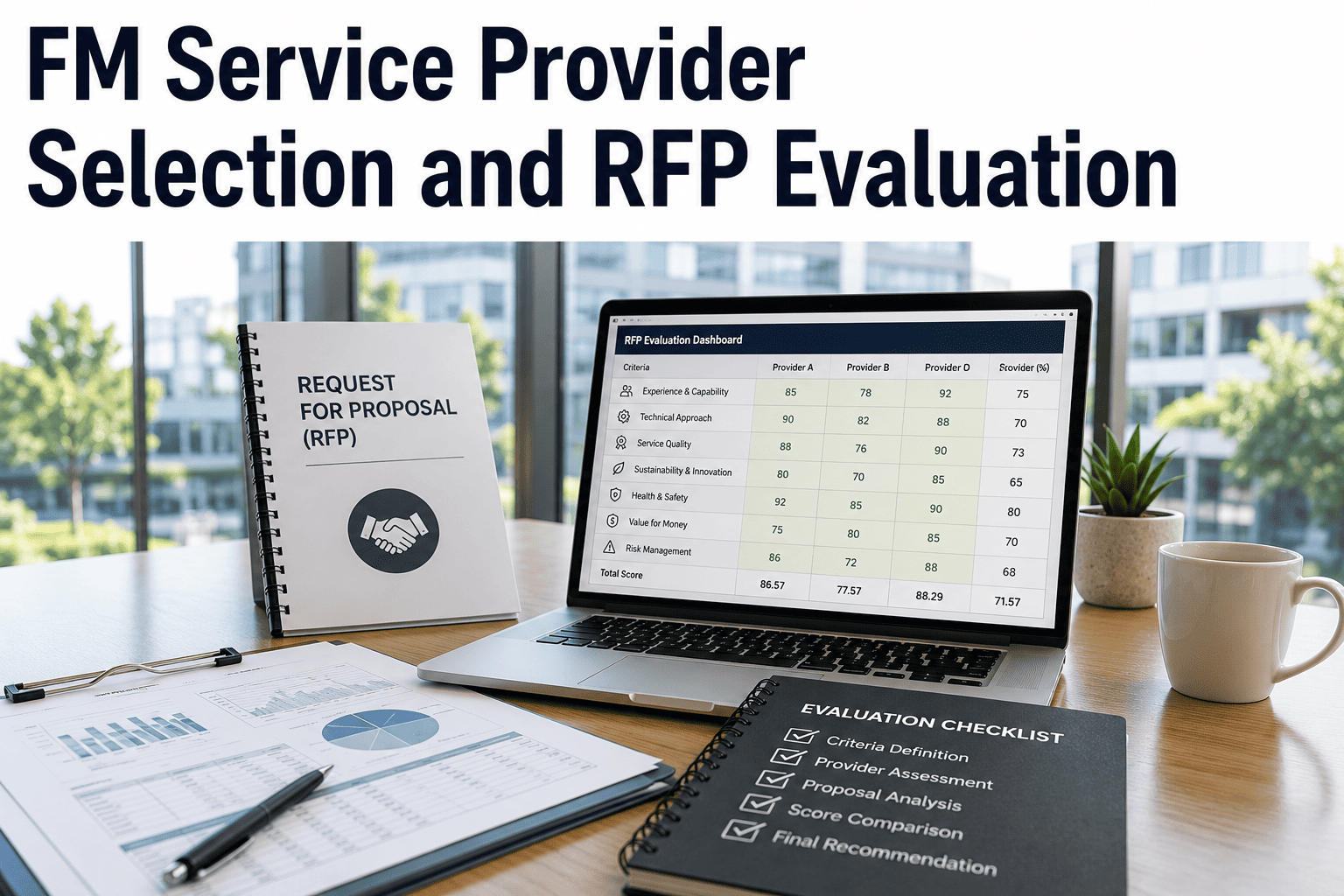
A rigorous IFM services evaluation scores six dimensions on a weighted scale. Each criterion below maps to a concrete financial or operational risk — skip any one and you may find yourself three years into a contract that looked good on paper but underperforms in practice.
Portfolio Complexity Threshold
IFM bundling delivers economies of scale above ~5 sites or 50K sq ft. Below that, specialist providers often price 8–12% lower per service line because they carry less overhead. Score your portfolio's site count, asset volume, and service-line diversity before assuming bundling wins.
Service Quality & SLA Architecture
The IFM provider model must define measurable SLAs per service line with credits for underperformance. Evaluate their historical SLA attainment rate (demand 92%+), response-time guarantees, and whether they self-perform or subcontract — subcontracted services dilute accountability.
Technology & Data Integration
The single biggest differentiator between a good and bad IFM contract is the technology layer. Does the provider offer a unified CMMS/IWMS platform with real-time dashboards, asset-level work-order tracking, and mobile technician dispatch? If they rely on spreadsheets or siloed per-service tools, you are buying fragmentation rebranded as integration.
Pricing Transparency & Escalators
Scrutinize the fee structure: fixed management fee vs. cost-plus vs. gainshare. Cap annual escalators at CPI + 1% maximum. Watch for hidden markups on sub-contracted labor (15–25% is common) and demand a quarterly open-book cost reconciliation.
Exit & Transition Risk
The integrated FM contract must include a structured exit clause with 6-month transition support, data portability requirements (your asset register, work history, and compliance records exported in standard formats), and no non-compete restrictions on re-hiring key on-site technicians.
Innovation & Continuous Improvement
A strong IFM approach includes contractual commitments to year-over-year efficiency gains — predictive maintenance pilots, energy retrofits, IoT sensor deployment — with shared savings. Without this, the provider has no incentive to reduce the very work orders they bill for.
IFM Bundling — Risk Assessment
IFM vs. Multi-Provider Model: Side-by-Side Comparison
The decision between an integrated facilities services model and a best-of-breed multi-provider approach comes down to where you sit on the tradeoff between simplicity and specialization. The comparison below captures the real-world economics.
| Evaluation Dimension | Integrated FM Model (IFM) | Multi-Provider Model |
|---|---|---|
| Number of contracts to manage | 1 master contract + SLA schedule | 5–12 separate contracts, invoices, renewals |
| Typical cost savings | 10–20% via economies of scale & labor pooling | 0–5%; specialist pricing can be 8–12% cheaper per line |
| Accountability | Single point of contact — clear ownership | Finger-pointing between vendors on cross-service issues |
| Service quality depth | Good breadth; depth varies by service line (subcontracting risk) | Deep expertise per service; best-of-breed specialists |
| Technology & data visibility | Unified platform IF provider invests — otherwise still siloed | Fragmented by design; requires your own integration layer |
| Switching cost at renewal | High — one provider holds all institutional knowledge | Lower — swap one provider without disrupting others |
| Best fit portfolio | 5+ sites, 50K+ sq ft, multi-service complexity | 1–4 sites, specialized asset types, single-service dominance |
Worked Example
A 180-Asset Manufacturing Campus: IFM Evaluation in Practice
Consider a 180-asset manufacturing campus spread across 3 buildings (220K sq ft total) currently spending $42K/year across 7 facility service vendors — HVAC maintenance, fire safety inspections, janitorial, security, landscaping, pest control, and waste management. Coordination consumes roughly 280 hours/year of the facility manager's time, and the lack of a shared asset register means preventive maintenance compliance sits at 64% — well below the 85% ISO 55000-aligned benchmark.
In this scenario the integrated FM model wins by $17,940/year — a 43% improvement over the fragmented baseline. But the calculation flips negative below ~4 sites or if the IFM provider's technology stack is weak. The technology layer is what makes compliance gains and downtime avoidance achievable; without a real CMMS underpinning the contract, those numbers stay theoretical. That is exactly where OxMaint closes the gap.
How OxMaint Helps
How OxMaint Powers a Data-Driven IFM Evaluation — and Delivery
Whether you are evaluating IFM providers or already managing an integrated FM contract, OxMaint gives you the asset-level data, work-order tracking, and predictive analytics that make the model actually deliver on its promises. Here is how four concrete OxMaint capabilities map directly to IFM evaluation outcomes.
Unified Asset Register
OxMaint centralizes every asset — HVAC units, fire panels, elevators, generators — into a single searchable register with full maintenance history, warranty data, and compliance documents. No more vendor-by-vendor spreadsheets; your IFM provider gets one source of truth, and so do you.
Preventive & Predictive Maintenance
Automated PM schedules aligned to manufacturer intervals and ISO 55000 standards, plus AI-driven predictive alerts that flag failure patterns before they become breakdowns. OxMaint's analytics engine turns historical work-order data into failure predictions with 85%+ accuracy.
SLA & Work-Order Tracking
Every work order — hard services, soft services, reactive calls — flows through OxMaint with real-time status, SLA timers, and automated escalation. You get a live dashboard showing SLA attainment by provider, by service line, by site. No more waiting for monthly vendor reports that bury underperformance.
Maintenance Analytics & Cost Reporting
OxMaint's analytics dashboard breaks down cost-per-asset, cost-per-service-line, and maintenance-to-replacement ratio — the exact numbers you need for IFM contract evaluation and renewal negotiations. Export open-book reconciliation data in one click for quarterly business reviews.
See OxMaint on Your Assets — Book a 30-Min Demo
Bring your portfolio complexity, your SLA targets, and your toughest maintenance challenges. We will show you exactly how OxMaint makes your IFM evaluation — and delivery — data-driven.
IFM Evaluation — Frequently Asked Questions
Integrated Facilities Management: 5 Questions Decision-Makers Ask
What is the difference between IFM and bundled facilities management?
Integrated facilities management (IFM) goes beyond simple bundling by combining multiple services under one contract AND one management structure with a unified technology platform, single point of accountability, and shared SLA framework. Bundled FM simply groups services under one invoice — they may still be delivered by separate teams with siloed data. True IFM requires the provider to integrate operations, not just contracts. You can evaluate whether a provider delivers real integration by auditing their CMMS/IWMS stack — book a demo to see what integrated data visibility looks like in OxMaint.
How much does the integrated facilities management model save?
IFMA benchmarks show median savings of 10–20% from the integrated FM model, driven primarily by labor pooling (12–18% reduction in coordination overhead), volume discounts on materials and subcontracts (8–12%), and energy optimization (5–15% on utilities). However, savings vary widely by portfolio size — organizations below 5 sites or 50K sq ft often see net costs increase because the IFM provider's management fee premium exceeds coordination savings.
What are the biggest risks of the IFM contract model?
The three primary risks are vendor lock-in (difficult and costly to exit a 3–5 year contract when one provider holds all institutional knowledge), service-quality dilution (subcontracted service lines where the provider lacks depth), and hidden cost escalators (CPI + 2–3% annual increases, 15–25% markups on subcontracted labor, and change-order fees). Mitigate all three by demanding open-book cost reconciliation, capped escalators, structured exit clauses with data portability, and SLA credits for underperformance.
When should you NOT choose the integrated facility services model?
Avoid IFM when your portfolio is small (under 5 sites or 50K sq ft), when one service line dominates cost (e.g., a data center where cooling is 70% of FM spend — a specialist will outperform), when compliance requires niche certifications the IFM provider cannot self-perform, or when your organization has a mature multi-provider governance structure already delivering strong SLA attainment. In these cases, the overhead baked into an IFM margin erodes the savings.
What technology should an IFM provider include in their contract?
A credible IFM provider must deliver a unified CMMS or IWMS platform with: a shared asset register, mobile work-order management for technicians, real-time SLA dashboards, preventive and predictive maintenance scheduling, spare-parts inventory tracking, and cost analytics by service line and asset. If the provider's technology is limited to invoicing and reporting — or if each service line uses a different tool — you are buying fragmented services with an integrated invoice, not true IFM. OxMaint delivers all of these capabilities — Start Free Trial to experience the difference.
Ready to Evaluate IFM With Real Asset Data?
Whether you choose integrated facilities management or stay multi-provider, the decision should be driven by data — not vendor pitches. OxMaint gives you the asset register, SLA tracking, and analytics to evaluate, negotiate, and deliver with confidence.
Free 14-day trial · No credit card