Elevators are the only assets in most buildings whose maintenance schedule is written into law rather than left to engineering judgement. ASME A17.1/CSA B44, the Safety Code for Elevators and Escalators, sets out what must be examined, how often, who may witness it and what record must survive afterwards — and every state, province or city adopts a specific edition with its own amendments. That patchwork is the real problem for a multi-site portfolio: the engineering is consistent, but the legally enforceable frequencies and filing deadlines are not. A CMMS that treats elevator work as ordinary preventive maintenance will miss category tests, lose witness records and fail the first serious audit. To see how a compliance-grade elevator schedule is built, book a working session or start a free account.
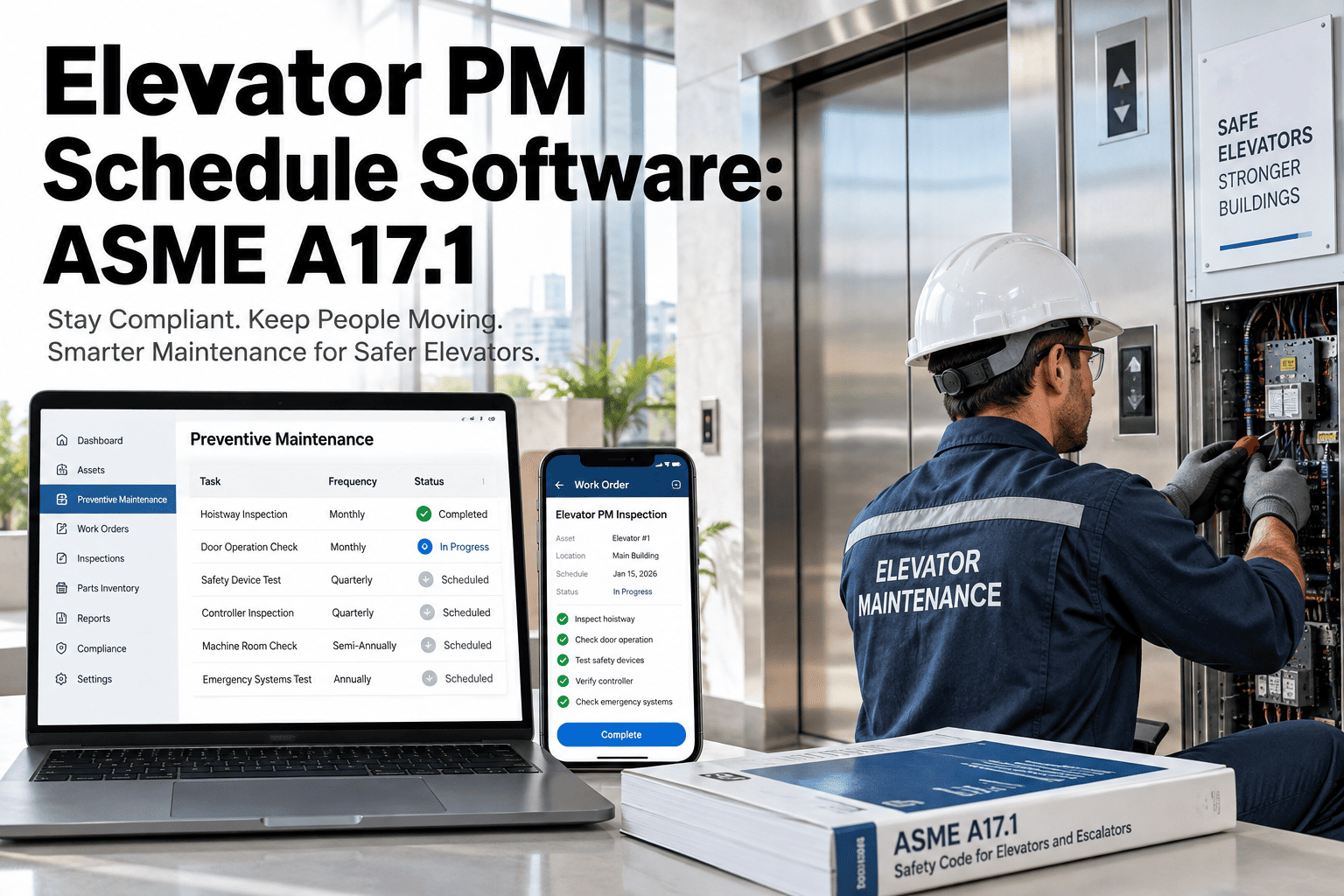
Elevator PM schedule software built around ASME A17.1
Monthly firefighters' service checks, annual Category 1 tests, five-year Category 5 tests and the written Maintenance Control Program that ties them together — scheduled, executed and evidenced from one asset record per car.
Monthly
Firefighters' emergency operation Phase I and Phase II operational check, with a written record kept on site
Routine interval
Examinations, cleaning, lubrication and adjustments at the intervals set by the Maintenance Control Program
Annual
Category 1 periodic test of safety devices and operating equipment, by qualified elevator personnel
Three years
Category 3 test, applicable to water hydraulic elevators where installed
Five years
Category 5 full-load, full-speed test of safeties, governors, buffers and suspension means
Exact frequencies, witnessing requirements and filing deadlines depend on the code edition your jurisdiction has adopted.
The Maintenance Control Program is the document that fails inspections
Since the code introduced the Maintenance Control Program, the written programme itself is inspectable. An inspector can find the equipment in good order and still write a violation because the MCP is incomplete, out of date or not available at the site.
Written procedures for the specific equipment
Not a generic service contract. The MCP must describe the maintenance tasks for the actual installed equipment, including any unique procedures the manufacturer requires for proprietary components or software.
Defined intervals for examinations and adjustments
Cleaning, lubrication, examination and adjustment each need a stated frequency derived from usage, environment and equipment type — a high-rise office bank and a low-use residential car should not carry identical intervals.
Records of examinations, tests and callbacks
Completed maintenance, repairs, replacements, callbacks and the corrective action taken must be recorded and available. Callback history is often the first thing an inspector asks for and the weakest record in a paper system.
Availability on site
The programme and its records must be accessible at the location where the work is performed. A binder in a contractor's office three counties away does not satisfy this, and neither does an email thread.
Wire rope and suspension means data
Inspection and replacement criteria for suspension means must be documented, including the criteria applicable to non-traditional suspension such as coated steel belts.
Periodic test tags and seals
Test tags record the date and category of the last periodic test, and adjustment seals on braking and safety components must be intact and identified. Both are physical evidence an inspector checks before reading a single page.
Who is responsible
Ownership of the MCP sits with the building owner, not the maintenance contractor. Contracting the work out does not transfer the obligation, and a portfolio that assumes otherwise usually discovers the gap during a jurisdictional inspection rather than during a contract review.
The elevator inspection and test schedule at a glance
The table below summarises the structure of the periodic programme. Treat it as a planning skeleton and confirm each line against the code edition and amendments adopted in each jurisdiction where you operate.
| Activity |
Typical interval |
Applies to |
Performed by |
Record produced |
| Firefighters' emergency operation check |
Monthly |
All cars with Phase I and Phase II operation |
Building or elevator personnel as permitted locally |
Written monthly record retained on site |
| Routine examination, lubrication and adjustment |
Per the Maintenance Control Program |
All elevators and escalators |
Qualified elevator personnel |
Dated task record in the MCP |
| Periodic inspection |
As set by the authority having jurisdiction |
All units |
Qualified elevator inspector |
Inspection report and jurisdictional filing |
| Category 1 periodic test |
Annual |
Electric and hydraulic elevators, escalators |
Qualified elevator personnel, witnessed where required |
Signed test report and test tag update |
| Category 3 periodic test |
Every three years |
Water hydraulic elevators |
Qualified elevator personnel |
Signed test report |
| Category 5 periodic test |
Every five years |
Units with governors, safeties, oil buffers, ropes, plunger grippers or overspeed valves |
Qualified elevator personnel, witnessed by a qualified inspector |
Full-load test report, tag and seal verification |
| Pressure relief and overspeed valve verification |
With the applicable category test |
Hydraulic elevators |
Qualified elevator personnel |
Recorded setting and result |
| Two-way emergency communication check |
Per code and jurisdiction |
All passenger elevators |
Building or elevator personnel |
Dated functional test record |
Why a spreadsheet stops working at scale
One building with three cars can be managed on a wall calendar. Forty buildings across six jurisdictions, each with a different adopted edition, mixed traction and hydraulic equipment and staggered five-year anniversaries, produces several hundred dated obligations a year. That is a scheduling problem, and scheduling problems belong in a CMMS.
Where portfolios actually lose compliance
Missed tests are rarely the result of negligence. They come from a small number of predictable structural weaknesses, plotted below by how often they occur against what they cost when they do.
Consequence
Occasional
Frequent
Very frequent
Severe
Category 5 anniversary missed because the five-year clock was tracked in a departed employee's calendar
Unit kept in service after a failed test because the shutdown decision had no owner
Contractor test report never filed with the authority before the deadline
Moderate
Test tag not updated after a completed test, triggering a violation on an otherwise compliant car
MCP not updated after a modernisation, so procedures describe equipment that no longer exists
Monthly firefighters' service record kept informally and unavailable at inspection
Low
Lubrication interval drifts a few weeks on a low-use car
Callback logged by phone and never entered against the asset
Inspection findings closed verbally with no dated corrective record
The common factor
Every cell above describes a record that existed somewhere but not in the asset's own history. The fix is not more diligence; it is a single system where the schedule, the execution, the evidence and the filing deadline live on the same record.
Elevator compliance in OxMaint
Put every car, every category and every deadline on one schedule
Asset records per car with equipment type and adopted code edition, recurring PM triggers for monthly through five-year obligations, mobile inspections with photo and signature capture, and contractor reports attached to the test that produced them.
Traction and hydraulic equipment need different schedules
A single generic elevator PM template applied across a mixed portfolio is one of the fastest routes to a compliance gap, because the two drive types fail differently and are tested differently.
Traction elevators
Suspension means inspected against defined wear, broken wire and diameter reduction criteria, with coated belt systems following manufacturer-specific methods
Governor and car safety tested at rated load and rated speed on the five-year cycle
Machine brake holding capacity verified and the adjustment sealed after test
Oil buffers tested and refilled to the correct level and grade
Rope equalisation, sheave groove wear and secondary sheave condition tracked over time
Counterweight clearance and buffer travel checked for rope stretch effects
Hydraulic elevators
Relief valve setting verified and recorded during the applicable category test
Overspeed valve or plunger gripper function confirmed where fitted
Cylinder and jack integrity monitored for settling, seepage and packing wear
Fluid condition, level and temperature managed as a maintained parameter, not an afterthought
Pressure switch, low oil protection and anti-creep levelling checked on schedule
Environmental protection for buried cylinders documented where applicable
Escalators and moving walks
Escalators carry their own annual and five-year obligations covering brake performance, step and skirt clearances, handrail speed and safety device function. They belong on the same compliance calendar as the elevator fleet, not in a separate contractor file.
The record chain that survives an audit
Compliance is judged on documents. Each stage below produces a record, and a break at any stage makes the whole chain unverifiable regardless of how well the work was performed.
1
Asset register per car
Each unit carries drive type, capacity, speed, installation date, adopted code edition, jurisdiction, permit number and last category test dates. Without this, no schedule can be generated correctly.
2
Obligation calendar generated
Recurring triggers create the monthly, annual, three-year and five-year work in advance, with lead time for scheduling a contractor and a witnessing inspector where required.
3
Work executed and captured
The technician or contractor records results on a mobile checklist with readings, photographs of tags and seals, and a signature. The record is timestamped against the asset as it happens.
4
Findings become corrective orders
A failed item raises a corrective work order with a priority and a due date, so the gap between finding and repair is measured rather than assumed.
5
Documents attached at source
Contractor test reports, inspector sign-offs and jurisdictional filings are stored on the work order that generated them, not in a shared drive organised by year and vendor name.
6
Portfolio view maintained
A dashboard shows every unit's next obligation, overdue items and expiring permits across sites, so the portfolio position is known without a manual roll-up each quarter.
Audit-readiness checklist for a mixed portfolio
Work through this before the next scheduled inspection rather than during it. Each line is a document or a data point an inspector may reasonably ask to see.
Current MCP available at each site, matching the equipment actually installed
Adopted code edition recorded per jurisdiction, with amendments noted
Last and next Category 1 date on every unit in the register
Last and next Category 5 date, with witnessing arrangements booked in advance
Twelve months of monthly firefighters' service records retrievable per car
Test tags updated and legible, adjustment seals intact and identified
Callback log complete with corrective action recorded against each event
Open inspection findings tracked with owner and due date
Suspension means inspection criteria documented for every traction unit
Modernisation and repair history reflected in updated procedures
Emergency communication functional test records current
Permits valid and filing deadlines tracked per jurisdiction
Measures that keep an elevator programme honest
Uptime alone hides compliance risk. These measures make the state of the programme visible to facilities leadership and to risk management.
On-time category test completion
Share of Category 1, 3 and 5 tests completed within their due window across the portfolio. The single most important compliance number a facilities director can report.
Monthly record completeness
Percentage of cars with a complete rolling twelve months of firefighters' service records. Gaps here are cheap to fix and expensive to explain.
Finding-to-closure time
Median days from an inspection finding to verified correction, split by severity. Long tails indicate a parts or contractor bottleneck, not a technician problem.
Callbacks per car per year
Normalised entrapment and service callback rate by unit. Consistently high performers are modernisation candidates and contract negotiation evidence.
Entrapment response time
Time from call to release, tracked per site. This is a life-safety and tenant-experience measure that rarely appears in maintenance reporting.
Out-of-service days per unit
Cumulative downtime by car and by cause, which turns accessibility complaints and contract performance disputes into a data conversation.
How OxMaint handles vertical transportation assets
The capabilities below are what the elevator programme needs from a CMMS — nothing exotic, but all of it in one place and tied to the individual car.
Preventive maintenance scheduling
Recurring triggers at monthly, annual, three-year and five-year intervals, with lead time so a witnessing inspector can be booked before the due date arrives.
Asset management
A record per car holding drive type, jurisdiction, permit details, code edition, category test history, modernisation history and cumulative cost.
Digital inspections
Checklists with required readings, photo capture for tags and seals, and signature fields, usable in a machine room without a signal.
Work order management
Corrective orders raised directly from findings and callbacks, with priority tiers, assignment and a tracked closure date.
Compliance records
Dated, attributable records with attachments, filterable by site, by unit or by date range, which is exactly how an inspector asks for them.
Inventory
Critical spares tracked against minimum levels so a failed door operator or controller board does not extend an out-of-service period unnecessarily.
Dashboards and reporting
Portfolio view of upcoming and overdue obligations, callback rates by unit and open findings by site, available without a manual roll-up.
Mobile workflows
Technicians and contractors record work where it happens, which is the only reliable way to keep the on-site record requirement genuinely satisfied.
Elevator PM scheduling questions
Does OxMaint replace our elevator maintenance contractor?
No. Category tests must be performed by qualified elevator personnel. OxMaint schedules the obligations, holds the asset and code data, and stores the contractor's reports against the right unit. Book a demo to see the contractor workflow.
How do we handle different adopted code editions across sites?
Record the adopted edition and local amendments on each site or asset, then build the schedule from that field rather than from a single global template. Portfolios operating in several jurisdictions need this from day one.
Can the Maintenance Control Program live in the CMMS?
Yes, and that is usually the cleanest approach. Procedures, intervals and completed records sit against the unit and remain accessible on site through mobile access — you can set up your first unit free and build outward.
What is the difference between Category 1 and Category 5 testing?
Category 1 is the annual functional test of safety and operating devices. Category 5 is the five-year test that loads the car and exercises safeties, governors, buffers and suspension means, and it is normally witnessed by a qualified inspector.
How far ahead should category tests be scheduled?
Generate five-year test work at least three to six months before the anniversary. Coordinating a contractor, a witnessing inspector, a service outage and any required weights is a planning exercise, not a same-week booking.
Start your compliance calendar
Every car, every category, every deadline — in one place
Build the asset register, generate the obligation schedule, capture the evidence on mobile and keep the whole portfolio position visible. OxMaint turns elevator compliance from a filing exercise into a managed maintenance programme.