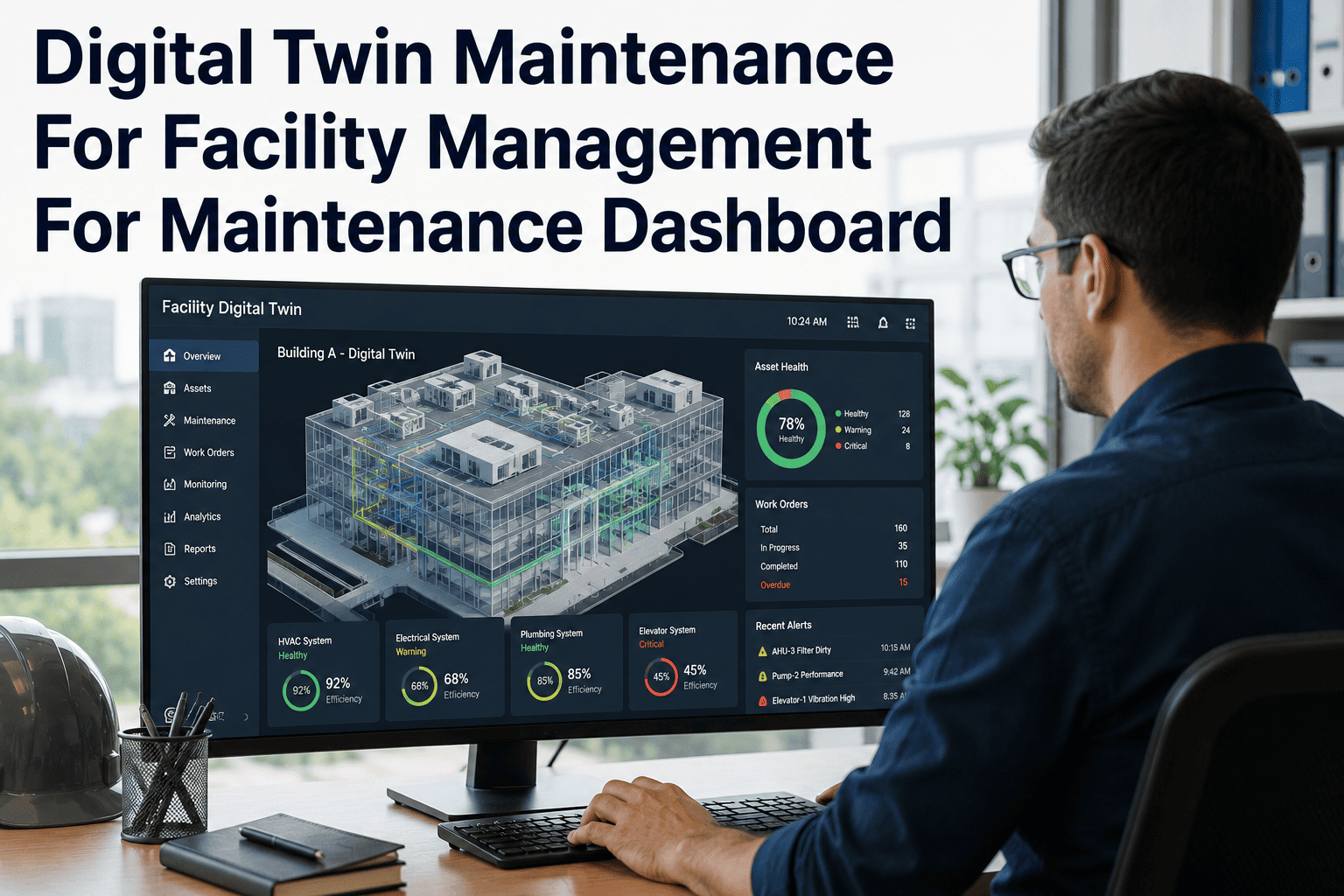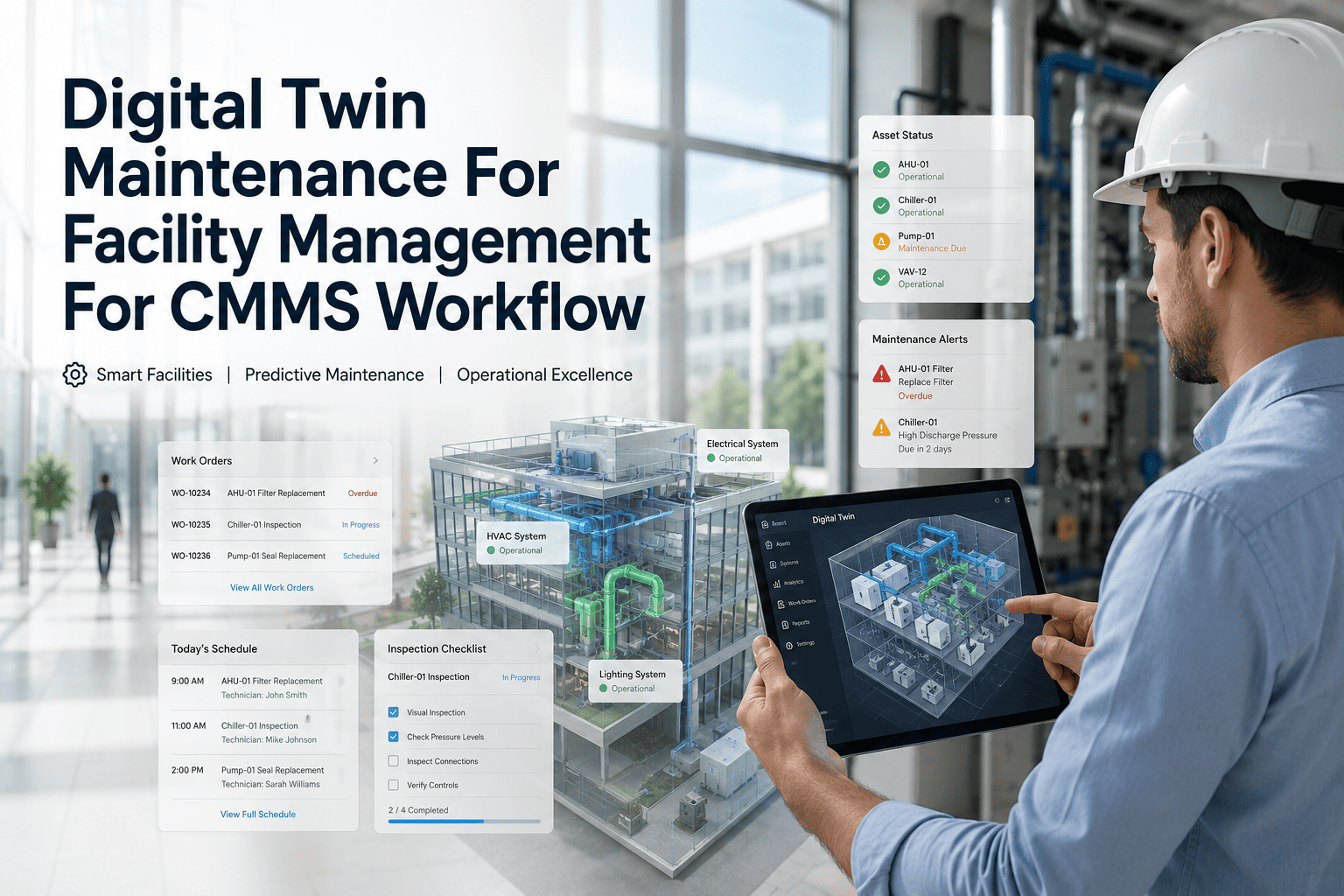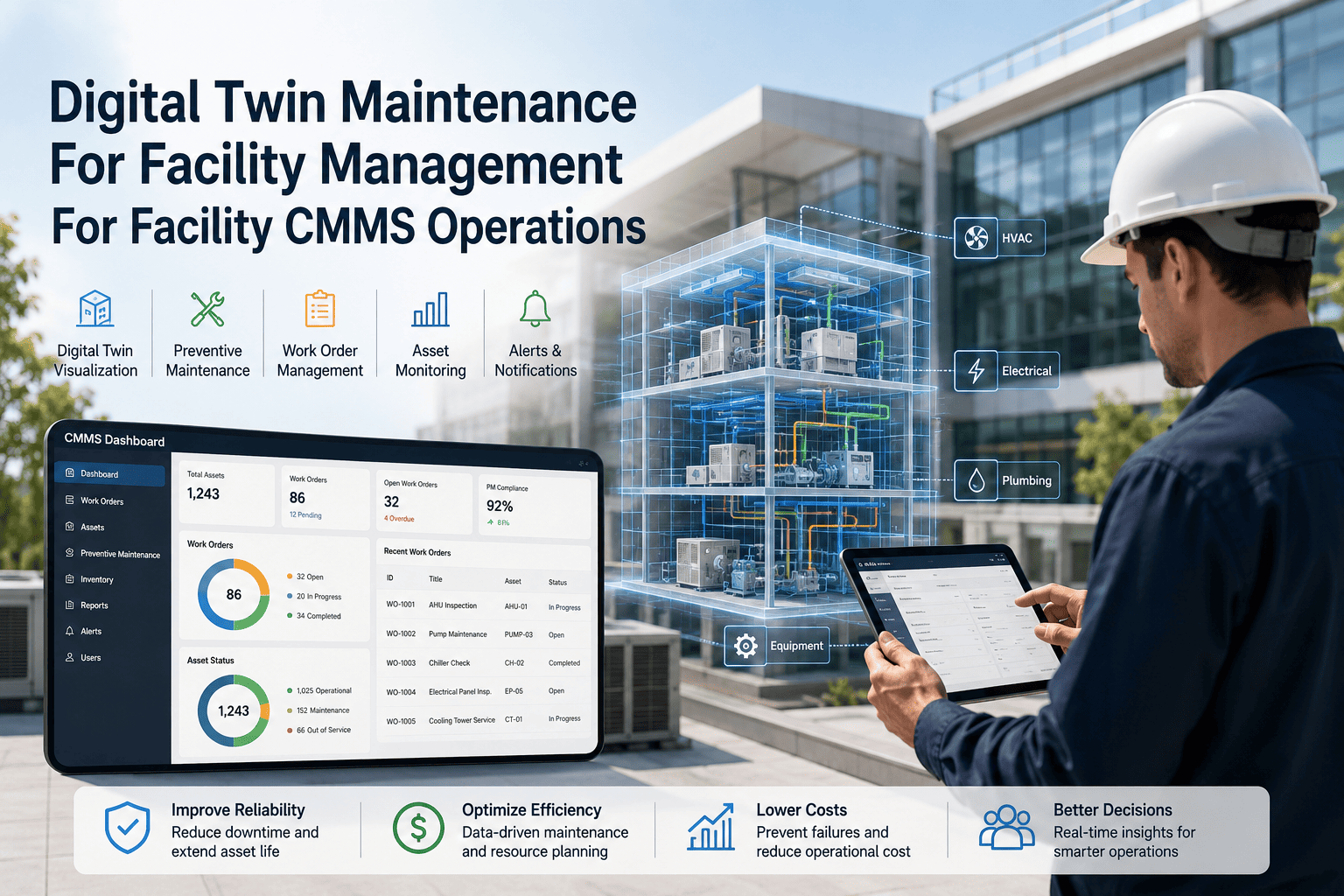
Digital twin governance in FM determines whether the twin stays accurate — or quietly degrades into a costly 3D fiction. A facility digital twin is only as valuable as the data feeding it, so without rigorous FM digital twin governance, even the most detailed model drifts from reality within months of handover. The fix is a structured approach to digital twin model maintenance: clear ownership, automated data syncs, and audit-ready change logs. OxMaint handles the heavy lifting by tying live asset and work-order data directly to your facility twin, so the model you trusted on day one still reflects the building on day 1,000. Start Free Trial and see the difference governed data makes.
A digital twin that isn't maintained becomes fiction fast.
Up to 70% of facility digital twins lose accuracy within 18 months of handover because no one owns the model. OxMaint keeps your facility twin true to the building — live asset data, automated work-order syncs, and audit-ready change logs.
Why facility digital twin accuracy collapses without governance
A digital twin is a living model — and living things decay without upkeep. The moment a pump is swapped, a valve re-routed, or a sensor battery dies, the twin and the physical building start to diverge. Without FM digital twin governance, that divergence compounds silently.
Unrecorded field changes
Roughly 40% of maintenance work orders change an asset's condition, location, or spec. If those updates never flow back to the twin, the model becomes a historical snapshot — not a live representation.
Sensor data gaps
When IoT sensors go offline — battery failure, network loss, calibration drift — the twin stops reflecting real-time conditions. Most teams don't notice for 30–90 days, leaving predictive models blind.
No single source of truth
When BIM, CMMS, BMS, and spreadsheet inventories each hold a different version of asset data, the twin inherits conflicts. Decisions made on conflicting data cost FM teams an estimated 15–20% in wasted effort annually.
Handover cliff edge
At practical completion, the contractor hands over a pristine model — then walks away. With no governance plan, the twin freezes at day-one condition while the building evolves continuously around it.
The four pillars of building digital twin governance
Effective facility digital twin management rests on four repeatable pillars. Together they form a lifecycle that keeps the model accurate, auditable, and decision-grade — not just a pretty 3D visualization.
Data ownership and accountability
Assign a named Digital Twin Steward for each facility or portfolio. This role owns the data dictionary, approves model changes, and resolves conflicts between BIM, CMMS, and BMS sources. Without a named owner, governance collapses into committees — and committees don't update twins.
Automated data synchronization
Every work order completion, asset replacement, sensor calibration, and spare-parts transaction must flow back to the twin automatically. Manual updates fail because technicians won't double-enter data after a 10-hour shift. The sync must be event-driven, not batched weekly.
Change logging and audit trails
Every modification to the twin — geometry, attribute, relationship, or sensor binding — gets a timestamped, user-attributed entry. This satisfies ISO 19650 common data environment requirements and lets you trace any discrepancy back to its source in seconds, not days.
Accuracy scoring and drift alerts
Run automated reconciliation between the twin and live field data weekly. Flag any asset whose digital twin data hasn't been updated in 90 days, or whose sensor feed has gone silent. Accuracy scores below 85% trigger a targeted audit of the affected building zone.
Digital twin lifecycle facility governance: month-by-month
Digital twin upkeep in FM isn't a one-time project — it's a 36-month lifecycle that repeats. Here's what a governed twin looks like from commissioning through maturity, with the critical failure points flagged along the way.
Commissioning and handover
Contractor delivers LOD 350+ model with COBie data. Twin Steward validates asset attributes against physical installation — 15–25% of handover data is typically wrong. Baseline accuracy: ~95%.
Operational integration
Twin connects to CMMS, BMS, and IoT platform. Work-order completions begin updating asset status. First drift appears: minor field repairs not reflected. Accuracy: 88–92%.
Drift acceleration (critical window)
Without governed sync, accuracy drops 1–2% per month. Sensor batteries start failing. Preventive maintenance schedules diverge from actual asset condition. Without intervention, accuracy falls below 80%.
Governed maturity
With automated CMMS-to-twin sync and weekly reconciliation, accuracy stabilizes at 90–95%. Predictive maintenance models become trustworthy. Energy and space utilization analytics reach decision-grade quality.
Renewal or revalidation
Major refits, capex projects, or system replacements trigger a targeted model update. The twin's data dictionary is reviewed against ISO 19650. Assets older than 36 months without a sensor refresh are flagged for IoT re-investment.
The real cost of ungoverned twins: a 180-asset facility
Consider a 120,000 sq ft corporate campus with 180 tracked assets, from AHUs to chillers to access control panels. The digital twin was delivered at handover for $85,000. Here's what happened over 24 months — governed vs. ungoverned.
| Governance metric | Ungoverned twin | Governed with OxMaint |
|---|---|---|
| Twin accuracy at month 24 | 61% | 93% |
| Annual wasted maintenance hours | 1,140 hrs ($68K) | 210 hrs ($12.5K) |
| Unplanned downtime events/year | 23 | 8 |
| Energy overspend from stale setpoints | $31K/yr | $4K/yr |
| Audit prep time (ISO 55000 / SOC 2) | 6 weeks | 2 days |
| Model re-creation cost at year 3 | $85K (full rebuild) | $8K (targeted update) |
For this 180-asset campus, governed digital twin model maintenance pays for itself in under 4 months and returns $6.67 for every dollar invested in governance tooling and process.
How OxMaint keeps your facility twin decision-grade
OxMaint is the governance engine that sits between your maintenance operations and your digital twin — ensuring every work order, asset change, and sensor reading flows back to the model automatically, with full audit trails.
Automated work-order-to-twin sync
Every completed work order updates the corresponding asset's condition, status, and maintenance history in the twin — no manual re-entry. Keeps twin accuracy above 90% and eliminates the 40% data-loss gap from paper or spreadsheet workflows.
Predictive maintenance integration
OxMaint's AI analyzes vibration, temperature, and runtime data from IoT sensors bound to twin assets. When failure patterns emerge, the twin flags the asset at risk — turning the model from a static record into an early-warning system.
Audit-ready change logs
Every asset attribute change, work-order update, and spare-parts transaction is timestamped and user-attributed. Export compliance reports for ISO 55000, ISO 19650, or SOC 2 in minutes — not the 6-week scramble of ungoverned systems.
Single source of asset truth
OxMaint unifies BIM, CMMS, BMS, and inventory data into one asset registry that feeds the twin. No more conflicting specs across spreadsheets and siloed databases — the twin always reflects the same data your technicians see on their mobile devices.
See OxMaint govern your facility twin — book a 30-minute demo
Watch live work-order data update a digital twin in real time. We'll show you how automated sync, drift alerts, and audit-ready logs keep your model accurate for years — not months.
Digital twin governance FM: frequently asked questions
What is digital twin governance in facility management?
Digital twin governance in FM is the framework of roles, processes, and automated data flows that keep a facility's digital twin accurate over time. It covers data ownership, change logging, automated synchronization between CMMS/BMS and the twin, and accuracy scoring. Without it, a twin degrades into a static 3D model within 12–18 months of handover.
How often should a facility digital twin be updated?
A governed facility twin should update in near-real time through automated event-driven syncs — every completed work order, sensor reading, or asset change flows back to the model immediately. In practice, weekly reconciliation runs catch any gaps, and a full accuracy audit should occur quarterly. Any asset untouched for 90+ days should be flagged for review.
Who owns digital twin maintenance in an FM team?
A named Digital Twin Steward — typically within the facilities or asset management function — owns the data dictionary, approves model changes, and resolves source conflicts. This person works closely with the maintenance team and IT. Tools like OxMaint reduce the steward's manual workload by automating data syncs and flagging drift automatically.
How much does ungoverned digital twin drift cost?
For a mid-sized facility (100–200 assets), ungoverned twin drift typically costs $50K–$120K annually in wasted maintenance labor, energy overspend from stale setpoints, and unplanned downtime from decisions made on outdated data. The full model rebuild at year 3 adds another $60K–$90K — costs that governed model maintenance largely eliminates.
Can a CMMS maintain digital twin accuracy automatically?
Yes — an AI-powered CMMS like OxMaint can sync work-order completions, asset condition changes, and IoT sensor data directly to the twin, maintaining 90%+ accuracy without manual re-entry. The key is event-driven integration rather than batch updates. You can book a demo to see live twin updates triggered by simulated work orders.
Stop maintaining a fiction. Start governing your facility twin.
OxMaint turns your digital twin from a day-one deliverable into a living, decision-grade asset that stays true to your building for years. Automated sync, drift alerts, audit-ready logs — all in one platform.
Free 14-day trial · No credit card