The average property management team receives 15–25 maintenance requests per 100 doors every week — and the difference between a well-run property and a chaotic one is rarely the number of work orders received. It is the system used to prioritize them. A property that triages correctly resolves true emergencies in under 2 hours, completes urgent requests within 24 hours, and keeps routine work from blocking critical repairs. A property without a prioritization framework leaves emergency calls waiting while routine bulb changes get dispatched — frustrating tenants, burning technician hours, and creating liability exposure that grows with every delayed response. OxMaint's work order prioritization engine automatically classifies incoming requests by severity, calculates response SLAs, and routes urgent work to available technicians — turning maintenance chaos into a predictable, defensible dispatch system that property managers can trust.
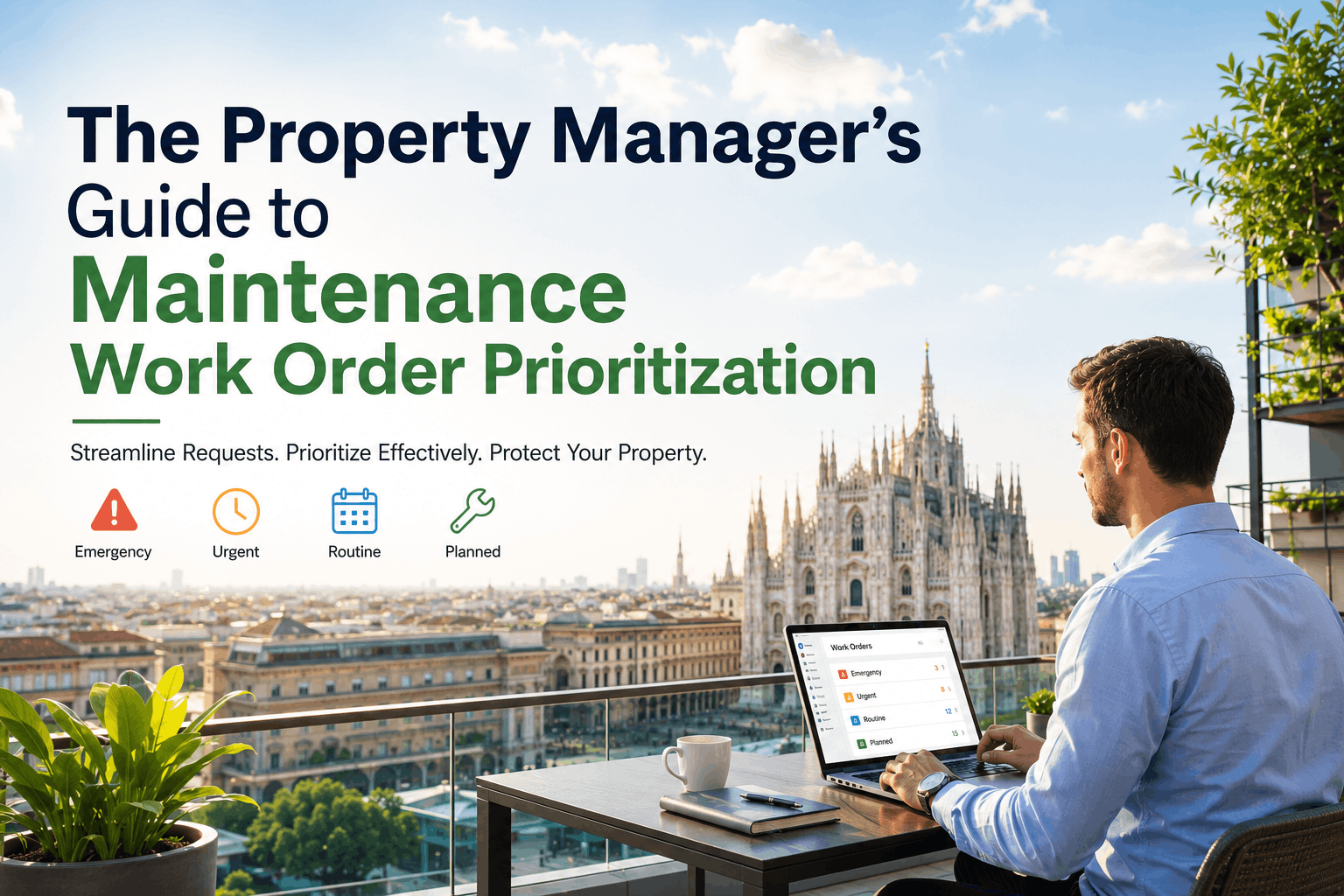
The Property Manager's Guide to Maintenance Work Order Prioritization
Emergency vs. urgent vs. routine: classification frameworks, response time standards, SLA definitions, priority matrices, technician assignment rules, backlog management, and the CMMS tools that make triage systematic instead of chaotic.
The 4 Priority Levels — Classification That Drives Action
Effective work order prioritization rests on one foundational decision: defining what each priority level means in terms of response time, escalation path, and required documentation. Properties without clear definitions leave every decision to the dispatcher's judgment — creating inconsistency, liability gaps, and tenant disputes about what constitutes an "emergency." The four-tier framework below separates true emergencies from everyday requests, establishing response SLAs that tenants can understand and maintenance teams can actually deliver. OxMaint's priority matrix lets property managers configure their own definitions, SLAs, and escalation rules — then applies them automatically to every incoming work order from any source (tenant portal, phone call, email, or inspection).
The Priority Matrix — Mapping Severity vs. Urgency
Not every maintenance request fits neatly into a single priority bucket. A running toilet is rarely an emergency — but if it is the only toilet in a unit occupied by a disabled tenant, the urgency changes. A dripping faucet is routine — unless the drip is audible in a bedroom and preventing sleep. The priority matrix below separates severity (how bad the problem is) from urgency (how soon it needs resolution) and maps their intersection to an actual priority level. Property managers who train their teams on this matrix reduce classification disputes by 70% and ensure that tenant-impacting factors (disability, time of day, temperature) are incorporated into prioritization — not ignored because the "standard" definition doesn't account for context. OxMaint's work order intake forms can include conditional fields that automatically escalate priority based on tenant-provided context (e.g., "Is this the only bathroom?" "Is the unit temperature below 55°F?").
Days to respond
Hours to respond
Immediate response
Slow leak, partial heat loss Emergency (P1)
Burst pipe, sewage backup Emergency+ (P1)
Gas leak, fire, electrical hazard
Dripping faucet, slow drain Urgent (P2)
Running toilet, fridge not cooling Emergency (P1)
No heat (winter), no hot water
Cosmetic paint, loose cabinet Routine (P3)
Window stick, missing screen Urgent (P2)
Tenant disability accommodation
Response SLA Standards — What Property Managers Should Commit To
Service Level Agreements (SLAs) for maintenance response are not just internal targets — they are tenant expectations and legal benchmarks. Properties that publish and consistently meet SLAs see 40% fewer rent credit requests and 60% fewer lease non-renewals attributed to maintenance delays. The SLA standards below reflect industry benchmarks for professionally managed multi-family properties. OxMaint tracks SLA compliance automatically — each work order records time-to-acknowledge, time-to-respond, time-to-resolve, and escalates automatically when thresholds are breached.
Work Order Aging — When Priorities Escalate Automatically
A routine work order that remains unresolved for 14 days is no longer routine — it has become a tenant relations issue and a potential lease violation. The best prioritization frameworks include automatic escalation rules that promote aging work orders to higher priority levels when response or resolution SLAs are breached. Escalation prevents the "forgotten work order" phenomenon — where requests fall through cracks because no one reviewed the backlog. OxMaint's automatic escalation engine re-prioritizes aging work orders based on configurable rules (e.g., P3 becomes P2 after 10 days unresolved, P2 becomes P1 after 48 hours with no technician assignment) and notifies property managers when escalation occurs.
Technician Assignment Rules — Matching Priority to Skills and Availability
Prioritization without intelligent assignment is incomplete. A P1 emergency requires the nearest available technician regardless of specialization — but a P2 urgent refrigerator repair should go to the technician with appliance certification. Assignment rules that match priority level to technician skills, proximity, and current workload reduce resolution time by 35% and prevent technicians from receiving tasks they aren't qualified to complete. OxMaint's assignment engine uses configurable rules per priority level: P1 → nearest available, any skills (speed prioritized). P2 → best skill match within 2 hours. P3 → next scheduled maintenance block. P4 → assigned in weekly planning meeting. The system knows each technician's certifications, current work order load, and estimated completion time — so dispatchers never have to guess who should get the next call.
Backlog Management — When Work Orders Exceed Capacity
Every property faces peak maintenance demand — post-storm, post-holiday, or after a staff departure. The difference between properties that manage peak demand and those that drown in it is a documented backlog management protocol. When work orders exceed technician capacity, prioritization becomes triage: which P2 tasks can be temporarily downgraded to P3? Which P3 tasks can be deferred to P4? Which P1 tasks require external vendor dispatch? Without a backlog protocol, technicians work on whatever is in front of them — often the easiest tasks (P3) rather than the most critical (P2 that are about to escalate). OxMaint's backlog dashboard shows real-time work order counts by priority, aging by days open, and estimated technician hours required to clear each priority level. Property managers can see at a glance whether their backlog is under control or approaching crisis.
We were drowning in work orders — FIFO dispatch meant emergency requests sat behind routine bulb changes that came in five minutes earlier. Switching to OxMaint's priority-based system cut our emergency resolution time from 6 hours to 90 minutes. More importantly, our tenant satisfaction scores for maintenance responsiveness went from 2.8/5 to 4.3/5 in four months. Tenants don't care how many work orders you have — they care whether their emergency is treated like an emergency.
Frequently Asked Questions
Stop Dispatching Work Orders by Accident.
OxMaint's priority-based work order system automatically classifies, escalates, and assigns every maintenance request — so emergencies get resolved first, routine work gets batched efficiently, and nothing falls through the cracks. Free to start.