The Property Manager's Guide to Maintenance Vendor Performance Reviews
By Alex Jordan on June 16, 2026
Property managers who do not conduct regular vendor performance reviews are paying too much for too little. Vendors that consistently miss response times, fail to fix issues on the first visit, and overcharge for emergency work go undetected when there is no systematic performance review process. The difference between a portfolio that optimizes vendor performance and one that accepts whatever vendors deliver is measurable: 15–25% lower maintenance costs, 30–50% faster response times, and 20–40% higher first-time fix rates. Start a free trial with Oxmaint to build your vendor scorecard, or book a demo to see how property managers use data to drive vendor accountability.
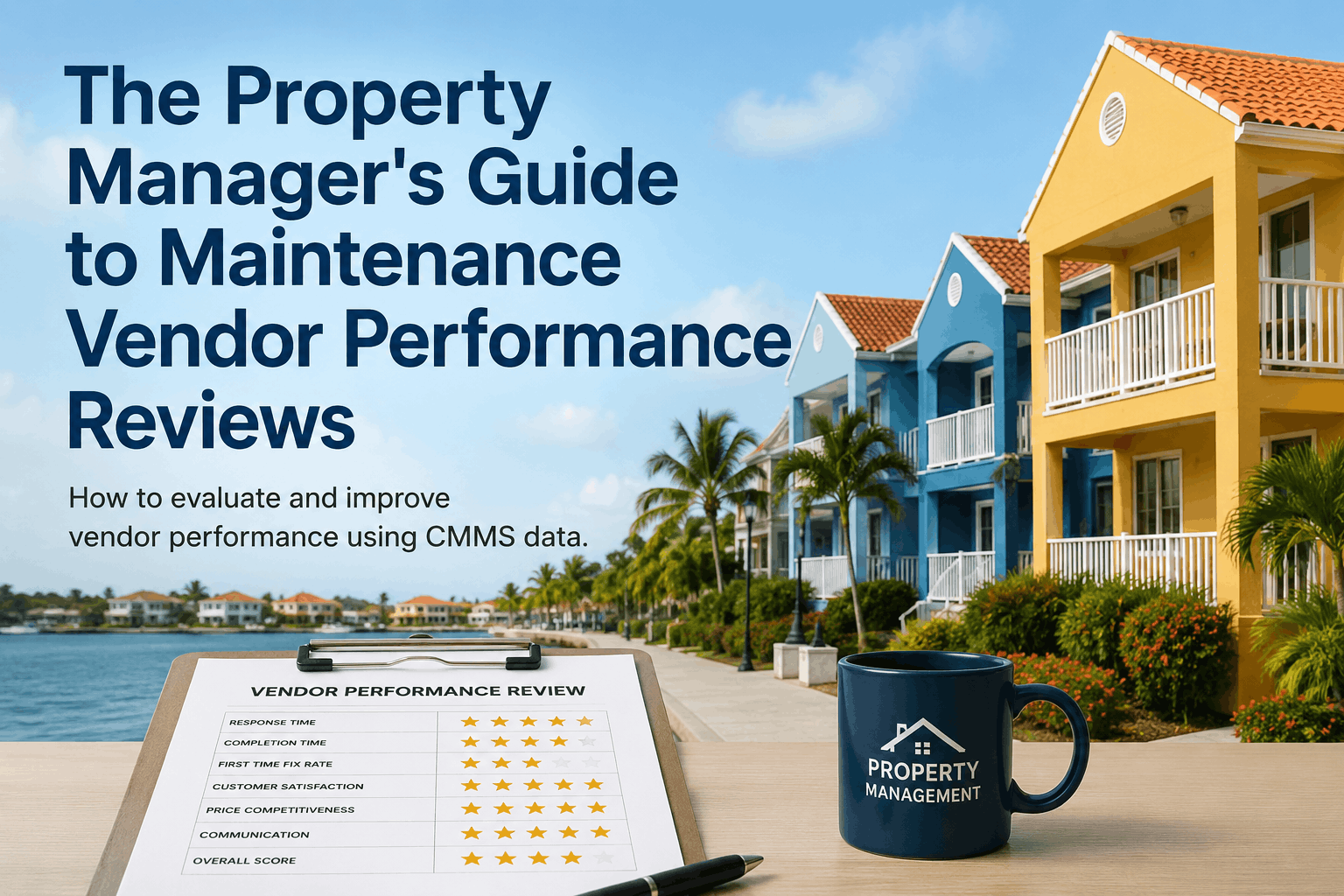
The Property Manager's Guide to Maintenance Vendor Performance Reviews: How to Evaluate and Improve Vendor Performance Using CMMS Data
Vendor scorecards, performance metrics, response time tracking, first-time fix rate, price competitiveness, improvement plans, and incentive programs — the complete guide to data-driven vendor performance management.
15–25%
Maintenance cost reduction with systematic vendor performance reviews
30–50%
Faster vendor response times with performance tracking and accountability
20–40%
First-time fix rate improvement with vendor scorecards
4.2×
Higher vendor performance improvement with quarterly reviews vs. annual
Vendor Performance Management
Stop Guessing Which Vendors Are Performing — Start Measuring
Oxmaint tracks every vendor interaction — response time, completion time, first-time fix rate, and cost variance — generating automatic vendor scorecards that identify top performers and those needing improvement. No more vendor management by instinct.
Why Vendor Performance Reviews Are Essential for Property Portfolios
Vendors perform 30–60% of maintenance work in most property portfolios. Yet most property managers lack a systematic way to evaluate which vendors deliver quality work and which drain the budget. Without performance reviews, underperforming vendors continue to get dispatched because "they've always been our vendor" or "they're the cheapest." Performance reviews change the conversation from cost-only to value-based vendor selection. Start a free trial or book a demo to see how Oxmaint generates vendor scorecards automatically.
What Happens Without Vendor Performance Reviews
Invisible Underperformers
Vendors who consistently miss response times or fail to fix issues on the first visit continue to get dispatched because no one tracks their performance.
Missed Cost Savings
High-performing vendors go unrecognized and underutilized. Volume discounts not negotiated because spending isn't aggregated by vendor.
No Improvement Leverage
Without performance data, you cannot have a meaningful conversation with underperforming vendors. They have no incentive to improve.
Inconsistent Quality
No standardization of quality expectations. The same vendor may perform differently across sites because expectations aren't documented or tracked.
No Vendor Accountability
Vendors know they won't be held accountable for performance. Missed response times and repeat calls are the norm, not the exception.
Vendor Loyalty Without Performance
Long-term vendor relationships persist not because of performance, but because of inertia. Missed opportunities to bring in better vendors.
The 6 Essential Vendor Performance Metrics
Vendor performance reviews must be based on measurable, objective metrics — not gut feelings or anecdotal evidence. The six metrics below form the foundation of any vendor scorecard. Oxmaint calculates all six metrics automatically from work order data, generating vendor scorecards without manual data entry.
Metric
Definition
Target
Action Trigger
Response Time (Emergency)
Time from dispatch to vendor arrival
<2 hours
>4 hours → investigation required
Response Time (Urgent/Routine)
Time from dispatch to vendor arrival
Urgent <4 hr, Routine <48 hr
Missed SLA → penalty clause applies
Completion Time
Time from vendor arrival to job completion
Varies by task — benchmark per job type
>2× average → investigation required
First-Time Fix Rate
% of jobs resolved in one visit
≥80%
<70% → performance improvement plan
Cost vs. Estimate
Actual cost compared to quoted estimate
Within ±10%
>20% variance → explanation required
Repeat Call Rate (30 days)
% of jobs requiring return visit within 30 days
<15%
>25% → quality issue investigation
Vendor Scorecard — Before vs. After Performance Reviews
The gap between a portfolio with no vendor performance reviews and one with systematic scorecard reviews is visible across every vendor metric — from response time to first-time fix rate. The comparison below shows the before-and-after results for a 12-property portfolio that implemented quarterly vendor performance reviews with Oxmaint. Oxmaint automates the scorecard generation so you spend time on vendor improvement conversations, not data gathering.
Before Reviews (No Scorecard)
Emergency Response Time
Average: 4.8 hours. 35% of emergency calls missed the 2-hour SLA. No vendor accountability — no one tracked response times.
4.8 hours average
After Reviews (Quarterly Scorecard)
Emergency Response Time
Average: 1.9 hours. 92% of emergency calls met 2-hour SLA. Vendors knew response times were tracked — performance improved immediately.
1.9 hours average
Before Reviews (No Scorecard)
First-Time Fix Rate
Average: 62%. 38% of jobs required a return visit — costing extra labor and delaying guest satisfaction.
62% FTFR
After Reviews (Quarterly Scorecard)
First-Time Fix Rate
Average: 84%. Vendors improved diagnosis and parts preparation when they knew FTFR was tracked and reviewed quarterly.
84% FTFR
Before Reviews (No Scorecard)
Cost Variance
Average variance: +22% above estimate. Invoices regularly exceeded quotes with no explanation required.
+22% variance
After Reviews (Quarterly Scorecard)
Cost Variance
Average variance: +6%. Vendors knew estimates were compared to actuals — accuracy improved without negotiation.
+6% variance
Vendor Performance Review Maturity Scoring
Vendor performance review maturity follows a clear spectrum — from no reviews (vendors operate without accountability) to quarterly data-driven reviews with improvement plans and incentive programs. The scoring framework below lets property managers assess their current capability — identifying the gaps that are costing budget and quality.
Quarterly reviews with comprehensive scorecards. Performance improvement plans for underperformers. Incentive programs for top performers. Vendors compete for portfolio volume.
15–25% cost reduction. 30–50% faster response.
4
Semi-Annual Reviews · Manual Scorecards
Reviews conducted twice per year. Scorecards created manually from CMMS data. Some vendor accountability. No incentive programs.
Action: Increase frequency to quarterly. Automate scorecard generation.
3
Annual Reviews · No Scorecard
Reviews conducted annually, usually at contract renewal. No formal scorecard. Performance discussed anecdotally. No data backing.
Gap: No data. Underperformers continue unchecked.
2
Reactive Reviews — Only After Problems
Reviews only occur after a major failure or complaint. No systematic tracking. Vendors changed only when problems become unbearable.
Risk: Poor performance goes undetected for months.
1
No Performance Reviews
No vendor performance reviews. Vendors selected by price or relationship. No performance tracking. No accountability.
Risk: Maximum cost and quality exposure. Immediate vendor scorecard implementation required.
How to Run a Vendor Performance Review — The 5-Step Process
Vendor performance reviews are most effective when they follow a structured process — not a casual conversation. The five steps below transform vendor reviews from awkward conversations to productive performance discussions. Oxmaint provides the data and scorecards for every step.
Step 1: Review Scorecard
Pull vendor scorecard — response time, FTFR, cost variance, repeat call rate. Review trends over last 3–6 months.
Step 2: Identify Gaps
Compare vendor performance against targets. Identify specific gaps — which metrics are below target and by how much.
Step 3: Conduct Review Meeting
Share data, discuss gaps, ask about root causes. Focus on specific examples, not generalizations.
Step 4: Improvement Plan
Document specific actions vendor will take to improve. Set clear targets and review timeline (30–60 days).
Step 5: Follow-Up Review
Re-evaluate performance in 30–60 days. If improvement achieved, maintain relationship. If not, escalate or replace vendor.
Bonus: Incentive Program
Offer preferred volume, faster payment, or other incentives to vendors who consistently exceed targets. Rewards drive performance.
"
We had 18 HVAC vendors across our 22 properties. Some were great, some were terrible — but we couldn't tell which was which because we had no performance data. After implementing quarterly vendor scorecards in Oxmaint, we discovered that two vendors were responsible for 40% of our repeat calls. We replaced them and consolidated work with the top performers. Our HVAC first-time fix rate improved from 58% to 84%. We also negotiated volume discounts with our top three vendors — saving $42,000 annually. The scorecards paid for themselves in the first quarter.
How often should vendor performance reviews be conducted?+
Quarterly reviews are recommended for active vendors. Monthly reviews for critical vendors (emergency response, high-volume trades). Annual reviews for low-volume or specialty vendors. More frequent reviews drive faster improvement — vendors know performance is being tracked and reviewed regularly. Book a demo to see automated quarterly scorecard generation.
What metrics should be included in a vendor scorecard?+
Include: response time (by priority), completion time, first-time fix rate, cost vs. estimate, repeat call rate (30 days), customer satisfaction rating (if available), and communication responsiveness. Weight each metric by importance. For emergency vendors, response time may be weighted 40%. For routine vendors, cost and FTFR may be weighted more heavily. Oxmaint's scorecard builder lets you customize weights per vendor type. Start a free trial to build your first scorecard.
How do you handle a vendor who consistently underperforms?+
First review: identify gaps, share data, agree on improvement plan. Second review (30–60 days): if improvement shown, continue; if not, issue formal warning with specific consequences. Third review: if still no improvement, terminate relationship and replace vendor. Document all steps — termination based on objective data protects you from claims of unfair treatment. Oxmaint's vendor scorecard provides the objective data for every conversation.
Can vendor scorecards help with contract negotiations?+
Yes — scorecards are your strongest negotiating tool. You can demonstrate to a vendor that they are a top performer (and should receive volume discounts or preferred status) or that they are underperforming (and need to improve pricing or service to retain business). Scorecard data also supports competitive bidding — you can compare vendors objectively on performance, not just price. Start free to generate scorecards for vendor negotiations.
How does a CMMS help with vendor performance reviews?+
A CMMS like Oxmaint automates the entire vendor review process: (1) Captures every vendor interaction — response time, completion time, cost, repeat calls, (2) Generates scorecards automatically — no manual data collection, (3) Tracks improvement over time — shows trends per vendor, (4) Documents review conversations — notes and improvement plans stored with vendor records. Without a CMMS, vendor reviews are manual, time-consuming, and often skipped.
Vendor Performance Intelligence from Oxmaint
Stop Guessing Which Vendors Are Performing — Start Measuring
Automated vendor scorecards, performance trend tracking, improvement plan documentation, and incentive program management — unified in one platform that holds every vendor accountable.
15–25%
Cost reduction with systematic vendor reviews
30–50%
Faster vendor response times with accountability
4.2×
Higher improvement with quarterly vs. annual reviews
100%
Vendor performance visibility across your entire portfolio