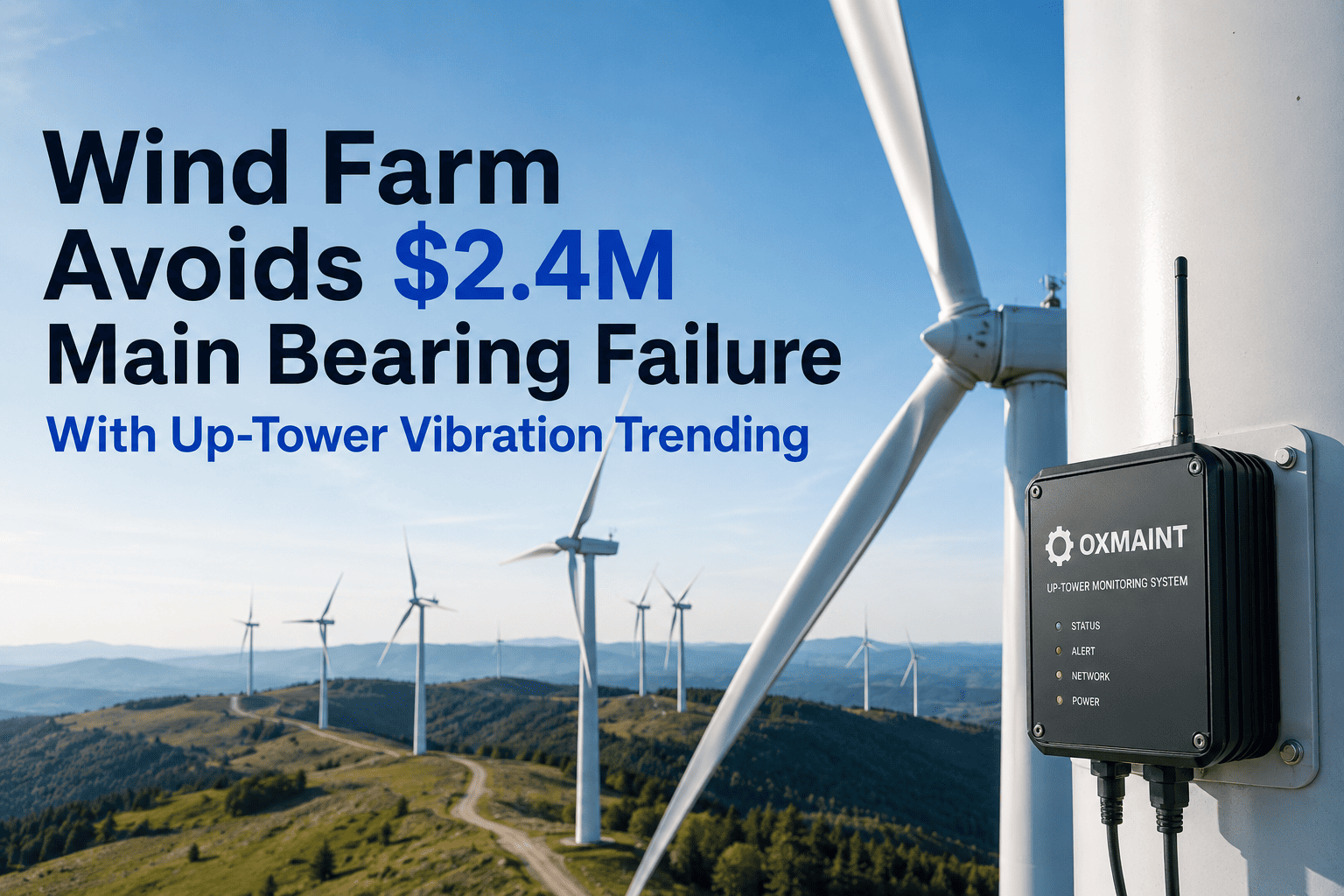
Wind turbine main bearing replacement is one of the most operationally complex and expensive events in wind energy maintenance — not because of the bearing cost itself, but because of what surrounds it: crane mobilization at $180,000 to $320,000 per event, production loss during the multi-week outage window, component shipping logistics for a unit that can weigh 12,000 to 18,000 kilograms, and the cascading damage risk to the main shaft, gearbox input stage, and nacelle frame that occurs when a degraded bearing progresses to failure rather than being replaced under controlled conditions. The wind farm in this case study was operating 18 turbines across a flat-terrain site with no systematic up-tower vibration trending program. When OxMaint's vibration analysis flagged an anomaly on Turbine 11, the site team had six weeks to plan and execute a controlled main bearing replacement — saving an estimated $2.4M and avoiding the safety risks of an uncontrolled in-nacelle failure event. This is how that six-week window was created, and what it means for how your fleet should be monitored.
$2.4M
Avoided Failure Cost
6 Weeks
Advance Warning Window
18 Turbines
Fleet Under Monitoring
1 Crane Call
vs. 3 Without Warning
Why Main Bearing Failures Are So Expensive When They Are Not Caught Early
A main bearing failure that progresses to complete mechanical failure — rather than being caught during a trending alarm window — typically triggers a sequence of consequences that multiply the base repair cost by 3 to 5 times. Secondary damage to the main shaft journal, gearbox input bearing, and nacelle mounting structure is common when the bearing seizes or fragments under load. Emergency crane mobilization at a 3 to 6-week lead time means extended production loss. And the regulatory and insurance documentation requirements following an uncontrolled mechanical failure add weeks to the overall outage duration beyond the repair itself.
Controlled vs. Uncontrolled Main Bearing Replacement — Cost Cascade
Controlled (This Case)
Production Loss (18 days)
$87,000
Total: $702,000
Uncontrolled Failure (Estimated)
Crane (Emergency)
$390,000
Secondary Damage
$880,000
Production Loss (54 days)
$261,000
Emergency Premium
$149,000
Total: $2,100,000+ (Avoided)
The 6-Week Warning: What OxMaint Detected and When
The detection sequence on Turbine 11 illustrates exactly how up-tower vibration trending creates a warning window that would not exist under periodic manual inspection protocols. The anomaly that eventually identified an advanced-stage main bearing defect began as a sub-threshold change in the 1x and 2x rotational frequency amplitude — a pattern that requires longitudinal comparison against that specific turbine's own baseline to be meaningful.
Detection Sequence — Turbine 11 Main Bearing
Week 6 Before Repair
Slight elevation in low-speed shaft 1x amplitude. OxMaint flags rate-of-change deviation. Alert generated for engineering review. No visible symptoms up-tower.
Alert Triggered
Week 5
Accelerated monitoring schedule activated. Outer race defect frequency (BPFO) rising. Bearing defect pattern confirmed. OEM notified. Crane scheduling initiated.
Defect Confirmed
Week 3
Replacement bearing procured from regional stock. Crane contracted at standard rate — no emergency premium. Outage window coordinated with grid operator and adjacent unit schedule.
Logistics Complete
Week 1
Turbine de-rated 30% as precaution. Final pre-replacement vibration data captured. Bearing replacement executed over 18-day planned outage. Post-repair baseline established.
Replacement Complete
6 Weeks of Warning Is the Difference Between $700K and $2.4M
OxMaint's up-tower vibration trending gives your fleet that window — without requiring additional sensors. Connect your existing vibration data and start building turbine-specific baselines today.
What Up-Tower Vibration Trending Monitors Across Your Fleet
Main Bearing
BPFO, BPFI, BSF, 1x amplitude, temperature cross-reference
Failure cost: $2M–$4M uncontrolled
Gearbox Stages
Gear mesh frequency, sidebands, bearing defect frequencies per stage
Failure cost: $300K–$800K per stage
Generator Bearings
Drive end and non-drive end bearing frequencies, rotor imbalance signature
Failure cost: $80K–$220K
Tower Resonance
1P and 3P excitation frequencies, structural resonance proximity
Structural integrity indicator
Frequently Asked Questions
Does OxMaint require installation of new vibration sensors on turbines to use the trending module?
OxMaint works with data from existing CMS sensors, SCADA vibration channels, or portable measurement uploads. If your turbines already have vibration monitoring hardware installed, the platform integrates with that data stream. For turbines without permanent sensors, the platform supports periodic up-tower measurement data entry.
Sign up free to configure your fleet's monitoring setup.
How does OxMaint establish the turbine-specific baseline needed for meaningful anomaly detection?
Baseline establishment begins at onboarding using the first 4 to 8 weeks of data for each turbine. The platform builds turbine-specific frequency fingerprints that account for rotor speed variability, load-dependent amplitude shifts, and seasonal temperature effects. Anomaly detection is triggered by deviation from that turbine's own baseline — not against generic fleet-average thresholds that miss unit-specific changes.
Book a demo to see baseline building in action.
Which turbine OEM models and gearbox configurations does OxMaint support?
OxMaint's wind module supports major OEM configurations including Vestas, Siemens Gamesa, GE, Nordex, and Enercon, across direct-drive and geared drivetrain configurations. Gearbox bearing defect frequency libraries are pre-loaded for common gearbox models, with the ability to import custom frequency tables for less common configurations.
Can the platform track oil sample and filter condition data alongside vibration data for the same turbine?
Yes. Each turbine's health record in OxMaint integrates vibration trending, gearbox oil sample results (particle count, viscosity, contamination), filter delta-pressure trends, and operational parameters in a single unified view. Gearbox oil sample anomalies often appear before vibration signatures, so the combined signal provides earlier and higher-confidence defect detection than either data type alone.
Up-Tower Monitoring
→
6-Week Warning
→
Planned Replacement
→
$2.4M Saved
Give Your Fleet the Same Warning Window That Saved This Site $2.4M
OxMaint's wind turbine health monitoring platform turns your existing vibration and oil sample data into a fleet-wide early warning system. Every turbine builds its own baseline. Every anomaly triggers an investigation workflow before it becomes a crane call.