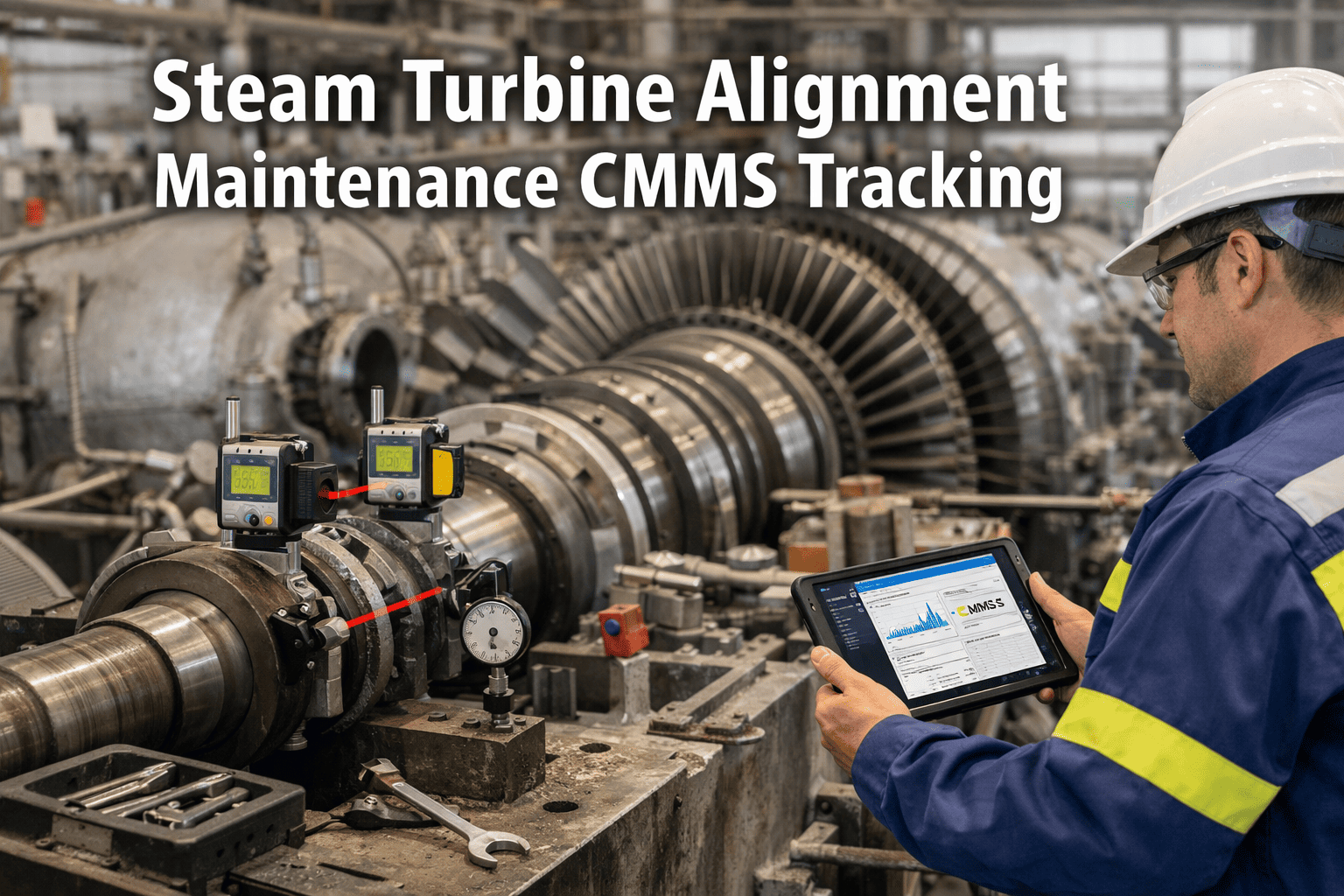
Steam turbines are among the most capital-intensive rotating assets in industrial operations — and among the most silently degraded. Blade erosion progresses at fractions of a millimetre per operating hour. Alignment tolerances drift imperceptibly across seasons. Deposit fouling builds invisibly on steam path surfaces. None of these failure modes announce themselves until efficiency has already fallen, output has already dropped, and a planned overhaul has become an emergency. For power generators, petrochemical operators, and industrial utility managers, the question is not whether steam turbine degradation is happening — it is whether your maintenance programme is detecting it before it costs you. Start a free trial of OxMaint or book a demo to see blade-by-blade condition tracking in action.
OxMaint · Steam Turbine Maintenance Software
Every Blade Has a Story.
Most Maintenance Teams Aren't Reading It.
Blade-by-blade condition mapping, alignment tolerance tracking, and overhaul planning — built for steam turbine operators who measure performance in megawatts and margins.
3–8%
Efficiency loss from unmaintained blade erosion annually
$500K+
Daily cost of unplanned large turbine outage
40%
Of turbine failures traceable to missed inspection signals
12 yr
Asset life extension possible with structured maintenance cycles
The Silent Efficiency Drain: How Steam Turbines Degrade Without Warning
Steam turbine degradation is not an event — it is a gradient. The same asset certified at 94% isentropic efficiency at commissioning will deliver 87% after three years without active monitoring. The loss accumulates across five overlapping mechanisms, each invisible to routine inspection intervals.
Year 1–2
Deposit Fouling Begins
Silica, iron oxide, and salt deposits accumulate on blade surfaces. Each micron increases surface roughness and reduces aerodynamic efficiency. Loss is sub-1% but compounds with every operating hour.
Efficiency loss: 0.5–1.5%
Year 2–4
Blade Erosion Accelerates
Wet steam stages see progressive leading-edge erosion from water droplet impingement. Blade profiles deviate from design geometry, altering steam flow angles and increasing stage losses. Root attachment zones accumulate fatigue cycles.
Efficiency loss: 1.5–3.5%
Year 3–6
Alignment Drift Emerges
Thermal cycling and foundation movement cause shaft alignment to drift outside design tolerances. Bearing loads increase asymmetrically. Vibration signatures change gradually, accelerating bearing and seal wear continuously.
Vibration increase: 15–40%
Year 5–8
Seal Degradation & Leakage
Labyrinth seals wear beyond clearance specifications, increasing steam leakage past stage boundaries. Gland seal degradation contributes to auxiliary steam consumption and air ingress. Each percentage point of seal leakage is a direct heat rate penalty.
Heat rate penalty: 1–2%
Year 6+
Stress Corrosion & Cracking Risk
High-pressure blade roots and disc bore locations accumulate stress corrosion damage in the presence of steam contaminants. Cracking develops over thousands of hours before detection — and failures are catastrophic when they occur undetected.
Failure risk: Critical
OxMaint tracks all five degradation mechanisms from a single dashboard — correlating inspection data, vibration trends, and performance metrics to show exactly where your turbine sits on this curve.
5 Critical Inspection Points OxMaint Maps for Every Steam Turbine
A turbine overhaul without structured inspection mapping is expensive guesswork. OxMaint builds a digital condition model of each turbine — tracking every measurable parameter at every critical inspection point across every maintenance interval.
01
Blade Condition & Profile
Leading-edge erosion depth, trailing-edge condition, surface roughness classification, tip clearance measurement, root attachment inspection for cracking indicators. Mapped blade-by-blade with photo documentation linked to each asset record.
Erosion depth (mm)
Profile deviation
Root condition
02
Shaft Alignment & Runout
Radial and axial alignment measurements at each coupling, shaft runout across bearing spans, casing alignment relative to foundation. Tolerance limits configurable per OEM specification with alerts when readings approach action thresholds.
Radial offset
Angular misalignment
Runout TIR
03
Bearing Clearances & Condition
Journal bearing diametric clearance, thrust bearing clearance and wear, bearing metal temperature trending between outages, oil contamination analysis scheduling. Bearing condition history linked to vibration trend data.
Diametric clearance
Babbitt condition
Oil analysis
04
Steam Path Deposits & Fouling
Nozzle block deposit classification, diaphragm fouling assessment, steam path flow area measurement compared to design. Deposit type identification to trace source contamination and guide water chemistry remediation.
Deposit thickness
Nozzle condition
Flow area loss %
05
Seal & Packing Condition
Labyrinth seal clearance measurement at each stage, gland seal packing condition, interstage seal strip integrity. Seal clearance accumulation tracked across outages to schedule replacement before leakage reaches heat rate impact threshold.
Labyrinth clearance
Gland seal condition
Strip wear
Overhaul Planning That Uses Condition Data, Not Just the Calendar
Fixed-interval overhauls are a legacy of the era before condition monitoring. Modern turbine management uses actual degradation data to schedule intervention at the right time — not too early, not too late.
Tier 1
Minor Outage Inspection
Typically 2–3 years / OEM-guided
Blade visual inspection — accessible stages
Alignment check at all couplings
Bearing clearance verification
Gland seal packing replacement
Steam path endoscopic survey
Vibration baseline re-establishment
Tier 2
Intermediate Overhaul
Typically 4–6 years / condition-triggered
Full blade removal and dimensional inspection
Rotor balancing — high-speed shop balance if required
Diaphragm and nozzle block restoration
Bearing replacement based on clearance history
Labyrinth seal re-clearancing to design spec
Casing bore measurement and alignment correction
Tier 3
Major Overhaul
Typically 8–12 years / life cycle event
Full blade replacement — all stages
Rotor refurbishment or replacement decision
Casing re-machining and distortion correction
Valve overhaul — governor, control, stop valves
NDE inspection — disc bores, blade roots, shaft
Complete performance test and efficiency baseline reset
OxMaint's condition-based trigger system flags when inspection data — erosion rates, alignment drift, vibration trends — indicates a tier upgrade is required before the scheduled interval expires.
Your turbine's condition data already exists. OxMaint turns it into decisions.
Blade-by-blade records. Alignment trend history. Overhaul scope forecasts. All in one platform, from your first inspection.
The Financial Case: What Poor Steam Turbine Maintenance Actually Costs
Steam turbine maintenance decisions carry financial consequences measured in millions — whether the decision is to intervene or defer. The numbers below are based on published outage cost data, heat rate impact studies, and turbine lifecycle economics from power generation and industrial process operations.
$1.2M–$4M/yr
Efficiency Loss Cost
A 200 MW steam turbine operating at 3% below design efficiency at $60/MWh loses between $1.2M and $4M annually in foregone generation value — accumulating silently while blade erosion progresses unchecked.
3× cost differential
Emergency vs. Planned Overhaul
Emergency turbine repairs cost 2.5–4× the equivalent planned work. Blade failure typically adds 6–14 days of unplanned downtime, contractor mobilisation premiums, and expedited parts sourcing to the direct repair cost.
$800K per 1%
Heat Rate Penalty
Each 1% increase in turbine heat rate from fouling, seal leakage, and blade degradation costs approximately $800K annually in additional fuel consumption for a 200 MW plant — a cost predictive maintenance directly recovers.
+10–15 years
Asset Life Extension
Structured condition-based maintenance programmes extend steam turbine operational life significantly beyond nameplate design life. Deferring a $15M–$40M turbine replacement by 10 years justifies a maintenance programme investment many times over.
OxMaint Steam Turbine Module: What You Get From Day One
01
Blade-by-Blade Condition Mapping
Every blade in every stage gets its own condition record — erosion measurements, photo attachments, previous inspection comparisons, and a trend line showing degradation rate. When your inspection team measures blade 47 in Stage 3, that reading is compared automatically against the last three outages. OxMaint flags anomalous degradation rates before they become failures.
Outcome: Inspection teams find targeted intervention points instead of inspecting uniformly across 200+ blades
02
Alignment Tolerance Tracking with OEM Limits Built In
Load each coupling's OEM alignment specification as the reference — then record every alignment measurement at each outage. OxMaint plots the alignment history over time, calculates drift rate, and projects when action thresholds will be reached. Technicians see clearly whether re-alignment is required at this outage or can wait for the next one.
Outcome: Alignment decisions based on documented drift history, not technician judgment alone
03
Overhaul Scope Forecasting from Condition Trends
OxMaint analyses condition data accumulated between outages — vibration trends, performance parameter deviation, bearing temperature drift — and generates a pre-outage scope forecast. Before the turbine is opened, your planning team sees which components are likely to need replacement and can pre-order parts and contractor resources accordingly.
Outcome: Parts ordered weeks before outage start — scope surprises reduced, outage duration compressed
04
Steam Path Performance Loss Calculator
Input operating performance data — steam consumption, output power, inlet and exhaust conditions — and OxMaint calculates current isentropic efficiency against the post-overhaul baseline. The efficiency loss is expressed in MW and fuel cost, giving operations managers a real-time financial argument for maintenance investment that resonates with finance and asset management teams.
Outcome: Maintenance investment justified in financial terms at every management review
Frequently Asked Questions
Does OxMaint work with multi-stage and multi-casing turbine configurations?
Yes. OxMaint's asset hierarchy supports any turbine configuration — single-casing, tandem compound, cross-compound, and extraction turbine arrangements. Each casing, each stage group, and each individual blade row is modelled as a separate asset node with its own condition records, inspection schedules, and maintenance history. The platform scales from small industrial backpressure turbines to large utility reheat machines without configuration constraints.
Can OxMaint integrate with existing vibration monitoring and DCS systems?
OxMaint connects to continuous monitoring data via OPC-UA, PI historian, and standard SCADA interfaces — ingesting vibration, bearing temperature, and process performance data between outages. This between-outage data is correlated with physical inspection records entered during shutdowns, creating a complete condition picture that spans both online monitoring and hands-on inspection. Most integrations are configured within the first two weeks of deployment.
How does OxMaint handle blade inspection data from third-party inspection contractors?
OxMaint supports mobile data entry via web browser — inspection contractors can enter blade measurements, condition classifications, and photos directly into the asset record during the outage without any special software installation. Records are timestamped, user-attributed, and immediately visible to the operations team. Bulk measurement import via structured spreadsheet templates is also available for contractors with existing data collection workflows.
Can OxMaint generate documentation for OEM warranty compliance and insurer inspections?
Yes. OxMaint's reporting module generates structured maintenance history reports, inspection record packages, and component condition summaries suitable for OEM warranty documentation, property insurer risk assessments, and regulatory compliance submissions. The version-controlled audit trail ensures all historical inspection data and measurement records are preserved and retrievable regardless of staff turnover or system changes.
OxMaint · Steam Turbine Maintenance
Your Next Overhaul Should Be Planned,
Not Prompted by a Failure.
OxMaint gives steam turbine operators the condition records, alignment histories, and overhaul forecasts needed to maintain assets at design performance — not just nameplate potential. Most facilities are live within three weeks.

.png)