Battery energy storage capacity has grown fast enough that NERC now tracks it as its own reliability category, expanding almost in step with solar over the past two years. The inverter is the part of that system most likely to fail first — it switches constantly, runs hot, and absorbs every irregularity from both the battery side and the grid side. NERC's 2026 State of Reliability report already flagged a rare but serious BESS thermal event during routine testing, a reminder that storage assets carry failure modes utilities are still learning to monitor. Predictive maintenance on the inverter fleet is where most of that risk can be caught early.
Energy Storage · Blog
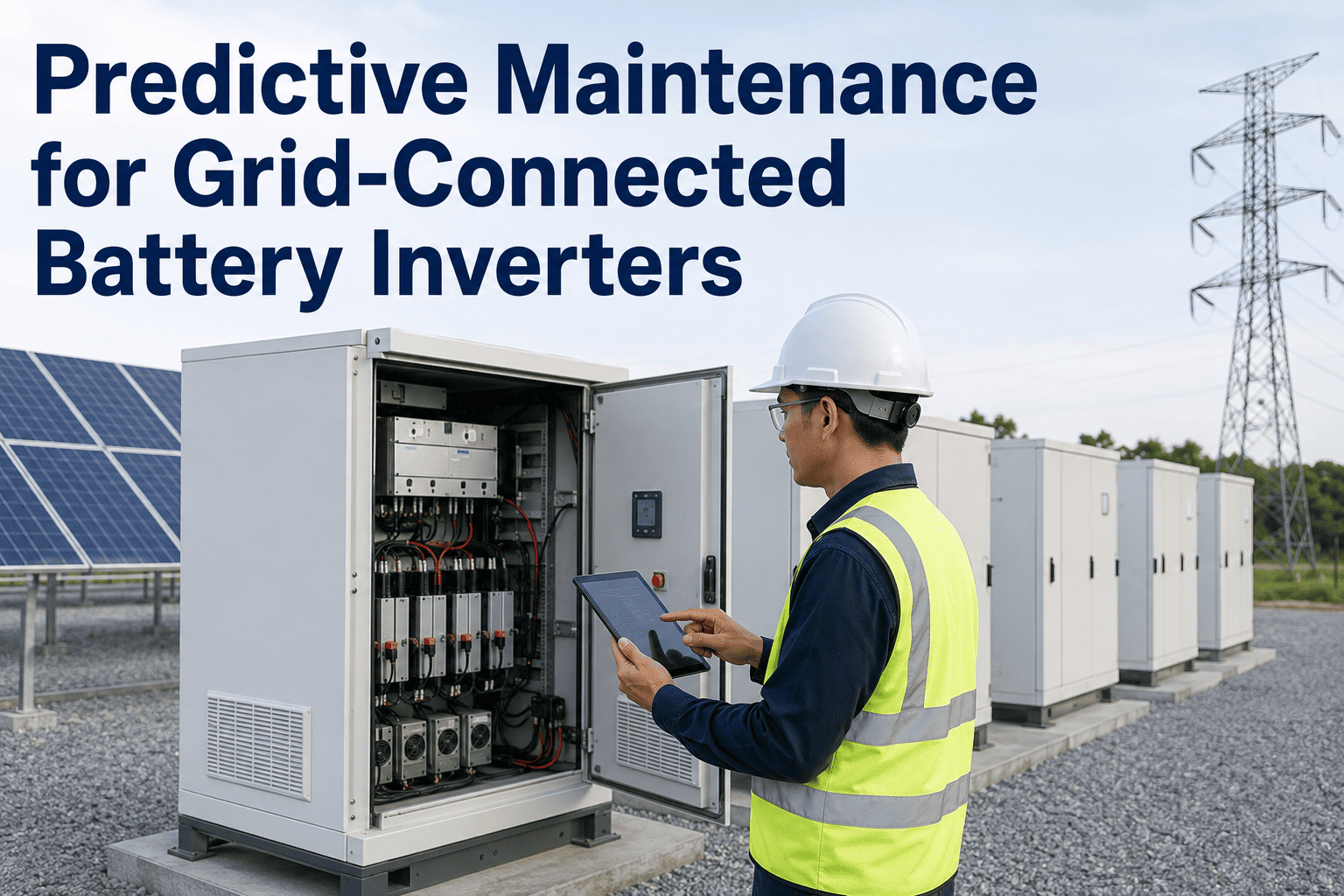
Predictive Maintenance for Grid-Connected Battery Inverters
Inverters sit at the highest-stress point in a battery energy storage system. Here's how predictive monitoring catches the failure signatures before they turn into a derated asset or an unplanned outage.
Why Inverters Fail Before the Battery Does
In most BESS installations, the inverter — not the battery cells — is the component most likely to trigger an unplanned service event. It carries continuous high-frequency switching, thermal cycling, and every grid-side voltage disturbance the system experiences.
DC Input Stage
Capacitor degradation from continuous ripple current — the single most common inverter failure point
Switching Stage (IGBT/MOSFET)
Thermal cycling fatigue from repeated charge/discharge switching under variable load
Cooling System
Fan bearing wear and heat sink fouling reduce thermal margin exactly when switching stress is highest
AC Output / Grid Interface
Voltage transients and harmonic distortion stress output filters and grid-tie relays
Five Failure Signatures Predictive Monitoring Catches Early
Each of these signatures shows up in monitored data well before it shows up as a fault code on the inverter display.
DC Capacitor Aging
Rising ripple current and falling capacitance trend over weeks — visible in monitored data long before it trips a fault, and the leading cause of inverter derates industry-wide.
IGBT Thermal Drift
Junction temperature climbing under equivalent load conditions signals degrading thermal interface material or a cooling system losing effectiveness.
Cooling Fan Bearing Wear
Vibration signature and current draw shifts on cooling fans precede failure by weeks, and are inexpensive to catch versus the thermal cascade that follows a fan loss.
Insulation Resistance Decline
Gradual insulation resistance drop on DC-side wiring is a leading indicator for ground faults, especially in installations with high ambient humidity exposure.
Harmonic Distortion Increase
Rising total harmonic distortion on the output stage often points to degrading output filter components before they cause a grid-compliance issue.
A Capacitor Trend Line Is Cheaper to Read Than an Inverter Trip.
OxMaint's predictive maintenance module tracks the exact failure signatures above against your inverter fleet — flagging degradation weeks before a fault code does.
Reactive Repair vs. Predictive Monitoring — The Cost Gap
The cost difference between catching an inverter fault at the trend stage versus the failure stage is not incremental — it typically runs an order of magnitude.
| Stage Caught | Typical Response | Relative Cost |
|---|
| Trend Deviation (Predictive) | Scheduled component swap during planned maintenance | Low |
| Fault Code / Derate | Reactive service call, partial capacity loss until repaired | Moderate |
| Full Inverter Failure | Emergency replacement, extended asset downtime | High |
| Cascading Thermal Event | Full system shutdown, potential safety investigation | Severe |
What a Predictive Monitoring Setup Actually Tracks
A working predictive program for grid-connected inverters doesn't need exotic sensors — it needs consistent, structured tracking of a small set of parameters over time.
DC Bus Voltage & Ripple
Continuous trend tracking against baseline, flagged when ripple current climbs beyond expected range for the load level.
Switching Device Temperature
Junction and heat sink temperature logged per cycle, compared against historical values at equivalent load and ambient conditions.
Cooling System Vibration & Current
Fan and pump signatures tracked for early bearing wear, well before airflow reduction becomes measurable at the outlet.
Insulation Resistance
Periodic megger readings logged and trended, catching gradual decline long before a ground-fault trip.
Output Harmonic Distortion
THD sampled at the point of interconnection, trended against grid-code compliance thresholds.
Cycle Count & Depth of Discharge
Duty-cycle history feeding directly into remaining-life estimates for both the inverter and the battery it serves.
Inverter Platforms Predictive Monitoring Typically Covers
Grid-connected BESS inverters vary by manufacturer and topology, but the underlying failure signatures — capacitor aging, thermal drift, cooling wear — are consistent enough that a well-built monitoring program covers most fleets without custom engineering per unit.
| Inverter Class | Typical Application | Key Monitoring Focus |
|---|
| Central String Inverters | Utility-scale BESS and co-located solar-plus-storage | DC capacitor health, cooling fan condition |
| Containerized PCS Units | Standalone grid-scale storage installations | Thermal drift, insulation resistance, THD |
| Modular Rack-Mounted Inverters | Distributed and behind-the-meter storage | Switching stage temperature, output harmonics |
| Hybrid Multi-Port Inverters | Combined solar, storage, and grid-tie systems | Cross-port thermal loading, cycle count tracking |
Where the Return on Predictive Monitoring Shows Up
The financial case for predictive monitoring on inverters isn't just avoided repair cost — it shows up across several categories that compound over the life of the asset.
Avoided Emergency Replacement
Scheduled component swaps cost a fraction of an emergency inverter replacement, and avoid the lead time risk of sourcing parts under pressure.
Extended Asset Life
Catching thermal and electrical stress early reduces cumulative wear, often extending useful inverter life beyond the original design estimate.
Reduced Capacity Derates
Fewer unplanned derates means more consistent state-of-charge availability for grid services and revenue-generating dispatch.
Lower Insurance & Safety Risk
Early detection of insulation and thermal anomalies reduces the likelihood of the kind of rare but severe thermal events NERC has flagged industry-wide.
Frequently Asked Questions
How early can predictive monitoring actually catch an inverter failure?
For the most common failure mode — DC capacitor aging — trend data typically shows measurable degradation weeks to months before a fault code appears, depending on duty cycle and ambient conditions. Thermal and vibration-based signatures on cooling components usually give a shorter but still useful window of days to weeks.
Do we need to install new sensors on existing inverters to enable predictive monitoring?
Most modern grid-connected inverters already expose the relevant parameters — DC voltage, temperature, current — through their existing communication interface.
OxMaint ingests this data directly in most cases, with additional sensors only needed for older units without digital monitoring output.
How does predictive maintenance on inverters relate to overall BESS reliability?
The inverter is typically the highest-turnover component in a BESS installation, so catching its failures early has an outsized effect on overall system uptime. It also reduces the risk of secondary damage to battery cells caused by an inverter fault propagating into the DC side.
What's the difference between predictive maintenance here and a standard preventive maintenance schedule?
Preventive maintenance replaces or inspects components on a fixed calendar regardless of actual condition, which can mean replacing healthy parts early or missing a component that degrades faster than expected. Predictive maintenance instead triggers action based on the trend data itself, which typically reduces both unnecessary replacements and unplanned failures.
Can this approach scale across a fleet of inverters at multiple sites?
Yes — the trending logic is the same whether it's applied to a single site or a distributed fleet, and centralizing the data makes it easier to compare degradation patterns across units of the same model.
Book a demo to see how fleet-wide inverter tracking is set up in practice.
The Fault Code Is the Last Warning Your Inverter Gives — Not the First.
OxMaint tracks capacitor health, switching temperature, and cooling degradation on every inverter in your fleet — so the trend line reaches you before the outage does.