Procuring a CMMS for a power plant is not like buying software for a warehouse or a hospital. Your RFP must reflect the realities of fired-hour counters, NERC GADS reporting, ASME boiler code compliance, and turbine OEM inspection intervals — requirements that generic CMMS RFP templates ignore entirely. A poorly scoped RFP returns proposals from vendors who cannot handle your boiler, turbine, or generator maintenance complexity, forcing a costly re-evaluation six months after go-live. This 18-section power plant CMMS RFP template is built specifically for thermal, combined-cycle, and cogeneration facilities — covering every evaluation criteria from boiler tube inspection workflows to DCS/SCADA integration and outage critical-path scheduling. Use it to identify vendors who actually understand power generation maintenance, score them objectively, and make a selection your plant won't regret. To see how OxMaint responds to each section of this RFP template, book a live walkthrough or start a free trial with your actual asset types configured from day one.
RFP Template · Power Generation · 18 Sections
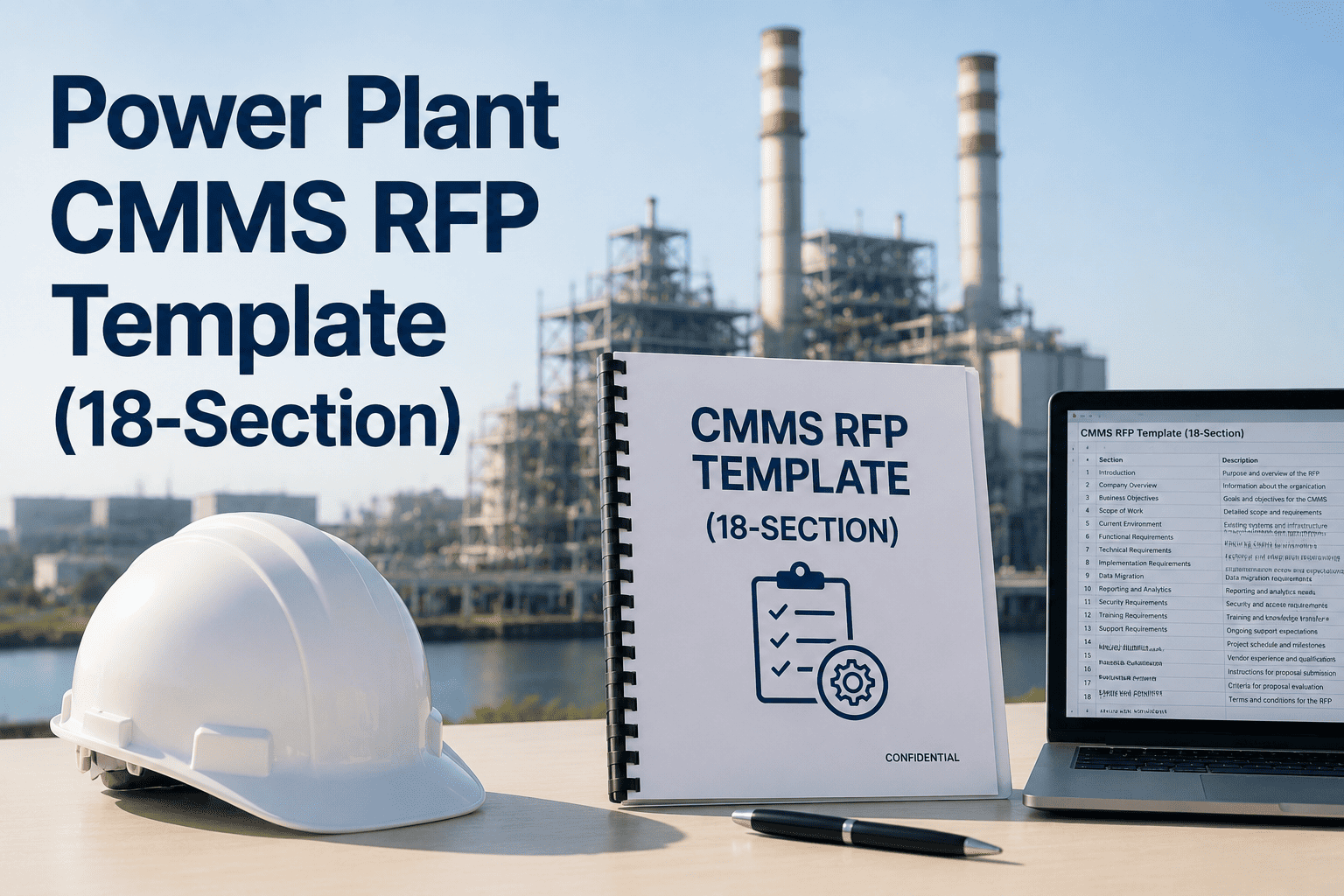
Power Plant CMMS RFP Template
18 sections covering boiler, turbine, generator, NERC compliance, SCADA integration, vendor scoring, and deployment. Copy, customize, send — your plant-specific RFP in one document.
Thermal Plants
Combined Cycle
Cogeneration
Hydro
52%
of forced outages caused by boiler tube failures that a structured CMMS PM program can predict
$28M+
average cost of a 23-day forced outage at a utility-scale thermal plant
14 days
reduction in major overhaul duration with CMMS-driven outage critical-path scheduling
91%
PM compliance rate achievable with fired-hour-based scheduling vs calendar scheduling
Why Most Power Plants End Up with the Wrong CMMS
The standard CMMS selection mistake in power generation is using a generic RFP. Generic RFPs ask about work order management, mobile access, and reporting dashboards — every CMMS vendor says yes to all three. The questions that actually separate power-plant-ready platforms from facility-management tools are specific: Can the system trigger a combustion inspection PM from fired-hour accumulation rather than calendar days? Can it ingest DCS alarm codes and auto-generate priority-routed work orders? Can it produce NERC GADS-formatted outage reports without manual data entry? These questions belong in Section 4, Section 9, and Section 13 of your RFP — and this template puts them there.
01
Fired-Hour PM Triggers
Turbine combustion inspections run on fired hours and starts, not calendar weeks. Generic RFPs never ask for this. Section 5 of this template does.
02
NERC GADS Reporting
EFOR, GADS event logging, and reliability reporting are regulatory requirements. Most CMMS platforms require costly custom configuration to produce them. Section 11 tests this directly.
03
DCS / SCADA Integration
Alarm-to-work-order automation from your DCS is table stakes for a modern power plant CMMS. Section 9 defines exactly what integration depth you should require.
04
Outage Planning Engine
A 200-task major overhaul with parallel workstreams, contractor access, and parts staging cannot be managed in a generic work order queue. Section 14 covers this requirement completely.
The 18 Sections — At a Glance
Each section below maps to a distinct evaluation requirement. The first eight sections define your plant, project, and technical requirements. Sections 9 through 14 test asset-specific and regulatory capabilities. Sections 15 through 18 govern vendor qualification, commercial terms, and selection scoring.
01
Organization Overview
Plant type, generation capacity, number of units, asset count, current maintenance system, and O&M team structure.
02
Project Scope & Objectives
What the CMMS must achieve — downtime reduction targets, PM compliance goals, regulatory documentation, and integration requirements.
03
Asset Hierarchy Requirements
Multi-level asset tree: plant → unit → system → component. Separate maintenance histories per turbine stage, boiler section, and generator subcomponent.
04
Work Order Management
Corrective, preventive, predictive, and outage work order types. Priority routing by asset criticality. Contractor and multi-crew assignment workflows.
05
Boiler PM Requirements
Tube thickness inspection scheduling, waterwall PM intervals, soot blower cycles, refractory inspection triggers, and ASME B&PV code documentation requirements.
06
Turbine PM Requirements
Fired-hour and starts-based PM triggers. Combustion inspection, hot gas path, and major inspection intervals per OEM schedule. Bearing vibration trend tracking.
07
Generator PM Requirements
Insulation resistance testing schedules, partial discharge monitoring integration, excitation system calibration records, and cooling system PM intervals.
08
Spare Parts & Inventory
Critical spare tracking by asset, min/max reorder thresholds, outage kitting, and parts reservation against planned work orders.
09
DCS / SCADA Integration
Alarm ingestion protocol (OPC-UA, Modbus, REST), auto-work-order generation from alarm thresholds, and historian data correlation with maintenance records.
10
IoT & Condition Monitoring
Vibration sensor integration, lube oil analysis data import, thermal imaging attachment to work orders, and predictive alert-to-work-order workflows.
11
NERC / Regulatory Compliance
GADS event logging, EFOR calculation, NERC CIP evidence management, EPA CEMS integration, and one-click audit export by standard and date range.
12
Reporting & KPI Dashboards
Availability factor, heat rate trend, MTBF by asset class, PM compliance rate, and forced outage rate — configurable per unit and per plant.
13
Mobile & Offline Access
Technician mobile app with offline capability for work in the boiler drum, turbine hall, and switchyard where connectivity is absent.
14
Outage Planning & Scheduling
Gantt-based outage planner with critical path, parallel workstream management, contractor crew scheduling, parts pre-staging, and outage duration modeling.
15
ERP / EAM Integration
SAP PM, Oracle EAM, or Maximo data sync for purchase orders, cost center accounting, and capital project tracking.
16
Vendor Qualification
Power generation references (minimum 3 operating plants), implementation team credentials, and support SLA for 24/7 operations environments.
17
Commercial & Licensing Terms
Pricing model (per-user vs per-asset), implementation cost, training cost, annual maintenance fee, and data export rights at contract end.
18
Scoring & Selection Criteria
Weighted scoring matrix: technical fit (40%), power plant references (25%), implementation approach (20%), total cost of ownership (15%).
See How OxMaint Answers Every Section of This RFP
Walk through each of the 18 sections live — boiler PM scheduling, turbine fired-hour triggers, NERC GADS reporting, and outage planning — configured for your plant type and asset mix.
Section Deep Dive — The Three Sections That Eliminate Unqualified Vendors
Sections 5, 6, and 11 are the most effective filters in a power plant CMMS RFP. Vendors who cannot answer these sections in concrete, technical detail — not marketing language — are not qualified for your plant, regardless of their G2 rating or reference list size.
Ask Vendors
How do you schedule waterwall tube thickness inspections? Can intervals be set by fired hours, calendar days, or inspection finding — whichever comes first?
Qualifying Answer
Native multi-trigger PM scheduling with compound AND/OR logic. Boiler section-level asset records with UT measurement history attached to each work order.
Red Flag Answer
"We support time-based and meter-based scheduling." This is calendar and single-meter only — not compound triggers. Not adequate for boiler PM.
Vendors passing this section
~35%
Ask Vendors
How do you handle fired-hour counters for gas turbine combustion inspection intervals? Can the system track equivalent starts and apply OEM-defined inspection limits?
Qualifying Answer
Asset-level fired-hour meter with equivalent starts weighting. PM triggers fire when either threshold is reached first. OEM inspection interval templates configurable per turbine model.
Red Flag Answer
"We can track runtime hours." Runtime hours are not fired hours. A vendor who conflates these two does not understand gas turbine maintenance engineering.
Vendors passing this section
~28%
Ask Vendors
Can your system produce a NERC GADS-formatted outage event report? Can it export NERC CIP-007 evidence packages sorted by standard and date range?
Qualifying Answer
Native GADS event logging with cause codes, one-click NERC audit export, and CIP evidence package generation — no spreadsheet extraction required.
Red Flag Answer
"We have robust reporting capabilities and can export data to Excel." This means you will be building NERC reports manually every quarter.
Vendors passing this section
~22%
Section 18 — Scoring Matrix Template
Apply this weighted scoring framework to each vendor proposal. The weights below reflect the priorities of a reliability-focused power plant — technical fit and power generation experience outweigh cost. Adjust weights for your plant if cost constraints are a primary driver.
| Evaluation Category |
Weight |
Max Score |
Scoring Criteria |
| Technical Fit — Power Generation |
40% |
40 |
Fired-hour PM, boiler section assets, NERC reporting, DCS integration — native, not configured |
| Power Plant References |
25% |
25 |
Minimum 3 operating power plant references, contactable, with comparable asset types |
| Implementation Approach |
20% |
20 |
Asset data migration plan, SCADA integration timeline, technician onboarding, go-live support |
| Total Cost of Ownership |
15% |
15 |
3-year TCO including licensing, implementation, training, and ongoing support |
| Total |
100% |
100 |
Vendors scoring below 65 should not advance to demo stage |
Vendor Demo Script — Test Scenarios to Include in Your RFP
Require all shortlisted vendors to demonstrate these five scenarios live, using your actual asset data — not a generic demo environment. A vendor who cannot execute these scenarios in their platform during evaluation will not be able to support your plant after contract signature.
A
Turbine Combustion Inspection Trigger
Set up a gas turbine with a 24,000 fired-hour combustion inspection interval and an 800 equivalent-starts limit. Advance the counter to threshold. Show the work order auto-generating, routing to the correct technician craft, and attaching the OEM inspection checklist.
B
Boiler Tube Leak Forced Outage
Simulate a DCS alarm for boiler tube failure. Show alarm ingestion creating a Priority-1 corrective work order, triggering parts reservation for tube stock, and initiating the outage notification workflow. Export the GADS outage event record.
C
Major Outage Gantt with Critical Path
Build a 200-task major overhaul with turbine, boiler, and generator workstreams running in parallel. Show critical path identification, crew assignment across contractors, parts pre-staging by task, and outage duration modeling if two tasks slip by one day.
D
NERC Audit Export
Pull a NERC CIP-007 evidence package for all maintenance records on a specific unit for the past 12 months. The export must be sortable by standard reference, asset, and technician — without any manual spreadsheet compilation.
E
Mobile Offline in the Boiler Drum
Put the mobile app into airplane mode. Have a technician complete a boiler waterwall inspection checklist, enter UT thickness readings, take a photo of a suspect weld, and sync all data when connectivity is restored. Verify the work order updates correctly.
Frequently Asked Questions
Can I use this RFP template as-is, or do I need to customize it for my plant?
The template is structured for customization — Sections 1 and 2 require your plant-specific data (unit count, asset types, current system), while Sections 5 through 7 have plant-type variants for thermal, combined-cycle, and cogeneration. Most power plants can complete a fully customized RFP in 2 to 3 days using this template as the foundation.
Book a session if you want help scoping it for your specific asset mix.
How many vendors should we send this RFP to?
A power plant CMMS RFP should go to 4 to 6 vendors maximum — enough for meaningful comparison, few enough to evaluate responses thoroughly. Pre-screen for power generation references before sending; vendors without at least two operating plant references should not receive your RFP. Sections 16 and 17 of this template include pre-qualification requirements for this purpose.
How long should vendors be given to respond to this RFP?
A 21 to 28-day response window is appropriate for a power plant CMMS RFP of this scope. Shorter windows produce shallow responses; longer windows do not improve quality. Allow a 5-day Q&A window after distribution where vendor questions and all answers are shared with every recipient. See
OxMaint's response as a benchmark for what a strong vendor submission looks like.
What is the most common mistake power plants make when selecting a CMMS?
Selecting on price or demo aesthetics rather than plant-specific technical fit. A CMMS that costs 30% less but requires 6 months of custom configuration to handle fired-hour PM triggers will cost more in consulting fees than the price difference in year one. The scoring matrix in Section 18 weights technical fit at 40% specifically to prevent this outcome.
Does OxMaint provide a pre-filled RFP response for power generation procurement teams?
Yes — OxMaint provides a completed RFP response document mapped to each of the 18 sections in this template, including live demonstration scenarios for all five required demo tests. Request the pre-filled response document during your
demo booking and it will be delivered before the call.
Your Boilers, Turbines, and Generators Deserve a CMMS That Understands Them.
OxMaint is built for power generation — fired-hour PM triggers, NERC GADS reporting, DCS integration, and outage planning out of the box. See every section of this RFP answered live, with your actual asset types.