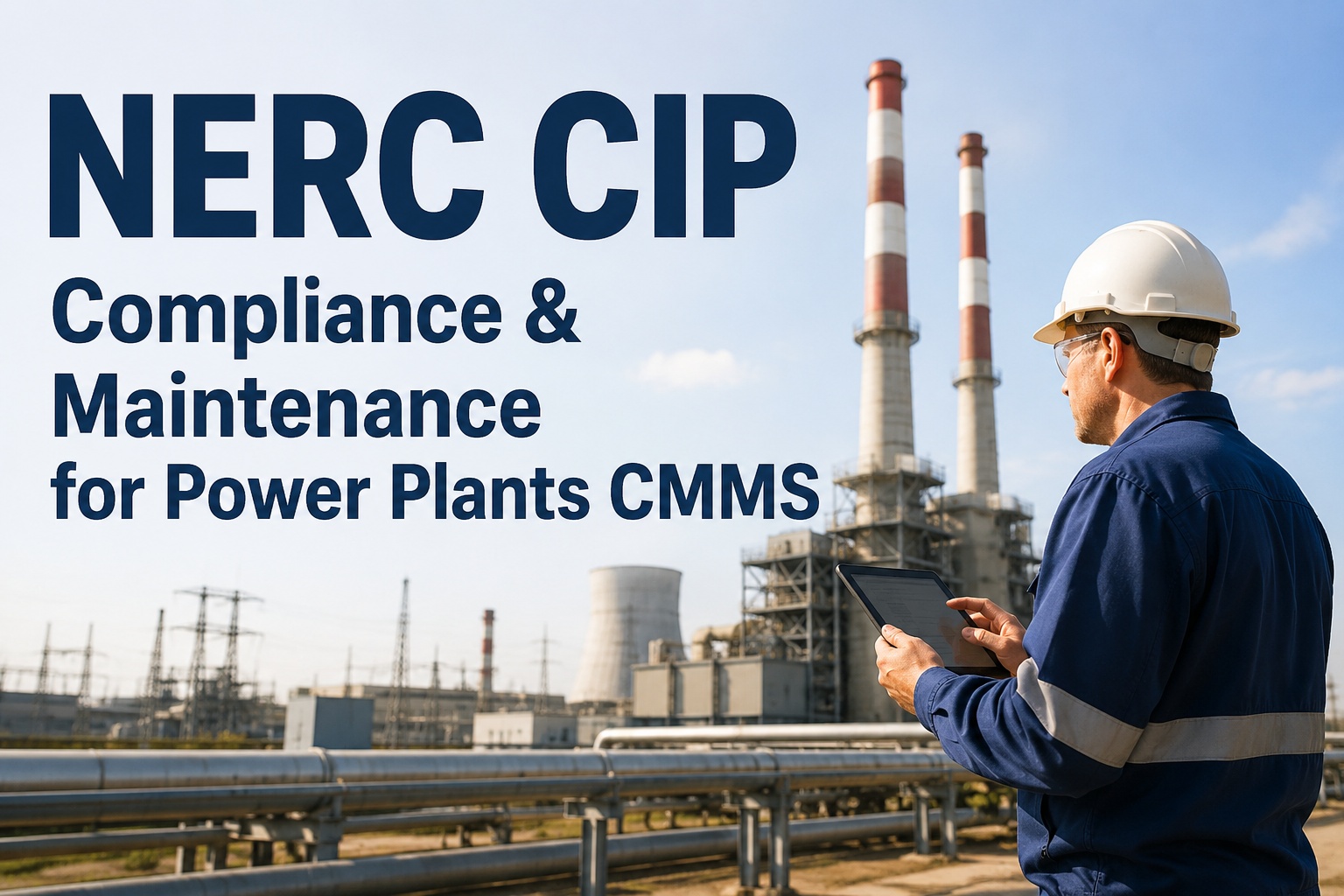
NERC CIP compliance for power plants hinges on rigorous, auditable maintenance records for every cyber asset — and a CMMS purpose-built for NERC CIP maintenance is the fastest way to pass audits without drowning in spreadsheets. Standards like CIP-007 (Systems Security Management) and CIP-010 (Configuration Change Management) require generation owners to document patching, vulnerability scans, port management, baselines, and change history with timestamped, tamper-evident evidence. Missing or incomplete maintenance records are among the most frequently cited CIP violations during audits, exposing utilities to penalties that can reach $1.4 million per day per violation. OxMaint centralizes cyber asset maintenance, work-order history, configuration baselines, and spare-parts traceability into one AI-powered CMMS so your team is audit-ready every day — start your Start Free Trial today and see how fast you can close compliance gaps.
NERC CIP Maintenance & Compliance
Is your power plant audit-ready for CIP-007 & CIP-010 — or one missing record away from a violation?
NERC CIP maintenance requires documented evidence for every patch, scan, port change, and configuration baseline on every cyber asset. OxMaint turns scattered spreadsheets into a single, audit-ready CMMS that maps directly to CIP-007 R2–R6 and CIP-010 R1–R4.
CIP-007 & CIP-010 Requirements
What NERC CIP maintenance records must a power plant CMMS capture?
CIP-007 requires six maintenance-related controls for every cyber asset: security patch management, malware protection, log event monitoring, vulnerability scanning, account management, and port and service hardening. CIP-010 adds configuration baseline management, change control, and configuration vulnerability assessment. Each action must produce a timestamped, attributable record that an auditor can trace from trigger to closure.
Document every patch evaluation, test result, deployment date, and exception — including the 35-day remediation clock for missing patches on high-impact assets.
Record quarterly vulnerability scan results, remediation actions, and re-scan evidence for every BES Cyber System.
Maintain a baseline configuration for each cyber asset: OS version, services, ports, authentication settings, and security patches. Re-baseline after every change.
For every configuration or software change: document the request, test plan, test results, rollback plan, and approval before deployment.
At least every 36 months, compare the active configuration against the baseline and document every deviation with justification or remediation.
Keep an up-to-date inventory linking each asset to its asset owner, classification, baseline ID, and maintenance history. Auditors request this first.
Spreadsheet vs. CMMS
Why spreadsheets fail NERC CIP audits — and a CMMS passes them
| Maintenance Requirement | Spreadsheets / Shared Drives | OxMaint CMMS for NERC CIP |
|---|---|---|
| Work-order traceability (who, what, when) | Manual cell edits, no immutable timestamp | Automatic, timestamped audit trail on every work order |
| Patch & scan evidence retention (3+ years) | Files scattered across SharePoint and email | Centralized document vault linked to each cyber asset record |
| Baseline change tracking (CIP-010 R2) | Separable Excel tabs with no approval workflow | Change requests with test plans, approvals, and rollback stored inline |
| Audit evidence assembly | 2–4 weeks of manual report compilation | One-click compliance report filtered by CIP requirement |
| Recurring maintenance scheduling | Calendar reminders that get ignored | Automated PM triggers with escalation on overdue tasks |
| Spare-parts traceability for patched assets | No link between parts consumed and asset baseline | Inventory records tied to work orders and asset configuration history |
Real-World Scenario
The hidden cost of non-compliance: a 180-asset power plant example
A 500 MW gas-fired plant maintaining 180 BES Cyber Assets across two control houses spent roughly $42,000 per year on spreadsheet-based CIP compliance labor — and still received two findings in their last audit for missing patch-deployment timestamps on a serial gateway. The root cause: technicians logged work in the field on paper, and a compliance analyst transcribed entries into Excel two days later, losing the exact deployment time the auditor needed.
After switching to OxMaint, the same plant cut audit-prep time from 120 hours to under 15 hours per cycle, eliminated transcription errors, and produced a one-click CIP-007 R2 report that showed every patch, scan, and approval in chronological order. The compliance overhead dropped to $9,800/year — a 77% reduction — and the next audit passed with zero findings.
How OxMaint Helps
How OxMaint closes CIP-007 & CIP-010 maintenance gaps
CIP-Mapped Work Orders
Every work order tag links to a CIP requirement (R2 patch, R4 scan, R1 baseline). Technicians select the tag in the field; OxMaint auto-stamps date, time, user, and asset ID — no manual entry, no gaps.
Outcome: 100% of maintenance records arrive audit-ready, cutting prep time by 80%+.
Baseline & Change Control
Store the current baseline configuration for every cyber asset. When a change occurs, OxMaint's workflow captures the request, test plan, approval, rollback, and re-baseline — fully traceable to CIP-010 R1–R3.
Outcome: Every configuration deviation is documented and justified — zero "unauthorized change" findings.
Automated PM Scheduling
Recurring maintenance tasks — quarterly scans, annual baseline assessments, 35-day patch remediation clocks — auto-generate and escalate if overdue. OxMaint never forgets a CIP deadline.
Outcome: 90%+ on-time PM completion rate, eliminating missed-cycle violations.
One-Click Compliance Reports
Generate a CIP-007 or CIP-010 evidence report filtered by asset, requirement, and date range in under 60 seconds. Every entry links back to the source work order, approval, and attached scan result.
Outcome: Audit prep drops from weeks to hours; auditors self-serve during on-site reviews.
See OxMaint on your cyber assets — book a 30-minute demo
We will map your CIP-007 and CIP-010 requirements to OxMaint workflows live, show you a one-click compliance report, and outline a migration plan from spreadsheets in under two weeks.
FAQ
NERC CIP compliance & CMMS — frequently asked questions
What is NERC CIP maintenance, and which standards apply to power plants?
NERC CIP maintenance refers to the documented, repeatable maintenance activities required for BES Cyber Assets under CIP-007 (Systems Security Management) and CIP-010 (Configuration Change Management). Power plants must maintain records for patching, vulnerability scans, malware protection, log monitoring, port hardening, baseline configurations, and change control. A CMMS like OxMaint ensures every activity is timestamped, attributable, and retrievable for auditors.
Can a CMMS help pass a NERC CIP audit?
Yes — a NERC-compliant CMMS is one of the most effective audit tools because it creates an immutable, timestamped trail for every maintenance action. OxMaint maps each work order to a specific CIP requirement, stores approval evidence and scan results inline, and generates compliance reports in under a minute. Most plants cut audit-prep time by 80% or more after switching from spreadsheets. You can see it on your own assets when you Book a Demo.
How long must NERC CIP maintenance records be retained?
NERC CIP standards generally require retaining cyber security event logs and maintenance evidence for a minimum of 12 months, with some records — like baseline configurations and change documentation — retained for the life of the asset plus 3 calendar years. OxMaint stores all records in a centralized, searchable vault so nothing is lost in email or local drives when retention deadlines arrive.
What are the most common NERC CIP maintenance violations?
The most common violations involve missing or incomplete documentation — patch deployment timestamps without exact times, vulnerability scans without remediation evidence, configuration changes without test plans or approvals, and overdue recurring maintenance that was never escalated. These are documentation failures, not technical ones, which is why a CMMS with automated scheduling and mandatory workflow fields prevents the majority of findings.
How long does it take to implement OxMaint for NERC CIP compliance?
Most power plants are live on OxMaint within 2–4 weeks. The process includes importing your cyber asset inventory, configuring CIP-mapped work-order tags, setting up recurring PM schedules for scans and patch cycles, and migrating existing baseline documents. You can begin immediately with a Start Free Trial or let our team guide you through a tailored setup in a 30-minute demo.
Stop risking CIP findings on spreadsheets — get audit-ready today
Join the power plants that cut compliance labor by 77%, eliminated missing-record findings, and turned NERC CIP maintenance from a fire-drill into a routine. OxMaint's AI-powered CMMS has your cyber assets covered.
Free 14-day trial · No credit card