Three hundred near-misses happen for every serious injury recorded on a power plant floor, and almost none of them get written down. A loose handrail someone grabbed in time, a valve that almost let go during a switch, a forklift that braked half a second early — these moments carry the exact warning signal a safety team needs, and they vanish the moment the shift ends because there is no fast way to log them. Power plants that close this gap do not just collect more paperwork, they catch the pattern before the pattern becomes an incident. That shift starts with the OxMaint CMMS platform.
Why Near-Misses Disappear Before They Reach a Safety Team
A near-miss only becomes useful data if someone reports it, someone reviews it, and someone closes the corrective action that comes out of it. Break any one of those three links and the warning is wasted. The funnel below shows where most power plants leak this information — and how much of it never reaches a decision-maker at all.
Near-Miss Occurs on the Floor
An operator notices a near-miss — a slip, a missed isolation step, an unexpected energy source. The moment is real and the warning is valid.
Actually Gets Reported
Most near-misses never reach a logbook or form. Reporting feels like extra admin, the process is slow, or workers fear it reflects on them personally.
Reviewed With a Corrective Action Assigned
Of the reports that land somewhere, only a fraction get a named owner, a deadline, and a documented root cause.
Corrective Action Actually Closed Out
The loop closes only when the fix is verified, evidence is attached, and the crew sees that reporting led to a real change.
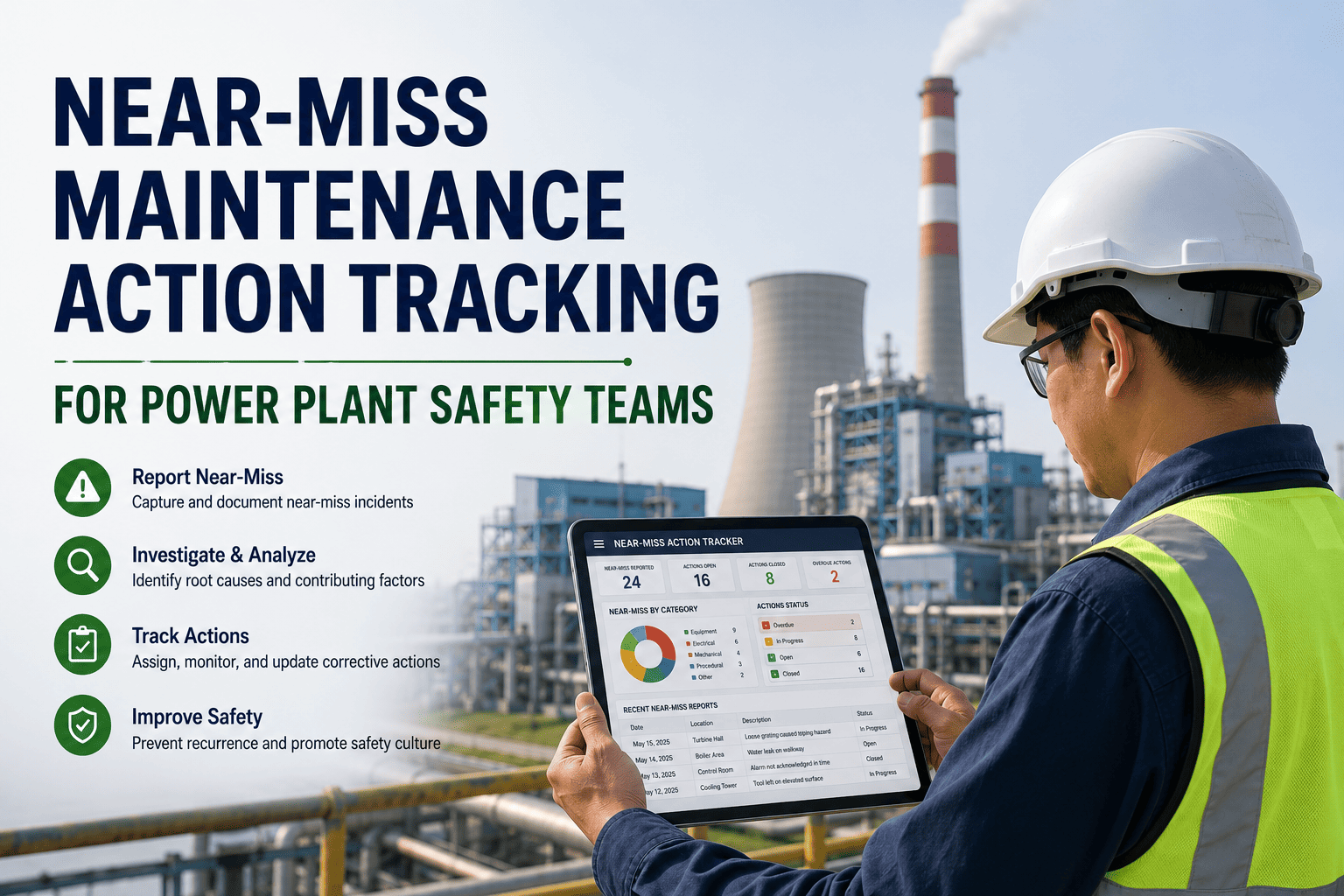
The Near-Miss Action Tracking Cycle Inside OxMaint
A near-miss program only works when capture, investigation, and closure live in one continuous workflow instead of three disconnected systems. The cycle below is how that workflow runs from the moment a hazard is spotted to the moment the fix is verified and the lesson is shared.
Capture in the Field
Operators log a near-miss from a mobile device in under 90 seconds — location, asset, time, and what almost happened, structured so nothing critical gets skipped.
Auto-Route to a Reviewer
Every report routes instantly to the right safety coordinator or shift supervisor based on area and severity, instead of sitting in an inbox.
Assign Corrective Action
The reviewer assigns an owner, a deadline, and links the fix to the affected asset record, generating a trackable work order automatically.
Verify and Close the Loop
The action only closes once evidence is attached and the control is confirmed working — not just when someone marks a checkbox.
Share the Lesson Plant-Wide
Closed near-misses feed a searchable history so the next investigation starts informed instead of starting from zero.
What a Tracked Program Catches That a Paper Logbook Never Will
Patterns are invisible one report at a time. They only surface when near-miss data is structured, searchable, and tagged consistently across equipment, location, and root cause. The comparison below shows what changes when that data actually lives somewhere a safety team can analyze it.
Give Every Near-Miss a Path to a Closed Corrective Action
Stop letting warning signs disappear into binders and inboxes. OxMaint connects near-miss capture directly to your maintenance and compliance workflow.
Severity Classification — How OxMaint Helps Teams Prioritize What Gets Reviewed First
Not every near-miss carries the same urgency, and treating them all identically slows down review of the ones that matter most. A structured severity tier lets safety coordinators triage at a glance instead of reading every report in submission order.
Low Potential Severity
Minor procedural deviation with low injury potential. Logged for trend analysis, reviewed within five working days.
Moderate Potential Severity
Could have caused a recordable injury or equipment damage. Reviewed within 24 hours with a named corrective owner.
High Potential Severity
Could have caused serious injury or major asset failure. Escalated immediately to shift supervisor and safety manager.
Critical Potential Severity
Could have caused fatality, multiple injuries, or catastrophic failure. Triggers immediate stand-down and formal RCA.
Frequently Asked Questions
Three Hundred Warnings Precede Every Serious Incident. Start Catching Them.
Move your safety team from reactive incident response to proactive pattern detection — all inside the maintenance system your technicians already use every day.